House Spending Panel Flatlines NSF
More science budget news: The House proposes no budget increase for the National Science Foundation.
The House today proposed cutting NASA’s budget back to 2008 levels while eliminating all funds for the James Webb Space Telescope.
As much as I’d hate to see the Webb telescope die, it has cost far more than planned, is way behind schedule, and carries a gigantic risk of failure. However, if I had a choice, I’d rather they cut the $1.95 billion for Congress’s homemade heavy-lift rocket, the program-formerly-called-Constellation. There is a much better chance that Webb will get completed, launched, and work, than there is for this improvised and impossibly costly Congressionally conceived rocket.
Senator Jon Cornyn (R-Texas) suggested yesterday that the Republicans might take “mini” debt-ceiling deal.
This story today from what is generally considered a Democratic newspaper, suggests that the political debate has shifted strongly in favor of the Republicans and against Obama and the Democrats. From the Los Angeles Times: Deficit battle shaping up as GOP victory
Even as the political battle mounts over federal spending, the end result for federal policy is already visible — and clearly favors Republican goals of deep spending cuts and drastically fewer government services.
President Obama entered the fray last week to insist that federal deficits can’t be reduced through spending reductions alone. Federal tax revenue also must rise as part of whatever deficit reduction package Congress approves this summer, he said.
Obama has been pushing to end a series of what he calls tax loopholes and tax breaks for the rich. But even if Obama were to gain all the tax-law changes he wants, new revenue would make up only about 15 cents of each dollar in deficit reduction in the package. An agreement by the Republicans to accept new revenue would be a political victory for Obama because “no new taxes” has been such an article of faith for the GOP.
But substantively, budget experts note, the plan would still be dominated by cuts to government programs, many of them longtime Democratic priorities, such as Medicaid and federal employee pensions.
For a liberal newspaper to recognize and describe in detail the absurdity of Obama’s position on taxes versus cuts is remarkable. Normally a liberal newspaper would ignore the fact that the President’s suggested tax-law changes will bring in practically no significant revenue, and focus instead on the so-called refusal of Republicans to compromise. That the Los Angeles Times is not willing to carry water for Obama and the Democrats shows that the Democratic position is incredibly weak politically, and is likely to collapse if the Republicans stand firm. That the newspapers is also willing to describe fairly the Republican position, something liberal newspapers have almost never done in the past two decades, also suggests that they have had enough, and have finally realized how much their creditability has suffered in recent years by their unwillingness to cover political news honestly.
If this pattern spreads, the Republicans might find themselves getting everything — and more — of what they want. And that will be something I have not seen in almost fifty years of watching political life.
The law is such an inconvenient thing: The Obama administration gave an almost $80,000 grant to the largest branch of a renamed ACORN, despite a Congressional prohibition.
A dose of reality: Obama’s repeated demand at yesterday’s press conference to end the tax break for corporate jet owners would reduce the deficit by less than one-tenth of 1 percent.
I say, the Republicans should trade this measly tax increase for $1 trillion in cuts. This tax increase is stupid, and will do nothing bu harm, but if they can trade it for lots of cuts, it’s worth accepting it.
Obama and Republicans in agreement: The Senate should cancel next week’s vacation.
At House hearings this week the head of NOAA was attacked for ignoring Congressional law in setting up a National Climate Service.
One big sticking point for legislators is language in this spring’s final 2011 spending bill that averted a government shutdown, which states that “none of the funds made available by this division may be used to implement, establish, or create a NOAA Climate Service.” Representative Dana Rohrabacher (R-CA) said the appointment of Karl and the hiring of six regional directors appear to have ignored those instructions. He quipped that NOAA was “living in climate sin,” a reference to Karl’s statement during an interview in December 2010 with ClimateWire that “we’ve moved in, … we’re waiting for the marriage certificate, but we’re acting like we have a climate service.”
Lubchenco defended her actions, saying that her appointments were “smart” and merely “good planning.” She said their salaries are drawn from “existing funds” and that legislation dating back to the National Climate Program Act of 1978 describes providing climate services as part of NOAA’s mission. She responded to Hall’s concerns that the climate service would take away from NOAA’s other activities by saying, “It’s good government to reorganize periodically.” She also referred to its economic potential, citing the $1 billion industry that has emerged around the National Weather Service.
Speaking with ScienceInsider after the hearing, she made it clear that NOAA intends to push ahead. “This is an idea whose time has come.” [emphasis mine]
In other words, so what the law forbids NOAA from doing this. We know best, Congress can go to hell.
Finally: The White House announced today that Obama will now directly involve himself in the debt limit negotiations.
The day of reckoning beckons: Global bankruptcy months away? Key quote:
“Based upon world liquidity, the amount of money available to fund sovereign debt in 2011 is between $6-9 trillion,” Marc Nuttle told Townhall Finance. Nuttle runs the site DebtWall.org. “The world’s government projections for deficit financing in 2011 is $8-10 trillion. We are bumping into the ceiling of the world’s ability to fund ongoing sovereign deficits and debt on an annual basis.”
The space war continues: Several senators are threatening to subpoena NASA over what they perceive as the agency’s foot-dragging in building a heavy-lift rocket.
Idiots. They give NASA less money and less time to build the program-formerly-called-Constellation, and then are surprised when things don’t go well. Of course, it doesn’t help that the Obama administration is trying to sabotage the project anyway.
The Senate Republicans have pulled out of Biden’s debt limit negotiations.
This article strongly suggests to me that the Democrats, who hold a majority in this negotiating group, have refused to take seriously the Republicans’ demand to cut spending, instead focusing on tax increases as a solution. The problem is that you could raise our taxes to 100 percent and you wouldn’t solve the debt problem. The government has got to reduce its spending.
The day of reckoning looms: The Congressional Budget Office today reported that unless something drastic is done, the national debt will exceed the size of the entire U.S. economy by 2021.
In negotiations over raising the debt limit Democrats are now calling for more stimulus spending.
These guys just don’t get it. We don’t have the money, the federal government is broke, and it was their out-of-control spending and complete lack of responsibility that helped create today’s economic mess.
The one thing that worries me most however is that the public might not get it yet either, and might not vote these bums out of office. If that happens, we are really screwed, in ways that most Americans today probably can’t imagine.
Conservative lawmakers are coalescing behind a pledge to cut spending across the board while requiring a balanced budget amendment.
This story once again suggests to me that the political winds are definitely favoring big cuts in government spending. Woe to the politician of either party who ignores these winds.
Some pigs win, some lose: Republicans refuse to cut farm and ethanol subsidies, but cut international food aid instead.
The cowardice of politicians from both parties to honestly face the federal deficit problem sadly continues.
Ten congressmen (from both parties) and a law professor are suing the Obama administration to stop the war in Libya.
Though some progress has been made, the negotiations over the debt limit and the budget still appear deadlocked.
Gotta keep that propaganda machine running: The Congressional Budget Office has hired an Obamacare advocate, Democrat Party operative, and Obama administration official to provide it “objective” health care budget numbers.
It’s a start: The House has trimmed the budget for the Homeland Security Agency by $1.1 billion, including a cut of about 75% from the Obama administration’s request for the agency’s science budget, ($398 million versus $1.2 billion requested). And of course, we don’t have to wait long to hear the pigs squeal:
DHS officials say the decrease in the directorate’s budget will wipe out dozens of programs, stalling the development of technologies for border protection, detection of bio-hazards, and cargo screening.
My heart bleeds.
Some squealing from the journal Science: NSF faces uphill budget battle in Congress.
When he asked the witnesses for ideas on shrinking the government’s $1.6 trillion deficit, Mo Brooks (R-Alabama) [chairman of the research panel of the House of Representatives Science and Technology Committee] made it clear he was talking about possible cuts to NSF’s entire $7 billion budget, not simply its SBE directorate.
Note that in 2008 the NSF budget was a $6.1 billion. Cutting it back to that number would hardly destroy social science research in this country.
The day of reckoning beckons: Moody has threatened to lower the US credit rating if the debt ceiling negotiations don’t show progress soon.
Good news indeed: The House tonight overwhelmingly voted down an unconditional hike to $14.3 trillion debt ceiling.
The vote was 318-97, with 82 Democrats joining every Republican in rejecting legislation that would have authorized $2.4 trillion in additional borrowing by the federal government. Seven Democrats voted present on the legislation.
Now comes the business of tying the increase in the debt ceiling to some real spending reduction.
The next budget battle begins: A vote on a “clean” debt ceiling increase has been set for tonight by the House Republican leadership.
More than 100 House Democrats recently signed a letter demanding that Speaker John Boehner bring forward a vote for an increase in federal debt levels without any conditions for cuts or future spending curbs. Imagine their surprise when Boehner agreed and will serve up a bill that would provide enough borrowing to cover all of president Obama’s spending requests for next year without any preconditions.
It is expected that the legislation will be defeated soundly in a very bipartisan vote. To quote the article again:
The political reality is that increasing the nation’s swollen $14.3 trillion debt is a political loser. Voters hate it and lawmakers don’t even get anything new to give away since the money is going to cover existing obligations.
If the bill is defeated as predicted, it will be very good news, as that defeat will bolster the efforts of those who want big cuts in spending to go with any debt ceiling increase.
GOP Senators to the White House: Better start planning for no debt ceiling increase and making do on a $2.6 trillion budget.
Obama’s budget request for 2012 received zero votes today when it came up for a vote in the Democratic controlled Senate. Meanwhile, the House budget, proposed by Paul Ryan (R-Wisconsin) was also rejected, but by the much closer vote of 40-57.
I’m not sure if this is good or bad. It suggests that there is increasing recognition in the Senate that cuts must happen, and that Obama’s budget failed in this regard. It also suggests that the Senate is also not ready to make those cuts.
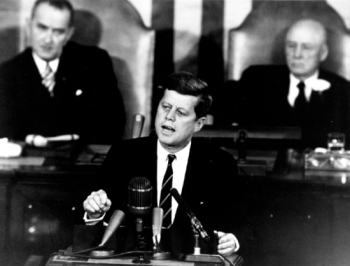
Fifty years ago today, John Kennedy stood before Congress and the nation and declared that the United States was going to the Moon. Amazingly, though this is by far the most remembered speech Kennedy ever gave, very few people remember why he gave the speech, and what he was actually trying to achieve by making it.
Above all, going to the Moon and exploring space was not his primary goal.
For Kennedy — whose presidential campaign included an aggressive anti-communist stance against the Soviet Union — the months before the speech had not gone well. Five weeks earlier, for instance, the CIA-led attempt to invade Cuba and overthrow Castro’s communist government had ended in total failure. When Kennedy refused to lend direct military support to the Bay of Pigs invasion, the 1,200 man rebel force was quickly overcome. “How could I have been so stupid as to let them go ahead?” Kennedy complained privately to his advisors.
In Berlin, the tensions between the East and the West were continuing to escalate, and would lead in only a few short months to Khrushchev’s decision to build the Berlin Wall, sealing off East Berlin and the citizens of East Germany from the rest of the world.
In the race to beat the Soviets in space, things were going badly as well. NASA had announced the United States’ intention to put the first man into space sometime in the spring of 1961. The agency hoped that this flight would prove that the leader of the capitalist world still dominated the fields of technology, science, and exploration.
Originally scheduled for a March 6, 1961 launch, the short fifteen minute sub-orbital flight was repeatedly delayed. The Mercury capsule’s first test flight in January, with a chimpanzee as test pilot, rose forty miles higher than intended, overshot its landing by a hundred and thirty miles, and when the capsule was recovered three hours later it had begun leaking and was actually sinking. Then in March another test of the Mercury capsule included the premature firing of the escape rocket on top of the capsule, the unplanned release of the backup parachutes during descent, and the discovery of dents on the capsule itself.
These difficulties caused NASA to postpone repeatedly its first manned mission. First the agency rescheduled the launch to late March. Then early April. Then mid-April. And then it was too late.
» Read more

Republican Presidential candidate Tim Pawlenty today called for phasing out ethanol subsidies — in Iowa.
We need more candidates like this, willing to say these kinds of things face-to-face with the very people who benefit from the funding.