Space Force awards multi-satellite contracts to Lockheed Martin and Northrop Grumman

Capitalism in space: In what is a landmark deal indicating the complete shift by the military from building its own satellites to letting private enterprise do it, the Space Development Agency (SDA) of the Space Force yesterday announced it has awarded Lockeheed Martin and Northrop Grumman each a contract to build and operate 36 satellites.

The 72 satellites will make up a portion of SDA’s network known as Tranche 2 Transport Layer. SDA is building a large constellation called the proliferated warfighter space architecture that includes a Transport Layer of interconnected communications satellites and a Tracking Layer of missile-detection and warning sensor satellites. Northrop Grumman’s contract for 36 satellites is worth approximately $733 million. The agreement with Lockheed Martin, also for 36 satellites, is worth $816 million, SDA said.

What makes this contract different than previous military satellite contracts is that the military will do relatively little design. It has released the basic specifications, and is asking private enterprise to do the work for it. It is a customer, not a builder. When the military attempted its own design and construction, the job would take sometimes a decade or more, cost many billions (with cost overruns), and often failed. This new constellation is targeting a 2026 launch, only two years from now.

The constellation will also be more robust than the gold-plated giant satellites the military would build previously. Rather than rely on a single do-it-all satellite which is easy to take out, the constellation has many satellites, and can easily compensate if one or even a few are damaged or destroyed.

This shift was one of the fundamental reasons the military wanted to create a separate Space Force. As part of the Air Force the office politics within that branch of the military had been impossible to make this shift. Too many managers in the Air Force liked building big gold-plated satellites. Once the Space Force took over those managers were taken out of the equation.

Russian engineers pinpoint approximate crash site of Luna-25

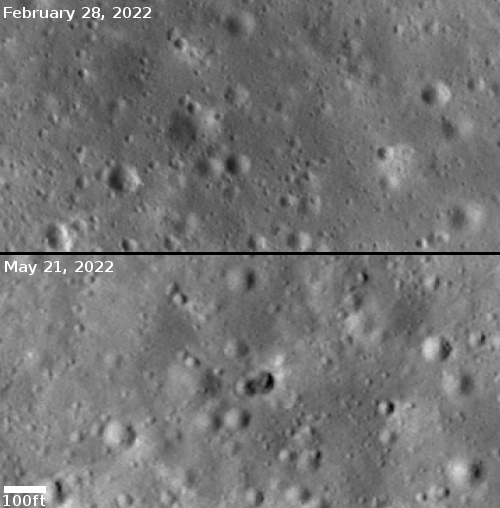
Russian engineers have pinpointed the approximate crash site of Luna-25 on the Moon as the 42-mile-wide crater Pontecoulant G, located at about 59 degrees south latitude, 66 east longitude.

Researchers from the Russian Academy of Sciences’ Keldysh Institute of Applied Mathematics have simulated the trajectory of the Luna-25 mission, figuring out where and when it crashed into the moon’s surface, the institute said in a statement on Telegram. “The mathematical modeling of the trajectory of the Luna-25 spacecraft, carried out by experts from the Ballistic Center of the Russian Academy of Sciences’ Keldysh Institute of Applied Mathematics, made it possible to determine the time and place of its collision with the moon,” the statement reads.

According to the institute, the spacecraft fell into the 42-kilometer Pontecoulant G crater in the southern hemisphere of the moon at 2:58 p.m. Moscow time on August 19.

The planned landing site, in Boguslawsky Crater at 73 degrees south latitude and 43 degrees east longitude, was many miles away.

SpaceX launches 21 Starlink satellites using Falcon 9

Using a Falcon 9 rocket with a first stage making its 15th flight, SpaceX early this morning launched 21 Starlink satellites, lifting off from Vandenberg in California.

The first stage landed successfully on a drone ship in the Pacific. SpaceX now has two first stages that have flown 16 times, and one that has flown 15 times. Those 47 flights like reduced the launch cost of those launches by about 70%. Since no other rocket company can do this, SpaceX can pocket the profits since it isn’t forced to lower prices as much as it would if it had some real competition.

The leaders in the 2023 launch race:

57 SpaceX
36 China
11 Russia
6 Rocket Lab
6 India

In the national rankings, American private enterprise now leads China in successful launches 65 to 36. It also leads the entire world combined, 65 to 58. SpaceX by itself remains in a neck-in-neck race with the rest of the world (excluding American companies), trailing 57 to 58 in successful launches.

Axiom raises $350 million in private investment capital

Axiom's space station assembly sequence
The assembly sequence for Axiom’s space station while attached to ISS.
Click for original image.

Axiom announced today that in its most recent round of funding it raised an additional $350 million in private investment capital, almost tripling the private capital it has obtained in total.

Axiom Space announced today that it secured $350 million in its Series-C round of growth funding, lifting the total funds raised to over $505 million from investors and achieving more than $2.2 billion in customer contracts.

To date, Aljazira Capital and Boryung Co., Ltd., have anchored the round, paired with support from an array of diverse backers that include deep-tech venture capital funds and strategic brand partners, positioning Axiom Space as second to SpaceX for the most amount of money raised by a private space company in 2023, based on available pitchbook data.

The press release also reaffirms the company’s planned schedule for its space station project, with the first module launching and attaching to ISS in 2026. The graphic shows the assembly sequence, with the rear docking port the one linked to ISS. When assembly reaches the stage of the fourth image it will then be able to separate from ISS and fly independently in 2031. That last number however is one year later than NASA’s previous predictions for the retirement of ISS, suggesting Axiom knows something NASA has not yet told us.

Hat tip to Jay, BtB’s stringer.

A Martian wedding cake surrounded by brain terrain

Brain terrain surrounding a Martian wedding cake
Click for original image.

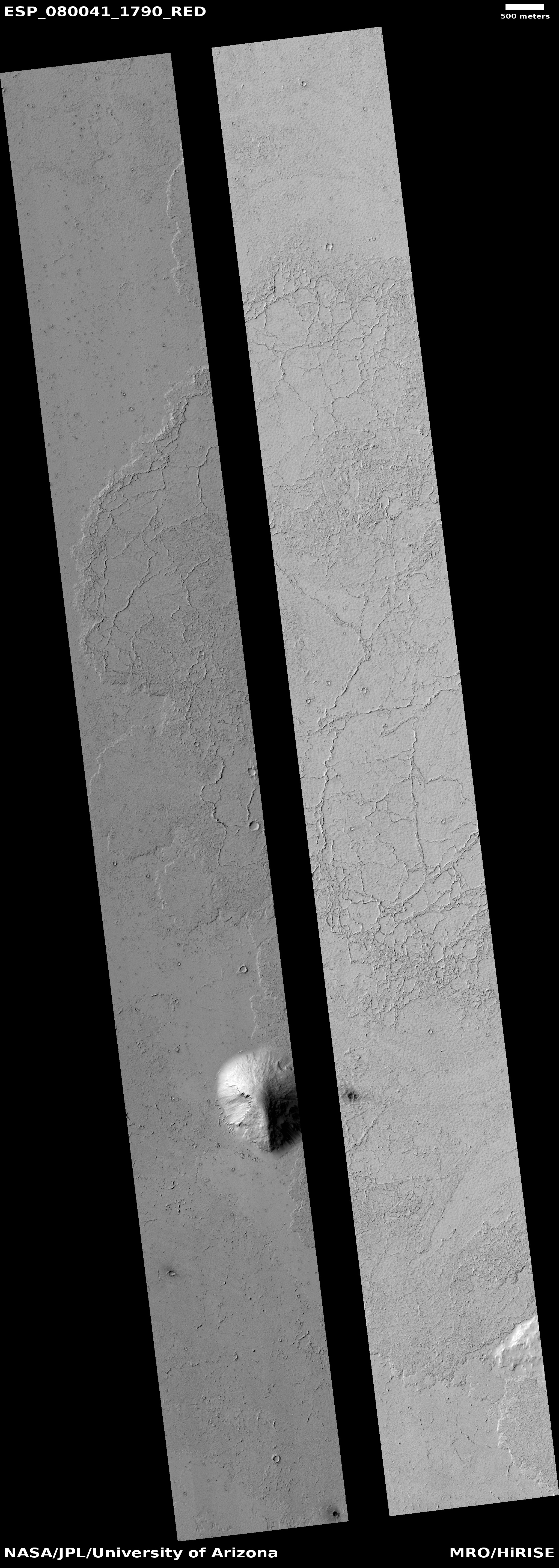
Of all many cool images I’ve posted, today might take the cake (pun intended) for the best illustration of the alien nature of Mars. The picture to the right, cropped, reduced, and sharpened to post here, was taken on June 28, 2023 by the high resolution camera on Mars Reconnaissance Orbiter (MRO), and shows what the scientists simply label as “flow features.”

I personally don’t see any obvious flow features in the full image, unless one wants to call the brain terrain that covers this entire plain a flow feature. Brain terrain is a feature unique to Mars whose origin remains a mystery to geologists. As noted by scientists in captioned MRO image in 2019:

You are staring at one of the unsolved mysteries on Mars. This surface texture of interconnected ridges and troughs, referred to as “brain terrain” is found throughout the mid-latitude regions of Mars.

…This bizarrely textured terrain may be directly related to the water-ice that lies beneath the surface. One hypothesis is that when the buried water-ice sublimates (changes from a solid to a gas), it forms the troughs in the ice. The formation of these features might be an active process that is slowly occurring since HiRISE [MRO’s high resolution camera] has yet to detect significant changes in these terrains.

The wedding cake inside the small crater to the upper right only adds to the alienness of this terrain.
» Read more

Watch the landing attempt of Chandrayaan-3’s Vikram lander on August 23, 2023


Click for interactive map.

After separating from its Chandrayaan-3 propulsion module on August 17, 2023, India’s Vikram lunar lander has been slowly making orbital adjustments in preparation for its landing attempt on August 23rd.

I have embedded the live stream of that landing attempt below. As it is scheduled for 6:04 pm (India time), in India, in the U.S. that landing will occur in the early morning hours of August 23rd.

Following the failed crash on the Moon of Russia’s lunar lander Luna-25 yesterday, this landing attempt is likely to garner a lot more interest. It is also India’s second attempt, having failed in 2019 when its Vikram lander ran out of fuel before landing and crashed.
» Read more

China’s Long March 4C rocket places Earth observation satellite into orbit

China yesterday used its Long March 4C rocket to put what that country’s state-run press calls an “Earth observation satellite” into orbit, lifting off from the Jiuquan spaceport in the interior.

No word on whether the rocket’s first stage crash landed near habitable areas, as China’s disposable first stages often do.

The leaders in the 2023 launch race:

56 SpaceX
36 China
11 Russia
6 Rocket Lab
6 India

American private enterprise still leads China in successful launches 64 to 36 in the national rankings, while the entire world combined 64 to 58. SpaceX alone now trails the entire world (excluding American companies) 56 to 58.

Luna-25 lost after crashing on Moon

During its last major orbital burn, Luna-25’s engines apparently fired for longer than planned so that, instead of placing it into a lower orbit, the spacecraft was de-orbited and sent crashing onto the lunar surface.

The Russian space agency noted that all measures regarding the location of the spacecraft and establishing communications with it on August 19 and 20 yielded zero results. “Preliminary analysis results suggest that a deviation between the actual and calculated parameters of the propulsion maneuver led the Luna-25 spacecraft to enter an undesignated orbit and it ceased to exist following a collision with the surface of the Moon,” Roscosmos stated.

This is a tragedy for Russia, as this mission hoped to re-establish it as one of the major players in the exploration of the solar system. Instead, we once again have a data point suggesting significant quality control problems within Russia’s aerospace industry. Its misplaced focus on providing government jobs rather than actually building and quickly flying spacecraft and rockets results too often in failure.

Luna-25 fails to enter orbit for landing on Moon

Though it is in lunar orbit, Russia’s Luna-25 lander today was unable to perform an engine burn as planned to place it in its final orbit for landing.

“Today, in accordance with the flight program of the Luna-25 probe, at 2:10 p.m. Moscow time, a command was issued to the probe to enter the pre-landing orbit. During the operation an emergency occurred on the space probe that did not allow it to perform the maneuver in accordance with the required parameters,” Roscosmos said.

Engineers are analyzing the issue, but no other information was released.

This issue could simply be the spacecraft’s computer aborted the engine burn because it sensed something not right, and that after some correction another burn can follow later. Under this circumstance the landing attempt would simply be delayed.

It is also possible something happened during that engine burn, and the spacecraft is either in an incorrect orbit, or might even be lost entirely. Stay tuned.

Mars’ endless cycles of glacial activity

Overview map

Mars' endless cycles of glacial activity
Click for original image.

While the images being sent to us from Mars Reconnaissance Orbiter (MRO) repeatedly show features that appear convincingly like glaciers, the data is also beginning to tantalize us with evidence of the endless glacial cycles that have occurred on Mars.

The picture to the right, cropped, reduced, and sharpened to post here, was taken on June 27, 2023 by MRO’s high resolution camera. The red dot in the inset of the overview map above shows the location, the western flanks of an apron that surrounds a 3,800-foot-high mesa in the chaos region Deuteronilus Mensae, the western end of the 2,000-mile-long mid-latitude strip of chaos regions I dub glacier country, because every image seems to show some form of glacial feature.

Today’s picture is no different. The apron shown here drops the last 1,000 feet of the mesa’s total 3,800-foot height, during which it shows dozens of what the scientists label “parallel lines.” These lines likely reveal the layers of glacial ice in this apron, with the older layers larger and more extensive. Apparently, with each growth cycle the glacier obtained less snow from the atmosphere, so the more recent layers grew less.

In other words, the amount of water on Mars has been declining with time.

Untangling these numerous layers will undoubtedly give us a remarkably detailed history of Mars entire geological history. Unfortunately, that untangling cannot happen until we have boots on the ground, on Mars, able to drill core samples from many different places.

Regulatory problems for Saxavord spaceport in Shetland?

In a short statement reported in the local Shetland press, the under-construction Saxavord spaceport in Scotland has apparently laid off some construction workers, claiming it has done so “because the project was so far ahead of schedule.”

The statement however also alluded to the United Kingdom’s Civil Aviation Authority (CAA), which must issue a launch license before any launches can occur.

SaxaVord Spaceport said: “SaxaVord continues to have excellent dialogue with the authorities and is fully expecting to receiving its spaceport licence very soon from the Civil Aviation Authority. We are looking forward to hosting vertical rocket launches in the coming months.”

The application for this launch license was submitted in November 2022. It appears that the CAA still needs a year or more to approve any launch license, a slow and endless process that if not corrected will make launches from the United Kingdom completely unprofitable.

Saxavord had hoped to get its first launch off this year, by fall. It now appears that will not happen.

Luna-25 takes first image of lunar surface

Luna-25's first lunar image
Click for interactive map. Zeeman is located on the lower left.

Russia’s state-run press today issued the first picture taken by Luna-25 after entering lunar orbit two days ago. That picture, to the right and cropped and reoriented to post here, shows part of Zeeman Crater at 75 degrees south latitude and 135 degrees west, on the far side of the Moon. From the TASS announcement:

“The Luna-25 spacecraft, flying in a circular orbit as the Moon’s artificial satellite, has taken pictures of the lunar surface with television cameras of the STS-L system. The image, taken today at 08:23 Moscow time, shows the southern polar crater Zeeman on the far side of the Moon. The coordinates of the crater center are 75 degrees south and 135 degrees west,” the state corporation said. Roscosmos said the Zeeman crater is of great interest to researchers. Its rim rises eight kilometers above its relatively flat floor.

The picture shows Zeeman’s southern rim to the left, with its pockmarked crater floor to the right. The crater the lander is targeting, Broguslawsky Crater, sits in the opposite hemisphere of Zeeman, slightly closer to the south pole but on the Moon’s near side.

The inexplicable behavior of Martian dust devils

The inexpicable behavior of Martian dust devils
Click for original image.

Today’s cool image illustrates the puzzling inclination of Martian dust devils to strongly favor specific regions on the Martian surface, for reasons that at present no one can confidently explain.

The picture to the right, rotated, cropped, reduced, and sharpened to post here, was taken on June 28, 2023 by the high resolution camera on Mars Reconnaissance Orbiter (MRO). It shows a plethora of dust devil tracks, almost all of which have an east-west orientation. Moreover, the tracks seem uninfluenced by the surface topography, continuing on their path without deviation, even as they cross cliffs, craters, and mounds. The orientation tells us the direction of the prevailing winds, though I don’t know if those winds blow to the east or to the west.

What makes this image revealing is that a gathering of such dust devil tracks is seen so rarely in other MRO high resolution photographs. I look at a lot of MRO pictures, and though dust devil tracks are not rare, most images don’t show this many. Apparently, there are specific conditions on Mars that cause a lot of tracks to appear in specific locations, either because atmospheric conditions create a lot more dust devils, or the ground conditions allow the tracks to become more visible.
» Read more

Ball Aerospace purchased by BAE Systems

BAE Systems today announced it has purchased from Ball Corporation its aerospace division, Ball Aerospace, for $5.6 billion.

It appears that the Ball corporation wants to focus its business plan around its “circular aluminum packaging for global beverage and household brands,” rather than aerospace. This sale essentially concludes the company’s slow transition away from its long time space business, which began just prior to Sputnik in 1956. It is essentially out of that business now, and instead has returned entirely to its packaging roots from the late 1800s.

BAE meanwhile strengthens its focus on space, both in the commercial and defense markets, with the addition of the Ball Aerospace division, which has been in the space business for decades.

The ups and downs of capitalism in space

Two stories today illustrate how allowing freedom and capitalism to rule in the development of America’s aerospace industry carries with it the potential for wonderful achievements as well as depressing failures.

First the potential failure. Despite having successfully flown several missions demonstrating its orbital tug and service module for cubesats, the company Momentus has been forced to lay off 30% of its staff because of dwindling cash reserves.

Momentus reported a record quarterly revenue of $1.7 million in the second quarter, the first time it reported revenues of more than $1 million in a quarter. However, the company reported a net loss of $18.8 million and ended the quarter with $21.6 million of cash and equivalents on hand.

The company is presently scrambling to find new sources of investment capital, as it does not expect its income to grow sufficiently in the next year to keep itself above water, even though it should successfully fly more flights of its Vigoride orbital tug as well as a new service module version.

Next we have the potential achievement: The financial status of the startup satellite company Terran Orbital appears healthy and strong, mostly because of a $2.6 billion contract to build 300 satellites for the wireless communications company Rivada Space Networks. The first $180 million payment under that contract is expected this year.

At the same time, there are storm clouds in the distance, as there remain unanswered questions about whether Rivada has the resources sufficient to fulfill the contract.

During Terran Orbital’s Aug. 15 earnings call, H.C. Wainwright & Co analyst Scott Buck said Rivada’s vagueness about its plans for financing the constellation has caused “investor hesitation around the contract.”

Terran Orbital has already a number of successes building satellites for others, with its most significant achievement the CAPSTONE lunar orbiter it built for NASA. If the Rivada contract falls through I suspect the company will still be able to garner plenty of customers to survive.

For Momentus the situation is more dire, especially because it already faces strong competition from a number of other orbital tug companies.

Chandrayaan-3’s Vikram lander separates from its propulsion module; Luna-25 in lunar orbit


Click for interactive map.

The two probes aiming to land in the high southern latitudes of the Moon in the next week are now both in lunar orbit and preparing for their planned landings.

First India’s Chandrayaan-3: With its propulsion module having completed the job of getting Chandrayaan-3 from Earth to lunar orbit, the Vikram lander today separated from that module in preparation for firing its own engines on August 23, 2023 and landing on the Moon.

Vikram needs to make several orbital adjustments before that landing attempt.

Second, Russia’s Luna-25 probe entered lunar orbit yesterday, where it will spend the next few days making its own orbital adjustments before attempting its landing on August 21st.

Vikram carries a small rover, Pragyan. Luna-25 is only a lander, though it has a scoop and will do analysis of the lunar soil below it. Neither is landing “near the south pole”, as most news sources are saying. They are landing at latitudes comparable to landing in the Arctic on Earth, on the northern coast of Alaska. As such, neither will find out anything about the question of remnant ice in south pole’s permanently shadowed regions.

SpaceX launches another 22 Starlink satellites from Cape Canaveral

SpaceX tonight successfully launched another 22 Starlink satellites into orbit. its Falcon 9 rocket lifting off from Cape Canaveral at 11:36 pm Eastern.

The first stage completed its thirteenth flight, landing on a drone ship in the Atlantic. The two fairings completed their 10th and 11th flights, respectively. As of posting the satellites had not yet deployed.

SpaceX has another launch scheduled only hours hence, at midnight (Pacific) from Vandenberg Space Force Base in California, aiming to put another 22 Starlink satellites in orbit using a first stage flying for its fifteenth time.

Until that second launch, the leaders at this moment in the 2023 launch race are as follows:

56 SpaceX
35 China
11 Russia
6 Rocket Lab
6 India

In successful launches, American private enterprise now leads China 64 to 35 in the national rankings, and the entire world combined 64 to 57. SpaceX by itself trails the rest of the world combined (excluding American companies) 56 to 57, but this will become a tie if the second launch occurs as planned.

An avalanche in the West Virginia of Mars

An avalanche in the West Virginia of Mars
Click for original image.

Cool image time! The picture to the right, rotated, cropped, and reduced to post here, was taken on June 27, 2023 by the high resolution camera on Mars Reconnaissance Orbiter (MRO).

I have cropped it to focus on this one hill, about 900 feet high (though the elevation data from MRO is somewhat uncertain at this resolution), because of that major landslide on its northern slopes. At some point in the past a major piece of the exposed bedrock at the top broke off and slide about halfway down the mountain, almost as a unit, settling on the alluvial fill that comprises the bottom half of the hill’s flanks.

The bedrock surrounding the peak is also of interest because of its gullies, all of which were created by downward flowing material. Was it ice? Water? Sand? Or maybe a combination of two or three? If water or ice was involved it was a very long time ago, as this location is in the dry equatorial regions of Mars. There is little known near-surface ice here.
» Read more

SpaceX report on first Starship/Superheavy launch failure submitted to FAA

Though we don’t know exactly when this was done, SpaceX has submitted to the FAA its final report on its investigation into the launch failure during the first Starship/Superheavy test launch in April, and now awaits the FAA’s response.

Now comes the FAA’s review of SpaceX’s investigation, fulfilling the agency’s role as the regulator charged with ensuring public safety during commercial launch operations. “When a final mishap report is approved, it will identify the corrective actions SpaceX must make,” an FAA spokesperson told Ars. “Separately, SpaceX must modify its license to incorporate those actions before receiving authorization to launch again.

Do not expect that response to be fast, or accepting. I predict the FAA will demand a lot more investigation and changes from SpaceX, actions that will take time to implement and be approved. Furthermore, I fully expect the FAA to take at least two months to review the SpaceX report before it issues those demands. As I have been predicting since May, there will be no Superheavy/Starship launch this year.

Astra scrambling to find investors as its cash reserves dwindle

Despite a major reorganization, including laying off a quarter of its workforce, Astra now appears to be scrambling to find new investors even as its available cash reserves shrink.

The company’s financial runway is diminishing even as the company finds new sources of capital, such as a loan announced Aug. 4 that will provide Astra with $10.8 million and plans announced in July to sell up to $65 million in Astra stock in an “at-the-market” transaction. The company forecasted an adjusted EBITDA loss of $25 million to $29 million in the third quarter, ending the quarter with $15 million to $20 million of cash and equivalents on hand.

One analyst on the call expressed frustration with those projections, asking Astra executives for the “upside” of the company’s plans. Kemp emphasized the backlog of orders for its thrusters, which Astra said Aug. 4 was valued at $77 million, as well as orders from the U.S. Space Force and the Defense Innovation Unit for the Rocket 4.

However, he suggested the company’s efforts to focus on thruster production were intended to buy time for Astra as the company looks for new investors. The company said Aug. 4 it was working with PJT Partners, an investment bank, to identify “potential strategic investments in the Astra Spacecraft Engine business” that would bolster its finances. “We are actively focused on finding investors in these two businesses,” he said, noting that the company’s launch and spacecraft propulsion business lines are distinct and “in different phases of their development.”

Essentially the company is approaching a make-or-break moment. What I think is likely to happen is it will either go bankrupt, or be purchased outright by a new big-money investor who will take over the company entirely, replacing its present management with new people.

Chandrayaan-3 reaches final lunar orbit for landing


Click for interactive map.

India’s Chandrayaan-3 spacecraft completed its final lunar orbital engine burn today, placing it in the correct orbit to release the lander Vikram, carrying the Pragyan rover.

The release is scheduled for tomorrow, with the landing targeting August 23, 2023. This will be India’s second attempt to softland an unmanned probe on the Moon. The Vikram lander of Chandrayaan-2 failed in 2019 during its final engine burn above the surface, crashing thereafter. Engineers at India’s space agency ISRO spent several years upgrading that lander to better insure this new attempt would succeed.

The lander has been given more ability to manoeuvre during the descent, the mission allows for a bigger 4 km x 2.4 km area for landing, more sensors have been added, one of the thrusters has been removed, and the legs of the lander have been made sturdier to allow for landing even at slightly higher velocity. More solar panels have also been added to ensure that the mission can go on even if the lander does not face the sun. More tests to see the capability of the lander in different situations were carried out to make Chandrayaan-3 more resilient.

Both Vikram and Russia’s Luna-25 lander, scheduled for touchdown on August 21, will land in the high southern latitudes of the Moon, at about 70 degrees. They are not going to the Moon’s south pole, as many news reports claim.

The impact that almost cracked Mars open

An irregular pit chain on Mars
Click for original image.

Cool image time! The picture to the right, rotated, cropped, reduced, and sharpened to post here, was taken on June 25, 2023 by the high resolution camera on Mars Reconnaissance Orbiter (MRO). It shows what the scientists label an “irregular pit chain,” made up of a series of depressions scattered along a line that extends more than sixty miles to the northeast and to the southwest, beyond the edges of this high resolution close-up.

The chain likely indicates the existence of a fault line, or crack that created a void underground in which surface material is sinking. What makes this crack or fault line significant is how it and other similar fissures or cracks map across the Martian surface, extending for thousands of miles far beyond this particular pit chain and covering almost half the planet. In aggregate they imply the occurrence of past geological events so stupendous they are difficult to comprehend.
» Read more

Ingenuity’s 55th flight completed

Overview map
Click for interactive map.

The Ingenuity engineering team today updated the helicopter’s flight log, showing that the 55th flight occurred on August 12, 2023, one day later than originally planned, and flew 881 feet for 143 seconds, 61 feet and 9 seconds longer than planned.

The overview map above shows the present locations of both Perseverance and Ingenuity. The green dot marks Ingenuity’s new position, while the blue dot marks where Perseverance presently sits in Jezero Crater. Based on this map, the main goal of the flight was apparently to fly Ingenuity over a route that Perseverance will likely use to return to its planned route, as indicated by the red dotted line.

Intuitive Machines sets mid-November launch date for its Nova-C lunar lander


Click for interactive map.

Intuitive Machines announced yesterday that the launch of its lunar lander, Nova-C, is now targeting a November 15-20, 2023 window, lifting off on a SpaceX Falcon 9 rocket.

The yellow dot on the map to the right indicates the landing site, Malapert A, in the southern latitudes of the Moon. The white cross indicates the south pole.

The lander had originally planned to launch in 2021, but delays in construction pushed the launch back two years. A second company, Astrobotics, has its own lander, Peregrine, that though also delayed two years, has been ready to launch since early this year. It won’t launch until the end of this year at the earliest, however, due to delays in readying its rocket, ULA’s Vulcan on its first flight.

Both India’s Chandrayaan-3 and Russia’s Luna-3 are right now on their way to the Moon, with each planning a landing next week.

Residual ice on the shaded north-facing slope of northern Martian crater

Residual ice on Mars?
Click for original image.

Cool image time! The picture to the right, rotated, cropped, reduced, and sharpened to post here, was taken on April 10, 2023 by the high resolution camera on Mars Reconnaissance Orbiter (MRO). In the headline I am speculating a bit when I call that pile of material bunched up against the interior slope of this unnamed 18-mile-wide crater residual ice. No data is available to me that proves that assumption, but the look, the location, and the general previous data from Mars all tell me that this is what it is.

First, the location within the crater. Everyone who has lived in the northern latitudes where snow falls knows that snow will remain in the shaded slopes that face north — where less direct sunlight falls — much longer than in places where there is more sunlight. You can sometimes even find this residual snow as late as June and July in some such spots.

This phenomenon will be no different on Mars. In those alcoves this material, which looks exactly like glacial features found in many other places in the mid-latitudes of Mars (such as inside the small half-mile-wide crater in the lower left), is well protected, so that even when the rest of the ice sublimated away within the crater it remained. The cliff wall rises five hundred feet to the south, blocking sunlight so that for most of the year little directly sunlight touches this surface.
» Read more

China makes available to the international community Chang’e-5’s lunar samples

China on August 2, 2023 announced that it is now allowing scientists from all nations to apply for access to the lunar samples brought back to Earth by its 2020 Chang’e-5 mission to the Moon.

The announcement outlined very specific rules for the loan of the samples, including requirements that if any part of a sample needs to be destroyed to study it that action be videotaped in detail. Samples loaned for research are for one year periods only, though this can be extended.

The rules also allow two month loans for the use of samples in public display, such as at a museum.

In both cases China will closely supervise the research and retain the right to recall the samples at any time if it doesn’t approve of what the borrower is doing.

U.S. law forbids our government officials or agencies from working with China, so don’t expect NASA or its scientists to apply for these samples. However, the law doesn’t apply to independent scientists, though serious state department regulations would apply. I therefore doubt many American scientists will apply for any samples. It would carry too many risks to their other research.

Scientist creates longest time-lapse movie of exoplanet circling its star

A scientist at Northwestern University has used seventeen years of data to create the longest time-lapse movie yet of an exoplanet circling its star, Beta Pictoris, which is located 63 light years away.

Constructed from real data, the footage shows Beta Pictoris b — a planet 12 times the mass of Jupiter — sailing around its star in a tilted orbit. The time-lapse video condenses 17 years of footage (collected between 2003 and 2020) into 10 seconds. Within those seconds, viewers can watch the planet make about 75% of one full orbit.

“We need another six years of data before we can see one whole orbit,” said Northwestern astrophysicist Jason Wang, who led the work. “We’re almost there. Patience is key.”

I have embedded the video below. Because the star in the center is so bright, its light is blocked out, so that this part of the planet’s orbit is represented by the “X” in the video.
» Read more

Chandrayaan-3 completes next-to-last orbital maneuver before releasing Vikram lander


Click for interactive map.

According to India’s ISRO space agency, its Chandrayaan-3 spacecraft has successfully completed the next-to-last orbital maneuver burn before releasing Vikram lander, lowering the spacecraft’s orbit around the Moon to 150 by 177 kilometers.

Today’s maneuver can be considered the second last vital maneuver. The one that takes place on August 16, will set the course for the Vikram lander.

Based on how today’s and August 16’s manoeuvres are executed, ISRO will get to decide where the Vikram lander touches down, among three predesignated spots on the Moon’s surface.

It had been my understanding that the landing zone was as indicated by the red dot on the map to the right. It might be instead that was only one of three potential landing sites. If so, I will update the map when more data is released.

Axiom signs deal with Poland and ESA to send Polish astronaut to Axiom’s future space station

Capitalism in space: Axiom last week signed an agreement jointly with Poland and the European Space Agency (ESA) to send Polish astronaut to Axiom’s space station, expected to launch sometime in 2026.

This was the second European astronaut Axiom has signed a deal to fly to space, with the ESA in both cases providing support.

In April 2023, Axiom Space and the Swedish National Space Agency signed a letter of intent to send an ESA astronaut to the ISS. Through this agreement, the upcoming Axiom Space mission, Ax-3 now targeting launch in January 2024, will be the first commercial mission to the ISS to include an ESA project astronaut.

The date for the flight of the Polish astronaut was not announced. Nor is it clear whether this astronaut will fly to Axiom’s first module, attached to ISS, or wait until Axiom’s completes its station and separates from ISS entirely.

1 97 98 99 100 101 521