Perseverance looks across Jezero Crater from on high

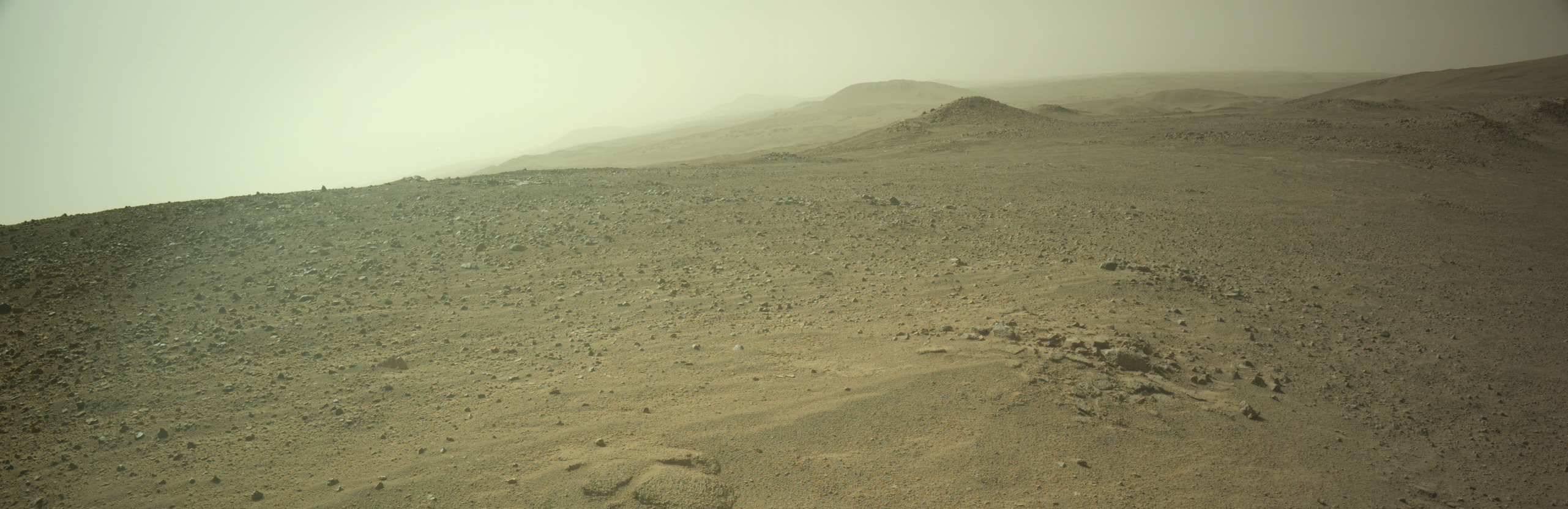
Panorama of Jezero Crater
Click for full resolution annotated image. Click here for unannotated full resolution image.

Cool image time! The panorama above, cropped, reduced, and sharpened to post here, was assembled from 44 pictures taken by the rover Perseverance on September 27, 2024 as it began its climb up the rim of Jezero Crater. If you click on it you can see the full resolution image that is also annotated to identify features within the crater as well as places where Perseverance has traveled.

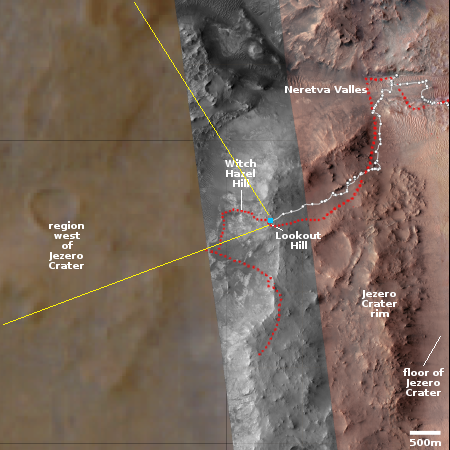
The overview map below, with the blue dot showing the rover’s location when this panorama was taken. The yellow lines indicate the area covered by the panorama, with the arrow indicating the direction.

Overview map
Click for interactive map.

According to the information at the link, the rover has been experiencing some slippery sandy ground as it has been climbing.
» Read more

0 comments

Two cubesats on Hera signal home

Engineers on the ground have now established good communications with the two cubesats that are being carried by the European probe Hera on its way to the binary asteroids Didymos and Dimorphos.

“Each CubeSat was activated for about an hour in turn, in live sessions with the ground to perform commissioning – what we call ‘are you alive?’ and ‘stowed checkout’ tests,” explains ESA’s Hera CubeSats Engineer Franco Perez Lissi.

…Travelling with Hera are two shoebox-sized ‘CubeSats’ built up from standardised 10-cm boxes. These miniature spacecraft will fly closer to the asteroid than their mothership, taking additional risks to acquire valuable bonus data.

Juventas, produced for ESA by GOMspace in Luxembourg will make the first radar probe within an asteroid, while Milani, produced for ESA by Tyvak International in Italy, will perform multispectral mineral prospecting.

This use of small cubesats in conjunction with a larger interplanetary probe is becoming increasingly routine, and provides a cheap and efficient way to increase the data and information obtained. Note too that both cubesats were apparently built entirely by private companies, thus establishing their creditionals as providers of interplanetary probes.

0 comments

ExoAnalytic now identifies more than 500 pieces from Intelsat satellite breakup

The private commercial space tracking company ExoAnalytic has now identified more than 500 pieces from Intelsat 33e satellite breakup.

Some of the smaller debris might actually quickly disappear as these pieces are possibly bits of solid fuel that will evaporate.

Much of the press has suddenly decided this failure is all Boeing’s fault, because the satellite was built by that company a decade ago. This seems a bit unfair, since Boeing’s problems now seem far removed from its design and construction of satellites then. At the same time one must wonder. Boeing built four of these type satellites for Intelsat, and the first was lost in 2019 when either it was hit by a meteor or had “a wiring flaw, which led to an electrostatic discharge following heightened solar weather activity.”

That means two of the four satellites have been lost, though the second, 33e, didn’t break-up until twelve years of operation, almost its expected lifespan. Furthermore, the other two satellites are still working fine.

All in all, that suggests to me that though there may be a technical cause that can be traced back to the company, it is more likely we are simply seeing a random expression of the dangers of space to engineering, by anyone.

1 comment

NASA picks nine lunar south pole candidate sites for Artemis-3 manned landing

The Moon's south pole, with candidate landing sites
Click for NASA’s original image.

NASA today revealed the nine candidate sites in the Moon’s south polar region for its Artemis-3 manned mission, presently targeting a 2026 launch date.

The map to the right shows the location of those nine sites, numbered in order of priority, as follows:

  • 1. Peak near Cabeus B
  • 2 . Haworth
  • 3. Malapert Massif
  • 4. Mons Mouton Plateau
  • 5. Mons Mouton
  • 6. Nobile Rim 1
  • 7. Nobile Rim 2
  • 8. de Gerlache Rim 2
  • 9. Slater Plain

The map also shows the planned landing sites for Intuitive Machine’s Athena lander in January 2025, and China’s Chang’e-7 lander in 2026, as well as where India’s Virkam lander touched down in 2023.

Cabeus B is likely the prime candidate site because its high elevation will make communciations easier, while placing it closer to the crater Cabeaus, which was impacted by the LCROSS mission in 2009 and found a significant signature of water in the ejecta plume of that impact.

To make a final decision NASA will be consulting all players, from the science community as well as the engineers. All of this however depends on other factors outside of science and engineering, mostly related to politics and practicality. The entire mission relies on the full version of the SLS rocket, the manned lunar version of SpaceX’s Starship, launched by Superheavy, and a working version of Lockheed Martin’s Orion capsule, none of which are presently flightworthy.

11 comments

Old rockets clash with new rockets in Europe

Two stories today from Andrew Parsonson at his website Europeanspaceflight.com today illustrate the battle going on in Europe’s vast space bureaucracy over its future rocket development, and clearly tell us who is winning.

First Parsonson described a presentation put forth by Arianespace officials at an “Ariane-6 User’s Club” meeting two weeks ago, outlining the planned and proposed upgrades Arianespace intends for the Ariane-6 rocket over the next decade. All the upgrades are focused on increasing the rocket’s payloac capacity. None will make any of the rocket reusable in order to lower its high cost which makes it uncompetitive in the modern launch market.

What was significant about Parsonson’s report is that he also noted that many of these upgrades need to be approved by the European Space Agency (ESA), and its officials won’t make that decision until 2025 during a planned conference. Thus, this presentation by Arianespace was essentially a lobbying effort to convince ESA to approve these upgrades.

Parsonson’s second story then told us what ESA is approving, right now.

The European Space Agency has selected Rocket Factory Augsburg, The Exploration Company, ArianeGroup, and Isar Aerospace to develop reusable rocket technology.

On 9 October, ESA held its Future Space Transportation Award Ceremony in Paris. During the event, the agency announced the four awardees under two initiatives focused on the development of reusable rocket technology: the Technologies for High-thrust Reusable Space Transportation (THRUST!) project and the Boosters for European Space Transportation (BEST!) project.

Except for ArianeGroup, these are new startups. The German companies Rocket Factory and Isar are developing their own rockets, while the French company Exploration has so far focused on making cargo capsules to supply future space stations.

ArianeGroup meanwhile is the joint partnership between Airbus and Safran that built and owns the Ariane-6, and actually has more say on its future than Arianespace, which is merely a government agency that in the past (but no more) managed and controlled all of Europe’s rockets. ArianeGroup hasn’t abandoned Ariane-6 by no means, but clearly is shifting its interests in new directions.

Interestingly, the final decisions on some of these reusable projects will be made at that same 2025 conference.

Want to bet that ESA at that conference shifts its focus from upgrading the non-reusable Ariane-6 and instead goes whole hog for reusability? I expect that, especially because all recent political signs at ESA has indicated no interest in maintaining Arianespace any longer. For example, ESA has taken the Vega family of rockets away from Arianespace and given it back to Avio, the Italian company that manufactures it. ESA has also returned management of French Guiana from Arianespace to France’s space agency, which owns the site.

Designed as the commercial arm of ESA, it no longer has a function, now that Europe is shifting from the Soviet-model of its rocket operation run by the government (Arianespace) to a capitalism model where competing independent companies provide products and services to that government.

1 comment

ISRO head unveils new timeline for major missions

The head of India’s space agency ISRO, S. Somanath, yesterday unveiled a new timeline for several of that nation’s major missions, both manned and unmanned.

The new timeline is as follows:

  • 2025: NISAR: a joint Indian-American radar orbiter, long delayed
  • 2026: Gaganyaan-1, India’s first manned orbital mission
  • 2028: Chandrayaan-4, an unmanned sample return mission to the Moon
  • 2028: Chandrayaan-5, a joint lander-rover to the Moon

The last project will be done in partnership with Japan, with India building the lander and Japan the rover.

2028 will be a very busy year for India in space. The Indian government had previously announced that ISRO would launch in 2028 the first module of its space station as well as a Venus orbiter.

0 comments

Unidentified astronaut from recent ISS mission released from hospital

Though NASA’s press release provided little informationto protect the astronaut’s privacy, including his or her name, the unidentified astronaut who was held overnight for observation after returning from a seventh-month stay on ISS mission has now been released from the hospital.

After an overnight stay at Ascension Sacred Heart Pensacola in Florida, the NASA astronaut was released and returned to NASA’s Johnson Space Center in Houston Saturday. The crew member is in good health and will resume normal post-flight reconditioning with other crew members.

This has happened before. Readapting to a 1G environment after months in weightlessness can be difficult, even if one does all the exercises required while in orbit.

7 comments

SpaceX yesterday launched another 23 Starlink satellites

SpaceX yesterday successfully launched 23 more Starlink satellites, its Falcon 9 lifting off from Cape Canaveral in Florida.

While the video link above says 23, a UPI report said the launch placed 22 satellites in orbit. I have no idea which is right, as the number of Starlinks on these launches range from 20 to 23.

The first stage completed its 19th flight, landing on a drone ship in the Atlantic.

The leaders in the 2024 launch race:

105 SpaceX
48 China
11 Russia
11 Rocket Lab

American private enterprise now leads the rest of the world combined in successful launches 122 to 71, while SpaceX by itself now leads the entire world, including American companies, 105 to 88.

4 comments

One unidentified astronaut hospitalized after return to Earth today

Though NASA has released very little information, including the indentity of the astronaut, one of the four crew who were brought back to Earth early today has ended up in the hospital.

NASA said Friday one its astronauts is in a hospital in Florida for medical observation after a “normal” predawn splashdown in the Gulf of Mexico inside a SpaceX capsule.

The mission’s other three crew members were cleared to return to their home base at Johnson Space Center in Houston after their own medical evaluations, NASA said.

The hospitalized astronaut “is in stable condition and under observation as a precautionary measure,” a NASA spokesperson said in a statement. The agency did not identify the astronaut or provide any more details about their condition, citing medical privacy protections.

That the other three astronauts returned to their home base at Johnson in Houston strongly suggests the hospitalized astronaut is the one Russian, Alexander Grebenkin, Normally Russians head back to Russia relatively quick after landing.

This remains speculation. We will have to wait for more information.

17 comments

Boeing considering selling its space division

According a Wall Street Journal exclusive today (behind a paywall), the company is now exploring the possibility of selling off its space division.

The NASA business that Boeing is exploring a sale of includes the troubled Starliner space vehicle and operations that support the International Space Station, but excludes the unit building NASA’s Space Launch System, the newspaper reported.

The U.S. planemaker’s shares rose 0.6% in afternoon trading.

Boeing’s space division includes its Starliner capsule and its work on NASA’s SLS rocket, as well as building many of the modules on ISS and operating it for NASA.

If this is so, it appears the new CEO, Kelly Ortberg, has decided that in order to get the company back on track it needs to focus on Boeng’s first and central business, building airplanes. Space is a distraction that is not helping the company bottom line right now in any way. Furthermore, NASA in 2020 told Boeing it would not entertain any new project bids from the company because its past bids were so poorly conceived. That decision remains in effect now, four years later. Since then Boeing has only have gotten a renewal contract to build more SLS rockets, plus a contract to develop a new airplane wing, but little else.

7 comments

SpaceX rolls out the next Superheavy for sixth test orbital launch

SpaceX in a tweet on October 22, 2024 announced the roll out to the launch tower of the next Superheavy to be used in the sixth orbital test flight, only nine days after that launch tower had successfully caught a Superheavy at the end of the fifth orbital test flight.

Though no launch date has been announced, the company is clearly wants to do it soon. Though its present launch license allows it go when ready, it remains unclear whether it will get that approval from the FAA when requested. FAA upper management has repeatedly indicated a desire to delay its approvals to SpaceX, and until there is a change in the White House — thus forcing a change in that FAA upper management — there is no reason to expect the agency to change its behavior.

12 comments

Spaceport startup SUAS Aerospace signs deal to launch small suborbital rocket from west coast of Ireland

SUAS's proposed spaceport plan
Click for original image.

The Irish spaceport startup SUAS Aerospace has now signed a partnership deal with the Netherlands rocket startup T-Minus Engineering to launch a small suborbital rocket from west coast of Ireland in order to demonstrate the viability of Ireland as a potential spaceport location.

According to this report, “T-Minus will provide its Dart rocket for the launch. Dart stands at 3.5 metres and is capable of carrying payloads of up to 3.5 kilograms to a maximum altitude of 200 kilometres.”

Though SUAS has raised €5 million in private investment capital to push its project to build two launch sites within Ireland, it has not made it clear the exact locations of these sites, other than indicating it wants to place them at two locations on Ireland’s west coast, as shown by the company graphic to the right. I suspect it does not yet have rights to the land, and its lobbying effort is largely focused on getting government help to obtain those rights, either on public or private land.

For example, its press release does not provide any details on where this suborbital launch will occur. I am not even sure the company knows. It might simply arrange some coastal location, simply to make possible this demonstration launch, even if that place is not the actual location of its proposed spaceport.

0 comments

JPL unveils website for viewing all high resolution imagery so far taken of Europa

In anticipation of the eventual arrival of Europa Clipper in orbit around Jupiter to begin its close investigation of that planet’s moon Europa, JPL yesterday unveiled a website that allows a view to quickly find and review all the high resolution imagery so far taken of Europa by the Jupiter orbiters, Voyager, Galileo, and Juno.

You can visit the Europa Trek portal website here.

The announcement touts the webpage’s ability to take viewers on “fly-overs” of the terrain, but that’s just a bell and whistle claim of little importance. More significant is the easy access this webpage provides to all that imagery, organized in context with a global map of the planet. Not only can anyone quick find interesting features, you can do so within the global context of the whole planet. In addition, the page provides detailed commentary about each image.

When Europa Clipper arrives this portal will be invaluable in deciphering the significance of every new image and datapoint.

0 comments

Boeing forced to take another $250 million charge on Starliner

Because of the continuing problems getting its Starliner manned capsule operational, Boeing has now taken another $250 million charge on the project, raising the total spent of its own money to $1.85 billion.

The company’s original fixed-price contract with NASA to deliver the capsule was $4.2 billion. The bulk of that won’t be paid until Starliner begins flying astronauts commercially, and NASA has now delayed that until 2026 at the earliest. The company’s new CEO, Kelly Ortberg, has now made it clear that he is focused on imposing changes to fix the bankrupt engineering management culture that has caused it so many failures in so many of its recent projects, not just Starlner. In his remarks announcing the company’s third quarter results, he said this:

The trust in our company has eroded. We’re saddled with too much debt. We’ve had serious lapses in our performance across the company which have disappointed many of our customers.

In addressing these issues Ortberg listed a whole range of changes, many of which focused on getting managers more closely involved in design and construction, or as he said, management needs “to be on the factory floors, in the back shops and in our engineering labs.”

Whether he will succeed is unknown. Its factory workers today rejected a new contract offer, continuing their now six-week strike that has halted work on company’s airplane business. In addition, Boeing reported a loss of $6 billion in that third quarter report.

One thing Ortbeg did make clear this week however: Boeing is not walking away from its Starliner contract with NASA. At a minimum it will complete that initial fixed price contract. Whether it will go on to fly more Starliner missions however Ortberg left open. I suspect he remains in negotiation with NASA over this issue.

11 comments

Dragon Endeavour undocks from ISS to bring 4 astronauts home

After more than a month delay resulting first from the issues with Starliner and then by poor weather in the splashdown zones, SpaceX’s Endeavour capsule today finally undocked from ISS, with a planned splashdown on October 25, 2024 at approximately 3:29 am (Eastern) off the coast of Florida. I have embedded the live stream of that splashdown below.

The capsules brings home three Americans and one Russian after a seven-month-long mission.
» Read more

0 comments

Review of the four private space stations presently under construction

Link here. The review provides a nice summary of the status of all four stations, being built by Axiom, Vast, and consortiums led by Blue Origin (Orbital Reef) and Voyager Space (Starlab).

The article included one piece of new news, based on recent stories suggesting major financial issues at Axiom:

As a result of these issues, the Axiom Station is believed to have been downsized to two modules from the originally planned four. There will be a reduced research capability from this arrangement compared to what was expected. However, it remains to be seen if additional capability can be added after the station becomes operational.

The original plan had been to separate the station from ISS once all four modules were launched. Whether it will be able to do so, flying independent of ISS’s systems with only two modules is unclear.

3 comments

SpaceX launches 23 more Starlink satellites

SpaceX today successfully launched another 23 Starlink satellites, its Falcon 9 rocket lifting off from Cape Canaveral in Florida.

The first stage completed its 18th flight, landing on a drone ship in the Atlantic.

The leaders in the 2024 launch race:

103 SpaceX
48 China
11 Russia
11 Rocket Lab

American private enterprise now leads the rest of the world combined in successful launches 120 to 71, while SpaceX by itself now leads the entire world, including American companies, 103 to 88.

2 comments

A pointy mesa once washed by theorized Martian ocean

A pointy mesa on Mars
Click for original image.

Today’s cool image returns to the same region yesterday’s cool image visited. The picture to the right, cropped, reduced, and sharpened to post here, was taken on July 21, 2024 by the high resolution camera on Mars Reconnaissance Orbiter (MRO). It was clearly taken to get a close look at this unusual pointy mesa.

MRO elevation data says this mesa is about 800 feet height. The color difference between the north and south flanks suggests the accumulated presence of dust on the north, suggesting the prevailing winds here come from the northeast and blow to the southwest. This conclusion is reinforced by the dark accumulated dust found in the southwest quadrants of all the crater floors in the full image. The wind blows this dust into the craters, where it gets trapped against the southwest crater wall.

Note the mesa’s wide base, with one crater partly eaten away on its eastern edge. The overall shape of this base suggests that it was carved by some flow coming from the southwest, as indicated by the arrow.
» Read more

0 comments

A slight bend in one boom delays NASA solar sail flight

Even though NASA’s solar sail test mission, dubbed the Advanced Composite Solar Sail System (ACSSS), successfully unfolded its giant sail in late August, engineers have not yet reactivated the sail’s attitude control system because they have detected a slight bend in one of the sail’s four booms.

While the solar sail has fully extended to its square shape roughly half the size of a tennis court, the mission team is assessing what appears to be a slight bend in one of the four booms. This likely occurred as the booms and sail were pulled taut to the spacecraft during deployment. Analysis indicates that the bend may have partially straightened over the weeks since boom deployment, while the spacecraft was slowly tumbling.

The attitude control system was turned off as planned during the deployment, allowing the sail to slowly tumble. It has been kept off longer than expected because the tumbling appears to be helping straighten the bend.

Once the control system is reactivated, the mission will then attempt to use the sail to change its orbit, to actually fly in space using sunlight like the wind.

0 comments

ULA begins stacking Vulcan for military launch, anticipating Pentagon approval

Though the Space Force is still reviewing the nozzle issue on the second flight of ULA’s Vulcan rocket and has not yet certified the rocket for military operational launches, ULA has begun stacking the next Vulcan for an anticipated military launch of a national security satellite.

On Monday [October 21], ULA shared photos of the 109.2-foot-long (33.3 m) booster being hoisted into the Vertical Integration Facility to begin the stacking process. In the days and possibly weeks to come, the 38.5-foot-long (11.7 m) Centaur 5 upper stage will be added along with four solid rocket boosters and the payload fairings.

It appears that the military has accepted Vulcan for this launch because — despite the nozzle falling off of
a strap-on side booster — the rocket was successful in placing its payload in its precise orbit. The Space Force is simply completing the paperwork required for certification.

No date however has been set, but the company hopes to complete two military Vulcan launches in 2024, so it won’t be that far in the future.

7 comments
1 99 100 101 102 103 814