Sunspot update: The ramp down to solar minimum continued to stall in June

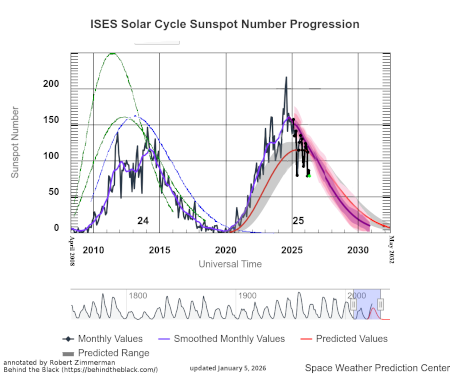
As I have tried to do every month since I started Behind the Black sixteen years ago, it is time for another sunspot update tracking the Sun’s sunspot activity as it evolves across its eleven year cycle. As always, I use as my basis the monthly update by NOAA of its graph showing the sunspot activity on the Earth-facing hemisphere but annotated by me with extra information to illustrate the larger scientific context.

As you can see by that graph below, June activity (the green dot) was only slightly less that in May, indicating a continuing stall in the ramp down to solar minimum, a ramp down that NOAA’s panel of solar scientists had predicted had begun in April 2025.

» Read more

1 comment

Sunspot update: May sunspot activity jumps

It is the beginning of the month, so it is time for my monthly sunspot update. According to NOAA’s June update of its monthly graph of the sunspot activity on the Earth-facing hemisphere, the amount of sunspots in May surprised us once again by increasing upward, though the totals continue to be below prediction.

That graph is below, annotated with extra information by me to illustrate the larger scientific context.
» Read more

1 comment

New long term analysis of solar activity suggests the Sun is undergoing some form of internal structural change

Sunspot activity for the past two cycles
NOAA’s chart of sunspot activity.
Click for the most recent update.

The uncertainty of science: Scientists doing a new analysis of more than forty years of solar data have concluded that some form of “subsurface structural changes associated with successive 11-year [sunspot] cycles” are taking place, with those changes “ever more progressively confined just beneath the solar surface.”

Using almost 40 years of helioseismic data from six telescopes around the world in the Birmingham Solar Oscillations Network (BiSON), the researchers uncovered a gradual change in structure just beneath the surface that has spanned multiple cycles, with the current solar cycle 25 showing particularly strong signatures of these changes.

Lead author Professor Bill Chaplin, from the University of Birmingham, said: “The Sun has its own ‘active biorhythm’ creating rising and falling magnetic activity that shapes space weather. However, traditional surface measures don’t capture the full story – that the Sun may be entering a different mode of behaviour unfolding over decades.

“We have uncovered evidence of systematic changes in the solar activity cycle. Crucially, magnetic activity is becoming more tightly confined near the surface with each cycle.”

The confinement appears to be within the first 600 miles below the surface, which for the Sun is barely skin deep.

In reading the paper [pdf], it is very clear they have detected these changes, but are as yet unable to apply them to any larger fundamental processes. They are observing the Sun change, but don’t know why. It could be simply random fluctuations of behavior, or it could be part of the Sun’s normal behavior related to its magnetic field and the nuclear fusion that makes it burn.

In either case, this lack of deeper understanding means it is impossible as yet to predict what will happen next, or how those future changes will impact us here on Earth.

1 comment

Sunspot update: The number of sunspot continues to decline

For only the second time since I started this website in 2010, I forgot last month to do my monthly sunspot update. No matter. The Sun’s behavior in producing sunspots in the past two months was actually amazingly similar, so doing both months at once works.

According to NOAA’s monthly graph of the sunspot activity on the Earth-facing hemisphere, the amount of sunspots in both March and April continued to be low, well below the predictions put forth by NOAA’s panel of scientists in their April 2025 prediction.

That graph is below, annotated with extra information by me to illustrate the larger scientific context.
» Read more

11 comments

Sunspot update: Sunspot activity tumbles in February, including the 1st blank days since ’22

The uncertainty of science! It is the start of the month, and thus time for another sunspot update, using NOAA’s monthly graph of the sunspot activity on the Earth-facing hemisphere, updated by NOAA to include the activity in February but annotated with extra information by me to illustrate the larger scientific context.

Last month I lambasted NOAA’s solar science panel for its consistently failed predictions, and made a tentative prediction of my own, suggesting the ramp down to solar minimum might not be occurring as they had predicted in April 2025.

This month I can lambast myself, because the Sun in February saw a significant drop in sunspots, including three consecutive days in which the Sun was blank of spots, for the first time since 2022. This drop supports the NOAA panel prediction and makes my prediction look foolish, but it also suggests the ramp down is continuing to go faster than predicted.
» Read more

2 comments

Fake scientist Michael Mann slapped down hard by DC superior court

Michael Mann
Fake leftist scientist Michael Mann

In the never-ending legal battle between fake climate scientist Michael Mann and his critics, Rand Simberg and Mark Steyn, Mann has once again lost badly in an appeal to a higher court, with the Superior Court in DC not only ruling that Mann must immediately pay Simberg and Steyn a total of more than $27K in court costs and fees, but blasting Mann for his lies to the court during the proceedings.

The fact remains that Dr. Mann throughout this litigation complained that he suffered lost grant funding directly stemming from the defamatory statements of Messrs. Simberg and Steyn, while providing very little in the way of specifics about the dollar amounts of his losses directly attributable to the statements (such as corroborating testimony from percipient witnesses), all while promising to illuminate the Court at trial. At trial, Dr. Mann elected through his attorneys to present to the jury a blown-up demonstrative, without redaction or explanation, a demonstrative intentionally prepared for its use at trial, which included a budget (loss) amount of $9,713,924.00, when the correct amount, previously corrected during a third round of discovery, was $112,000.

…the Court simply cannot condone such bad faith litigation tactics, particularly in a case that had been zealously litigated across several years and a case involving complicated facts. Thus, the Court’s ruling must stand. It is the Court’s duty to punish and deter bad faith litigation tactics.

In other words, Mann didn’t simply falsify his scientific results, using false data in his infamous hockey stick graph to create the illusion of human-caused global warming, when Simberg and Steyn called him out on this fake science, he tried to sue them using more fake data that was quickly revealed in discovery to be outright lies.

The court has thankfully decided it cannot tolerate such behavior.

What must be understood about Mann is that he is a very typical leftist radical, who thinks that because his cause is just and good, he is somehow immune from any consequences for bad behavior. Such leftists increasingly believe they are allowed to lie, cheat, defame, and even sometimes commit violence, because anyone who disagrees with them is evil. Mann did not do the last item (though many other leftists now are), but he did all the others, and truly believed he could get away with it. He is now finding out otherwise.

25 comments

Sunspot update: Ramp down to minimum continues?

Another year, another month, another sunspot update! Time to post my monthly update of the never-ending sunspot cycle on the Sun, using NOAA’s own monthly update of its graph of sunspot activity and annotating it with extra information to illustrate the larger scientific context.

The green dot on the graph below indicates the level of sunspot activity on the Sun’s Earth-facing hemisphere during the month of December. Unlike November, when activity plunged, in December the sunspot count recovered, producing more sunspots, though the number still reflected the ramp down to solar minimum that NOAA’s panel of solar scientists had predicted in April 2025 (as indicated by the purple/magenta line).
» Read more

2 comments

European sea-level satellite releases first data

First data from Sentinel-6B
Click for original.

The European Space Agency’s (ESA) Sentinel 6B satellite, launched a month ago, has now released its first sea-level data.

Following its launch on 17 November 2025, the first data from Sentinel-6B was captured on 26 November by the satellite’s Poseidon-4 altimeter. The image [to the right] is a combination of altimeter data from both the Sentinel-6 sea-level tracking satellites: Sentinel-6B and its twin, Sentinel-6 Michael Freilich, which was launched in 2020. The image shows the Gulf Stream current in the North Atlantic Ocean, off the eastern coasts of the US and Canada.

The Gulf Stream is a hugely important area of the North Atlantic Ocean, not only for the role it plays in global weather patterns and climate, but also because it’s a busy shipping route as well as a key ecosystem for marine species and therefore an important fishing zone.

What makes this particular government press release unusual is that though it is about a climate-related satellite, it makes no mention of global warming and how the sea level rise that has been recorded by the string of similar orbital satellites going back to 1993 is going to eventually drown us all. Maybe that’s because that total rise measured since 1993 equals only about 4 inches. That’s 4 inches of rise detected in more than three decades. At that rate, a little over an inch per decade, it will take centuries to drown anyone, but only those who refuse to walk a few feet to higher ground.

It could be the scientists and government PR hacks that are involved in writing this release also realized that the gig is up, and everyone now knows it, and it would only embarrass them further to push the global-warming hoax again.

4 comments

Sunspot update: Sunspot activity again crashes far below predictions

It is the start of another month, so it is time again to post my monthly update of the never-ending sunspot cycle on the Sun, using NOAA’s own monthly update of its graph of sunspot activity and annotating it with extra information to illustrate the larger scientific context.

The green dot on the graph below indicates the level of sunspot activity on the Sun’s Earth-facing hemisphere during the month of November. And once again, the Sun surprised us, producing far less sunspots than expected, based on the April 2025 prediction by NOAA’s panel of solar scientists (as indicated by the purple/magenta line).
» Read more

3 comments

France’s space agency CNES found liable for environmental damage at French Guiana spaceport

French Guiana spaceport
The French Guiana spaceport. The Diamant launchsite is labeled “B.”
Click for full resolution image. (Note: The Ariane-5 pad is now the
Ariane-6 pad.)

France’s space agency CNES, which has taken back management from Arianespace of the French Guiana spaceport it owns, has now been found liable for destroying a protected habitat as it began construction to upgrade the old abandoned Diamant rocket launch site into a pad for several of Europe’s new commercial rocket startups.

In March 2022, the regional environmental authority of French Guiana (DGTM) formally informed CNES that it could not begin demolition or earthworks at the Diamant site without first securing the legally required species and water-law authorisations. Despite this, the agency leveled the area in the preceding weeks, with the environmental NGO CERATO discovering the destruction in April 2022.

In August 2022, the DGTM carried out an unannounced inspection of the Diamant site and found further destruction of protected habitats linked to the agency’s PV2 solar farm project. In October 2022, the PV2 project manager informed DGTM that CNES had known about the presence of protected species on the PV2 site since 1 July 2022, yet began earthworks anyway.

In response to repeated flouting of DGTM procedures, the Prefect of French Guiana, the top regional authority, issued a stop-work order requiring CNES to halt all works at both sites.

It appears this stop-work order has contributed to delays in construction. The news now is that the case appears to have been settled.

The agency has been ordered to repair the damage within three years or face a fine of €50,000. It will also be required to finance ecological compensation actions elsewhere on the grounds of the Guiana Space Centre. The conclusion of the lawsuit will allow the agency to fully resume construction at the site, which it had been ordered to stop in late 2022.

In other words, CNES has been told to spend money elsewhere at the spaceport to make the local environmental authorities happy. It remains unclear how these delays have or even will impact the plans of the Spanish rocket startup PLD, which hopes to do the first orbital launch of its Miura-5 rocket from this site in 2026. PLD expects the first flight-worthy Miura-5 to be delivered to French Guiana early next year, so the delays in French Guiana have not yet effected its plans. That might now change if the site won’t be ready as planned.

This whole story however does indicate a fundamental problem within all of Europe’s space regulatory infrastructure that in the future is likely to hinder the development of its new commercial space industry. Europe’s leadership likes its red tape, and has done nothing to reduce it as it has shifted from the government-run model (where it controls and owns everything) to the capitalism model (where it buys what it needs from an independent competing private sector).

2 comments

Blue Origin faces opposition renewing its permit to dump waste water at Florida launch facility

Chicken Little strikes again!

It appears several local politicians as well as the typical anti-everything activists are expressing opposition to Blue Origin’s request to renew its permit to dump waste water at its Florida launch facility.

Some county commissioners have concerns about the proposal because of how much money and effort has gone to cleaning up the Indian River. “That’s really troubling to me especially when we are spending so much money as a community on the half-cent sales tax and the save the Indian River Lagoon tax,” said Brevard County Commissioner Katie Delaney.

Space experts say large-scale companies don’t necessarily follow rules and regulations put on them. “There has been all sorts of industrial waste issues associated with the aerospace industry not just here in Florida but all across the country,” Florida Tech space professor, Don Platt, said.

The water is likely that used during launches to dampen the shock produced by the rocket’s engines, and like SpaceX’s systems, is almost certainly potable and harmless. This is also a permit that Blue Origin obtained five years ago and has used without harm during all its launchpad tests and launches.

None of this whining really matters, as it appears the county commission has no authority over the matter. The permit was issued by the state’s environmental department which will almost certainly approve the renewal. It is just unfortunate that these whiners almost always get positive coverage from our propaganda press. In this case the local Fox affiliate that reported the story clearly made no effort to research anything. It just simply spouted back the grumbles of these politicians and activists.

2 comments

Sunspot update: Solar activity continues to decline as predicted

Another month has passed, and so it is time for my monthly update on the never-ending sunspot cycle on the Sun. using NOAA’s own monthly update of its graph of sunspot activity and annotating it with extra information to illustrate the larger scientific context.

The green dot on the graph below indicates the level of sunspot activity on the Sun’s Earth-facing hemisphere during the month of October. Not only did the number of sunspots decline from the count in the previous month, as predicted in April 2025 by NOAA’s panel of solar scientists (as indicated by the purple/magenta line), it dropped below their prediction.
» Read more

5 comments

Space Force approves Vandenberg environmental assessment, allowing SpaceX’s to launch as much as 100 times annually

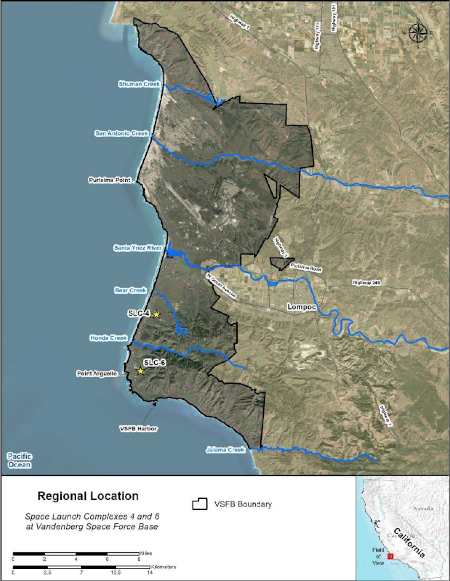
Map of Vandenberg Space Force Base, showing SpaceX's two launchpads
Figure 2.1-1 of the final environmental assessment report

The Space Force on October 10, 2025 announced it has now finalized and approved the environmental assessment that will permit SpaceX’s to increase its launch rate at Vandenberg to as much as 100 times per year.

The DAF [Air Force] has decided to increase the annual Falcon launch cadence at VSFB [Vandenberg] through launch and landing operations at SLC-4 and SLC-6 [the two SpaceX launchpads], including modification of SLC-6 for Falcon 9 and Falcon Heavy launch vehicles to support future U.S. Government and commercial launch service needs. The overall launch cadence will increase from 50 Falcon 9 launches per year at SLC-4 to up to 100 launches per year for Falcon 9 and Falcon Heavy at both SLCs combined. Falcon Heavy, which has not previously launched from VSFB, would launch and land up to five times per year from and at SLC-6. The DAF will authorize SpaceX to construct a new hangar south of the HIF [SpaceX’s horizontal integration facility] and north of SLC-6 to support Falcon 9 and Falcon Heavy integration and processing.

You can read the full environmental assessment here [pdf]. The map to the right, from the assessment, shows the location at Vandenberg of the two SpaceX launch sites. SLC-4 (pronounced “slick-four”) is the pad SpaceX has been using for years to launch Falcon 9s. SLC-6 was originally built for the space shuttle but never used for that purpose. Subsequently ULA leased it to launch its Delta family of rockets. When that rocket was retired SpaceX won the lease to reconfigure the site for both Falcon 9 and Falcon Heavy launches.

The Space Force apparently decided to ignore the objections of the California Coastal Commission as well as a number of anti-Musk leftwing activist groups. And its decision is well grounded in facts. The report documents at length the lack of any consequential environmental impacts from the increase of launches, which is further supported by almost three quarters of a century of actual use.

The decision is also well founded in basic American culture and law. The Space Force as a government agency must act as a servant of the American people, in this case represented by the private company SpaceX. It must therefore do whatever it can to aid and support that company, not put up roadblocks because it doesn’t like what the company proposes.

At least under Trump, this is the approach the Space Force is taking. I fear what will happen if a Democrat regains the presidency, based on the radical and enthused communist make-up of that party today.

4 comments

The hurricane season in 2024 confounded the predictions again

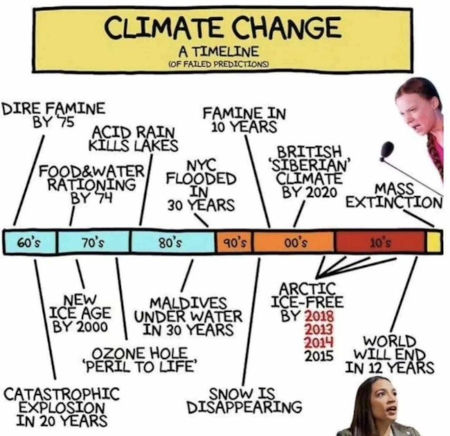
The trail of bad global warming predictions

The uncertainty of science: Though the climate science community had predicted that last year’s hurricane season was going to be one of the most active ever, a new study published two weeks ago in Geophysical Research Letters of the American Geophysical Union (AGU) found that the 2024 season did not behave as predicted. It ended up producing about the predicted number of hurricanes, but did so only because of a sudden rise in activity near the end of the season, after a long lull with almost no activity. From the study’s conclusion:

As has been noted throughout this study, the lull was immediately followed by one of the busiest ends to an Atlantic hurricane season on record, including two major hurricane landfalls in Florida (Helene and Milton), resulting in more than 250 fatalities and $100 billion in damage (National Centers for Environmental Information, 2025). Though the final overall number of hurricanes and major hurricanes were aligned with the seasonal forecasts, the extremely busy beginning and end to the season and marked lull in the middle highlight just how unusual the season was.

Last year’s prediction was not the first to be incorrect, though this time the error was in how the season unfolded instead of the total numbers. In the past two decades — since Al Gore prophesied that global warming would cause a gigantic increase in violent storms — NOAA has repeatedly called for very active hurricane seasons, and repeatedly those predictions have turned out wrong. In fact, from 2006 until 2018 there were almost no major hurricanes at all, the exact opposite to what Gore had foretold. Since then the seasons have returned to more normal numbers, but the predictions of the scientists have continued to be no better than throwing a dart at a wall while wearing a blindfold.

The ongoing 2025 hurricane season is following this same pattern. In May 2025 NOAA predicted this year would be a very active hurricane season. Instead, this season has matched those from 2006 to 2016, in which no hurricanes made landfall in the U.S. and the number of strong hurricanes was almost nil.

The season of course is not yet over. We could see a burst of activity in the next few months, similar to what happened in 2024. Nonetheless, the important takeaway from this story is that the scientists who claim to know what is going to happen simply don’t know anything. They are guessing, because as the paper above admits, the Earth’s weather and climate are incredibly complex, and our understanding of it is still in its infancy.

Remember this when you read the next “We’re all gonna die!” prediction touted in the propaganda press.

20 comments

Sunspot update: For one month the Sun does what the scientists predicted!

It is the start of the month, which means it is time for my monthly sunspot update, using NOAA’s own monthly update of its graph of sunspot activity and annotating it with extra information to illustrate the larger scientific context.

This graph is below, with the green dot showing the sunspot number for activity on the Sun’s Earth-facing hemisphere in September. As you can see, the count closely matched the April 2025 prediction by NOAA’s panel of solar scientists, which posited that the Sun was finally beginning its ramp down from solar maximum (as indicated by the purple/magenta line).
» Read more

2 comments

Climategate global-warming activist Michael Mann resigns from PennU after celebrating murder of Charlie Kirk

Michael Mann
Climate activist Michael Mann

Though he has claimed to be a climate scientist for decades, Michael Mann at the University of Pennsylvania has been proven time and again to merely be a leftwing global-warming activist, faking data to make it appear the increase of carbon dioxide in the atmosphere is causing global warming, falsely claiming he was a Nobel laureate winner, and acting to destroy the careers of anyone who challenged the veracity of his research.

Sadly, when these facts were discovered almost two decades ago, about the time the climategate emails were released, the climate science community ignored the facts (a very bad thing for scientists to do) and acted to defend Mann. Thus he was able to continue to publish while keeping his job as a professor in academia, first at Pennsylvania State University and then at the University of Pennsylvania.

Mann’s ability to survive fraud and abuse of power however has finally come to an end, and it did so because he decided to go on line after Charlie Kirk was assassinated to joke about that murder and to slander Kirk by reposting comments that called Kirk “head of Trump’s Hitler Youth.”

Though Mann subsequently denied that was what he was doing, deleting some of his worst tweets while claiming to condemn such violence, it appears no one believes him. As a result, he announced yesterday that he resigning his position at Pennsylvania University in order to become a full time political activist. From his resignation statement:
» Read more

41 comments

Trump administration moving to reduce rocket launch environmental regulations

FAA logo

According to a draft executive order that has not yet been released, the Trump administration is planning a major revision of the FAA’s environmental and launch regulations that has badly impacted rocket companies, with the goal of streamlining licensing.

The order would give Trump even more direct control over the space industry’s chief regulator by turning the civil servant position leading the FAA’s Office of Commercial Space Transportation into a political appointment. The last head of the office and two other top officials recently took voluntary separation offers.

The order would also create a new adviser to the transportation secretary to shepherd in deregulation of the space industry.

…The draft order also seeks to restrict the authority of state coastal officials who have challenged commercial launch companies like SpaceX, documents show. It could lead to federal officials interfering with state efforts to enforce their environmental rules when they conflict with the construction or operation of spaceports.

The order would also have the secretary of transportation ‘reevaluate, amend, or rescind’ sections of Part 450, the FAA licensing regulations that it imposed during the Biden administration that was supposed to streamline licensing but ended up adding considerable new red tape which contributed significantly to squelching the new launch industry that had popped up during the first Trump term.

As is usual for the propaganda press, the article at the link implies that these changes would result in horrible environmental consequences as well as increased safety risks to the public. What it does not note is that these changes appear to simply return the regulatory framework back to what existed prior to the Biden administration, a framework that had existed for more than a half century previously. The environment and public safety did just fine under those more freedom-oriented rules. I am sure both will do just fine again.

This order might also help explain Trump’s decision to withdraw Jared Isaacman as NASA administrator and appoint Transportation Secretary Sean Duffy as interim NASA administrator. The order puts much of this work on his head, and having him in charge of NASA will likely aid that work.

2 comments

The failed MethaneSat climate satellite apparently had problems from launch

According to a detailed New Zealand news report today, the failed MethaneSat climate satellite — funded and operated by the Environmental Defense Fund — apparently had significant problems during its short fifteen month life-span, going into safe mode many times, before failing completely last month.

An earlier report from this same news outlet described more fully the issues — which began in September 2024 only about six months after launch.

The mission’s chief scientist has now said more intense solar activity because of a peak in the sun’s magnetic cycle has been causing MethaneSAT to go into safe mode. The satellite has to be carefully restarted every time.

There has also been a problem with one of the satellite’s three thrusters, which maintain its altitude and steer the spacecraft. MethaneSAT says it can operate fully on two thrusters.

It appears there is a lot of unhappiness in New Zealand for spending $32 million on this project that was designed, built, and operated by an environmental activist organization with little space experience.

What is clear now is that the spacecraft likely got relatively little data during its fifteen month life span.

11 comments

New data: the ozone hole occurs mostly because of the sunspot cycle and cosmic rays, not CFC pollution

The ozone hole linked to the solar cycle

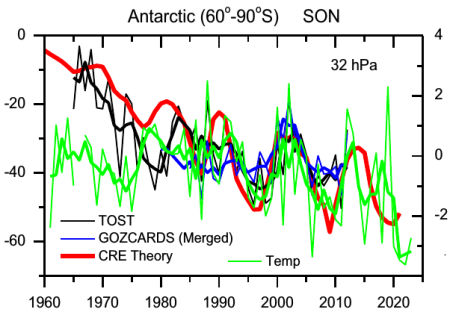
The uncertainty of science: A science paper released yesterday suggests that the ozone hole over Antarctica that scientists have been tracking for almost a half century is caused mostly by the solar cycle and the accompanying fluctuations in cosmic rays hitting the upper atmosphere, not the release of chlorofluorocarbons (CFCs) that used to be used in aerosol spray cans.

The graph to the right, from figure 2 of the paper, illustrates the data. The red line is the ozone hole fluctuations predicted by the paper’s model, labeled “CRE Theory”, based on the increase of cosmic ray radiation during solar minimum. The blue, black, and green lines indicate the actual fluctuations of ozone and temperature in the lower stratosphere where the ozone layer exists. As you can see, the model and actual fluctuations match quite closely. From the paper’s abstract:
» Read more

18 comments

Sunspot update: Sunspot activity rebounds somewhat in June

As I have done since I started this website fifteen years ago, I post at the start of every month an update of the Sun’s ongoing sunspot activity, using the update that NOAA posts each month to its own graph of sunspot activity but annotated by me with extra information to illustrate the larger scientific context.

Below is that graph, showing that in June sunspot activity rebounded upward somewhat from the shocking drop in activity that occurred in May.

» Read more

0 comments
1 2 3 44