The hurricane season in 2024 confounded the predictions again

The trail of bad global warming predictions

The uncertainty of science: Though the climate science community had predicted that last year’s hurricane season was going to be one of the most active ever, a new study published two weeks ago in Geophysical Research Letters of the American Geophysical Union (AGU) found that the 2024 season did not behave as predicted. It ended up producing about the predicted number of hurricanes, but did so only because of a sudden rise in activity near the end of the season, after a long lull with almost no activity. From the study’s conclusion:

As has been noted throughout this study, the lull was immediately followed by one of the busiest ends to an Atlantic hurricane season on record, including two major hurricane landfalls in Florida (Helene and Milton), resulting in more than 250 fatalities and $100 billion in damage (National Centers for Environmental Information, 2025). Though the final overall number of hurricanes and major hurricanes were aligned with the seasonal forecasts, the extremely busy beginning and end to the season and marked lull in the middle highlight just how unusual the season was.

Last year’s prediction was not the first to be incorrect, though this time the error was in how the season unfolded instead of the total numbers. In the past two decades — since Al Gore prophesied that global warming would cause a gigantic increase in violent storms — NOAA has repeatedly called for very active hurricane seasons, and repeatedly those predictions have turned out wrong. In fact, from 2006 until 2018 there were almost no major hurricanes at all, the exact opposite to what Gore had foretold. Since then the seasons have returned to more normal numbers, but the predictions of the scientists have continued to be no better than throwing a dart at a wall while wearing a blindfold.

The ongoing 2025 hurricane season is following this same pattern. In May 2025 NOAA predicted this year would be a very active hurricane season. Instead, this season has matched those from 2006 to 2016, in which no hurricanes made landfall in the U.S. and the number of strong hurricanes was almost nil.

The season of course is not yet over. We could see a burst of activity in the next few months, similar to what happened in 2024. Nonetheless, the important takeaway from this story is that the scientists who claim to know what is going to happen simply don’t know anything. They are guessing, because as the paper above admits, the Earth’s weather and climate are incredibly complex, and our understanding of it is still in its infancy.

Remember this when you read the next “We’re all gonna die!” prediction touted in the propaganda press.

20 comments

Sunspot update: For one month the Sun does what the scientists predicted!

It is the start of the month, which means it is time for my monthly sunspot update, using NOAA’s own monthly update of its graph of sunspot activity and annotating it with extra information to illustrate the larger scientific context.

This graph is below, with the green dot showing the sunspot number for activity on the Sun’s Earth-facing hemisphere in September. As you can see, the count closely matched the April 2025 prediction by NOAA’s panel of solar scientists, which posited that the Sun was finally beginning its ramp down from solar maximum (as indicated by the purple/magenta line).
» Read more

2 comments

Climategate global-warming activist Michael Mann resigns from PennU after celebrating murder of Charlie Kirk

Michael Mann
Climate activist Michael Mann

Though he has claimed to be a climate scientist for decades, Michael Mann at the University of Pennsylvania has been proven time and again to merely be a leftwing global-warming activist, faking data to make it appear the increase of carbon dioxide in the atmosphere is causing global warming, falsely claiming he was a Nobel laureate winner, and acting to destroy the careers of anyone who challenged the veracity of his research.

Sadly, when these facts were discovered almost two decades ago, about the time the climategate emails were released, the climate science community ignored the facts (a very bad thing for scientists to do) and acted to defend Mann. Thus he was able to continue to publish while keeping his job as a professor in academia, first at Pennsylvania State University and then at the University of Pennsylvania.

Mann’s ability to survive fraud and abuse of power however has finally come to an end, and it did so because he decided to go on line after Charlie Kirk was assassinated to joke about that murder and to slander Kirk by reposting comments that called Kirk “head of Trumpโ€™s Hitler Youth.”

Though Mann subsequently denied that was what he was doing, deleting some of his worst tweets while claiming to condemn such violence, it appears no one believes him. As a result, he announced yesterday that he resigning his position at Pennsylvania University in order to become a full time political activist. From his resignation statement:
» Read more

41 comments

Trump administration moving to reduce rocket launch environmental regulations

FAA logo

According to a draft executive order that has not yet been released, the Trump administration is planning a major revision of the FAA’s environmental and launch regulations that has badly impacted rocket companies, with the goal of streamlining licensing.

The order would give Trump even more direct control over the space industryโ€™s chief regulator by turning the civil servant position leading the FAAโ€™s Office of Commercial Space Transportation into a political appointment. The last head of the office and two other top officials recently took voluntary separation offers.

The order would also create a new adviser to the transportation secretary to shepherd in deregulation of the space industry.

…The draft order also seeks to restrict the authority of state coastal officials who have challenged commercial launch companies like SpaceX, documents show. It could lead to federal officials interfering with state efforts to enforce their environmental rules when they conflict with the construction or operation of spaceports.

The order would also have the secretary of transportation ‘reevaluate, amend, or rescind’ sections of Part 450, the FAA licensing regulations that it imposed during the Biden administration that was supposed to streamline licensing but ended up adding considerable new red tape which contributed significantly to squelching the new launch industry that had popped up during the first Trump term.

As is usual for the propaganda press, the article at the link implies that these changes would result in horrible environmental consequences as well as increased safety risks to the public. What it does not note is that these changes appear to simply return the regulatory framework back to what existed prior to the Biden administration, a framework that had existed for more than a half century previously. The environment and public safety did just fine under those more freedom-oriented rules. I am sure both will do just fine again.

This order might also help explain Trump’s decision to withdraw Jared Isaacman as NASA administrator and appoint Transportation Secretary Sean Duffy as interim NASA administrator. The order puts much of this work on his head, and having him in charge of NASA will likely aid that work.

2 comments

The failed MethaneSat climate satellite apparently had problems from launch

According to a detailed New Zealand news report today, the failed MethaneSat climate satellite — funded and operated by the Environmental Defense Fund — apparently had significant problems during its short fifteen month life-span, going into safe mode many times, before failing completely last month.

An earlier report from this same news outlet described more fully the issues — which began in September 2024 only about six months after launch.

The mission’s chief scientist has now said more intense solar activity because of a peak in the sun’s magnetic cycle has been causing MethaneSAT to go into safe mode. The satellite has to be carefully restarted every time.

There has also been a problem with one of the satellite’s three thrusters, which maintain its altitude and steer the spacecraft. MethaneSAT says it can operate fully on two thrusters.

It appears there is a lot of unhappiness in New Zealand for spending $32 million on this project that was designed, built, and operated by an environmental activist organization with little space experience.

What is clear now is that the spacecraft likely got relatively little data during its fifteen month life span.

11 comments

New data: the ozone hole occurs mostly because of the sunspot cycle and cosmic rays, not CFC pollution

The ozone hole linked to the solar cycle

The uncertainty of science: A science paper released yesterday suggests that the ozone hole over Antarctica that scientists have been tracking for almost a half century is caused mostly by the solar cycle and the accompanying fluctuations in cosmic rays hitting the upper atmosphere, not the release of chlorofluorocarbons (CFCs) that used to be used in aerosol spray cans.

The graph to the right, from figure 2 of the paper, illustrates the data. The red line is the ozone hole fluctuations predicted by the paper’s model, labeled “CRE Theory”, based on the increase of cosmic ray radiation during solar minimum. The blue, black, and green lines indicate the actual fluctuations of ozone and temperature in the lower stratosphere where the ozone layer exists. As you can see, the model and actual fluctuations match quite closely. From the paper’s abstract:
» Read more

18 comments

Sunspot update: Sunspot activity rebounds somewhat in June

As I have done since I started this website fifteen years ago, I post at the start of every month an update of the Sun’s ongoing sunspot activity, using the update that NOAA posts each month to its own graph of sunspot activity but annotated by me with extra information to illustrate the larger scientific context.

Below is that graph, showing that in June sunspot activity rebounded upward somewhat from the shocking drop in activity that occurred in May.

» Read more

0 comments

Sunspot update: The Sun confounds the predictions again!

It is time for my monthly update of the Sun’s ongoing sunspot activity, using the update that NOAA posts each month to its own graph of sunspot activity but annotated by me with extra information to illustrate the larger scientific context.

The activity in May was shocking in that it completely contradicted all expectations by everyone in the solar science community, with the Sun’s sunspot count changing in a way that was somewhat unprecedented. The graph below makes this very clear:

» Read more

6 comments

Supreme Court unanimously rules the federal government’s regulatory overuse of environmental impact statements is wrong

In a ruling that will have wide-ranging impacts across multiple industries, including rocketry, the Supreme Court yesterday ruled 8-0 that the mission creep expansion of federal government’s regulatory use of environmental impact statements (EIS) to hinder all new construction projects is incorrect and must stop.

The case involved a planned railroad in Utah, that had gotten all its permits for construction, including approval of its environmental impact statement, but was then stymied by lawsuits by political activist groups that claimed the impact statement, issued under the National Environmental Policy Act (NEPA), had not considered the impact of the industries the railroads would serve, including impacts far from the railroad’s location itself.

This is a perfect example of the broad expansion of NEPA that has been imposed in the last two decades by federal bureaucracy working hand-in-glove with these leftist political groups.

The Supreme Court, including all of the Democratic Party appointees, said enough!

In its majority opinion, authored by Justice Brett Kavanaugh, the Court clarified that under NEPA the STB “did not need to evaluate potential environmental impacts of the separate upstream and downstream projects.” The Court concluded that the “proper judicial approach for NEPA cases is straightforward: Courts should review an agency’s EIS to check that it addresses the environmental effects of the project at hand. The EIS need not address the effects of separate projects.”

This statement “is particularly significant for infrastructure projects, such as pipelines or transmission lines, and should help reduce NEPA’s burdens (at least at the margins),” wrote Jonathan Adler, a law professor at the Case Western Reserve University School of Law, in The Volokh Conspiracy. “The opinion will also likely hamper any future efforts, perhaps by Democratic administrations, to expand or restore more fulsome (and burdensome) NEPA requirements.”

The article notes (and confirms) what I have been writing now for the past five years in connection with the FAA’s demand that rocket companies require new impact statements every time they revise their operations, even when those changes are relatively minor.

This point could reduce one of the largest delays caused by NEPA: litigation. Since its passage in 1969, NEPA has been weaponized by environmental groups to stunt disfavored projectsโ€”which has disproportionately impacted clean energy projects. On average, these challenges delay a permitted project’s start time by 4.2 years, according to The Breakthrough Institute.

The increased threat of litigation has forced federal agencies to better cover their bases, leading to longer and more expensive environmental reviews. With courts deferring more to agency decisions, litigation could be settled more quickly.

This ruling is an excellent move in the right direction, but no one should assume it will be followed honestly by the next Democrat who sits in the White House. Just as Biden expanded red tape by simple forcing the FAA to slow-walk its launch licensing process, future presidents could do the same.

Nor should be expect the lawsuits by these luddite leftists to cease. They will find other legal challenges and will push those instead.

The real solution is to reduce the bureaucracy’s size entirely, so there won’t be paper-pushers for these petty dictators to utilize for their authoritarian purposes. Eliminating or simplifying these environmental regulations would help as well, giving the activists fewer handles on which to hang their lawsuits.

7 comments

Fish & Wildlife has expanded its regulatory rule to every tree in much of the U.S.

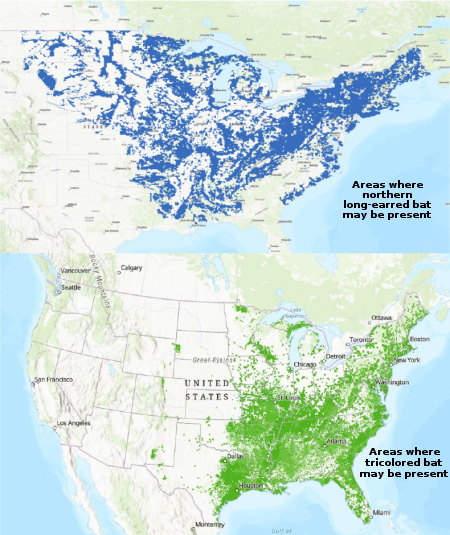
Areas now subject to regulation if you intend to cut down any trees
The blue and green areas are now subject to
Fish & Wildlife regulation if you intend to cut
down any trees

Apparently in a bid to give itself more power over every proposed building project in the United States, the Fish & Wildlife Service in October 2024 (just before the election) wildly expanded its regulatory rules for protecting endangered bats.

According to the new rules, Fish & Wildlife now considers the removal of any trees at such projects to be a risk to the endangered species, because those trees “may” have been used as roosts and would therefore threaten the species ability to survive if removed.

No matter that there may be thousands of other trees nearby, including many acres of forest. If you are building anything that involves cutting down any trees, you will be subjected to Fish & Wildlife supervision that could block construction. And the area this new rule covers includes almost the entire eastern and northern parts of the United States, as shown on the maps to the right, taken from the new regulation guidelines [pdf].

Long time reader Jack O’Leary informed me of this new power grab. He also sent me information about one particular project in Massachusetts involving the installation of a well and pump station in a forested area southeast of Boston, far from any bat hibernacula. The only impact this project might have on any bats is the removal of some trees, though the project is located in a forested area with hundreds of acres of trees all around (as shown clearly on the satellite view on Google maps).

Yet Fish & Wildlife makes it clear in its letter [pdf] to the project that its “Endangered Species Act requirements are not complete.” Fish & Wildlife admits that the project will pose no direct threat to the endangered bats, but the very act of cutting down a few trees “may affect” the bats, so therefore government regulatory supervision is required.
» Read more

9 comments

Sunspot update: Activity rises slightly in April

It is the start of the month, so it is of course time for my monthly report on sunspot activity, based on the update that NOAA posts each month to its own graph of sunspots activity. As I have done since the start of Behind the Black in 2010, I take that graph each month and annotate it with extra information to illustrate the larger scientific context.

Sunspot activity in April did nothing to tell us anything about the Sun’s future activity. It rose slightly, but not by enough to suggest that the prediction put forth last month by NOAA scientists that the ramp down to solar minimum has begun is wrong.
» Read more

4 comments

FAA okays increase in SpaceX launches from Vandenberg from 36 to 50 per year

The FAA today approved an environmental reassessment at Vandenberg Space Force Base that permits SpaceX to increase its annual launches there from 36 to 50.

The reassessment determined (not surprisingly) that there was “no significant impact” on the environment caused by the increased number of launches.

We already have more than seven decades of empirical data at spaceports in both Florida and California that rocket launches do no harm to the environment, and in fact act to significantly protect wildlife and natural resources because they require the creation of large regions where no development can take place.

The real question should be this: Why is the federal government wasting taxpayer money on these reports? They are utterly unnecessary, and only serve to hinder the freedom of Americans while spending their taxes on make work that accomplishes nothing.

5 comments
1 2 3 4 73