Resilience has docked with ISS

SpaceX’s Resilience Dragon capsule successfully docked with ISS tonight.

They are in the process of checking the seal of the docking, and the opening of the hatch.

As much as I have been critical of Boeing in recent years, I truly hope they can get their management and engineering problems worked out so they can accomplish the same thing with their Starliner capsule. The competition with SpaceX will be healthy for both companies, the nation, and the future of the human race.

13 comments

The Apollo 12 crew’s excursions on the Moon, 51 years ago

In celebration of the anniversary this week of the Apollo 12 mission to the Moon in November 1969, the science team for the Lunar Reconnaissance Orbiter (LRO) have created a wonderful animation showing step-by-step where and when Pete Conrad and Alan Bean walked during their two EVAs on the lunar surface.

That video is below. It highlights strongly the need of any future short-term mission to any planetary landing to have a vehicle on board. Conrad and Bean accomplished a lot during their two four-hour walks, but nowhere near as much as they could have accomplished if they could have driven about on their EVAs. In fact, in the 1960s NASA had already recognized this, and was to put a rover on the last three Apollo lunar landings.

2 comments

SpaceX successfully launches four astronauts to ISS

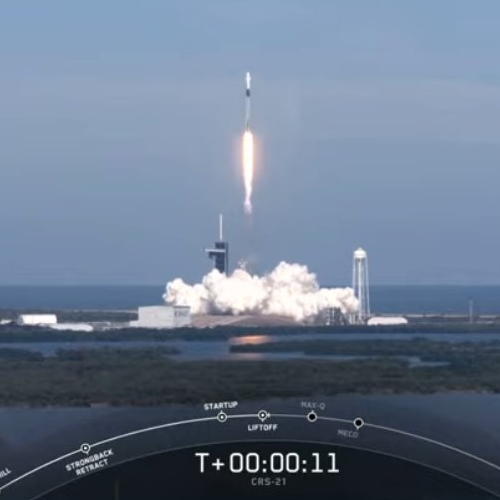
Falcon 9 launch on November 15, 2020 with four astronauts

Capitalism in space: SpaceX tonight successfully launched four astronauts to ISS on its Dragon capsule Resilience, using its Falcon 9 rocket.

They also recovered the first stage, landing it on its drone ship in the Atlantic. The routine manner in which SpaceX ran this launch is truly admirable. They make landing and reuse of the first stage so expected it is hard to believe that for fifty years rocket managers and engineers insisted it wasn’t doable.

They had one issue today, a failure of the capsule hatch to hold air pressure after closure. They calmly reopened the hatch, cleared the issue, added some lubricant, and closed the hatch, all in less than ten minutes.

Resilience will dock with ISS tomorrow evening.

The leaders in the 2020 launch race:

30 China
20 SpaceX
5 ULA
4 Europe (Arianespace)
4 Rocket Lab

The U.S. now leads China 32 to 30 in the national rankings.

6 comments

First US Rocket Lab launch delayed until ’21

Because of issues in Rocket Lab’s flight termination system (used to destroy the rocket should it go out of control during launch), the company has announced that its first U.S. launch will be delayed until 2021.

One reason for the delay, Rocket Lab said, was that it was waiting on NASA to certify the autonomous flight termination system (AFTS) that will be used on the rocket to provide range safety. NASA controls the launch range at the Wallops Flight Facility, where LC-2 is located. “There’s a very long certification process that, quite frankly, we probably underestimated how long it would take,” Peter Beck, chief executive of Rocket Lab, said in an interview in August.

That certification process is ongoing. In a Nov. 10 talk at a Maryland Space Business Roundtable webinar, David Pierce, director of NASA Wallops, mentioned preparations for Rocket Lab’s first launch as part of an overview of the facility’s activities. “We’re really proud of our work with Rocket Lab,” he said. “We’re working really hard to support Rocket Lab with a launch in ’21.”

Asked later about the certification of the AFTS, Pierce said that engineers had kept on schedule with the development of the system into the summer despite the pandemic. “When they sent the unit out for review of the software, we found some errors,” he said. That review involved teams at NASA’s Katherine Johnson Independent Verification and Validation Facility, the Federal Aviation Administration, Vandenberg Air Force Base and Cape Canaveral Air Force Station.

While I have no evidence of this, I cannot help being suspicious of these various government agencies. For years numerous people in the government put fake roadblocks up to slow or stop SpaceX’s first manned launch, merely because it threatened their turfs. This autonomous termination system will make the ground crews at Vandenberg and at Cape Canaveral irrelevant, and I would not be surprised if some of these issues were drummed up to delay or block this system because of that.

I know I am being cynical, but based on history it is not unreasonable to be so.

1 comment

Most recent engine test on eighth Starship prototype had issues

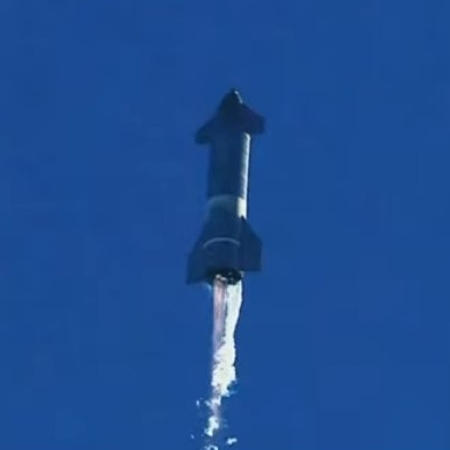
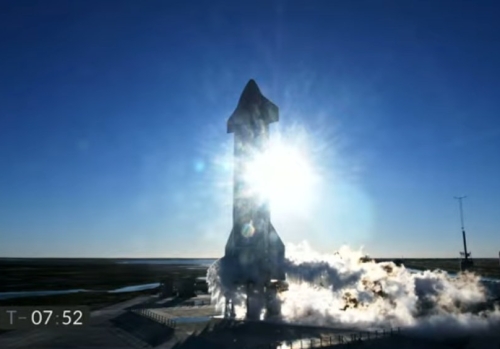
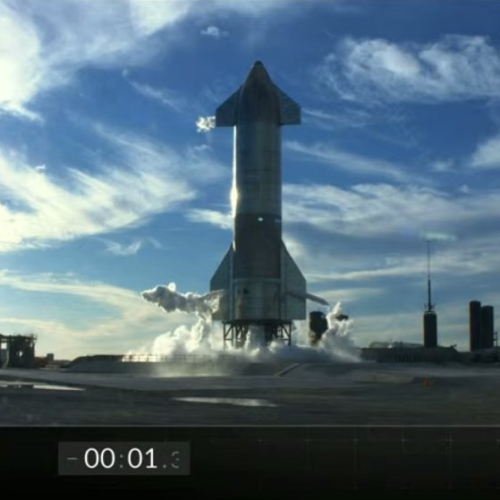
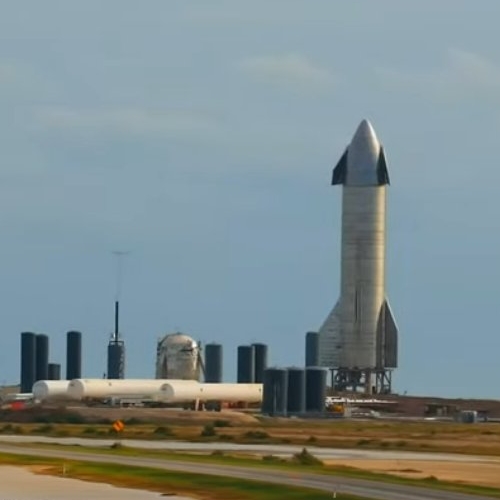
Capitalism in space: The most recent engine test on November 12th of SpaceX’s eighth Starship prototype had a problem that will delay its planned 50,000 foot test hop.

The Starship SN8 vehicle performed its third brief “static fire” — a test in which engines are ignited while a rocket remains tethered to the ground — at SpaceX’s South Texas facility on Thursday, near the village of Boca Chica.

Shortly after the test, which several outside organizations webcast live, material could be seen apparently dripping from SN8’s base. This looked odd, and SpaceX founder and CEO Elon Musk soon confirmed that something off-nominal had happened. “We lost vehicle pneumatics. Reason unknown at present. Liquid oxygen header tank pressure is rising. Hopefully triggers burst disk to relieve pressure, otherwise it’s going to pop the cork,” Musk said via Twitter on Thursday night. (Burst disks are single-use devices that, like valves, seal off different sections or systems of a vehicle. They relieve pressure when they open, as Musk noted.)

The cause of the problem is unknown at the moment, Musk said in another Thursday tweet: “Maybe melted an engine preburner or fuel hot gas manifold. Whatever it is caused pneumatics loss. We need to design out this problem.”

The decision to pin down the cause and redesign things so it won’t happen again makes perfect sense, but it also means that the hop will not occur in the next week or so, as hoped for by the company. Expect a delay. Based on the pace that SpaceX works, that delay however should not be longer than one or two months.

5 comments

Elon Musk gets contradictory COVID-19 test results

The uncertainty of science: Because SpaceX’s founder Elon Musk had had some minor cold-like symptoms, he decided to get tested for COVID-19, and discovered that after four tests, he still had no idea whether he had it or not.

The Tesla boss and fifth-richest man in the world had initially tweeted Thursday night that “Something extremely bogus is going on” regarding COVID-19 testing. “Two tests came back negative, two came back positive. Same machine, same test, same nurse.”

…Though Musk had initially tweeted that his symptoms were “nothing unusual” and those “of a typical cold,” he gave more detail Friday morning. “Mild sniffles & cough & slight fever past few days,” he told one Twitter user who asked how he was feeling. “Right now, no symptoms, although I did take NyQuil.”

First, the results tell us that the so-called surge going on in new coronavirus cases that is panicking our Democratic Party lords and masters might very well be bogus. At a minimum we should all be more skeptical of the numbers.

Second, assuming Musk does have COVID-19, his symptoms illustrate once again how relatively harmless the virus is to healthy people. In fact, no one seems to notice that of the numbers of people diagnosed with COVID-19 in the general populace, no one seems ever to die from it. Like the flu, they are sick for a week or so, and then recover.

12 comments

Weather forces one day delay in launch of Resilience with four astronauts

Because of high winds and ocean weather interfering with the recovery of the first stage, NASA and SpaceX today decided to delay the launch of SpaceX’s second manned Dragon mission, the capsule Resilience carrying four astronauts, to Sunday, November 15.

NASA and SpaceX are now targeting 7:27 p.m. EST Sunday, Nov. 15, for liftoff of the agency’s SpaceX Crew-1 mission to fly astronauts from Launch Complex 39A at NASA’s Kennedy Space Center in Florida to the International Space Station.

Teams moved the launch by one day because of onshore winds and to enable recovery of the first stage booster, which is planned to be reused to launch the Crew-2 mission next year. The booster is expected to land on the recovery ship about nine minutes after launch.

They now plan to dock with ISS at 11 am (eastern) on November 16th.

1 comment

ULA successfully launches reconnaissance satellite with Atlas 5

Capitalism in space: ULA today successfully launched a military reconnaissance satellite using its Atlas 5 rocket.

This launch was the first Atlas 5 using these particular Northrop Grumman solid rocket boosters.

Because this was a military launch, the live broadcast ended at the moment the fairings were released, exposing the satellite. Final announcement of the satellite’s successful deployment will come later, assuming all goes well.

The leaders in the 2020 launch race:

30 China
19 SpaceX
5 ULA
4 Russia
4 Europe (Arianespace)
4 Rocket Lab

The U.S. now leads China 31 to 30 in the national rankings, with two more launches scheduled for the next two day. SpaceX is first with its second manned Dragon mission tomorrow, followed by Rocket Lab’s next launch from New Zealand on November 15.

0 comments

Ukraine signs Artemis Accords

Ukraine has becomed the ninth nation to sign the Artemis Accords, designed to encourage private enterprise in space.

The article at the link provides little information, other than claiming that ” Ukraine has all the scientific and technical capabilities and experience that allow it to become one of NASA’s important partners in the implementation of the Artemis program.”

Russia and the Ukraine are on opposite sides of a war, with Russia attempting to steal territory, with some success. Russia has also boycotted all Ukrainian space technology, ending a half century of business dealings.

It seems that the Ukrainian government looked at this political landscape, and decided to align itself with the United States. By signing the accords, it now has the opportunity to sell its space technology to NASA, as well as participate in any American effort to get to the Moon and elsewhere. That it chose to pick an ally halfway around the world instead of its big and powerful neighbor, tells us a great deal about the Ukrainian’s opinion of Russia.

I expect there will be a NASA press release in the next day or so that will provide us additional information.

1 comment

Private space company announces new upgraded tug for moving satellites in orbit

Capitalism in space: The private space company Spaceflight yesterday announced the development of a new upgraded tug for moving small satellites from their launched orbit to their operational locations, including locations in orbit around the Moon.

Spaceflight announced the first flight of its Sherpa-LTE orbital transfer vehicle (OTV) will take place in mid-2021. The vehicle is based on the next-generation Sherpa-FX tug announced in the summer, but equipped with the Apollo Constellation Engine, a Hall effect thruster provided by Apollo Fusion.

With that propulsion system, Sherpa-LTE will be able to generate a change in velocity, or delta-V, of more than 6 kilometers per second. That will allow the vehicle to deliver smallsats to geostationary Earth orbit, cislunar space, or Earth-escape trajectories after a launch into low Earth orbit.

Spaceflight is a direct competitor with Momentus, which already has contracts with several satellite companies for its in-space tug services. Nor is this competition bad. This new cottage industry of tugs helps focus innovation. Satellite companies can focus on improving their satellites, while buying the propulsion from tug companies who can provide that technology best.

0 comments

Update on continuing engine testing of Starship prototype #8

Link here. The article provides details on the on-going engine tests of SpaceX’s eighth prototype of its Starship reusuable upper stage.

As should be expected, the testing has not gone exactly as planned, though clear progress is being made, especially in the testing of the header tanks in the nosecone..

After several days of test windows come and gone and an aborted attempt on November 9th, Starship SN8 finally ignited one of its three Raptor engines, feeding the engine with liquid methane and oxygen stored in two separate header tanks. Oddly, a second or two after startup and ignition, Raptor’s usual exhaust plume was joined by a burst of shiny firework-like debris. A relatively normal five seconds later, the Raptor cut off, though the engine appeared to remain partially on fire for another ten or so seconds – also somewhat unusual.

It appears that fire was from nearby debris, not the engine itself.

Another engine test is likely later this week. The actual 50,000 foot hop will not happen until they have completed all these engine tests.

2 comments

NASA officially approves operational Dragon manned missions

Capitalism in space: NASA yesterday officially certified SpaceX’s Dragon capsule for future operational manned missions to ISS.

NASA officials gave approval Tuesday for SpaceX to begin regular crew rotation flights to the International Space Station with the launch of four astronauts set for Saturday from the Kennedy Space Center in Florida, signaling a transition from development to operations for the human-rated Dragon spacecraft.

Mission managers completed a two-day Flight Readiness Review Tuesday and issued a preliminary go-ahead for the launch of SpaceX’s Crew Dragon “Resilience” spacecraft Saturday at 7:49 p.m. EST (0049 GMT Sunday) with NASA commander Mike Hopkins, pilot Victor Glover, and mission specialists Shannon Walker and Soichi Noguchi, a veteran Japanese space flier.

The decision means that SpaceX will now be rotating crews for NASA at ISS every six months. It will also be reusing both the first stages and the capsules. Endeavour, the capsule used on the demo flight earlier this year, will be reused in the spring. Resilience, the capsule scheduled for launch on November 14th, will be reused next fall.

Since SpaceX also has a commercial manned flight planned for next fall, that will probably require a third capsule. With those three capsules they will have at least for the next few years a fleet will cover all their initial needs. Don’t be surprised if however the introduce an upgraded capsule or two along the way, based on what they learn on these initial flights.

The article had one other piece of new news concerning Boeing’s Starliner capsule. The second unmanned demo flight has now officially been delayed into the first quarter of next year, rather than late this year.

0 comments

New Hampshire legislature flips from Democrat to Republican

Resist! Not only did all parts of the New Hampshire legislature flip from Democrat to Republican, Republicans saw upset victories in state races in Rhode Island, Vermont, and Maine.

The victories included the defeat of the incumbent Democratic Party state house speaker in Rhode Island, the first time that has happened in more than a century. The same thing happened to the incumbent house speaker in Vermont, where voters ended the Democrats hold on a super-majority.

The Republican victories generally strengthen their power throughout much of New England, a region that for years has been assumed to be a permanent Democratic stronghold. It appears that assumption is no longer valid.

2 comments

Relativity completes testing of rocket engine

Capitalism in space: The smallsate rocket company Relativity has successfully completed, ahead of schedule, the testing of its Aeon-1 rocket engine, and is now moving to completing design and construction of its Terran-1 rocket, tentatively scheduled for its first test flight in 2021.

The successful tests augur well for the ongoing development of the Terran 1 rocket, which represents a challenge as this rocket will now be larger than originally anticipated. In 2019, due to customer requests, Relativity resized its rocket to nearly double the available volume for payloads. It expanded the diameter of the fairing at the top of the rocket to 3 meters and height to 7 meters. While this is smaller than the fairing used in big rockets like the Falcon 9, in the class of “small satellite” launch vehicles it is quite large.

Relativity’s move to a larger fairing necessitated a more powerful engine with a gas generator cycle. The original Aeon engine had a thrust of 17,000 pounds at sea level, and the new version boosts the power considerably to 23,000 pounds. And now the company has been able to validate this larger, more powerful engine design.

The Terran 1 rocket, with a lift capacity of 1.25 tons to low Earth orbit, is powered by a first stage with nine Aeon engines. Success with the engine testing gives the company confidence that it can hit its target of launching the first Terran 1 rocket in 2021, said Zach Dunn, vice president of factory development. The next step is integrated stage testing, which will happen next year, followed by a launch from Space Launch Complex-16 at Cape Canaveral Air Force Station in Florida.

Right now it appears to me that in the race by American companies to join Rocket Lab in providing launch services for smaller satellites, Virgin Orbit and Astra are in the lead, having completed their first test flights, with Firefly and Relativity close behind.

1 comment

SpaceX launches Space Force GPS satellite

Capitalism in space: SpaceX tonight successfully launched the GPS satellite that on a previous launch had experienced a launch abort at T-2.

This was a completely new Falcon 9 rocket, with two of its original engines replaced after the company had traced the issue that caused the launch abort. The first stage successfully landed on the drone ship in the Atlantic Ocean, and will fly again on the next GPS launch by SpaceX for the Space Force.

The satellite has been deployed successfully, completing the launch.

The leaders in the 2020 launch race:

27 China
19 SpaceX
12 Russia
4 ULA
4 Europe (Arianespace)
4 Rocket Lab

The U.S. now leads China 30 to 27 in the national rankings.

3 comments

Rocket Lab will try to recover 1st stage on next launch

Capitalism in space: Rocket Lab announced today that it will attempt to recover the 1st stage of its Electron rocket on its next launch, using parachutes to slow its descent into the ocean and then fishing from the sea.

On its next mission set for liftoff later this month, Rocket Lab will try to recover the first stage of its Electron small satellite launcher after parachuting into the Pacific Ocean downrange from the company’s privately-run spaceport in New Zealand, officials announced Thursday.

The attempt to retrieve the Electron rocket’s first stage moves Rocket Lab closer to eventually capturing falling boosters in mid-air with a helicopter, then reusing the hardware. The reuse initiative is aimed at increasing Rocket Lab’s flight rate, and could result in cost savings, according to Peter Beck, the company’s founder and CEO.

The flight is presently scheduled for November 15 from New Zealand. It appears the goal with this recovery is not to reuse the 1st stage, but to recover it so they can determine how it fared during re-entry. For re-use they will capture the first stage using a helicopter, before splashdown and is exposed to saltwater.

When they attempt the helicopter capture on an actual launch remains unclear.

0 comments
1 197 198 199 200 201 412