Spring etch-a-sketch near the Martian south pole

Spring etch-a-sketch near the Martian south pole
Click for original image.

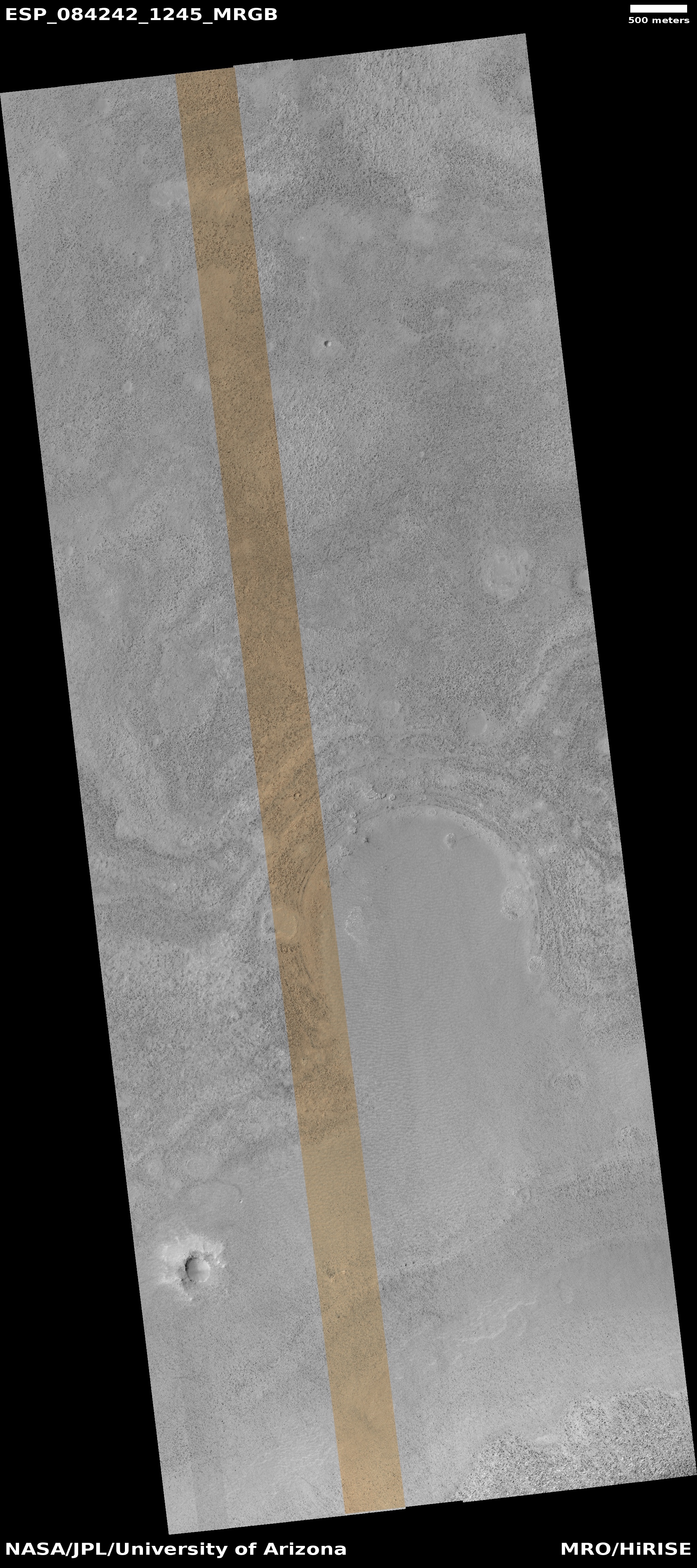
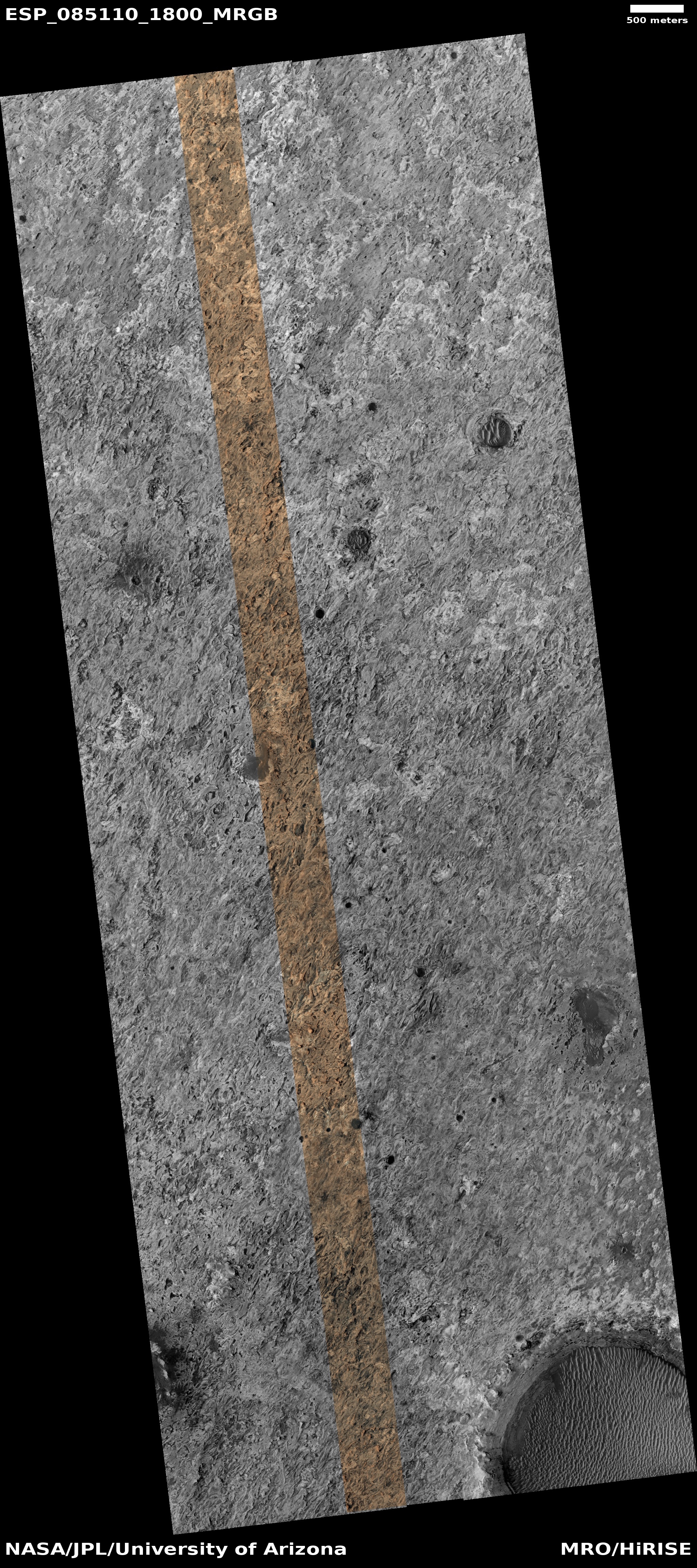
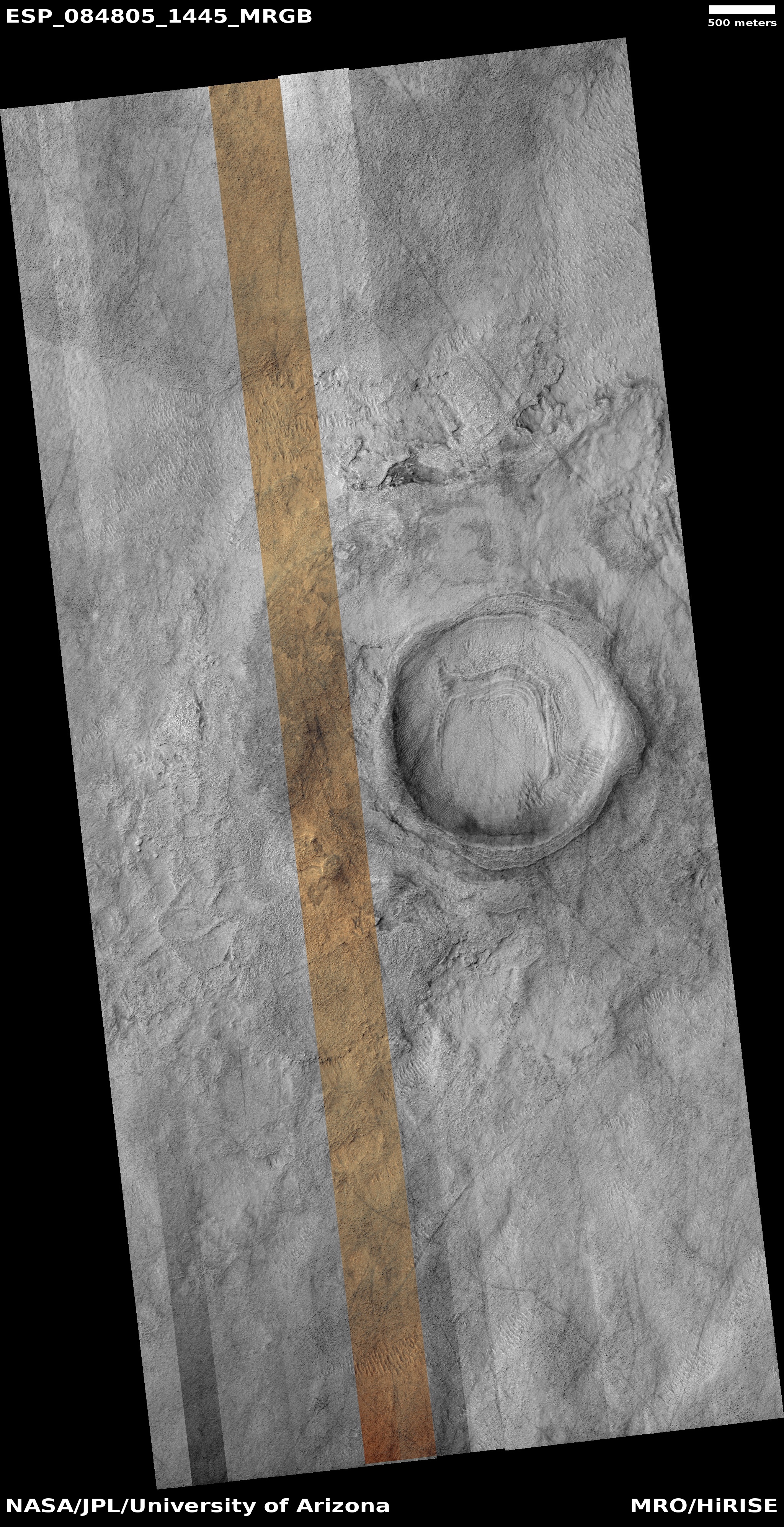
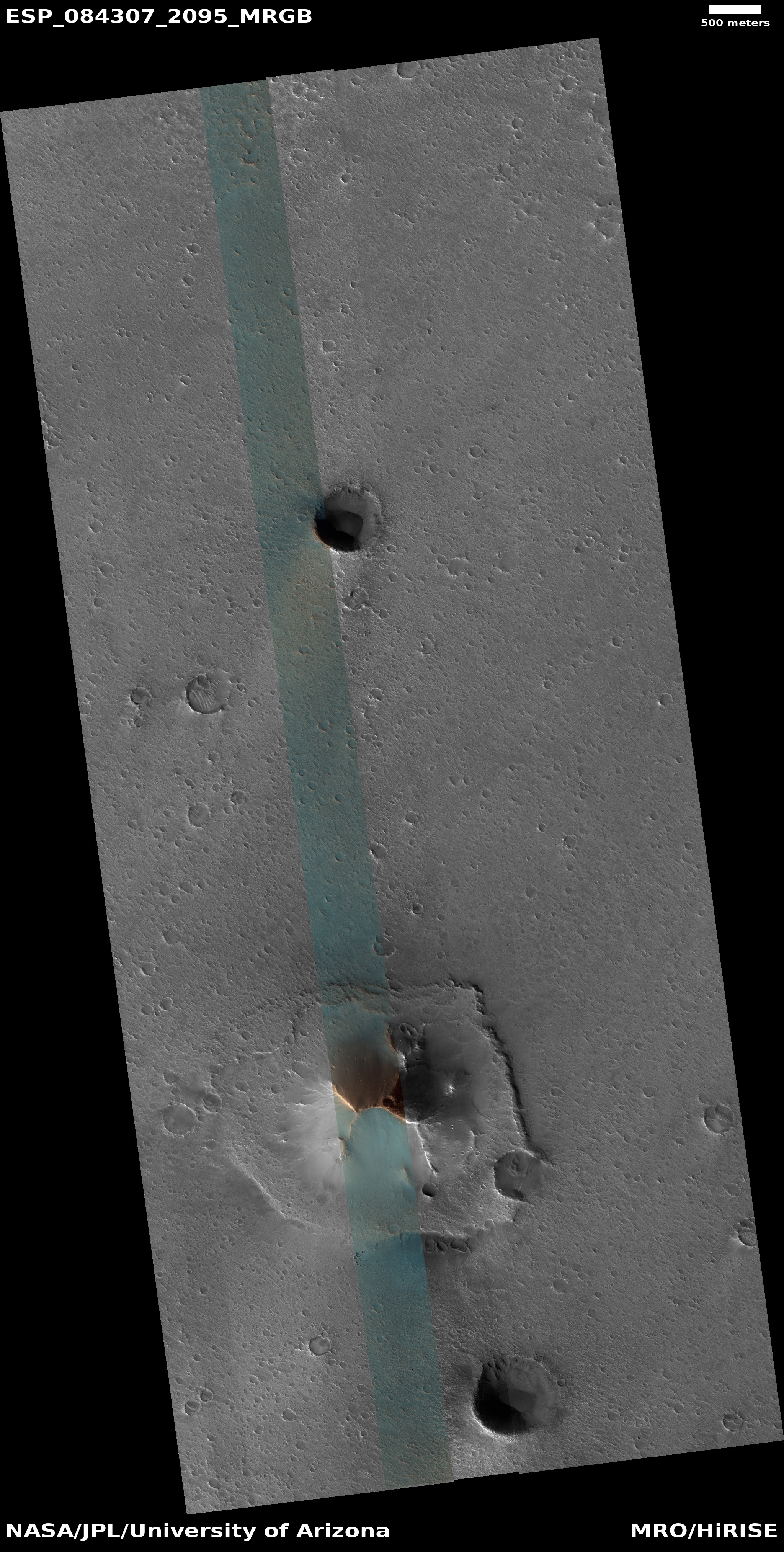
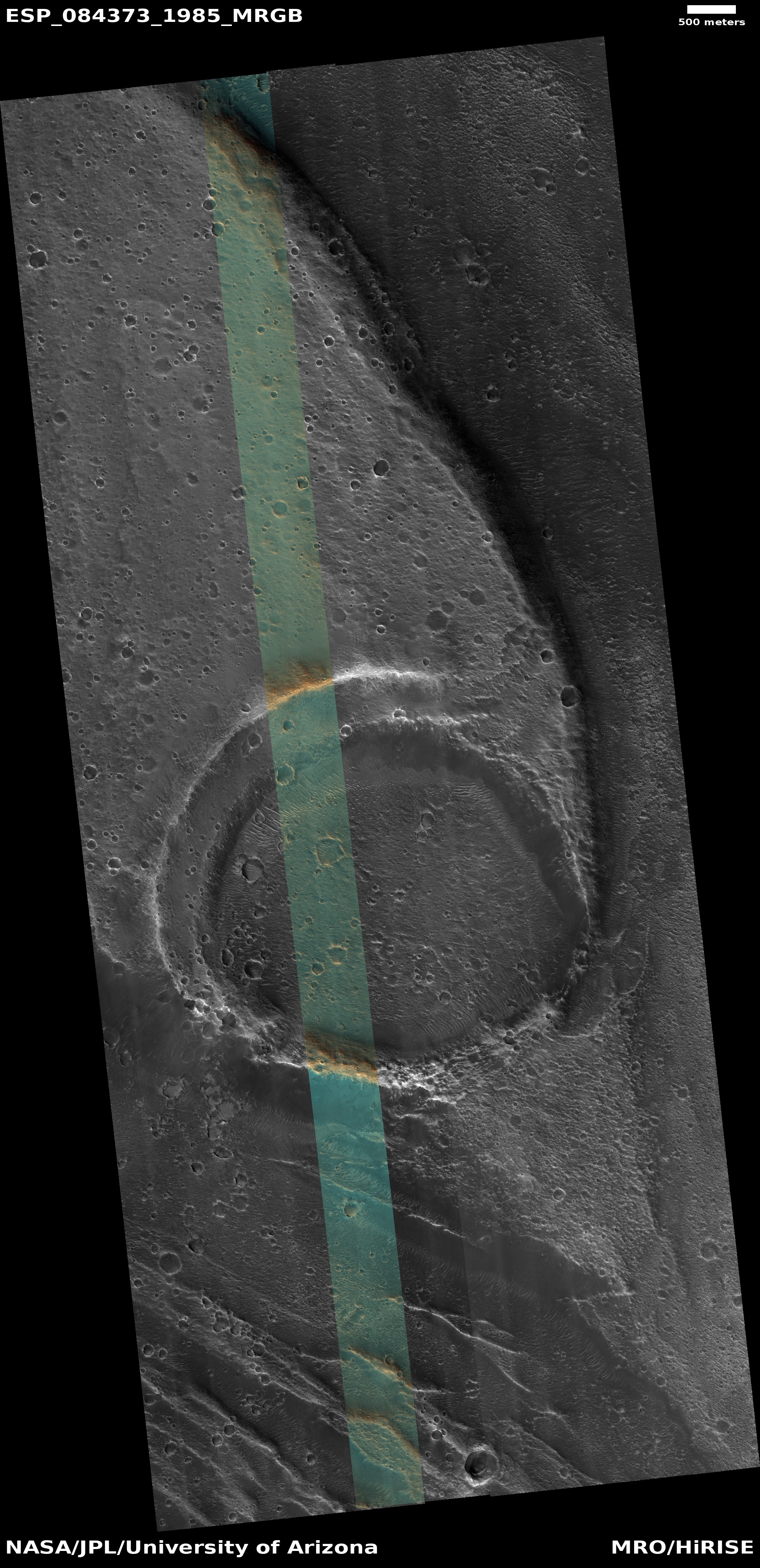
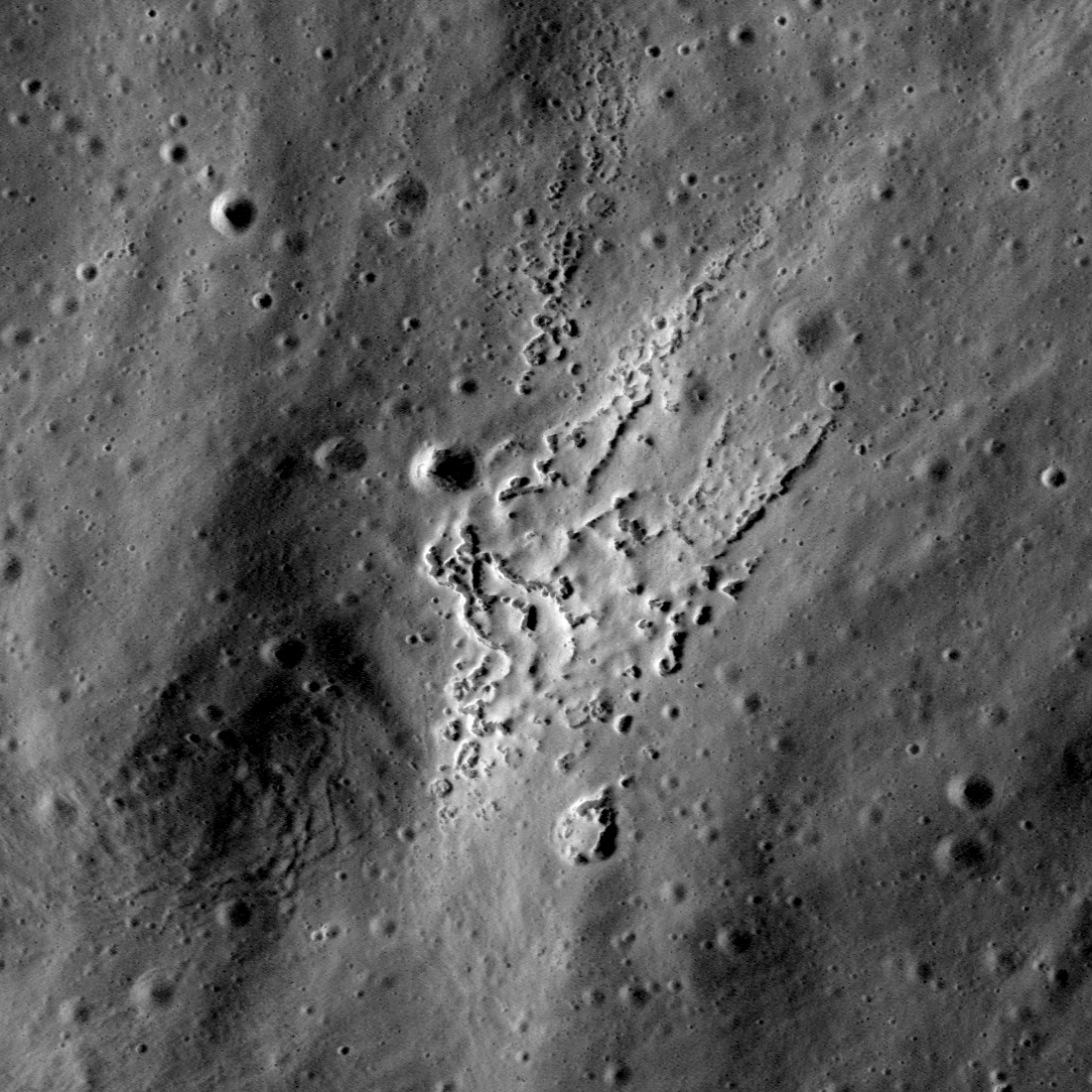
Cool image time! The picture to the right, cropped, reduced, and sharpened to post here, was taken on May 28, 2024 by the high resolution camera on Mars Reconnaissance Orbiter (MRO). Labeled merely as a “terrain sample,” it was likely snapped not as part of any specific research project but to fill a gap in the camera’s schedule so as to maintain its proper temperature.

The camera team tries to find interesting geology when they do this, and are frequently successful. In this case the image shows some truly alien Martian terrain at 77 degrees south latitude, about 475 miles from the south pole.

What are we looking at? I promise you it isn’t the iron filings found inside an Etch-A-Sketch drawing toy. My guess is that the base layer is the light areas, a mixture of ice and debris impregnated with dust and eroded into the unique Martian geological feature dubbed brain terrain. As for the dark lines and splotches, their explanation might lie in the time of year, the spring.
» Read more

First test images sent back by Hera asteroid probe

The Earth and Moon system as seen by Hera
Click for original image.

During its initial in-space commissioning to make sure everything is working properly after an October 7, 2024 launch, engineers have successfully taken the first test images by Hera asteroid probe, proving those instruments are operating as intended.

The picture to the right, cropped, reduced, and sharpened to post here, was taken by the spacecraft’s mid-infrared camera, and shows both the Earth (lower left) and the Moon (upper right) as seen from a little less than a million miles away. Once Hera reaches the binary asteroid system of Didymos and Dimorphos, this instrument will be used to measure the changes of temperature on the asteroids’ surface.

Images of Earth taken by two other instruments proved those instruments were functioning properly as well.

Hera is a European Space Agency (ESA) follow-up asteroid mission to see up close what changes were caused to Dimorphos by the impact of NASA’s Dart mission in 2022. It will rendezvous with the asteroid in late 2026 after flying past Mars and its moon Deimos in earlier that year. It will then spend about a half year flying in formation with the asteroids before a planned landing in late July 2027.

The pimpled floor of Isidis Basin on Mars

The pimpled floor of Isidis Basin on Mars
Click for original image.

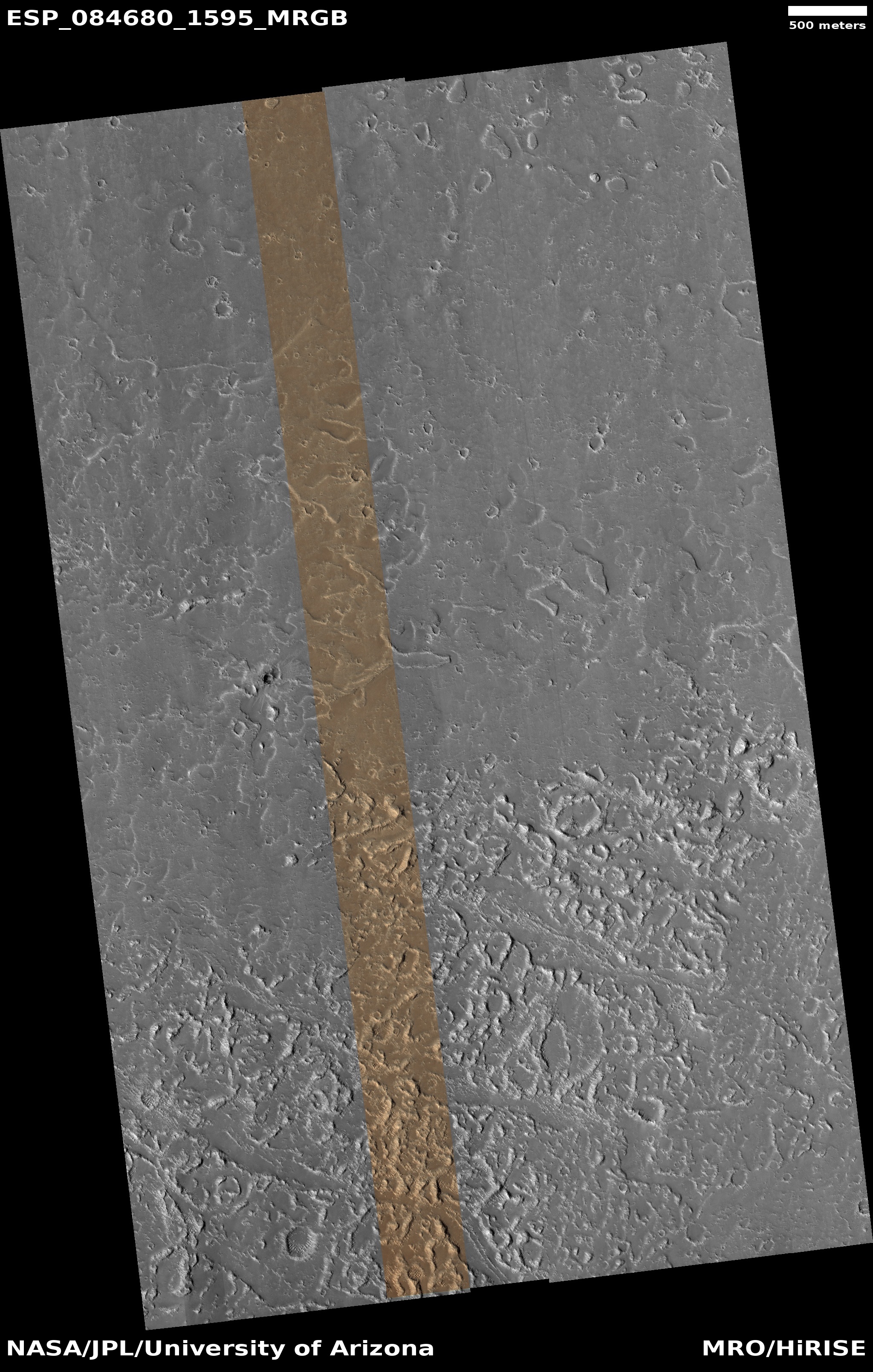
Cool image time! The picture to the right, cropped, reduced, and sharpened to post here, was taken on May 21, 2024 by the high resolution camera on Mars Reconnaissance Orbiter (MRO). Labeled merely as a “terrain sample,” it was likely taken not as part of any specific research project but chosen by the camera team to fill a gap in the camera’s schedule in order to maintain its proper temperature.

When they do this they try to pick a target that is somewhat interesting, though it is not always possible. In this case it appears they succeeded in capturing a location filled with lots of puzzling stuff, including low 60-to-80-foot-high mesas with either flat- or hollow-tops, shallow craters that appear almost buried, and other craters that appear so deep and shadowed that it is even possible these are skylights into underground caves.

In between these features the flat landscape has a scattering of ripple dunes, all oriented in the same direction and thus implying that the prevailing winds are or were blowing from the northeast to the southwest.
» Read more

Monitoring a changing spot on Mars

Monitoring a changing landscape on Mars
Click for original image.

Cool image time! The picture to the right, cropped, reduced, and sharpened to post here, was taken on July 18, 2024 by the high resolution camera on Mars Reconnaissance Orbiter (MRO). Based on its label, “Dark Filamentary Streak Year-Round Monitor Site in Promethei Terra,” it was apparently taken as part of a long-term project to monitor the changes that occur at this particular spot on Mars.

This monitoring began in 2008, not long after MRO began science operations. In that first image, taken in the Martian autumn, almost the entire terrain was covered with dust devil tracks, all running more-or-less parallel to each other in a northwest-to-southeast direction.

That unusual tiger-striped landscape prompted later monitoring. However, a follow-up photo in 2010, also in autumn, showed practically no dust tracks here at all. Another image, taken in 2011 during the Martian summer, showed new dust devil tracks, but instead of being aligned as in 2008, the tracks went in all directions, with only a hint of alignment to the southeast.
» Read more

Curiosity’s upcoming travel route

Curiosity's upcoming route
Click for original image.

Overview map
Click for interactive map.

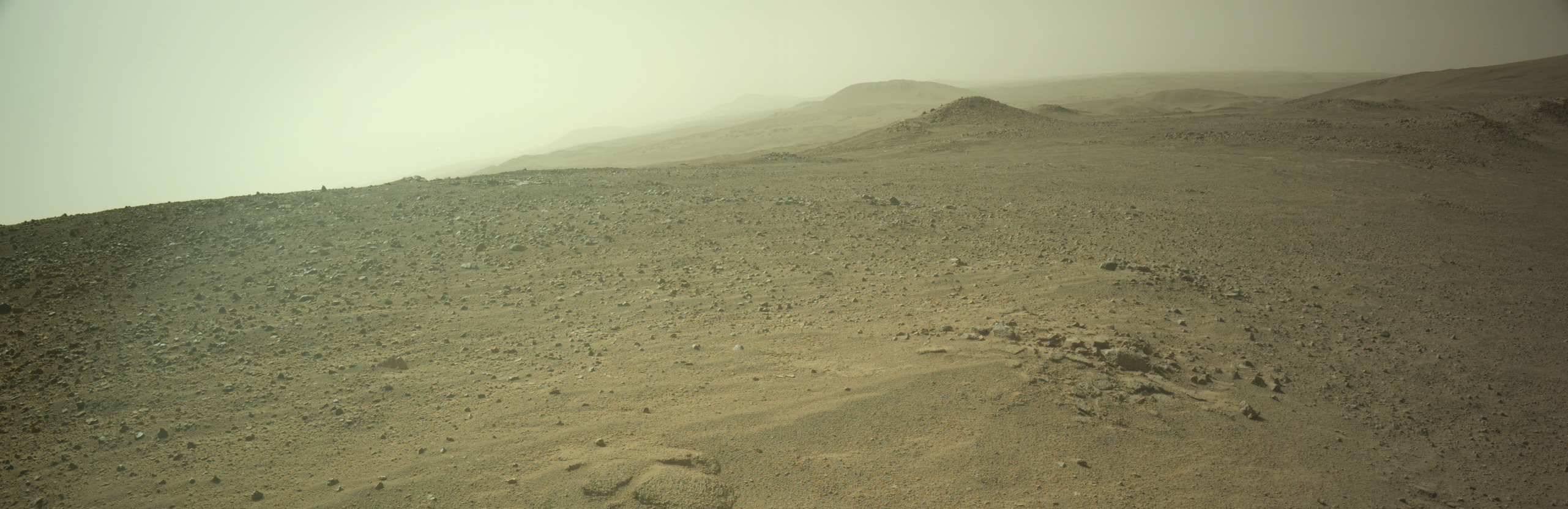
Cool image time! The panorama above, cropped and annotated to post here, was taken on October 6, 2024 by the right navigation camera on the Mars rover Curiosity. It looks south, down the slopes of Mount Sharp and across Gale Crater, the distant crater rim barely visible through the dusty air twenty to thirty miles away.

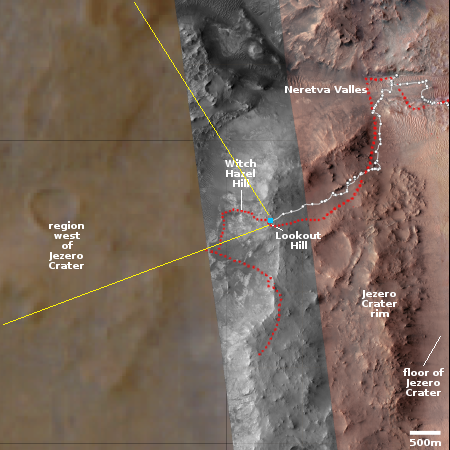
The overview map to the right provide the context. The blue dot marks Curiosity’s present position. The yellow lines the approximate area covered by the panorama. The red dotted line indicates the rover’s planned route, with the white dotted line the path it has recently traveled.

As you can see, the rover has moved up onto a higher terrace surrounding the Texoli butte, and will now travel downhill a bit to skirt around its northern nose. From there, the science team plans to send the rover westward, traversing along the contour lines on the side of Mount Sharp. Along the way it will lose more elevation, but eventually, after passing several parallel north-south trending canyons, it will finally turn south into one canyon to resume its climb up the mountain.

To review the rover’s journey, Curiosity during its dozen years on Mars has traveled just over 20 miles and climbed about 2,500 feet. The peak of Mount Sharp however is still about 26 miles away and about 16,000 feet higher. Getting there will probably take at least three more decades, which is possible since the rover uses a nuclear power source similar to that used by the two Voyager interplanetary probes, now functioning in space for almost a half century.

In fact, it would not surprise me if the first human Mars colonies are established while Curiosity is still working, and that in its later years it sends its data to that colony directly (via an orbiting relay satellite), rather than beaming it back to Earth.

Scientists: both liquid water and ice shaped Gale Crater

The uncertainty of science: Using isotope data from instruments on the Mars rover Curiosity, scientists have found evidence that suggests that both liquid water as well as glacial ice helped shape the present geology in Gale Crater.

The paper proposes two formation mechanisms for carbonates found at Gale. In the first scenario, carbonates are formed through a series of wet-dry cycles within Gale crater [involving intermittent liquid water]. In the second, carbonates are formed in very salty water under cold, ice-forming (cryogenic) conditions in Gale crater [involving glacial ice].

“These formation mechanisms represent two different climate regimes that may present different habitability scenarios,” said Jennifer Stern of NASA Goddard, a co-author of the paper. “Wet-dry cycling would indicate alternation between more-habitable and less-habitable environments, while cryogenic temperatures in the mid-latitudes of Mars would indicate a less-habitable environment where most water is locked up in ice and not available for chemistry or biology, and what is there is extremely salty and unpleasant for life.”

…The heavy isotope values in the Martian carbonates are significantly higher than what’s seen on Earth for carbonate minerals and are the heaviest carbon and oxygen isotope values recorded for any Mars materials. In fact, according to the team, both the wet-dry and the cold-salty climates are required to form carbonates that are so enriched in heavy carbon and oxygen.

What I glean from this report is that the evidence that ice played the dominant role continues to build, but since it counters the liquid water theories that scientists have favored for decades they are reluctant to shift entirely to it. It also suggests the geological processes on Mars were far more complex than proposed (no surprise!), and that some mixture of both processes was likely.

This paper is of course merely a newly proposed hypothesis, and therefore its conclusions should be considered only with great skepticism.

Frozen Martian eddies at the confluence of two glacier rivers

Frozen eddies at the confluence of two glacial rivers
Click for original image.

Cool image time! The picture to the right, rotated, cropped, reduced, and sharpened to post here, was taken on July 3, 2024 by the high resolution camera on Mars Reconnaissance Orbiter (MRO).

The science team labels the photo as capturing a “contact near Reull Vallis,” a 1,000-mile-long Martian canyon that flows down the eastern slopes of Hellas Basin, the death valley of Mars.

What I see isn’t a geological contact but a complex jumble of odd-shaped depressions and mesas, surrounded by an eroded surface that seems squashed and deformed by some process. If this is all we had to go on, I would simply label this as another “What the heck?” image on Mars and move on. However, the larger context of the overview map helps explain it all, at least as best as we can explain using orbital data.
» Read more

Water on the Moon? New data analysis from two different lunar orbiters say yes

Two papers in the past month using data from two different lunar orbiters have claimed the presence of water on Moon, based on the detection of evidence of hydrogen on the surface.

First, on September 16, 2024 scientists published a paper [pdf] that analyzed data collected in 2009 by India’s Chandrayaan-1 lunar orbiter, and concluded, as stated enthusiastically in the press release:

Map of permanently shadowed regions at the Moon's south pole
From the second paper, a map of permanently shadowed
regions at the Moon’s south pole. Click for original.

“Future astronauts may be able to find water even near the equator by exploiting these water-rich areas. Previously, it was thought that only the polar region, and in particular, the deeply shadowed craters at the poles were where water could be found in abundance,” said Roger Clark, Senior Scientist at the Planetary Science Institute and lead author of “The Global Distribution of Water and Hydroxyl on the Moon as Seen by the Moon Mineralogy Mapper (M3)” that appears in the Planetary Science Journal. “Knowing where water is located not only helps to understand lunar geologic history, but also where astronauts may find water in the future.”

Then today NASA announced the publication of a new paper [pdf] that looked at the data collected over the last decade by Lunar Reconnaissance Orbiter (LRO), and have concluded that “hydrogen-bearing volatiles are observed to be concentrated, likely in the form of water ice, within most of the Moon’s permanently shadowed regions (PSRs), poleward of 77°.” The press release, which included the map to the right of permanently shadowed areas at the Moon’s south pole, was more enthusiastic:
» Read more

The strange terrain of the Martian southern ice cap

The strange terrain of Mars' south pole
Click for original image.

Cool image time! The picture to the right, rotated, cropped, and sharpened to post here, was taken on July 29, 2024 by the high resolution camera on Mars Reconnaissance Orbiter (MRO). It shows a section at the Martian south pole at the very high latitude of 87 degrees south, only about 100 miles from the pole itself.

The label for this picture is “possible water ice and mesas,” suggesting we are looking at an ice cap of water that is partly sublimated away.

In truth, things are much more complicated. It was summer when this photo was taken. Note the drainage in the lower right and the dark spidery lines there. In the winter on Mars atmospheric carbon dioxide falls as snow and coats the poles to about 60 degrees latitude with a thin mantle of dry ice. In the spring this mantle sublimates away, but does so in an counter-intuitive manner. The sublimation first occurs at the mantle’s base, and the trapped gas flows up until it finds a weak spot in the mantle and cracks through, spewing out and deposting dark splotches of dust.

At the south pole this upward flow always follows the same paths, producing the dark spidery patterns we see here. In the case of the drainage in the lower right, this is a drainage of gas eastward until it pops out at the slope, causing that depression to become darkly stained.

This is only part of the story of this complex geology, however.
» Read more

Scientists detect jets of carbon dioxide and carbon monoxide from asteroid

Jets from asteroid
Click for original graphic.

Using the spectroscopy from the Webb Space Telescope, scientists have now detected jets of carbon dioxide and carbon monoxide spewing from the very active asteroid 29P/Schwassmann-Wachmann-1 (29P).

Based on the data gathered by Webb, the team created a 3D model of the jets to understand their orientation and origin. They found through their modeling efforts that the jets were emitted from different regions on the centaur’s nucleus, even though the nucleus itself cannot be resolved by Webb. The jets’ angles suggest the possibility that the nucleus may be an aggregate of distinct objects with different compositions; however, other scenarios can’t yet be excluded.

The graphic to the right illustrates the modeling of these jets. That the center of this two-lobed asteroid could have been created from distinct objects suggests a very complex formation process, since those objects would have had to have formed themselves in different locations in the solar system and then somehow come together.

Perseverance looks uphill

Perseverance looks uphill
Click for full resolution. The original images can be found here and here.

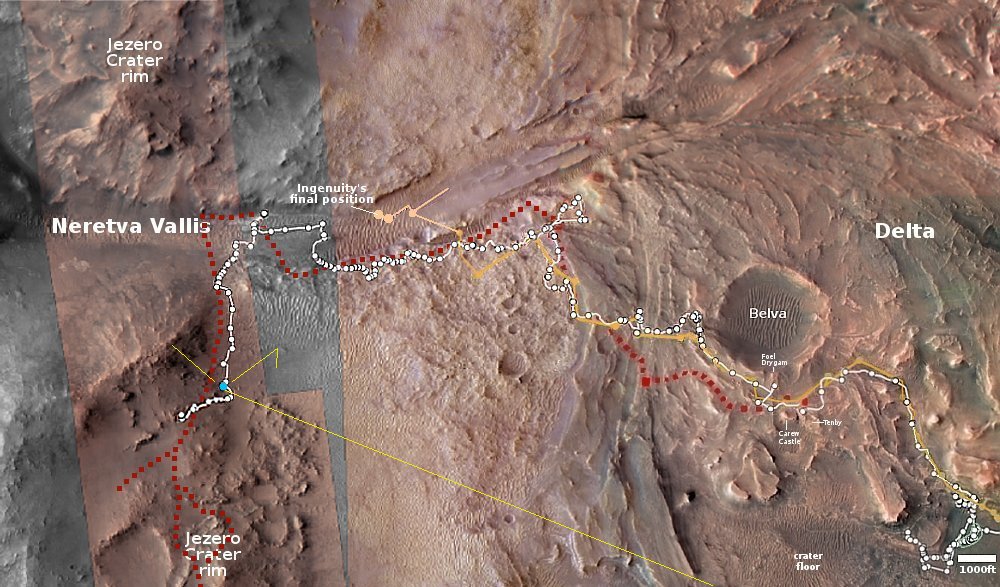
Cool image time! The panorama above was created by me from two pictures taken today by the left navigation camera on the Mars rover Perseverance (found here and here). The haziness in the air is the left over from a local dust storm in Jezero Crater during the past month.

On the overview map below, the blue dot marks Perseverance’s present position, with the red dotted line indicating the approximate planned route of the rover uphill. The yellow lines are my guess as to the area covered by the panorama above. That guess could be wrong, as not all the features in the picture match the overview map. The view could be much closer, with the hill and ridgeline nothing more than the small outcrops close to the rover.

Nonetheless, these navigation pictures show us the kind of terrain the rover will be climbing as it works its way up the rim of Jezero Crater. The ground is relative smooth, though steep. My guess is that this is about a 25% grade, which on Earth would be a problem but on Mars it is a grade that NASA’s other rover, Curiosity, has routinely traversed. Perseverance has not yet traveled this kind of steepness, but there is no reason to expect it to have any difficulties doing so.

Overview map
Click for interactive map.

Curiosity spots a corroded weathered rock

a weathered and corroded rock
Click for original image.

Cool image time! The picture to the right, cropped, reduced, and sharpened to post here, was taken on September 29, 2024 by the close-up camera mounted at the end of the robot arm of the rover Curiosity on Mars.

This is a small rock, less than three inches across. It is embedded in the sand and soil of Mars, its surface clearly weathered and smoothed by some process. The holes and gaps in the rock could have occurred prior to that smoothing, getting exposed by it. Or possibly the holes developed during the smoothing, with sections breaking off because the material was like sandstone, easily friable.

What caused the smoothing? The data from Curiosity as it climbs Mount Sharp suggests some water process, either flowing water or glacial ice. The scientists at present tend to prefer the liquid explanation, but that requires the Martian atmosphere to have once been much thicker and warmer, conditions that no model has yet demonstrated convincingly was ever possible.

The rock is also likely another example of sulfur, part of the sulfate-bearing unit of geology that Curiosity is presently traversing.

Crazy swirling Martian landscape

Crazy swirling Martian landscape
Click for original image.

Cool image time! The picture to the right, cropped, reduced, sharpened, and annotated to post here, was taken on July 1, 2024 by the high resolution camera on Mars Reconnaissance Orbiter (MRO).

The science team labels this “Contacts between Likely Sulfates and Chaos Blocks.” That contact I have indicated with the dotted line. To the west the lighter terrain is likely the sulfate-bearing unit, similar to the sulfate-bearing unit that Curiosity has been traversing on Mount Sharp for the past year or so.

To the east are the chaos blocks, but I think that description is wholly inadequate. In truth, I haven’t the faintest idea how this terrain got to be the way it is. It is evident that a lot of dust and sand has gotten trapped in the hollows, leaving behind ripple dunes in some places, but why the higher ridges swirl and curve about as they do is utterly baffling.
» Read more

Monitoring gullies on Mars for changes

Overview map

Monitoring gullies on Mars
Click for original image.

Cool image time! The picture to the right, cropped, reduced, and enhanced to post here, was taken on June 29, 2024 by the high resolution camera on Mars Reconnaissance Orbiter (MRO). The scientists label the picture simply as “gully monitoring,” with an apparent goal of looking to see if this gully has changed since MRO took the first high resolution image two years previously. In the interim this terrain went from Martian spring, through summer and winter, and has now returned to spring.

As far as I can tell, no changes are visible, but then I am not using the highest resolution data available. Small changes might be detectable in the highest resolution using good detection software. Overall, the gully drops about 3,000 feet.

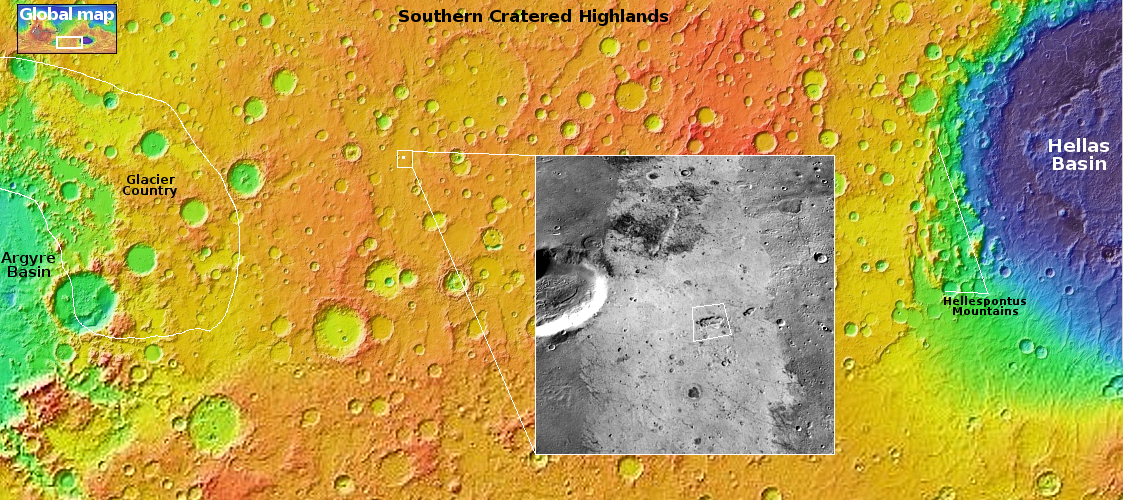
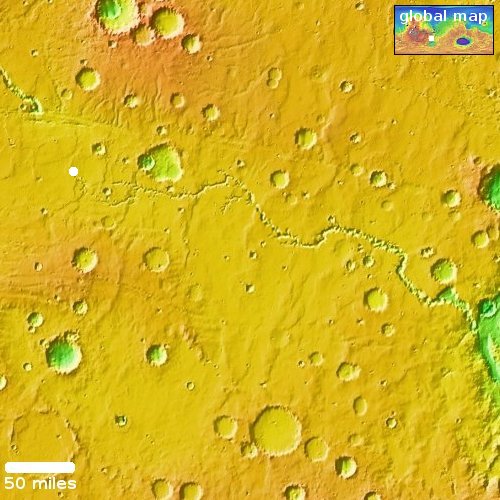
The white dot in the overview map above marks the location, on the southwest interior rim of an unnamed 30-mile wide crater. This region in the Martian cratered highlands was featured in a four part cool image series I did back 2023 (here, here, here, and here), with this as my conclusion:

Overall, our short survey of the southern cratered highlands suggests that the glacial material and ice found in the southern mid-latitudes affects the Martian surface differently than in the northern lowland plains. In the north the craters and the surrounding terrain often appear blobby, as if the ice is close to the surface and also a dominant component of the ground. Impacts therefore cause significant soft melt features, with craters often heavily distorted. Similarly, there is evidence of the existence of past mud volcanoes that once spewed water and mud from below ground.

In the south however the surface is at a higher elevation, and it appears the ice layer is deeper underground. Thus, it appears the ground is more firm, and the only obvious evidence of an underground layer of ice is revealed when sublimation and the subsequent erosion produce these large pits inside craters.

In the case of this crater, a small impact on its interior southwest slope apparently caused that underground layer of ice to melt temporarily and flow downhill, leaving behind the gully and flow features we see today. Based on the two MRO pictures taken a full Martian year apart, it appears the feature is generally stable and thus likely old, left over from that impact. If things are changing seasonally they are doing so in small amounts and slowly.

A puzzling striped rock on Mars

A striped rock on Mars
Click for original image.

Cool image time! The picture to the right, cropped, reduced, and sharpened to post here, was taken on September 13, 2024 by one of the high resolution cameras on the Mars rover Perseverance. The rock’s striped nature makes it unique, unlike any feature spotted by any rover previously. From an update today:

The science team thinks that this rock has a texture unlike any seen in Jezero Crater before, and perhaps all of Mars. Our knowledge of its chemical composition is limited, but early interpretations are that igneous and/or metamorphic processes could have created its stripes. Since Freya Castle [the name the science team gave the rock] is a loose stone that is clearly different from the underlying bedrock, it has likely arrived here from someplace else, perhaps having rolled downhill from a source higher up. This possibility has us excited, and we hope that as we continue to drive uphill, Perseverance will encounter an outcrop of this new rock type so that more detailed measurements can be acquired.

Without doubt the rock’s rounded surface suggests it was ground smooth by either water or ice. That surface certainly resembles glacial cobble seen across the northeast of the U.S. where ice glaciers once covered the entire landscape. The rock also resembles river cobble, smoothed by flowing water.

The stripes however suggest that prior to its being smoothed, this rock underwent a much more complex geological process, whereby two different materials were intermixed and squeezed together.

Layered mesas in Martian chaos

Layered mesas in Martian chaos
Click for original image.

Cool image time! The picture to the right, rotated, cropped, reduced, and sharpened to post here, was taken on May 19, 2024 by the high resolution camera on Mars Reconnaissance Orbiter (MRO). It shows a 2,500 to 3,000-foot-high mesa with what the scientists call “bedrock layers”, most obvious as the lower terraces on the mesa’s western slopes.

What makes this mesa especially interesting is its overall shape. It appears as if something has taken a bite out of it, resulting in that bowl-like hollow on the mesa’s southern half.

Was this caused by an impact? Or has some other long term Martian processes caused it?

This mesa is just one of many mesas in a region of chaos terrain dubbed Hydraotes Chaos. Such chaos terrain is thought to form when erosion processes, possibly glacial in nature, that carve out canyons along faultlines, leaving behind mesas with randomly oriented canyons cutting in many directions.
» Read more

More deterioration to Curiosity’s worst wheel

Comparison of changing damage from Feb to Sept 2024
For original images go here, here, and here.

The science team for the Curiosity Mars rover on September 22, 2024 did another survey of its damaged wheels using the close-up camera on the end of the rover’s arm, and though most of the pictures appear to show the situation remains stable, the one wheel that has consistently shown the worst damage now shows some additional deterioration since February 2024.

To the right are comparison pictures, with the February 2024 picture on top and two new September 22, 2024 images showing the same damaged area, though from a different angle, on the bottom. (The technical captions for the bottom images can be found here and here.) I have labeled the treads, dubbed growsers, to make it easier to understand how the pictures all line up.

Previous images have looked down at the large damaged area from growsers 1 to 4, and since it was first spotted in 2022 showed it to be growing, but very slowly. The new pictures show that same damaged area from the side, which reveals that the zig-zag divider between growser #3 and growser #4 has now collapsed, so that this whole damaged area is now a major depression, as indicated by the two arrows.

Overall, the rover’s wheels appear to surviving the rough terrain of the foothills of Mount Sharp, though it is clear that care must continue to be taken to extend their life for as long as possible. That the rover has six wheels gives it a lot of redundancy, so that even if this one wheel eventually fails the rover will likely be able to continue to rove, but with some limitations. This wheel is the left middle wheel, which is helpful, as it is less necessary than the four corner wheels. [Update: According to a rover update today, this wheel is the right middle wheel, which contradicts an earlier report which described this as the left middle wheel. I note this contradiction for accuracy.]

Land of cracks

Land of cracks

Cool image time! The picture to the right, cropped to post here, was taken on June 28, 2024 by the high resolution camera on Mars Reconnaissance Orbiter (MRO). Labeled a “terrain sample,” it was likely taken not as part of any specific research project but to fill a gap in the camera’s schedule in order to maintain its proper temperature. When the camera team needs to do this, they try to pick something interesting, but don’t always have that option.

In this case, the landscape available included the channel shown to the right. About a half mile wide and only about fifty feet deep, the floor of this canyon appears to have a lot of trapped dust, forming ripple dunes, along with a lot of knobby protrusions, likely small mesas. The canyon walls appear layered, with the erosion processes producing different features on opposite sides. On the southeast the layers appear to produce distinct terraces, while on the northwest the cliff is very steep at the top and then forms a long gently descending slope that appears formed of alluvial fill (from that cliff) and formed from erosion and landslides.
» Read more

Some new “What the heck?” geology on Mars

What the heck is going on here?
Click for original image.

Cool image time! The picture to the right, rotated, cropped, reduced, and enhanced to post here, was taken on April 21, 2024 by the high resolution camera on Mars Reconnaissance Orbiter (MRO).

My first reaction on seeing this picture was to scratch my head? What am I looking at? Are those fluted dark features going downhill to the south, or uphill to the north? What are they? Are they slope streaks? Avalanches? How do they relate to the flat-topped ground in the middle of the picture?

I have made it easier for my readers to interpret the picture by adding the “low” and “high” markers. We are looking at two parallel thin mesas about 1,400 feet high, with the saddle between them only dropping about 350 feet.

But what about the dark fluted features? To understand what these are requires more information.
» Read more

Perservance looks back from on high

Perservance's view looking back down Neretva Vallis
Click for original image.

Cool image time! The picture above, cropped to post here, was taken on September 9, 2024 by the left navigation camera on the Mars rover Perseverance, looking east and back along the route from which the rover had come.

The view is somewhat more spectacular than most Perseverance images because the rover took it during its on-going climb up unto the rim of Jezero Crater, as shown by the overview map below. The blue dot marks Perseverance’s present position, while the yellow lines indicate the area covered by the picture above, taken several days earlier.

The haze in the picture also suggests that the local dust storm first noted in late August might be clearing somewhat. This isn’t certain, however, as the previous picture was using the rover’s high resolution camera to look at distant hills (thus more obscured), while the picture above was taken by the left navigation camera looking more widely and at nearer objects.

Overview map
Click for interactive map.

New gravity map of Mars released

New global map of Mars gravity field
Click for original image.
Using both seismological data compiled over four years by the InSight Mars lander as well tiny changes in the orbits of Martian satellites, scientists have now created a global gravity map of the red planet, indicating the regions below the surface that are either low or high density.

That map is above, annotated by me to indicate some of Mars’ major surface features.

The density map shows that the northern polar features are approximately 300-400 kg/m3 denser than their surroundings. However, the study also revealed new insights into the structures underlying the huge volcanic region of Tharsis Rise, which includes the colossal volcano, Olympus Mons.

Although volcanoes are very dense, the Tharsis area is much higher than the average surface of Mars, and is ringed by a region of comparatively weak gravity. This gravity anomaly is hard to explain by looking at differences in the martian crust and upper mantle alone. The study by Dr Root and his team suggests that a light mass around 1750 kilometres across and at a depth of 1100 kilometres is giving the entire Tharsis region a boost upwards. This could be explained by huge plume of lava, deep within the martian interior, travelling up towards the surface.

I once again note that the largest impact basin on Mars, Hellas Basin, sits almost exactly on the planet’s far side from Tharsis, and appears to have a light density. This contrast once again makes me wonder if the origin of that impact and the Tharsis Bulge are linked.

A fluted mesa on Mars

A fluted mesa on Mars
Click for original image.

Cool image time! The picture to the right, cropped, reduced, and sharpened to post here, was taken on July 9, 2024 by the high resolution camera on Mars Reconnaissance Orbiter (MRO). It shows what the science team labels a “silica-rich mound”, as indicated by the bright streaks on all the high ridge points.

The flat-topped mesa on the right drops about 200 feet to the valley floor. The rims of that depression to the west rise about 50+ feet higher, while mesa nose in the upper left rising another 50+ feet more.

Was the depression caused by an impact? If so, the landscape has changed radically since that impact occurred, with most of the surrounding terrain eroded away. The two flat-topped mesas hint at the ancient surface when that impact occurred.

A wider view however raises questions about this impact theory.
» Read more

Scientists re-create on Earth the sublimation of Mars’s winter mantle of dry ice

Spiders created on Earth
Click for original image.

Scientists have successfully re-created on Earth the process on Mars that creates the unique “spider” formations seen in the the Martian south pole region, produced when the winter mantle of dry ice begins to sublimate away into a gas.

The study confirms several formation processes described by what’s called the Kieffer model: Sunlight heats the soil when it shines through transparent slabs of carbon dioxide ice that built up on the Martian surface each winter. Being darker than the ice above it, the soil absorbs the heat and causes the ice closest to it to turn directly into carbon dioxide gas — without turning to liquid first — in a process called sublimation (the same process that sends clouds of “smoke” billowing up from dry ice). As the gas builds in pressure, the Martian ice cracks, allowing the gas to escape. As it seeps upward, the gas takes with it a stream of dark dust and sand from the soil that lands on the surface of the ice.

At the south pole, the ground below the mantle is stable enough that each winter the trapped CO2 gas follows the same path to the same points where the dry ice cracks, slowly creating “tributaries” that combine to form the spider formations.

The picture to the right, cropped, reduced, and sharpened to post here, comes from figure 9 of the paper [pdf]. It shows the lab-created spiders formed by this simulated process, thereby confirming this hypothesis about how the spiders form.

A map of Io’s hot spots based on Juno data

The hot spots on Io
Click for original image.

The uncertainty of science: Using the JIRAM infrared camera on the Jupiter orbiter Juno, scientists have now created a global map of volcanic activity, showing where it appears the hottest and greatest activity is located.

That data is illustrated by the graphic to the right, taken from figure 1 of the paper. The top row shows the coverage of the planet, with Io’s southern hemisphere getting the fewest observations. The bottom row shows the observed regions with the greatest heat. This quote from the abstract is most revealing:

Using JIRAM, we have mapped where volcanoes are producing the most power and compared that to where we expect higher heat flow from the interior models. Our map doesn’t agree with any of these models very well. JIRAM observed more volcanic activity at the poles than we expected to see based on previous observations. However, since the south pole was only observed twice, it’s possible that these observations don’t represent the average volcanic activity of the south pole. Very bright volcanoes that may have been continuously active for decades were also imaged during these Juno fly-bys, some of which are nearer the poles than the equator.

The conflict between the data and the theories could very well be explained simply by the short term nature of these observations. The models could very well be right, over centuries. For example, the new volcano discovered by Juno is near the equator, suggesting with time those models will turn out to be correct.

Or not. A lot more observations will have to be made of Io before any model of its volcanic activity can be considered trustworthy.

Juno discovers new volcano on Io

New volcano on Io
Click for original image.

By comparing images taken twenty-seven years apart by the the Jupiter orbiters Galileo and Juno, scientists have discovered that during that time a new volcano appeared on the volcano-strewn Jupiter moon Io.

The two pictures to the right show the surface change on Io during those 27 years.

Analysis of the first close-up images of Io in over 25 years, captured by the JunoCam instrument on NASA’s Juno mission, reveal the emergence of a fresh volcano with multiple lava flows and volcanic deposits covering an area about 180 kilometres by 180 kilometres. The findings have been presented at the Europlanet Science Congress (EPSC) in Berlin this week.

The new volcano is located just south of Io’s equator. Although Io is covered with active volcanoes, images taken during NASA’s Galileo mission in 1997 did not see a volcano is in this particular region – just a featureless surface.

If anything, it has been somewhat surprising how little change the new Juno images have found on Io’s surface, considering its intensely active volcanic geology, with volcano plumes from eruptions captured in images repeatedly. Some volcanoes have shown change, but new features such as this new volcano have not previously been identified.

At the same time, the amount of high resolution imagery of the planet’s surface has been somewhat limited. Galileo sent back far fewer pictures than planned because its main antenna never deployed, and Juno had only a handful of close fly-bys. It will take a mission dedicated to studying Io to better map its violent surface.

The reasons why Mars two polar caps are so different

The Martian north pole
The Martian north pole.

The Martian south pole
The Martian south pole.

Elevation scale bar
What the colors mean in terms of elevation

A new paper, in review for the past year, has now been published describing the differences between the north and south poles of Mars, the most fundamental of which involve the planet’s orbit and the different elevations of the two poles, with the south pole three to six miles higher in altitude (as indicated by the colors on the maps to the right).

The cumulative data has allowed the researchers to explain why — when the thin winter cap of dry ice sublimates away in the spring — the process at the south pole results in spiderlike features that get enhanced from year to year, but in the north pole that sublimation process produces no such permanent features.

In both cases, the spring sunlight passes through the clear winter mantle of dry ice to heat its base. The sublimated trapped CO2 gas builds up, until the pressure causes the mantle to crack at weak spots. In the south that trapped gas flows uphill each spring along the same paths, carving the riverlike tributaries dubbed unofficially as “spiders” and officially as “araneiform terrain.”

Geophysicist Hugh Kieffer described that process in 2006. A few years later, [Candice] Hansen [the new paper’s lead author] followed up with her own model for the north polar cap, which also displays fans in the spring.

She found that the same phenomena occur in the north, but rather than relatively flat terrain, these processes play out across sand dunes. “When the Sun comes up and begins to sublimate the bottom of the ice layer, there are three weak spots – one at the crest of the dune, one at the bottom of the dune where it meets the surface and then the ice itself can crack along the slope,” Hansen said. “No araneiform terrain has been detected in the north because although shallow furrows develop, the wind smooths the sand on the dunes.”

There is also a lot more dust in the north, including a giant sea of dunes that circles the polar cap. In addition, the northern winter is shorter due to the planet’s orbit, and takes place during the annual dust storm season, causing there to be more dust concentrated within the northern ice. All of these factors make the the dunes and general surface in the north is more easily smoothed by the wind.

A crack on Mars more than 600 miles long

A crack on Mars more than 600 miles long
Click for original image.

Cool image time! The picture to the right, cropped and reduced to post here, was taken on March 29, 2024 by the high resolution camera on Mars Reconnaissance Orbiter (MRO).

The science team labels this “troughs in Labeatis Fossae.” On Mars, the word “fossae” is used to indicate regions where there are a lot of parallel fissures. Though there are a few examples where such fissures might have been caused by the movement of ice or water, carving out the channel, in almost all cases this is not the cause. Instead, fossae are usually formed when the surface stretches, either because underground upward pressure pulls it apart, or because there is a sideways spread at the surface. The resulting cracks are generally considered what geologists call “grabens,” depressions caused at faultlines when the ground on either side moves apart in some manner.

In this case the break in the trough proves this is a graben, though why it broke at this spot is not clear.
» Read more

Dust storm in Jezero Crater

Overview map
Click for interactive map.

Dust storm in Jezero Crater
Click for original image.

An update today from the science team for the Mars rover Perseverance included the picture to the right, cropped, reduced, and sharpened to post here and taken by the rover on August 20, 2024. As the update noted,

It is dust-storm season on Mars! Over the past couple of weeks, as we have been ascending the Jezero Crater rim, our science team has been monitoring rising amounts of dust in the atmosphere. This is expected: Dust activity is typically highest around this time of the Martian year (early Spring in the northern hemisphere). The increased dust has made our views back toward the crater hazier than usual, and provided our atmospheric scientists with a great opportunity to study the way that dust storms form, develop, and spread around the planet.

The yellow lines on the overview map above indicate the approximate direction of the photo. The blue dot marks Perseverance’s present position, with the red dotted line its planned route and the white dotted line its actual travels.

At the moment this dust storm is localized to the region around Jezero Crater, and based on past seasonal dust storms, is not expected to expand to a global storm.

Curiosity takes another look south into Gediz Vallis

Looking south inside Gediz Vallis

Overview map
Click for interactive map.

Cool image time! As it has been more than a month since I lasted posted a cool landscape image from the Mars rover Curiosity, it seemed time to upload the panorama above, changed not at all to post here and taken by the rover’s right navigation camera on September 4, 2024.

The blue dot on the overview map to the right marks Curiosity’s present position. The yellow lines indicate the approximate direction of the panorama’s view. The red dotted line indicates Curiosity’s planned route, with the white dotted line marking its actual path. After spending most of the last month on a drilling campaign at the southernmost point of its travels, the science team had Curiosity retreat northward, where it will eventually head uphill to the west to swing around that mountain to head south in a parallel canyon.

The panorama looks into the slot canyon Gediz Vallis that Curiosity has been exploring for a little more than a year. The light colored mountains are what the scientists call the sulfate-bearing unit, a region on the higher slopes of Mount Sharp that is likely to have a very alien geology and chemistry, when compared to what is seen on Earth. Mount Sharp itself is beyond these peaks, not visible because it is about 26 miles away and blocked by these lower mountains.

Since landing on Mars a dozen years ago, the rover has traveled 20 miles and climbed about 2,500 feet. Getting to the top of Mount Sharp will therefore probably take more than one or two decades more of travel.

A channel of ice, water, or lava?

A channel of ice, water, or lava?
Click for original image.

Cool image time! The picture to the right, rotated, cropped, reduced, and sharpened to post here, was taken on July 16, 2024 by the high resolution camera on Mars Reconnaissance Orbiter (MRO). It shows one small section of a Martian canyon approximate 750 miles long and dubbed Elysium Fossae.

The canyon walls at this spot rise about 3,300 to 3,800 feet from the canyon floor. The canyon itself is thought to be what geologists call a graben, initially formed when the ground was pulled apart to form a large fissure.

That’s what happened at this location, at least to start. This canyon is on the lower western flank of the giant shield volcano Elysium Mons. The cracks, which radiate out outward from the volcano’s caldera, likely formed when pressure from magma below pushed upward, splitting the surface.

That formation process however does not fully explain everything.
» Read more

1 5 6 7 8 9 61