Curiosity drill samples taken at different elevations show different Martian climates

Core samples used in study
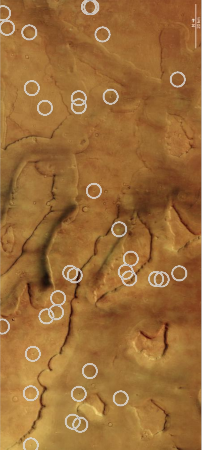
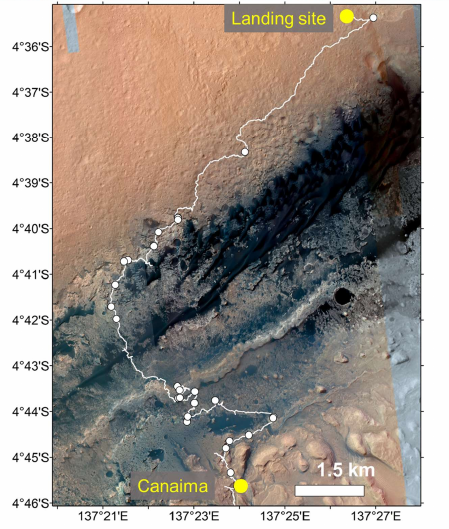
Figure S1 of the study, showing the location
of the core samples. Click for source.

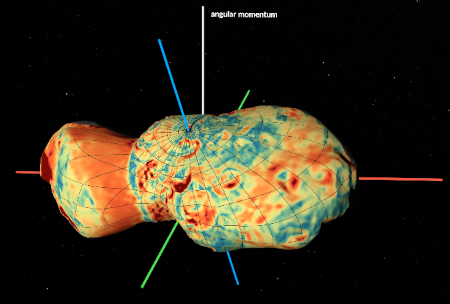
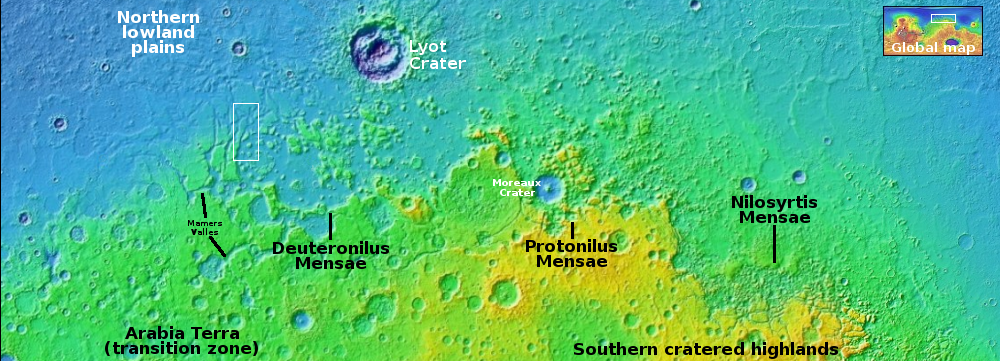
By comparing 20 different Curiosity drill samples taken during the rover’s fourteen years on Mars, scientists have detected hard evidence that the climate in Gale Crater was distinctly different at different elevations, for long periods.

This study shows that hematite can also be a marker of climate changes based on its crystallite sizes and structures, which change under different temperatures. The scientists found that hematite crystallites from higher elevations in Gale Crater were less than 10 nanometers in size, while crystallites from lower locations were generally larger, reaching up to 65 nanometers. These findings aligned with the observations that samples from higher elevations contained both hematite and goethite, while lower elevation samples lacked goethite.

They concluded that, under warmer conditions when the pH of water is neutral or slightly alkaline, goethite can transform into hematite. These warmer conditions also favored an increase in hematite crystallite size in the deeper layers of Gale Crater through a process known as Ostwald ripening, in which smaller crystallites dissolve and contribute to the growth of larger ones. “This can tell you that the top layers were colder and didn’t have enough water, or the water presence was relatively short-lived, so the crystallites didn’t have sufficient time and conditions to grow in size,” said Peretyazhko. “But the lower layers had longstanding warm water that allowed those crystallites to grow.”

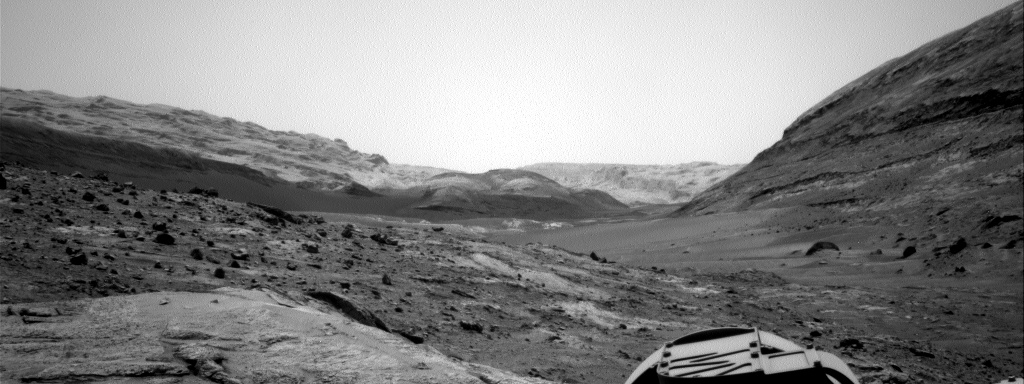
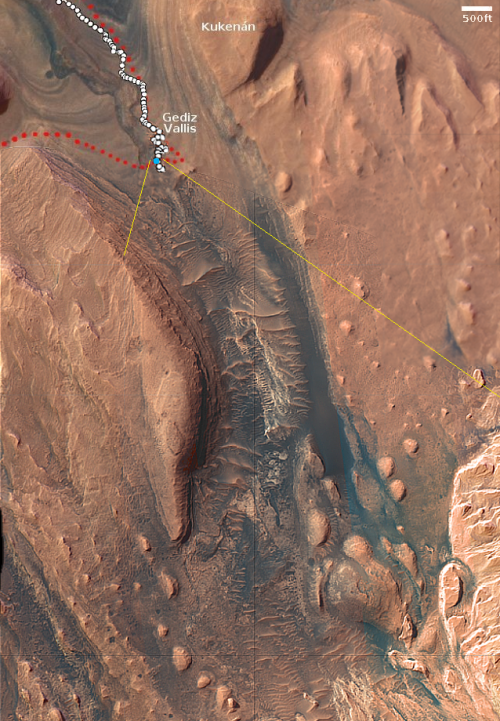
The white dots on the map to the right shows the location of the drill samples used, taken along Curiosity’s travels as it climbed Mount Sharp. Overall Curiosity has climbed about 2,500 feet, so the differences found the samples mark the past climate differences between the crater floor and the mountain’s foothills. According to this data, the crater floor had long-standing water in some form, exceeding millions of years. At higher altitudes there was less and less, and it was there for increasingly shorter periods.

As the press release notes, “A unique highlight of this study is that the data comes from Martian samples, rather than from theoretical modeling.” Similar conclusions from earlier Curiosity data required Earth proxies and computer modeling. This result is from hard data from Mars.

0 comments

An icy Martian crater filled with brain terrain

An icy Martian crater filled with brain terrain
Click for original image.

Cool image time! The picture to the right, rotated, cropped, and reduced to post here, was taken on March 26, 2026 by the high resolution camera on Mars Reconnaissance Orbiter (MRO). It shows what the scientists label an “ice-rich crater fill.”

And yup, that’s what we got. The floor of this 2.8-mile-wide unnamed crater is filled with what planetary scientists have labeled brain terrain, a feature found only on Mars that they associate with the sublimation of near surface ice, but as yet do not fully understand its entire formation process. In the upper right is a full resolution inset of that brain terrain, to give a good sense of its strange nature.

On that floor there are also several small fresh impact craters, as well as older small impacts that have faded almost to obscurity due to that mysterious process forming the brain terrain.

Its iciness of the terrain is also indicated by the rim of the crater, which is distorted as well as blobby. At impact or subsequently the ground here was soft like mud, and thus easy to shape into these cushioned features. Thus, though the rim was almost certainly circular after impact, time and the muddy nature of this ground allows it to get bent and warped.

Nor is it surprising there is near surface ice at this location. We are at 41 degrees south latitude, well away from the dry Martian tropics. This picture simply provides more evidence that once you get above 30 degrees latitude, it will not be hard to find water on Mars.
» Read more

0 comments

New study using Chandrayaan-2 data again suggests ice in crater near Moon’s south pole

The Moon's south pole region

The uncertainty of science: A new study by scientists in India using data from the Indian lunar orbiter Chandrayaan-2 has once again found evidence strongly suggesting the existence of water ice in several permanently shadowed craters near Moon’s south pole.

The findings are based on observations made by the Chandrayaan-2 orbiter’s Dual Frequency Synthetic Aperture Radar (DFSAR), a sophisticated microwave imaging instrument capable of probing beneath the lunar surface.

Among the craters examined, scientists found particularly strong evidence of subsurface ice in a 1.1-kilometre-wide crater located within the larger Faustini crater near the Moon’s south pole. Researchers said the crater displayed a distinctive “lobate-rim morphology”- a flow-like structural pattern that may indicate the impact event penetrated an ice-rich subsurface layer.

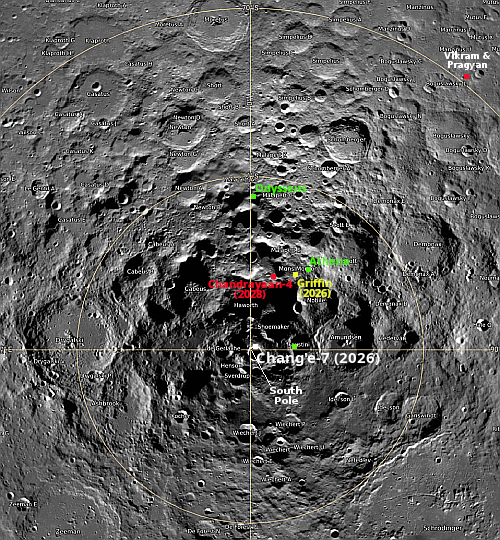
On the map above the green dot to the right of the south pole marks the location of the small crater inside Faustini Crater. Their conclusions were based first on microwave data suggesting subsurface ice, and second on the lobate shape of this crater’s rim, which has a kind blobby look implying the material is muddy and impregnated with ice.

Increasingly the data from all sources seems to suggest that if there is ice in these permanently shadowed craters, it is likely impregnated in the soil, and will require processing to extract.

3 comments

Colorful Martian dunes

Colorful Martian dunes
Click for original image.

Cool image time! The picture to the right, cropped to post here, was taken on March 15, 2026 by the high resolution camera on Mars Reconnaissance Orbiter (MRO).

The science team labels the image a “dune field.” What struck me immediately however was the vast range of colors, something that is usually not seen on Mars. Within a very short distance we go from bright orange to dark blue, with the change sometimes exceedingly sharp.

The orange is likely coarser rocks or bedrock, while the dark blue patches are likely piles of sand that has piled up due to prevailing winds. Why the dunes on the upper plateau change from bright orange to dark blue however is an unknown.

And why the patches of dust remain undefined is also a mystery. Dust on Mars is generally organized into dunes by the wind. It isn’t here.
» Read more

1 comment

An outcrop of many parallel layers on Mars

An outcrop of many parallel layers on Mars
Click for original image.

Cool image time! The picture to the right, rotated, cropped, and reduced to post here, was taken on March 11, 2026 by the high resolution camera on Mars Reconnaissance Orbiter (MRO). The picture has been rotated so that north is to the top.

The science team describes this feature as “dark linear ridges.” Apparently the ground at this location at some point in the past tilted upward, exposing these layers and creating this 250 to 400 foot high escarpment facing south. What makes this even more intriguing is the ground was only uplifted in this one area. If you look at the full image you will see that the surrounding terrain is flat and relatively featureless.

The location is in the high southern latitudes in the Martian cratered highlands. Thus, it is likely that there is some near surface ice in these layers, and in fact the many Martian climate cycles produced by the wide swings in the planet’s rotational tilt likely contributed to making the layers themselves.
» Read more

3 comments

A Martian wormlike dune field on the floor of a triple crater

Overview map

A Martian wormlike dune field on the floor of a triple crater
Click for original image.

Cool image time! The picture to the right, cropped, reduced, and enhanced to post here, was taken on March 18, 2026 by the high resolution camera on Mars Reconnaissance Orbiter (MRO).

The science team labels this simply as a “dune field.” The overview map above marks the location, in a large dune field that fills most of the floor of an unnamed 16-mile wide crater that is actually part of the triple impact. If you look at the inset, you can see that there are three craters here, the first the largest with a width of about 27 miles, the second about 18 miles wide that lies on top to the southwest, and the third 16-mile-wide crater arriving last slightly more to the southwest.

What likely happened to cause this triple impact is that the bolide likely broke up as it cut through Mars’ thin atmosphere, producing three pieces that hit bam-bam-bam right after each other.

The wormlike dune field illustrates the dusty nature of Mars. Over the eons the red planet’s copious amounts of volcanic ash was blown into these three craters and got trapped there, with the prevailing winds forcing the dust to pile up to the southwest. The physics of wind, sand, and dune fields resulted in these parallel dune ridges.

1 comment

Frost on Mars

Frost on Mars
Click for original image.

Cool image time! The picture to the right, cropped to post here, was taken on March 23, 2026 by the high resolution camera on Mars Reconnaissance Orbiter (MRO).

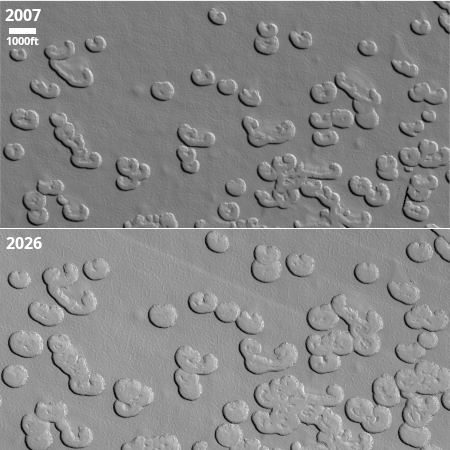
It shows the eastern interior rim of a 4.5-mile-wide crater, and was taken to find out if there has been any change to the gullies flowing down that 800 foot slope since the last high resolution image was taken in 2020.

Both pictures were taken in the spring, and both pictures not only don’t appear to show much change, both show the same white frost in exactly the same places. As no pictures have been taken at other times in the year, we do not know yet if this frost disappears as expected in summer.

In fact, until such images are taken and prove this white material disappears in the summer, we don’t even know for sure if it is indeed frost. We could instead be looking a some unusual form of white bedrock, though in my review of many MRO pictures such things are quite rare.
» Read more

0 comments

Scientists: Europa’s theorized plumes of water vapor might simply be statistical noise

Europa in true color
Europa in true color, taken by Juno September 2022.
Click for full image.

The uncertainty of science: Based on a re-analysis of data from the Hubble Space Telescope, scientists now say that the plumes of water vapor that Hubble had supposedly detected erupting from the surface of the Jupiter moon Europa might not exist, and could instead simply be statistical noise in the data.

The new paper looks at the last 14 years of data from the Hubble Space Telescope’s Space Telescope Imaging Spectrograph (HST/STIS) focused on Europa’s Lyman-alpha emissions. Lyman-alpha is a specific wavelength of ultraviolet light emitted and scattered by hydrogen atoms. From 2012-2014, the team was pushing the limits of the Hubble telescope’s capabilities.

“One of the difficulties in interpreting the data back then was determining where to place Europa within its context,” Retherford said. “The way Hubble works left some uncertainty in terms of placement relative to the center of the image. If Europa’s placement was off even just by a pixel or two, it could affect how the data gets interpreted.”

As a result, what they thought could be evidence of a water vapor plume could also just be statistical noise. “Our reanalysis took our original 99.9% confidence in the plumes’ existence and reduced it to less than 90% confidence,” said Dr. Lorenz Roth (KTH Royal Institute of Technology, Sweden), the paper’s lead author. “That’s simply not enough evidence to support the certainty of claims we made at the time.”

The plumes might still exist, but the data used here is simply more uncertain that previously thought. It is hoped that when Europa Clipper and Juice both enter Jupiter orbit in a few years they will be able to settle this issue more definitively.

3 comments

The weird tilted layers on the floor of Danielson Crater on Mars

Tilted layers inside Danielson Crater
Click for original image.

Today’s cool image to the right returns us to a previous cool image from 2022. Then I called this strange terrain visible on the floor of the 41-mile-wide Danielson Crater “freaky badlands,” because of the innumerable layers that are all tilted and appear eroded in the same way by prevailing winds coming from the northeast.

Today’s image shows more of the same. The picture to the right, cropped to post here, was taken on March 26, 2026 by the high resolution camera on Mars Reconnaissance Orbiter (MRO). It not only shows these layers, in the full image (which I strongly suggest you look at), it also shows several terraced mesas with the same tilt, each looking almost like wedding cakes that have slumped sideways. The aquamarine colors in the hollows suggest finer-grained dust, while the orange colors on higher terrain suggest coarser materials and bedrock.

As I noted in 2022:
» Read more

0 comments

The barren hills west of Jezero Crater

The barren Martian hills west of Jezero Crater
Click for full panorama.

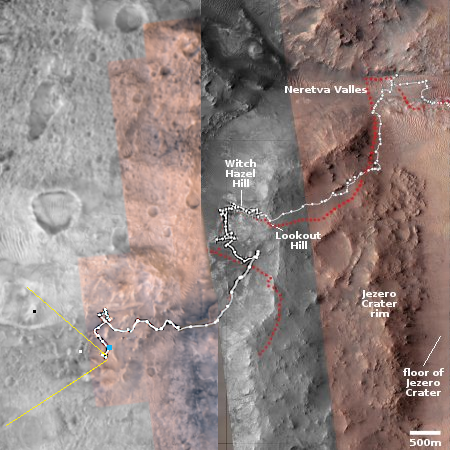
Overview map
Click for interactive map.

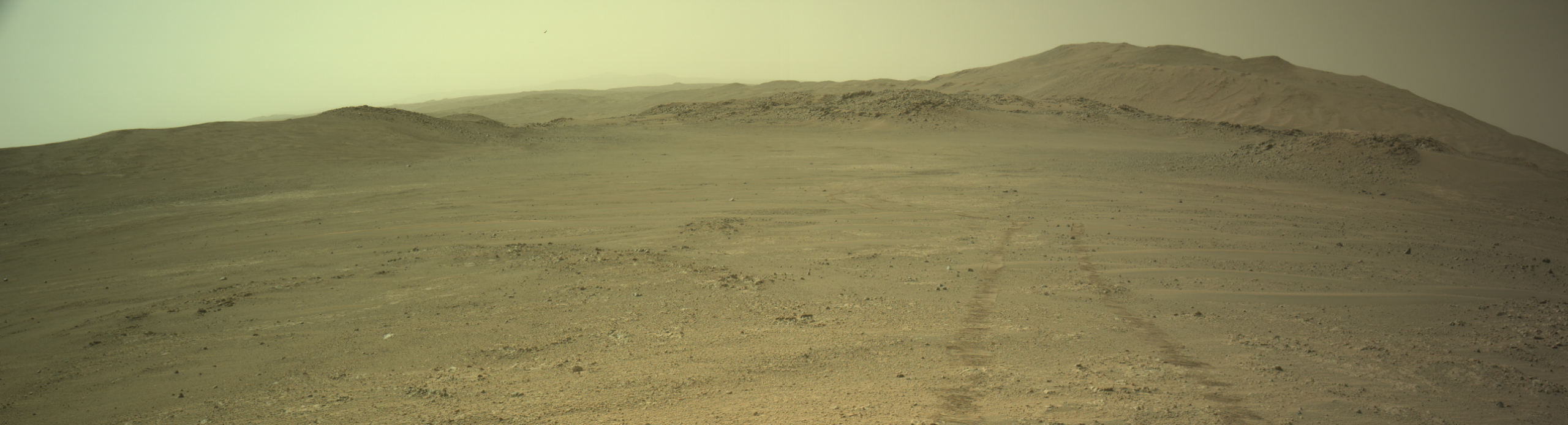
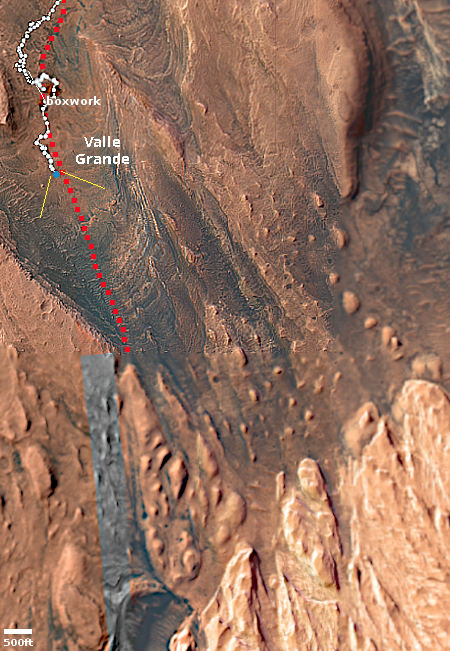
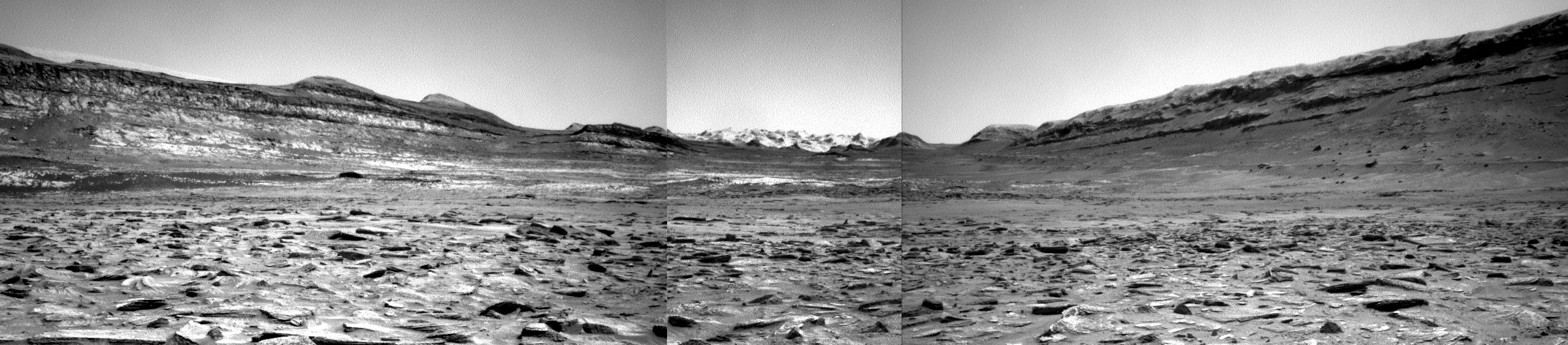
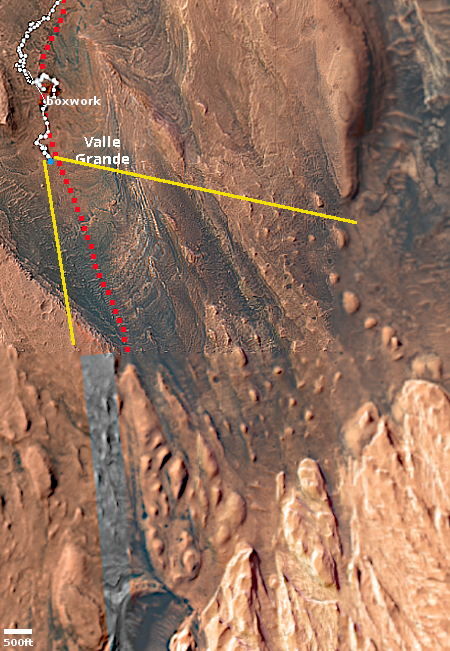
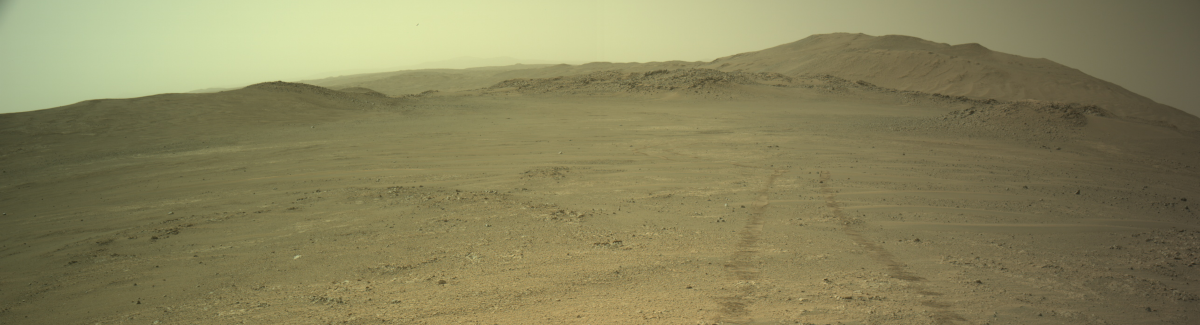
Cool image time! The panorama above, cropped and reduced to post here, was created on April 5, 2026 using 46 pictures taken by one of the high resolution camera’s on the Mars rover Perseverance. It also attempts to show this terrain in natural color.

The blue dot on the overview map to the right marks Perseverance’s present location. The green dot indicates where I think the rover was when the panorama was taken. (Note: I think the press release incorrectly lists the Sol number for these dates, but as I am not sure I can only guess.) The yellow lines indicate approximately the terrain seen in the full panorama.

As the press release notes, “the panorama offers one of the richest geological vistas of the rover’s mission, revealing a windswept landscape of diverse rock textures.” It also appears this is the direction the rover is presently headed.

I ask my readers to once again look at this panorama. It shows an utterly barren terrain. There is no life here, and if there ever was it was gone billions of years ago and never did much to shape the landscape. While some at NASA and in the planetary community like to tout the possibility of life on Mars in order to lobby for funding, the reality we see says there is none, and that life will only appear on Mars when humans finally arrive there to build new human societies.

5 comments

Brain terrain on Mars?

Brain terrain on Mars?
Click for original picture. For full image go here.

Cool image time! The picture to the right, cropped and expanded to post here, was taken on April 2, 2026 by the high resolution camera on Mars Reconnaissance Orbiter (MRO). Labeled simply as a “terrain sample”, such images are usually taken not as part of any specific research project, but to fill a gap in the camera’s schedule. The camera team needs to take pictures at a regular cadence to maintain its proper temperature.

When they have such a gap, they try to find interesting things to photograph, and usually succeed. In this case we are looking at what I think the scientists dub “brain terrain,” a feature unique to Mars that is thought related to near surface ice and its sublimation, though at present the origins of brain terrain remain murky. The scale is approximately 100 meters across the width of this picture.

However, the location of this brain terrain makes any conclusions about its origin difficult.
» Read more

3 comments

Corroding glacial features inside Martian crater

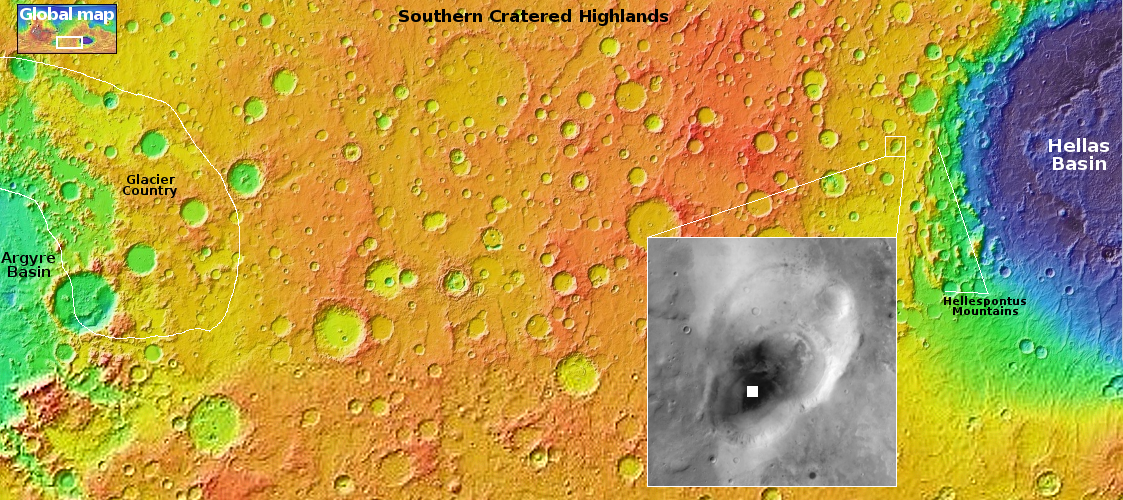
Overview map
Glacier country in the Martian northern mid-latitudes.

The corroding glacial floor of a Martian crater
Click for original image.

Today’s cool image gives us another nice example of the ample availability of near surface ice on Mars, even if it might take a bit of processing to extract it from the dust and soil. The picture to the right, rotated, cropped, and reduced to post here, was taken on March 31, 2026 by the high resolution camera on Mars Reconnaissance Orbiter (MRO).

The picture captures in detail most of the floor of a 5.8-mile-wide unnamed crater, located in the northern mid-latitudes of Mars, in a 2000-mile-long strip I like to call glacier country, because practically every image taken there shows extensive glacial features. The white dot on the overview map above shows the location within that strip, with the inset showing the full crater, as well as the surrounding terrain.

The softness of this landscape strongly suggests a topsoil well impregnated with ice. The crater’s rim is itself very soft and subdued, suggesting melting and sublimation over time.

The material in the floor of the crater resembles peeling paint, which in this case suggests the ice there has been sublimating away as well. Nonetheless, there remains a lot under the surface. Future Martian colonists will certainly come to this region to gather ice for their own purposes.

0 comments
1 2 3 157