Exposed weirdness on floor of Martian crater

Crazy shapes on floor of Martian crater
Click for original image.

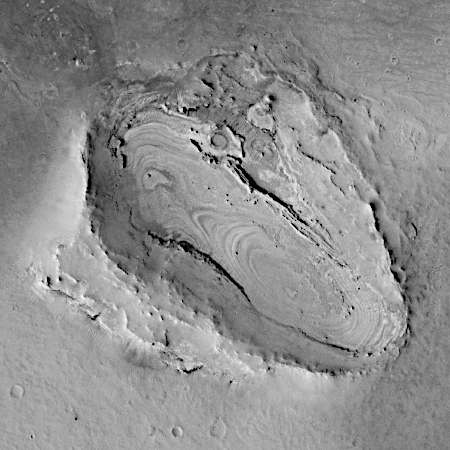
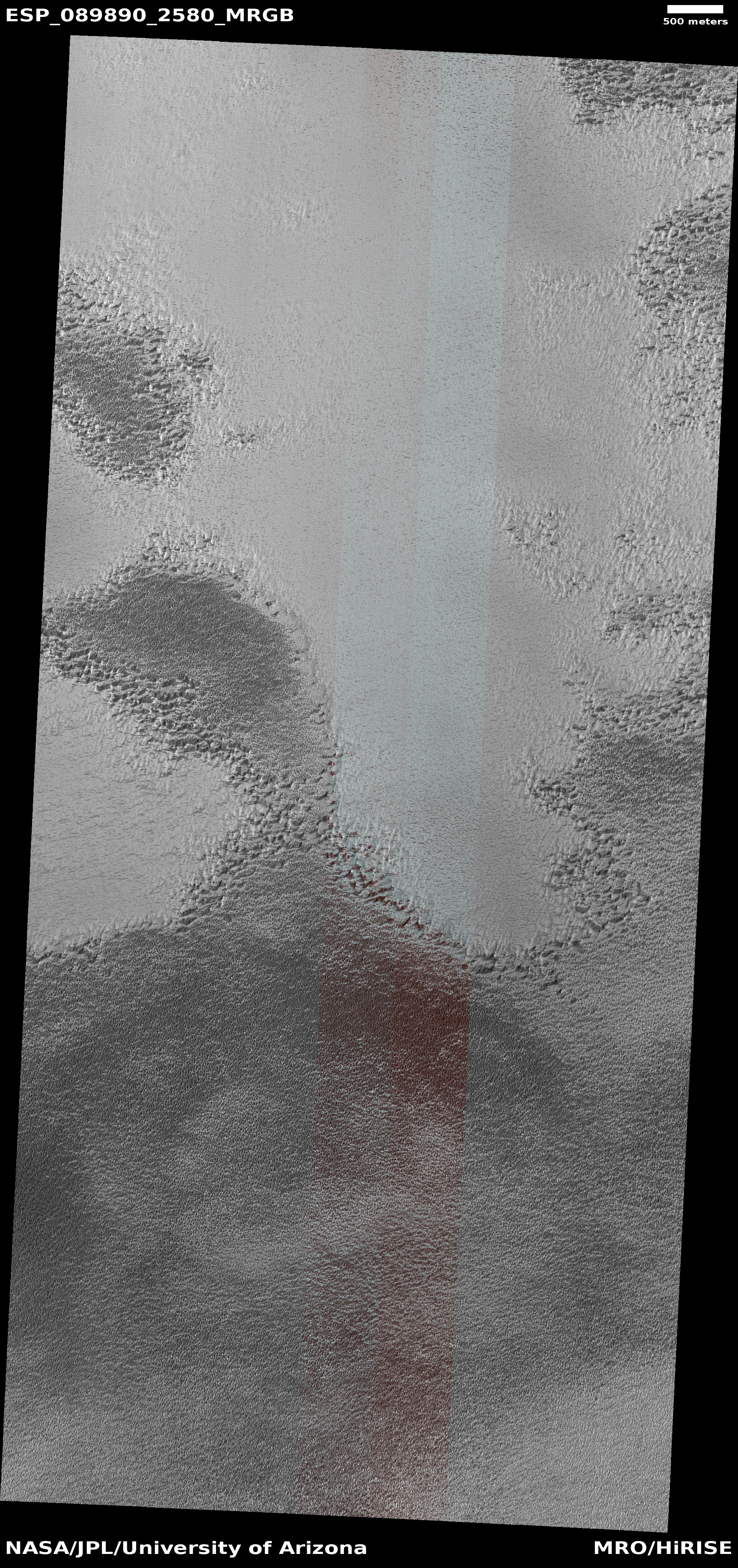
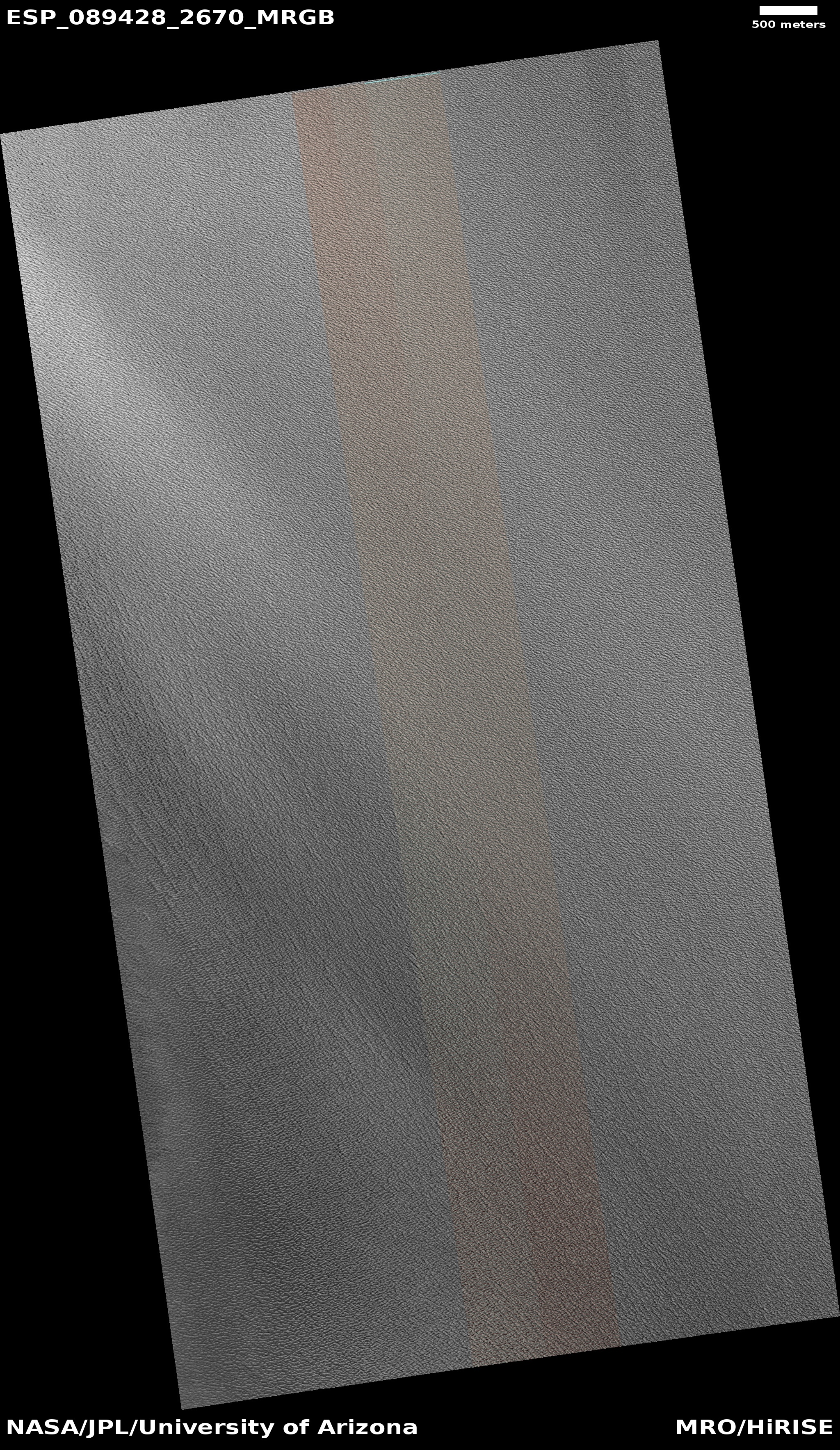
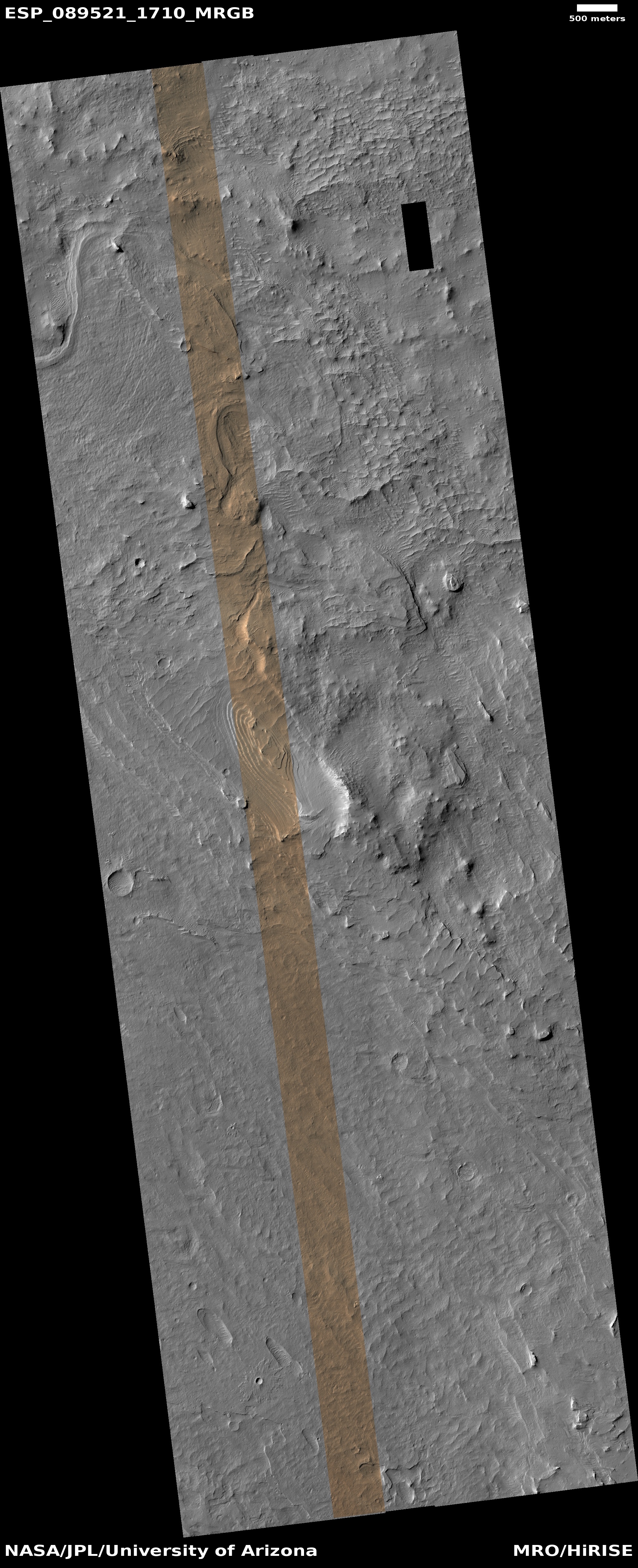
Cool image time! The picture to the right, rotated, cropped, reduced, and sharpened to post here, was taken on November 27, 2025 by the high resolution camera on Mars Reconnaissance Orbiter (MRO).

The science team labels this “exposed crater floor materials”. While properly vague, that hardly suffices. This image could easily fall into my “What the heck?!” category of Martian geology that is difficult to understand, no less explain.

The color strip suggests that dust dominates near the top and bottom, though dust is also present in the middle. The patches with the bluish tint in the middle suggests these lighter swirls and patches are bedrock.

Of course, none of that explains the weird shapes of these patches, nor why they exist at all.

Before delving into those weird shapes, we must note the two vertical black strips to the right of the color strip, indicating a gap in data. Such gaps have been appearing more frequently of late, suggesting MRO’s age, almost a decade in orbit around Mars, is beginning to show itself. A failure in 2023 in one filter band of the high resolution camera already leaves blank the color swath in black and white images. These new blank strips indicate further issues, warning us that we must be prepared for the loss of this camera and orbiter in the somewhat near future.
» Read more

0 comments

New research supports theorized intermittent ocean exiting Mars’ giant Valles Marineris canyon

Theorized ocean from 2019 & 2022 papers

Scientists studying the deltas of debris that exist at the base of the cliffs inside Mars’ giant Valles Marineris canyon have concluded the deltas suggest the existence of an ocean there about three billion years ago.

The theorized ocean on the map to the right comes from research published in 2019, with additional support published in 2022. This new work supports those conclusions. From the press release:

At the lower end of the canyon system, so-called “scarp-fronted deposits” were discovered, which are interpreted as “fan deltas”. Fan deltas form where a fan-shaped cone of debris and sand grows directly into a standing body of water. The researchers found that the structures mapped on Mars are very similar to classic deltas on Earth.

…The results also show that the ocean found was at least as large as the Arctic Ocean on Earth. Schlunegger says: “We are not the first to postulate the existence and size of the ocean. However, earlier claims were based on less precise data and partly on indirect arguments. Our reconstruction of the sea level, on the other hand, is based on clear evidence for such a coastline, as we were able to use high-resolution images.”

You can read the new paper here [pdf]., which I strongly suggest as the press release at the link above is very poorly written. The 2019 and 2022 work focused on computer models and the geological features in the region of the theorized ocean, including evidence of possible past tsumanis. This new research focuses on the debris piles at the base of Valles Marineris’ cliffs, all of which appear to end at similar elevations. As this new paper notes:
» Read more

0 comments

Icy Mars

Overview map

Icy Mars

Today’s cool image once again illustrates the fact that most of Mars Mars is not a dry desert like the Sahara, as most news sources and the general public still believes, but a cold icy place similar to Antarctica, with plenty of near surface ice covering almost the whole planet, except for the dry equatorial regions (the one region we have sent almost all our landers and rovers).

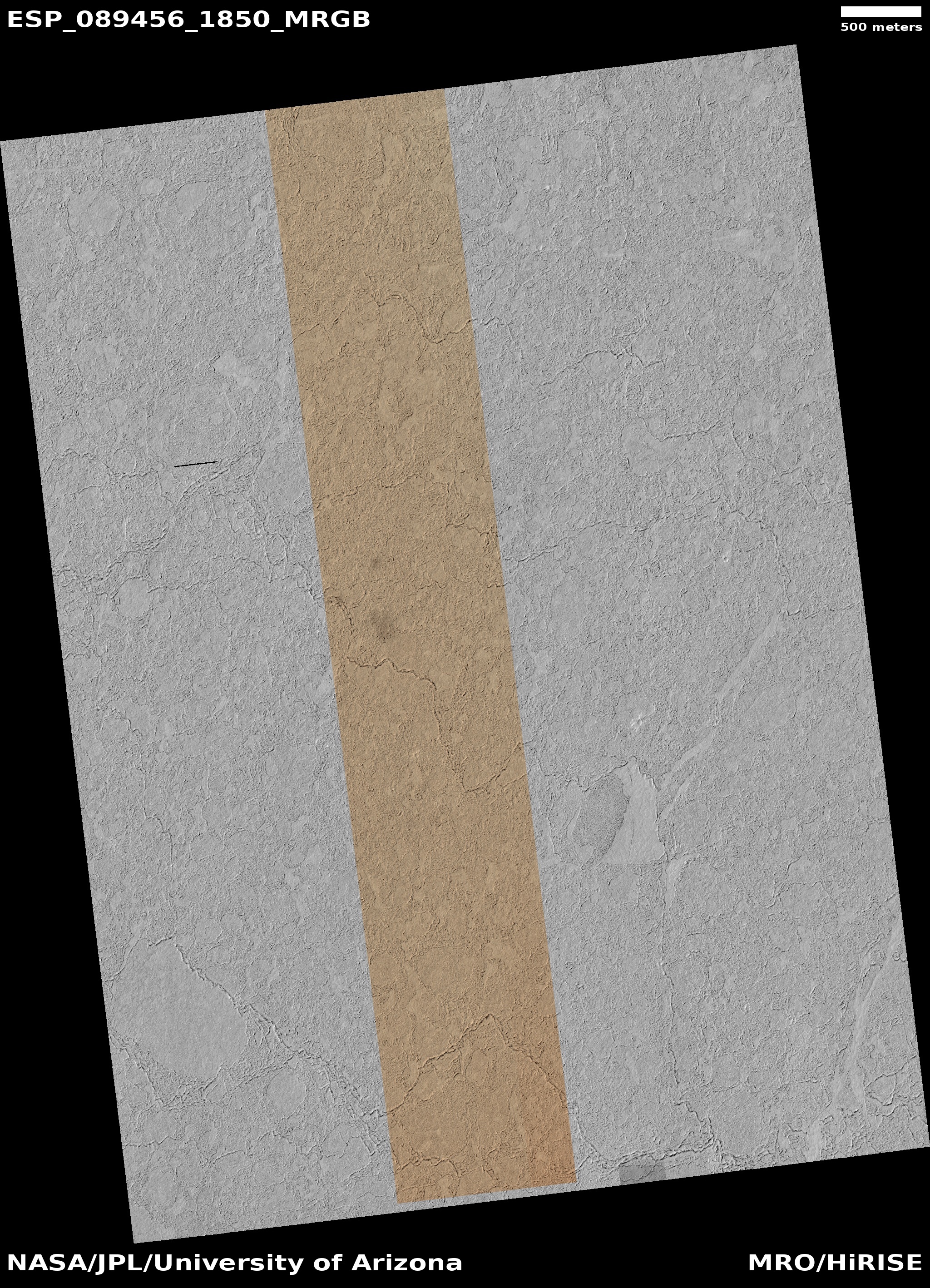
The picture to the right, rotated, cropped, reduced, and sharpened to post here, was taken on November 26, 2025 by the high resolution camera on Mars Reconnaissance Orbiter (MRO). It shows one small section of the floor of an unnamed very old and eroded 82-mile-wide crater located in the northern mid-latitudes of Mars.

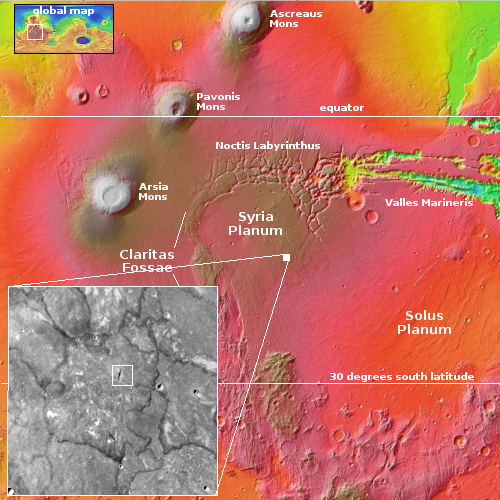
That location is indicated by the white dot on the overview map above. This part of the mid-latitudes is a region I dub “glacier country”, a 2,000-mile long strip where practically every image taken there shows very obvious glacial features.

Today’s image is no different. The 2-mile-wide crater in the upper left appears blobby, as if the impact had landed in mud. Its interior is filled with what the scientists believe is glacial debris. The surrounding landscape has a similar appearance, as if the ground was slushy and easily misshapen by seasonal temperature changes. To the southwest of the crater, within what appears to be a surrounding splash apron, there appears to be an eroded drainage channel, likely created by the flow of glacial ice downward.

So, when you read articles telling you Mars is dry and scientists are still hunting for water there, know that whomever wrote that article had no idea what he or she were talking about. The scientists studying Mars know that Mars has lots of water. Except for the tropics below 30 degrees latitude, there is near surface ice everywhere. Their questions revolve instead on figuring out how deep and extensive it is, and how it has shaped Mars’ overall geology.

1 comment

Computer model: A thin ice cap can preserve liquid water on Mars

The parameters used in the computer model
Figure 1 of the paper, showing the parameters
used in the computer model

Using a computer model, scientists have found that a thin cap of ice can act to allow liquid water to exist in lakes on Mars, for extended periods of time.

You can read their paper here. From the abstract:

Working at a localized scale, we combine climate input from the Mars Weather Research & Forecasting general circulation model with geologic constraints from Curiosity rover observations to identify potential climatic conditions required to maintain a seasonally ice-free lake. Our results show that an initially small lake system (10 m deep) with โˆผ50 mm monthly water input and seasonal ice cover would retain seasonal liquid water for over 100 years, demonstrating conditions close to long-term lake survivability.

From the press release:

In some simulations, the lakes completely froze during colder seasons, whereas in others, the lakes remained liquid and were covered by a thin layer of ice instead of freezing solid. This thin ice acted as an insulating lid, significantly reducing water loss while still allowing sunlight to warm the lake ice during warmer months. As a result of this seasonal cycling, some simulated lakes barely changed in depth over decades, suggesting that they could be stable for longer durations even with average air temperatures below freezing for much of the time.

Because this research is based on computer modeling, it carries great uncertainties. At the same time, it seems to explain the puzzling nature of Martian geology, which has repeatedly suggested the existence of liquid water in the past on a planet that has always been too cold with too thin an atmosphere for liquid water to exist. Data has also suggested that pockets of liquid water might have existed at the base of glaciers. This research aligns with that data.

9 comments

“Round Deposits” in Martian crater

Round deposits in a crater
Click for original image.

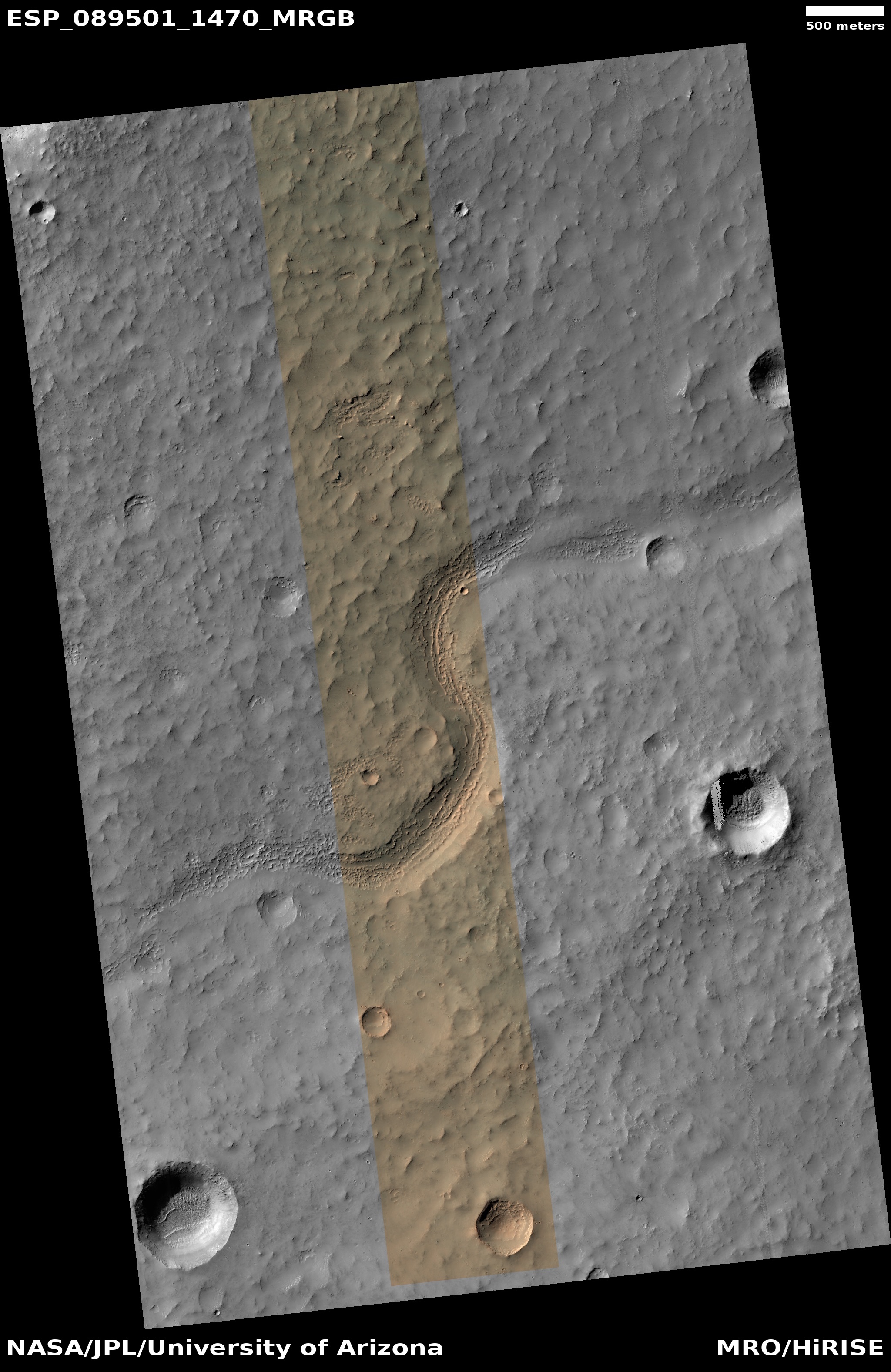
Today’s cool image could also be entered into my “What the heck?!” category of strange Martian geology. The picture to the right, cropped, reduced, and sharpened to post here, was taken on October 19, 2025 by the high resolution camera on Mars Reconnaissance Orbiter (MRO).

The science team labels this as “Round Deposits in Crater.” And yup, that’s what we have, round and flat small mesas inside an unnamed 3,500-foot-wide very shallow crater (no more than 10-20 feet deep) that also appears to be sitting higher than the surrounding landscape. Furthermore, several nearby craters are also raised, with one having its own oblong flat interior mesa. Moreover, the terrain around the crater appears stippled, as if it has been eroding or sublimating away.

The latitude, 37 degrees north, provides the first clue for explaining this weird landscape.
» Read more

0 comments

Many Martian mysteries in one spot

Many Martian mysteries in one spot
Click for original image.

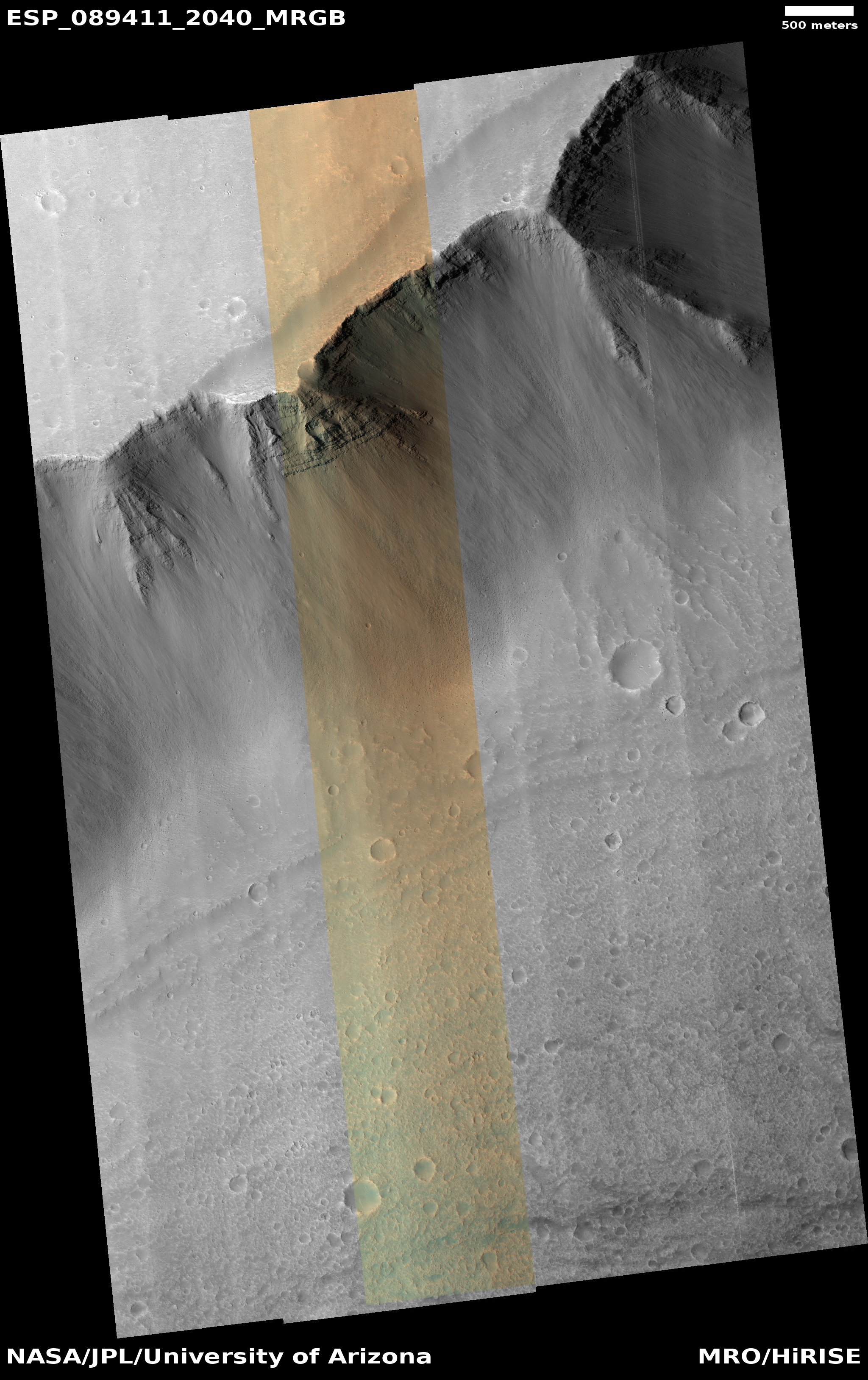
Just because there are no new images coming back from Mars at this time because the Sun is in the way does not mean we can’t enjoy more cool Martian images. The picture to the right, cropped, reduced, and sharpened to post here, was taken on October 20, 2025 by the high resolution camera on Mars Reconnaissance Orbiter (MRO).

Labeled merely a “terrain sample,” this means it was taken not as part of any particular research project but to fill a gap in the camera’s schedule. The camera team needs to take regular photographs in order to maintain the camera’s proper temperature, and when there is a long gap they add a terrain sample image to the schedule. Usually they try to pick some target of interest.

In this case the target is this 2,500-foot-high cliff, in which we can see a whole range of Martian geological mysteries. First there are the slope streaks on the cliff, a feature unique to Mars but as yet unexplained. Resembling avalanches, these streaks leave no debris piles at their base, do not change the topography in any way, and can appear randomly throughout the year, fading with time. Though the streaks in this picture are dark, streaks can also be bright.

Both the parallel ridges at the base of the cliff, as well as the cliff itself, are remnants of other major geological events, at least based on present theories.
» Read more

5 comments

The headwaters of an ancient Martian channel

glacial debris in canyon floor
Click for original image.

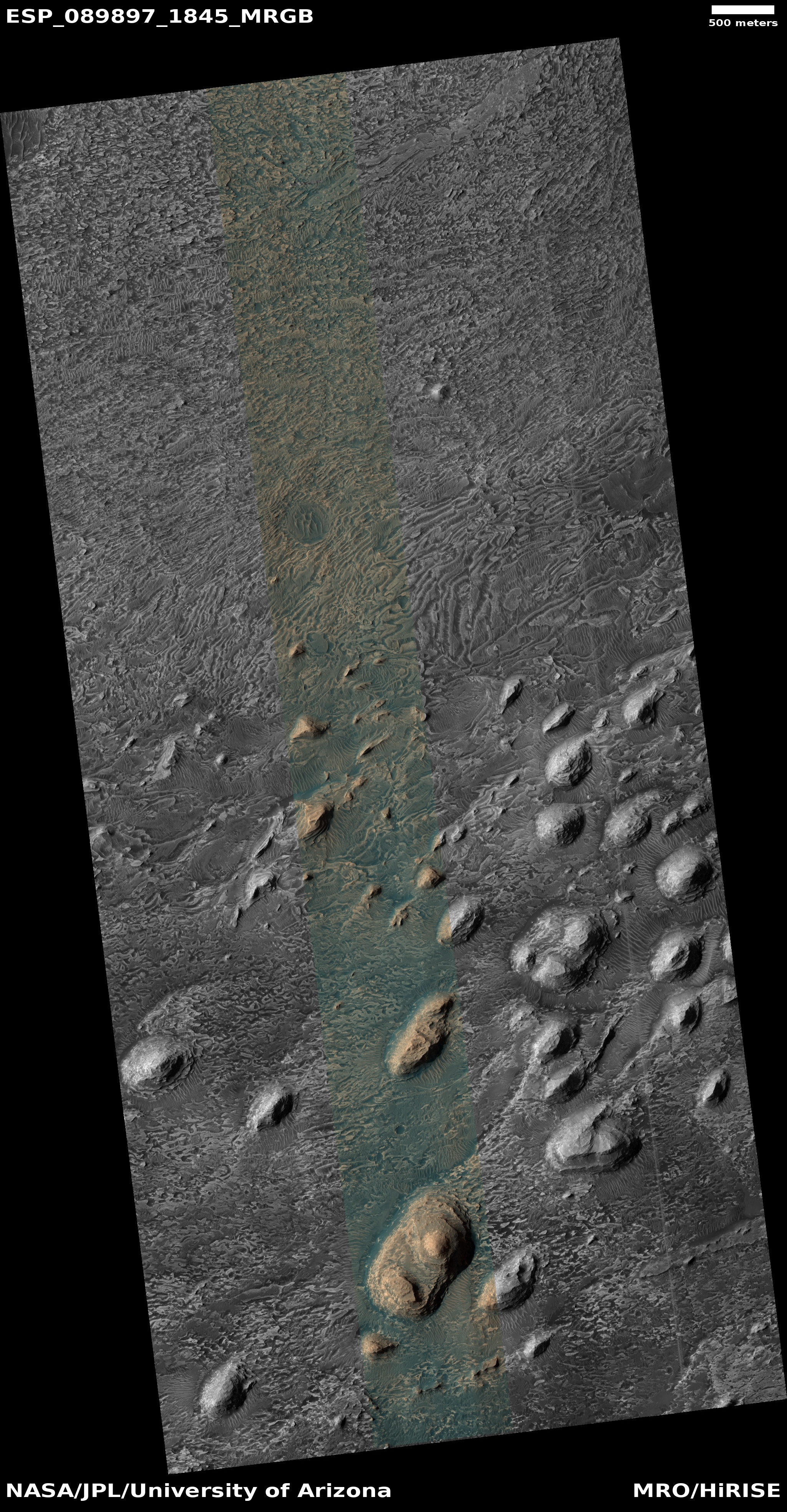
Cool image time! The picture to the right, rotated, cropped, reduced, and sharpened to post here, was taken on October 24, 2025 by the high resolution camera on Mars Reconnaissance Orbiter (MRO).

The science team labels this simply as “irregular terrain.” It is far more than that. We are looking at a three-mile-wide shallow canyon, with what appear to be eroding glacial features on the canyon floor.

The location is at 35 degrees north latitude, so finding glacial features here is entirely unsurprising, especially because this location is the southern edge of the 2,000-mile-long mid-latitude strip in Mar’ northern hemisphere I label glacier country, because almost every picture shows such glacial features.

In this case, the channel also suggests a much more complex geological history, that could involve flowing water though flowing glaciers are increasingly becoming an alternative explanation.
» Read more

0 comments

Layers in the biggest canyon in the solar system

Overview map

Layers in the solar system's biggest canyon
Click for original image.

Cool image time! The picture to the right, rotated, cropped, reduced, and sharpened to post here, was taken on October 24, 2025 by the high resolution camera on Mars Reconnaissance Orbiter (MRO).

The white dot on the overview map above marks the location, on the lower slopes of the south rim of Valles Marineris, the largest canyon on Mars and by far the largest so far discovered in the solar system. From the rim to the floor the elevation drop here is about 23,000 feet, with the layers shown in the picture to be about 5,000 feet above the canyon floor.

Those layers cover about 500 feet of that elevation drop. Each layer suggests a past event, possibly volcanic eruptions. The curved headwall near the upper left also suggests that some layers were avalanches or mass wasting events flowing downhill to the northeast, one on top of another.

As always, the scale of Valles Marineris is hard to imagine. The rim is 20 miles to the south, but the canyon’s opposite rim is from 140 to 300 miles to the north. You could fit two to five Grand Canyons in this part of Valles Marineris and each would look small in comparison.

1 comment

Curiosity’s exploration of boxwork on Mount Sharp

Curiosity panorama, December 18, 2025
Click for high resolution panorama. For original images, go here, here, and here.

Overview map
Click for interactive map.

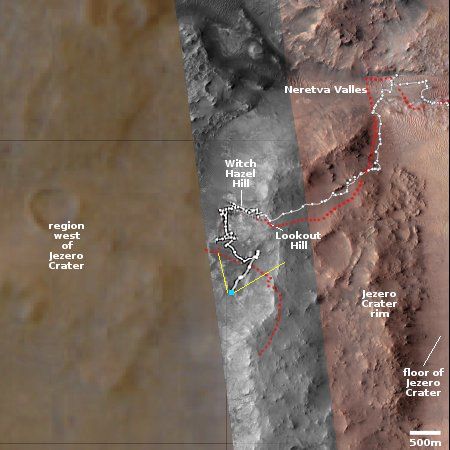
Cool image time! The panorama above was created from three photographs taken on December 18, 2025 (here, here, and here) by the right navigation camera on the Mars rover Curiosity.

The view is north, looking down the flanks of Mount Sharp and across the floor of Gale Crater to its rim about 20 to 30 miles away. In comparing this view with a similar one taken in July, it is obvious that the Martian atmosphere has become far dustier during the last six months. The rim and the mountains beyond are hardly visible now through the haze.

The blue dot on the overview map to the right marks Curiosity’s present position. The yellow lines indicate roughly the area covered by this panorama. The while dotted line indicates the rover’s travels, while the red dotted line its planned routes.

As you can see by both the rover’s tracks in the panorama above and the white dotted line in the overview, Curiosity has been traversing back and forth across the boxwork formation of criss-crossing ridges for more than half a year, as the science team attempts to decipher what caused these ridges and hollows. They have also done some drilling in this effort.

The science team has been getting close to the day it will move on, resuming Curiosity’s climb of Mount Sharp, but they keep finding things amidst this boxwork that requires additional study. For example, consider this from yesterday’s update:
» Read more

2 comments

Ancient Martian drainage into crater lake, now turned into ridges

Inverted channels
Click for original image.

Cool image time! The picture to the right, rotated, cropped, reduced, and sharpened to post here, was taken on September 9, 2025 by the high resolution camera on Mars Reconnaissance Orbiter (MRO). It shows what the science team labels “an inverted channel.” From the caption:

Topographic inversion is a process where geologic features that were once low-lying, like impact craters or riverbeds, become elevated over time, like mesas or ridges. In this process, a crater or channel is filled with lava or sediment that becomes lithified [hardened]. If this infill is more resistant to erosion than the surrounding landscape, the less-resistant material can be eroded away by wind or water. The former crater or valley fill, being more resistant, remains elevated as the landscape around it lowers. The original low-lying feature becomes a mesa or ridge.

In this image, an ancient river network and nearby impact craters have undergone topographic inversion. Impact craters contain round mesas within them, and the stream channel is defined by a network of ridges.

The location of this inverted channel makes its history even more interesting.
» Read more

1 comment

Mars Reconnaissance Orbiter’s high resolution camera takes its 100,000 picture

Oblique view
Click for original image.

Cool image time! On October 7, 2025, the science team that operates HiRISE, the high resolution camera on Mars Reconnaissance Orbiter (MRO), took its 100,000th picture since entering Mars orbit in March 2006.

The objective of this observation is to better resolve sand dunes and the rocky material underneath them. These dark, eroded rocks may be the source for some of these Syrtis Major sand dunes. Our image was suggested by a high school student enrolled in the Jefferson County Executive Internship program in Colorado in 2023, one of many public outreach programs the HiRISE Team engages in.

To celebrate this accomplishment and the fantastic geology of the scene, students and staff in the HiRISE Photogrammetry lab constructed this digital terrain model. This oblique image highlights the hummocky mounds of the plains that border Jezero Crater, which are among the oldest on Mars.

That oblique image, cropped, reduced, and sharpened to post here, is to the right. The location is about 50 miles to the southwest of Jezero Crater where the rover Perseverance landed.
» Read more

6 comments

Abstract art produced by nature within Marsโ€™ north pole ice cap

Abstract art created by nature on Mars
Click for original

Cool image time! The picture to the right, cropped, reduced, sharpened, and annotated to post here, was taken on October 27, 2025 by the high resolution camera on Mars Reconnaissance Orbiter (MRO). I have also rotate the image so that north is to the top.

The science team labels this โ€œExposure of North Polar Layered Deposits,โ€ an apt description of the horizontal red and grey and blue layers that dominate the image and make this geology look more like an abstract painting than a natural landscape. What we are actually looking at is a canyon 800-to-1,200 feet deep within the north polar ice cap of Mars.

The picture was taken in the summer with the Sun about 12 degrees above the horizon to the south. Thus, the northern cliff face is illuminated, revealing its many colored layers, while the south face is mostly in shadow, hiding those layers.
» Read more

0 comments
1 3 4 5 6 7 157