Finding ways to clean ISS and future interplanetary spaceships
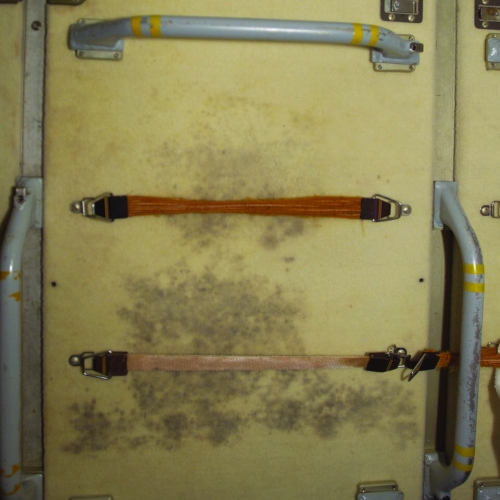
Fungi on ISS

According to multiple studies (see here, here, and here), a whole range of microorganisms, from bacteria (some dangerous) to fungi, have been found prospering on ISS.

The photo to the right shows a typical example of fungi growing on one of ISS’s older surfaces.

A European Space Agency (ESA) project is attempting to developing new coatings that will not only protect surfaces but act to clean them as well.

“With astronauts’ immune systems suppressed by microgravity, the microbial populations of future long-duration space missions will need to be controlled rigorously,” explains ESA material engineer Malgorzata Holynska. “So ESA’s Materials’ Physics and Chemistry Section is collaborating with Istituto Italiano di Tecnologia, IIT, to study antimicrobial materials that could be added to internal cabin surfaces.”

The IIT team has begun work on titanium oxide, also known as ‘titania’, used for example in self-cleaning glass down here on Earth, as well as in hygienic surfaces. When titanium oxide is exposed to ultraviolet light, it breaks down water vapour in the air into ‘free oxygen radicals’, which eat away whatever is on the surface, including bacterial membranes. “Bacteria gets inactivated by the oxidative stress generated by these radicals,” says Mirko Prato of IIT. “This is an advantage because all the microorganisms are affected without exception, so there is no chance that we increase bacterial resistance in the same way as some antibacterial materials.”

The application however is not as simple as painting the surface. Right now they wish to keep this coating as thin as possible (“50 to 100 nanometres, millionths of a millimetre”) so that it could even be applied to clothing, which requires using complex techniques similar to those used to make semi-conductors.

Though hand cleaning would likely be much simpler and cheaper, there are issues. First, it isn’t as easy to scrub a surface by hand in weightlessness. Second, in a closed environment like ISS cleaning materials pose a greater hazard to both the occupants and the equipment. Better if the surfaces of equipment and clothing are designed to stay clean, on their own.
10 comments

Starliner successfully docks with ISS

Starliner docked to ISS
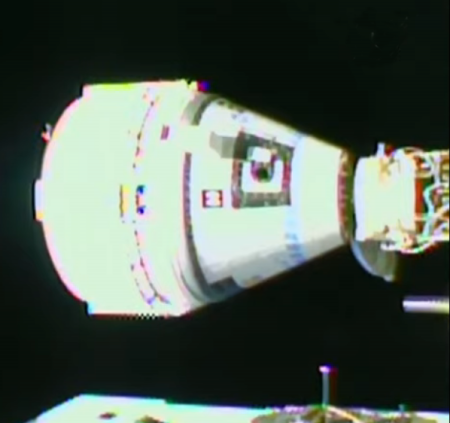
Screen capture just after soft docking.

Boeing and NASA today successfully docked an unmanned Starliner capsule to ISS for the first time, completing the up-from-Earth portion of this demo mission to prove out this Boeing spacecraft as a future ferry to bring astronauts to and from the station.

The screen capture to the right, taken from the live feed, shows Starliner just after a successful soft capture docking. This was shortly followed by a hard dock.

They will open the hatch tomorrow after checking out the capsule’s linkage with ISS.

The docking itself was delayed by about 78 minutes, partly to time the docking during a period of good orbital communications and partly because of an issue with NASA’s own docking ring on the station that required engineers to reset it.

8 comments

Starliner reaches proper orbit despite thruster problems

Unbelievable: During the post-launch press conference last night Boeing officials revealed that, though the final burn to get Boeing’s Starliner capsule into orbit using its own thrusters succeeded, the thrusters did not function as planned.

Boeing Vice President Mark Nappi said a Starliner thruster failed after firing for one second as the spacecraft made a burn to enter orbit after separating from its Atlas V launch vehicle. The flight software switched to a second thruster, which fired for 25 seconds before shutting down prematurely. A third thruster took over and completed the firing, Nappi said.

The thrusters were made by Aerojet Rocketdyne, which also made the valves that did not work in the previous launch attempt in the summer of 2021. Whether the two problems are related is not known at this time.

A NASA official also noted that a cooling unit on the spacecraft operated “sluggishly during ascent,” but began working correctly once in orbit.

Right now NASA and Boeing are planning to proceed with the docking on ISS tonight at 7:10 pm (Eastern). It appears that though two thrusters have failed, they have ten more thrusters that can be used for further maneuvers throughout the mission. Furthermore, these thrusters are not used during the actual rendezvous and docking.

The live stream of the docking goes live at 3:30 pm (Eastern), and is embedded below. Until then enjoy NASA propaganda, some of it might be of interest.

Update: NASA has cut off coverage of the docking on the channel I had embedded previously. I have now embedded an active live feed.

» Read more

9 comments

ULA’s Atlas-5 rocket successfully launches Starliner into orbit

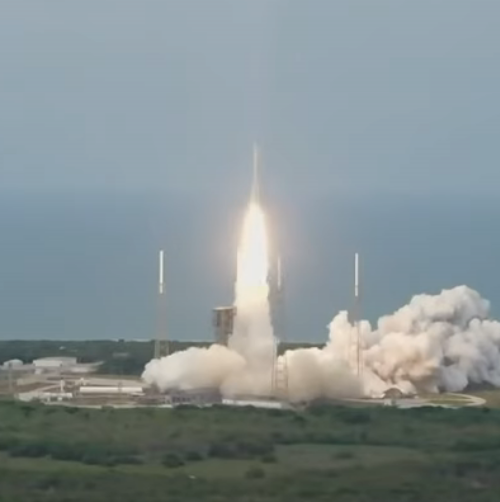
Atlas-5 immediately after lift-off
Screen capture just after lift-off

Capitalism in space: ULA’s Atlas-5 rocket today successfully launched Boeing’s manned Starliner capsule into orbit on its second attempt to complete an unmanned demo mission to ISS.

The capsule having been deployed by the rocket then followed with a final burn using the capsule’s own engines to get into its proper orbit for rendezvous with ISS tomorrow at 7:10 pm (Eastern). It was during this rendezvous period that Starliner had its problems in the first demo mission in December 2019 that caused the mission to be aborted prior to docking. Hopefully those software issues have been solved and all will go well through tomorrow.

It is interesting to compare the operation and equipment of Boeing/ULA vs SpaceX. While SpaceX has aimed for a sleek look, Boeing/ULA both retain the industrial feel of past rocketry. Neither is wrong, but the difference highlights the consequences of having competing operations. You get variety.

The leaders in the 2022 launch race:

21 SpaceX
15 China
7 Russia
3 Rocket Lab
3 ULA

American private enterprise now leads China 30 to 15 in the national rankings, and the entire world combined 30 to 25.

10 comments

NASA bans American spacewalks on ISS because of chronic spacesuit issues

NASA's failed spacesuit
NASA’s failed Moon spacesuits

Because of repeated water leaks in the helmets of NASA’s complex spacesuits and the agency’s inability to fix the problem, agency managers have to decided to cease all American spacewalks on ISS until engineers can definitively solve the problem.

The problem first occurred during a 2013 spacewalk, causing a major investigation. Though engineers managed to gain some control over the problem, it was never truly solved. In the most recent spacewalk on March 23rd, astronauts found water inside one helmet after the walk was over. That suit will now be returned to Earth for inspection and engineering work.

This suspension of spacewalks likely delays four spacewalks planned this year to complete the upgrade to the station’s power system.

Meanwhile, NASA’s own program to build new spacesuits for its lunar missions has been an utter failure — costing more than a billion dollars over fourteen years and producing nothing — thus forcing the agency to turn to the private sector to get new suits.

4 comments

Study: Russian astronauts on ISS have better techniques for protecting the brain

According to a study comparing the changes in the brain experienced during long term missions on ISS, it appears that the Russians have developed better protocols for preparing themselves for return to Earth that prevents the enlargement in one part of the brain seen in American astronauts.

From the link:

The study focused on 24 Americans, 13 Russians, and a small, unspecified number of astronauts from the ESA. The researchers collected MRI scans of the astronauts’ brains before and after they spent six months on the ISS (only 256 individuals have visited the space station).

After being in space, all the space travelers exhibited similar brain changes: cerebrospinal fluid buildup and reduced space between the brain and the surrounding membrane at the top of the head. The Americans, however, also had more enlargement in the regions of the brain that serve as a cleaning system during sleep, e.g. the perivascular space (PVS).

…The Russian astronauts did not exhibit enlarged PVS, suggesting there might be differences in protocol that are neuro-protective.

From the paper itself:

[Russian C]osmonauts undergo six lower body negative pressure (LBNP) sessions starting two weeks prior to landing, while NASA and ESA astronauts do not typically do it. LBNP induces caudal displacement of fluids from the upper body by placing the legs and pelvis in a semiairtight chamber with negative pressure.

An advanced resistive exercise device (ARED) is regularly used by space flyers to perform free weight exercises on the ISS, but the load and frequency of use are lower for [Russian] cosmonauts compared with NASA and ESA astronauts. Lifting heavy loads during resistive exercise is often accompanied by a brief Valsalva maneuver, inducing increased ICP and decreased cerebral blood flow and cerebrovascular transmural pressure, which can result in PVS fluid accumulation. Although the effects of LBNP and ARED on the brain during spaceflight are unknown, they could partly explain the different WM-PVS changes detected in astronauts and cosmonauts. We cannot exclude that other factors (e.g., diet) might play a role in this difference. Further studies are required to confirm these hypotheses.

Apparently two protocols are different that seem to help the Russians. First, the LBNP, developed by the Russians on their earlier space stations, is essentially a pair of pants that sucks fluids down to the legs, simulating the situation normally found on Earth, and thus reduces the fluids in the upper body sooner than landing. Second, doing exercises simulating lower weight loads apparently helps the Russians as well.

3 comments

Endurance successfully splashes down, returning 4 astronauts after a 6 month mission

Capitalism in space: SpaceX’s Endurance spacecraft successfully splashed down tonight off the coast of Florida, bringing home four astronauts after a six month mission on ISS.

This event capped a remarkable month for SpaceX. It launched two manned missions to ISS (one of which was entirely private) while returning two (including that private mission after seventeen days). In between the company also launched three Falcon 9 rockets putting satellites into orbit. All told, in the four weeks since the April 8th launch of the Axiom private manned mission to ISS, SpaceX completed five launches, all of which successfully landed the first stages for later reuse.

More important, everything on every one of those launches and splashdowns went like clockwork, with no problems, delays, or glitches. The only thing that delayed anything was the weather, something no one can do anything about.

Rocket engineering is hard, maybe the hardest technical challenge facing humans. The high quality of SpaceX’s work however is beginning to make it seem routine.

2 comments

Endurance undocks from ISS for splashdown tonight; Watch here

SpaceX’s Endurance manned capsule today undocked from ISS carrying four astronauts with a planned splashdown off the coast of Florida at shortly after midnight (Eastern) tonight.

I have embedded the live stream for the splashdown below. It will go live about 11:00 pm (Eastern) in order to cover all the splashdown events:

11:48 p.m. Trunk jettison
11:53 p.m. Deorbit burn
12:04 a.m. Nosecone closed
12:43 a.m. Dragon splashdown
» Read more

0 comments

Berger: The media should ignore Rogozin

Eric Berger today beat me to the punch with a very cogent op-ed outlining how the press is consistently being fooled by the head of Roscosmos, Dmitry Rogozin, by reporting what he says without really understanding any of the larger context.

It happened again this weekend. Both Bloomberg and Axios reported that Russia is quitting the International Space Station due to sanctions imposed by the United States on Russia. Each of these stories garnered considerable attention. And each of these stories was also wrong.

…Specifically, this is what Rogozin said on state television this weekend: “The decision has been taken already, we’re not obliged to talk about it publicly. I can say this only—in accordance with our obligations, we’ll inform our partners about the end of our work on the ISS with a year’s notice.”

This may sound ominous, but that is the wrong interpretation of Rogozin’s words. There is actually some positive news in there, with Rogozin saying Russia will give NASA and its other partners a full year’s notice before departing. This is more than enough time for NASA and its commercial partners, Northrop Grumman, SpaceX, and Boeing, to work together to salvage the larger Western segment of the space station.

Rogozin’s most recent comments are even more positive than his comments in early March, when he threatened to break off the ISS partnership by the end of the month.

The ignorance of both the Bloomberg and Axios reports were amplified in that they were reporting nothing new, as Rogozin had essentially revealed this decision three weeks earlier.

The bottom line is that Russia is facing the death of its space program. It doesn’t have the cash to finance its own space station, and it has no one else to fly with. China says it will be glad to work with Russia on its Tiangong station, but it isn’t going to put out one dime to help pay for Russian efforts. Nor will the future American private stations.

Thus, most of what Rogozin says is bluster, not to be taken too seriously. Russia is going to stay with ISS for at least the next two years, and if it eventually decides to continue the partnership through ’30 it will be no surprise.

0 comments

Axiom signs deal with the UAE to fly one astronaut to ISS in ’23

Capitalism in space: Axiom announced today that it has signed an agreement with the United Arab Emirate (UAE) to fly a UAE astronaut to ISS in ’23 for a six month mission.

Axiom was able to put its own passenger on this flight because of a complex deal with NASA that had Axiom act as the go-between for Mark Vande Hei’s launch on a Soyuz in April ’21. Axiom brought the flight for NASA (which didn’t have the funds), and got in exchange a free seat for a passenger on a later American launch. Axiom has now sold that seat to the UAE.

The UAE in turn solidifies its space effort, with a six month manned mission to ISS.

The deal also demonstrates the priceless value of leaving ownership to American companies. Axiom made this deal to sell globally its long term space station plans, and it will use a SpaceX Dragon capsule and Falcon 9 rocket to launch it. Both companies thus make money on their products, instead of the cash going to NASA. Such profits will only encourage further sales, not only to these companies but to other competing American rocket and space station companies.

0 comments

SpaceX’s Freedom spacecraft docks with ISS

Capitalism in space: As planned SpaceX’s Freedom capsule successfully docked with ISS last night, delivering four NASA astronauts to ISS for a five-month mission.

This launch was the sixth manned flight to ISS by SpaceX, and the seventh overall, with two of those seven launches entirely commercial and paid for by private customers. It appears that, based on already announced plans, that ratio between government and private customers should continue during the next few years, though beyond that expect the private launches to eventually outpace the government ones. When that begins to happen SpaceX might decide to expand its fleet from the four capsules (Endeavour, Resilience, Endurance, and Freedom) it presently operates.

0 comments

SpaceX successfully launches 4 astronauts into orbit

Capitalism in space: SpaceX early this morning successfully used its Falcon 9 rocket to launch its new capsule, Freedom, carrying four astronauts into orbit and heading to a docking with ISS this evening.

The first stage successfully landed on the drone ship in the Atlantic, completing its fourth flight.

The leaders in the 2022 launch race:

16 SpaceX
11 China
5 Russia
2 ULA
2 Rocket Lab

The U.S. now leads China 23 to 11 in the national rankings. In fact, at this moment the U.S. leads all other nations combined, 23 to 19.

4 comments
1 25 26 27 28 29 124