Two suborbital test launches in Poland during the past month

According to different reports, it appears Poland successfully completed two different suborbital test launches since October, both launching from Poland’s Central Air Force Training Range in Ustka.

First, on October 24, 2025 a consortium of private and government entities successfully launched a three-stage suborbital rocket.

The project began in early 2020 and received roughly 18.6 million zł (€4.1 million) in EU funding through the European Regional Development Fund. The consortium is led by state-owned aerospace company WZL-1, and includes the Military Institute of Armament Technology (WITU) of the Ministry of Defence, and defence manufacturer ZPS Gamrat. While initially intended to carry payloads into space, WITU has stated that the technology could also be used for the development of anti-aircraft and tactical missiles.

According to a government official, the rocket reached a planned altitude of 40 miles, short of space.

Next, on November 22, 2025, the Perun rocket built by the Polish startup SpaceForest was launched (translated by Google):

On Saturday, just before 2 PM, the company SpaceForest successfully launched its Perun suborbital rocket from the Central Air Force Training Ground in Ustka, Poland. The rocket carried research payloads from across Poland. This was the third test flight of this rocket.

According to Marcin Sarnowski, a representative of SpaceForest, the flight went according to plan. The launch time was announced approximately 40 minutes before the countdown, in accordance with the company’s earlier announcements. The flight was visible from the beach. “During the flight, we managed to test many systems and experiments. We will know all the details soon,” said Sarnowski.

It increasingly appears Poland is developing its own rocket industry. SpaceForest for example has deals to launch its suborbital rocket from multiple spaceports in the Azores, on a ocean platform in the North Sea, and in Norway’s Andoya spaceport.

0 comments

NASA releases images during Osiris-Apex’s fly-by of Earth in late September

Earth as seen by Osiris-Apex
Click for original image.

NASA today released photos taken by the asteroid probe Osiris-Apex (formerly Osiris-Rex) as it swung past the Earth on September 23, 2025 at a distance 2,136 miles, on its way to the asteroid Apophis.

The picture to the right, cropped, reduced, and sharpened to post here, was one of about 424 images taken by the spacecraft during the fly-by. From those, scientists compiled a movie, which you can view here. As this picture shows, South America was in view on the right side of the Earth.

Osiris-Apex, which had already completed its prime mission by returning samples from the asteroid Bennu, is scheduled to arrive at Apophis shortly after that asteroid’s close fly-by of the Earth on April 13, 2029. The Trump administration had threatened to shut it down for budget reasons, but Congress restored those funds in ending the government shut down.

At that time Apophis will zip past only 20,000 miles from Earth. There will be no chance of collision. Nor is there much chance Apophis will hit the Earth in the next two centuries. Its orbit however makes it a potentially dangerous asteroid, and that 2029 fly-by could change these calculations.

0 comments

Vast signs deal with Colombia’s space agency

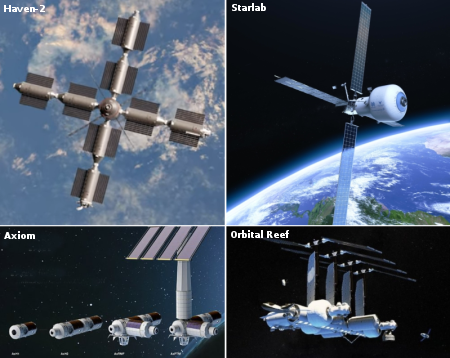
Haven-1 with docked Dragon capsule

The space station startup Vast last week signed an agreement with the space agency of the South American country of Colombia to do cooperative research, linked to Vast’s planned space stations.

The agreement suggested it would be used mostly to encourage educational and research opportunities for Colombia’s universities and schools. However, the press release added this tidbit:

Both organizations intend to work together to identify joint initiatives that leverage Vast’s spacecraft, including Haven-1, scheduled to be the world’s first commercial space station, with AEC’s [Columbia’s space agency] growing ecosystem of data analytics, connectivity, and science education programs.

Vast already has similar agreements with Uzbeckistan, the Czech Republic, and the European Space Agency. Its Haven-1 single module station, set to launch next year for a three-year mission during which it will be occupied four different times for several weeks, still has no confirmed passengers or crews. One can’t help wondering if these international deals hint at the possibility that one or all of these international partners will fly astronauts there.

It is also possible Vast has been hunting for passengers, and as yet has not been able to convince anyone to buy a ticket. I expect everyone is waiting to see the condition of Haven-1, after it launches.

There is one problem that might make any final deal with Colombia difficult: Its Marxist president does not have a very good relationship with the Trump administration.

7 comments

A Midnight Repost: Farewell to America

I wrote the essay below the day before the November 2024 election, when it remained very uncertain whether it would be Donald Trump or Kamala Harris as our next president.

The essay itself did not get picked up at very many news aggregates. Nor did it garner as much traffic as would be expected, based on the aggregates that did pick it up. I believe the reason was the depressing title.

No matter, the point I made then still holds. The fundamental American culture — based on freedom, family, and the Judeo-Christian values of Western Civilization — that made this the most prosperous place ever created by humankind in its entire history no longer exists.

What will come remains unknown. We might see a resurgence of that culture, especially based on the public’s response following the murder of Charlie Kirk. Then again, we might not. As I said in the very first line of my history, Leaving Earth, societies change.

I repost this essay now, during Thanksgiving week, because I strongly believe it essential that we understand exactly where we stand, in order to make it possible for us to move forward, in the right direction. The essay is also another example of my never-ending and too often successful effort to look farther into the future than others. I think a year later this essay stands up quite well in this sense.

———————————–
Farewell to America

The Liberty Bell
“Proclaim liberty throughout all the land unto all
the inhabitants thereof.” Photo credit: William Zhang

Despite my headline, this essay is not intended to be entirely pessimistic. Instead it is my effort to accept a reality that I think few people, including myself, have generally been able to process: The country we shall see after tomorrow’s election will not be the America as founded in 1776 and continued to prosper for the next quarter millennium.

The country can certainly be made great again. Elon Musk’s SpaceX proves it, time after time. The talent and creativity of free Americans is truly endless, and if Donald Trump wins it is very likely that energy will be unleashed again, in ways that no one can predict.

The country can certainly become free again. There is no law that prevents the elimination of bureaucracy and regulation, no matter how immortal government agencies appear to be. The fall of the Soviet Union in 1991 proves this. Though Russia has sadly retreated back to its top-down government-ruling ways, the country did wipe out almost all its bureaucracy in 1991, resulting in an exuberant restart that even today is nowhere near as oppressive as Soviet rule.

Should Donald Trump win, we should have every expectation that he will do the largest house-cleaning of the federal government ever. The benefits will be immeasurable, and magnificent.

What however will not change, even if Donald Trump wins resoundingly tomorrow, is the modern culture and political ethics that now exist. That modern culture is fundamentally different than the America that existed during the country’ s first 200 years, and it guarantees that America can never be the country it once was.
» Read more

12 comments

China launches unmanned Shenzhou-22 capsule to its Tiangong-3 station

UPDATE: The capsule successfully docked with Tiangong-3 as planned, thus giving its three astronauts a lifeboat again.

China tonight (November 25, 2025 Chinese local time) successfully launched an unmanned Shenzhou-22 capsule to its Tiangong-3 station, its Long March 2F rocket lifting off from its Jiuquan spaceport in northwest China.

China moved very fast to get this rocket and capsule integrated and stacked and ready to launch, less than three weeks. This speed was essential because the three-person crew on Tiangong-3 had no usable lifeboat capsule which they could use should something go wrong and they needed to evacuate. Their capsule, Shenzhou-21, had been used by the previous crew to get back to Earth because that crew’s capsule, Shenzhou-20, had been damaged by “space debris,” according to China’s state-run press.

The capsule is scheduled to dock with Tiangong-3 later in the day, about six hours after launch.

No word by China’s press where the rocket’s lower stages crashed inside China.

The leaders in the 2025 launch race:

154 SpaceX
73 China (a new record)
15 Rocket Lab
13 Russia

SpaceX still leads the rest of the world in successful launches, 154 to 121.

1 comment

NASA trims $768 million from Boeing’s Starliner contract

Starliner docked to ISS
Starliner docked to ISS in 2024.

According to one story late today, the modifications NASA announced today on its Starliner contract with Boeing will trim $768 million from the total contract, assuming the two later optional manned missions never fly.

Originally valued at $4.5 billion, Boeing’s contract under the Commercial Crew Program envisioned six operational astronaut flights. NASA’s latest modification cuts that number to four, including up to three crewed missions and an uncrewed cargo flight set for April 2026. Two additional flights remain optional. With the changes, the contract’s value has dropped by $768 million to $3.732 billion; NASA has already paid $2.2 billion to date.

Boeing can still earn that additional money if if somehow manages to convince NASA to do all six flights. It will have great difficult achieving this, however, since there probably won’t be enough time to get all six flights up before ISS is retired. That fact is partly why NASA has made this change.

This report however suggests that NASA is not paying Boeing extra money for the unmanned cargo mission in April 2026. Instead, it is treating it as if it were the first operational manned Starliner flight, paying Boeing its purchase price as if it had achieved all its milestones during the manned demo flight last year.

It really pays in today’s America to be a big giant corporation that does lots of business with our bloated and very corrupt federal government. That government is then quite willing to bend over backwards to help you, even if you are like Boeing and incompetent (Starliner), corrupt (737-MAX), or routinely go over-budget and fail to deliver on time (Air Force One). That certainly appears to be the case here with Boeing.

Hat tip BtB’s stringer Jay.

2 comments

Blue Origin’s Blue Ring orbital tug gets a customer

Blue Origin today announced that the orbital situational awareness company Optimum Technologies (OpTech) has purchased payload space on the first flight of its Blue Ring orbital tug.

Blue Ring’s first mission is expected to launch in 2026 with initial injection into Geostationary Transfer Orbit (GTO) and additional services performed in Geostationary Orbit (GEO). The Blue Ring vehicle will demonstrate its ability to simultaneously support the GEO tracking and custody mission as well as space object characterization, leveraging dynamic maneuverability to support high-resolution characterization.

OpTech’s Caracal sensor is designed to provide actionable insights on resident space objects and orbital activity and includes onboard image storage, object detection algorithms, and passive thermal control. The payload is designed to operate flexibly across dynamic orbits over a year-long mission profile. Caracal will fly with Scout Space’s Owl sensor, along with internally developed payloads, all demonstrating Blue Ring as the ideal platform for supporting future GEO space domain awareness missions.

This instrument is designed to inspect what else is in orbit. It could be that the mission will have Blue Ring fly close to other satellites, both foreign and domestic, so that Caracal can gather imagery and data. Such capabilities are things both the Chinese and Russians have tested repeatedly and the Pentagon needs as well.

This announcement once again indicates that under CEO David Limp, Blue Origin is finally beginning to actually do things.

0 comments

NASA downgrades Boeing’s Starliner contract

Starliner docked to ISS
Starliner docked to ISS in 2024.

NASA today announced a major revision to its contract for Boeing’s manned Starliner capsule, changes that will require it to fly one more unmanned cargo mission to ISS before putting people on it again, while also reducing the total number of later purchased manned flights.

As part of the modification, the definitive order has been adjusted to four missions, with the remaining two available as options. The next Starliner flight, known as Starliner-1, will be used by NASA to deliver necessary cargo to the orbital laboratory and allow in-flight validation of the system upgrades implemented following the Crew Flight Test mission last year.

NASA and Boeing are targeting no earlier than April 2026 to fly the uncrewed Starliner-1 pending completion of rigorous test, certification, and mission readiness activities. Following Starliner certification, and a successful Starliner-1 mission, Starliner will fly up to three crew rotations to the International Space Station.

It has been rumored for months that NASA would require Boeing to fly another unmanned mission before certifying Starliner for manned flights. The question that this press release does not answer is whether NASA is paying for this unmanned flight. The original contract was fixed price, and required Boeing to meet certain milestones before further payments. Another cargo flight to ISS was not in that original deal.

I therefore suspect this is NASA’s way to get Starliner certified. Boeing has likely refused to pay for another demo flight, threatening instead in negotiations to cancel the project entirely. NASA however needs to get cargo to ISS. By buying a cargo mission from Boeing (possibly instead of Northrop Grumman’s Cygnus capsule, which is presently hindered because it lacks its Antares launch vehicle), NASA gets that cargo while also saving Starliner.

The bottom line remains fundamental: Will Boeing finally be able to do a successful problem-free Starliner flight in April 2026? We shall have to see. The fact that NASA appears to be reducing the total number of eventual Starliner missions to ISS indicates its own lack of confidence.

17 comments

Bigoted academia upset that Trump won’t allow them to push the racist DEI agenda

Lysenko with Stalin
Trofim Lysenko (on the left), preaching to Stalin as he destroyed
Soviet plant research by persecuting anyone who disagreed with him,
thus causing famines that killed millions. He is now the role model for
today’s entire science community.

Cue the world’s smallest violin! An article today in the journal Science proves once again that science has nothing to do with what that journal now publishes. The headline:

‘This is censorship.’ Conference requires abstracts to comply with Trump anti-DEI order

It seems scientists submitting abstracts to the annual Lunar and Planetary Science Conference (LPSC) in Texas are upset because the Trump administration will not allow any papers to include any mention of diversity, equity, or inclusion (DEI) as a topic.

The Lunar and Planetary Science Conference (LPSC), hosted annually by the Lunar and Planetary Institute (LPI) in Texas, last week announced a new requirement for the upcoming 2026 conference: All submitted abstracts must comply with executive orders from the administration of U.S. President Donald Trump. His 20 January executive order called DEI “illegal and immoral discrimination programs” and terminated both federal DEI programs as well as grant funding for DEI initiatives. The conference policy follows moves earlier this year by LPI’s parent organization, the Universities Space Research Association (USRA), to scrub DEI-related content—including archived LPSC abstracts—from its websites.

Researchers are fuming, saying LPSC is doubling down on its previous decisions, and prioritizing avoiding trouble with the government over intellectual freedom. “This is censorship,” says planetary scientist Paul Byrne of Washington University in St. Louis. “Even if the percentage of people who would normally write a DEI abstract is small, a much larger percent are pissed off.”

In other words, the science community wants to support DEI racial discrimination, because it is designed to favor the racial and sexual groups they favor. To them it is more important to infuse these bigoted ideas into all science, rather than actually report real research about the solar system and planets.
» Read more

7 comments

China launches a “communications technology test satellite”

China today successfully launched what its state-run press called a “communications technology test satellite,” its Long March 3B rocket lifting off from its Xichang spaceport in southwest China.

No other details about the satellite were released. Nor did that state-run press provide any information about where the rocket’s lower stages, using very toxic hypergolic fuels, crashed inside China.

The leaders in the 2025 launch race:

152 SpaceX
72 China (a new record)
15 Rocket Lab
13 Russia

SpaceX still leads the rest of the world in successful launches, 152 to 120.

0 comments

The DC swamp proposes beating China in space by creating another bureaucracy here on Earth

Gotta feed those DC pigs!

My heart be still: A bi-partisan group of senators, led by Senator John Cornyn (R-Texas), yesterday introduced legislation they claim will help the U.S. beat China in space by creating a new government agency called the “National Institute for Space Research,” designed to encourage research in space tied to the proposed commercial space stations.

Reports indicate that China is launching new modules to its Tiangong space station to meet growing demands for science and to boost international cooperation and is developing a new-generation crew spacecraft with two variants: one for low Earth orbit (LEO) and one for crewed lunar missions. China has been actively promoting international cooperation through Tiangong, offering countries like Oman, Egypt, Pakistan, and others opportunities to participate in space research largely for free or at an extremely low cost. China has also offered to train foreign astronauts, garnering interest from countries like Saudi Arabia, Pakistan, and the UAE to train engineers, scientists, and mission operators for satellite development, and to launch services in which Egypt, Algeria, and Argentina are actively involved. This is a part of China’s broader Belt and Road Initiative, where space cooperation is bundled with tech transfer, loans, development projects, and the like.

This underscores strategic and accelerating investment by foreign adversaries in space-based infrastructure, research, and exploration. China’s ability to offer space-based partnerships to other nations allows it to build soft power and potentially shift international norms in space governance and tech standards.

In response, the Space RACE Act would create a National Institute for Space Research, a federally controlled but independently operated entity designed to coordinate and advance U.S. microgravity research in LEO using next-generation space platforms after the retirement of the ISS.

The last thing this bill will achieve is a stronger American space industry. Rather than funding real research or development in space, this legislation simply creates another Washington government agency supposedly functioning independent of presidential or even congressional oversight (a legal structure the courts have increasingly declared unconstitutional).

This is just more pork. It is also symbolic of the stupidity of our elected officials, who still do not really understand the real reasons beyond the on-going renaissance in America’s space effort. It hasn’t been the government that made it happen. It has been the private dreams of competing companies and individuals, figuring out ways they could make money launching rockets, often with the government acting as a major obstacle. Rather than streamline our bloated government to get it out of the way of this new private sector, these senators want to create more government to dictate how that sector functions.

Ugh. There are times I wish I didn’t have to read the news from DC. It almost always depresses me.

25 comments

ArianeGroup confirms it is targeting about six Ariane-6 launches in 2026

According to an official with ArianeGroup, the company that builds and owns the Ariane-6 rocket, it hopes in 2026 to double the launch rate from 2025, from four this year to as many as eight launches next.

The Group is ramping up production at its sites in France and Germany for this purpose. The main stage will be manufactured in Les Mureaux, France, and the upper stage in Bremen, Germany. The latter is considered the heart and brain of the rocket, as it is responsible for controlling the final flight section and reaching the target.

In Bremen, the Group developed a serial production process – similar to assembly line production in car manufacturing. Six upper stages are to be produced in parallel at the plant in future. Ten to twelve upper stages are to be completed and delivered each year. “The target of around ten missions per year should be achieved by 2027,” said Franzeck.

Franzeck’s prediction matches that made two weeks ago by the head of Arianespace, which manages Ariane-6 for ArianeGroup.

It is likely that these companies will get at least six launches off in 2026. Whether they can achieve eight is less likely, based on their past recent record. Reaching 10 launches in 2027 is probably more certain however. They have a big 18-launch contract with Amazon to launch its Amazon LEO satellites (formerly Kuiper), and there is great pressure to achieve those launches quickly because of Amazon’s FCC license requirements.

After this however the future of Ariane-6 remains uncertain. It is too expense (being expendable) to compete in the present launch market. Few European companies want to buy it, and there are numerous new reusable rockets about to begin operations.

2 comments
1 29 30 31 32 33 838