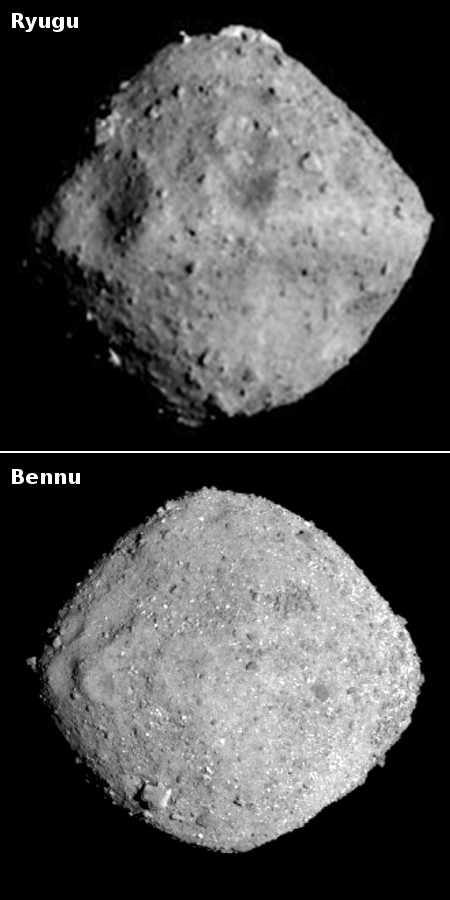
Scientists detect the five chemicals that make up DNA/RNA inside Ryugu samples
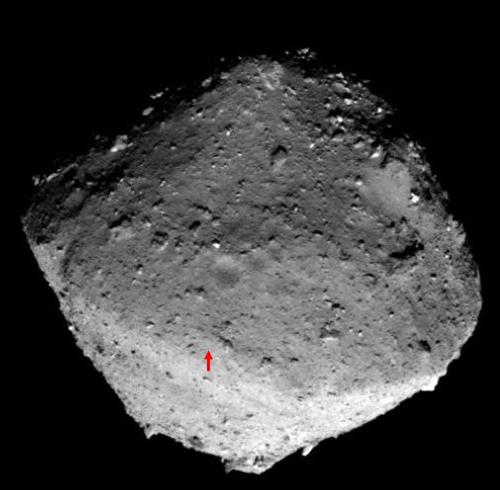
Ryugu as seen by Hayabusa-2 shortly before it grabbed
samples from the surface. Arrow indicates planned touchdown
site.
Scientists studying the samples brought back from the asteroid Ryugu by Japan’s probe Hayabusa-2 have found therein a full set of the five fundamental chemicals that make up either DNA or RNA: adenine, guanine, cytosine, thymine and uracil. From the paper’s [pdf] abstract:
Organic molecules delivered from extraterrestrial materials may have played a key role in supplying building blocks for life on Earth. Here we report all five canonical nucleobases—purines (adenine and guanine) and pyrimidines (cytosine, thymine and uracil)—in samples returned from the C-type asteroid (162173) Ryugu by JAXA’s Hayabusa2 mission and compare the results with data from similar extraterrestrial material.
Ryugu samples contain nearly equal amounts of purines and pyrimidines, whereas Murchison is enriched in purines and Bennu and Orgueil in pyrimidines. Samples from Ryugu, Bennu and Orgueil, which have a similar mineralogy and elemental composition, show purine-to-pyrimidine ratios negatively correlating with ammonia.
These observations indicate that the nucleobases in these samples may have formed via a shared pathway depending on the physicochemical environment of the respective parent bodies. The detection of diverse nucleobases in asteroid and meteorite materials demonstrates their widespread presence throughout the Solar System and reinforces the hypothesis that carbonaceous asteroids contributed to the prebiotic chemical inventory of early Earth.
In other words, the data from these samples suggests that the formation of life on Earth was greatly aided by the deposition of these carbon molecules from asteroids onto the Earth.
At the same time, some caution must be exercised. At present we only have samples from three asteroids, one of which (Orgueil) was obtained shortly after it crashed on Earth. It will take a much larger census of many in-space asteroids to confirm this hypothesis.