
Voyager Space partners with Airbus to build its Starlab space station

Voyager Space, one of the three companies with a contract from NASA to develop a commercial private space station, has now signed a partnership agreement with the European aerospace company Airbus to work together to build its Starlab space station.

The companies announced Aug. 2 the creation of a joint venture, also called Starlab, that will be responsible for the development and operation of the station. The joint venture builds upon an agreement announced in January where Voyager selected Airbus to provide technical support for the proposed station.

“This transatlantic venture with footprints on both sides of the ocean aligns the interests of both ourselves and Voyager and our respective space agencies,” said Jean-Marc Nasr, head of space systems at Airbus, in a statement. “Together our teams are focused on creating an unmatched space destination both technologically and as a business operation.”

Though no specifics of the deal were released, Voyager will continue to retain 51% control. It appears that Voyager’s goal with this deal is to get its foot in the door of Europe. With ESA no longer considering doing any work on the space stations of either China or Russia, it needs a place to go after ISS is retired. By signing up Airbus as a partner Voyager makes Starlab the most likely go-to station for these European companies and governments.

Isn’t private enterprise and freedom wonderful? Without even trying Europe is going to get a space station of its own, and it will do it by hiring this private consortium of American and European companies.

Hat tip to Jay, BtB’s stringer.
Voyager Space’s space station will use India’s manned capsule as ferry

Voyager Space, which is one of three consortiums building private space stations for NASA, has now signed a deal with India to begin work that would make possible using India’s Gaganyaan manned capsule as a ferry to Voyager’s Starlab space station.

Gaganyaan is presently under development. India hopes it will fly its first manned mission by 2025. Meanwhile, this international deal is not the first for Voyager. It has also signed launch contracts with India to use its two smaller rockets to launch payloads, as well as signed a development deal with Europe’s Airbus.

Space station builder Voyager raises $80 million in private investment capital

Capitalism in space: Voyager Space, one of three companies that NASA has provided funds to build a private space station, has now raised $80 million in private investment capital.

The funding includes participation from NewSpace Capital, Midway Venture Partners and Industrious Ventures, according to U.S. Securities and Exchange Commission filings and other documents viewed by TechCrunch. Seraphim Space also participated, TechCrunch has confirmed. The funding was filed with the SEC on January 27.

The company is building Starlab in partnership with Nanoracks (which is the majority owner of Voyager) and Lockheed Martin, which has already received $160 million from NASA.

Voyager signs deal with Airbus to build its private space station

Voyager Space, the division of Nanoracks that has a contract with NASA for building one of four private space stations, has now signed a deal with Airbus, which will provide Voyager additional technical support.

It appears this deal is going to give Europe access to at least one of those American stations, once ISS is gone.

“We are proud to partner with Airbus Defence and Space to bring Starlab to life. Our vision is to create the most accessible infrastructure in space to serve the scientific community,” said Dylan Taylor, Chairman and CEO of Voyager Space. “This partnership is unique in that it engages international partners in the Commercial Destinations Free-Flyer program. Working with Airbus we will expand Starlab’s ecosystem to serve the European Space Agency (ESA) and its member state space agencies to continue their microgravity research in LEO.”

Unlike ISS, where profit was not a motive, Voyager has to make money on its Starlab space station. If Europe wants in, it needs to provide Voyager something, and this deal is apparently part of that contribution. I also suspect that high level negotiations occurred within NASA, ESA, and Voyager to make this deal happen so that Europe would continue to have access to at least one of the American stations.

Voyager Space signs cooperative deal with Azerbaijan

Capitalism in space: Voyager Space, the subsidiary of Nanoracks that is building its Starlab private space station, has signed a cooperative agreement with Azercosmos, Azerbaijan’s space agency.

The press release is very vague about what the deal entails.

This strategic multi-year collaboration paves the way for Azercosmos and Voyager Space to proactively develop mutually beneficial space infrastructure, technology, and manufacturing initiatives, research programs, and further opportunities for innovation. With the potential to exchange experience and knowledge, the organizations will focus on commercial and educational opportunities in-country to foster a thriving local space ecosystem.

I suspect it will eventually lead to Azerbaijan sending research payloads to Starlab, once it is in orbit and operational.

The number of recent deals made by American private space companies, either to fly foreign astronauts in space, provide payload space on planetary missions, or provide space station capabilities for foreign science research, is beginning to be difficult to count. With at least four different American private space stations under construction, with at least one more proposed, the rush to sign up customers by these companies is accelerating.

Expect the business to be very brisk once these get launched. It appears that practically every government on Earth wants to claim it has a space program, and buying space and seats from these American commercial companies is going to be the quickest and cheapest way to do it.

Hilton chosen to design hotel suites on Nanoracks’ Starlab private space station

Nanoracks' Starlab space station
Nanoracks’ Starlab space station

Capitalism in space: Hilton has been chosen to design the hotel suites inside the Starlab private space station that Nanoracks is building and hopes to launch sometime this decade.

Voyager and Hilton will partner in the areas of architecture and design, leveraging Hilton’s word-class creative design and innovation experts, to develop Space Hospitality crew headquarters aboard Starlab, including communal areas, hospitality suites, and sleeping arrangements for the astronauts.

The announcement was made by Voyager Space, the Nanoracks’ division that is building Starlab, and already has a $160 million development contract from NASA.

NASA awards contracts to three private space station projects

Capitalism in space: NASA today announced development contract awards to three different private space station projects.

  • Nanoracks Starlab concept won $160 million. Partners include Voyager Space and Lockheed Martin.
  • Blue Origin’s Orbital Reef project was awarded $130 million, partnering with Sierra Space, Boeing, and Redwire.
  • Northrop Grumman won $125.6 million on a concept based on upgrades to its Cygnus freighter.

All three contracts are Space Act agreements, designed by NASA to jumpstart the companies and their design efforts. All three are in addition to the effort by Axiom to build its own ISS modules that will eventually detach to form its own independent station.

That’s four private American space stations now in the works. All are aiming to launch before this decade is out.

Nanoracks and Lockheed Martin to partner in building commercial space station

Capitalism in space: The companies Nanoracks and Lockheed Martin have announced that they have formed a partnership to build their own private commercial space station, dubbed Starlab.

Nanoracks, its majority owner Voyager Space and Lockheed Martin, will collaborate on the development of a commercial space station as others in industry warn of a potential space station gap.

Nanoracks said Oct. 21 that it was partnering with Lockheed Martin and Voyager Space on a commercial space station called Starlab. Nanoracks will be the prime contractor with Voyager handling strategy and investment and Lockheed serving as the manufacturer and technical integrator.

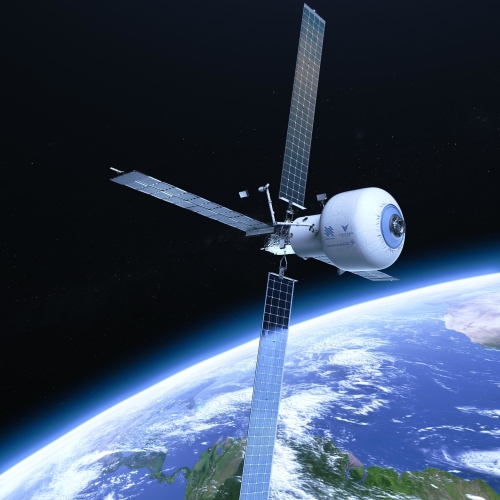
Starlab would consist of a docking node with an inflatable module attached to one side and a spacecraft bus, providing power and propulsion, attached to the other side. Starlab will have a volume of 340 cubic meters, about three-eighths that of the International Space Station, and generate 60 kilowatts of power. Starlab will be equipped with a robotic arm and “state-of-the-art” lab, and be able to host four astronauts at a time.

They are aiming for a 2027 launch.

1 2