Space station startup Voyager Technologies acquires lunar lander startup Astrobotic

Moon's south pole, with landers indicated
Mission’s to the Moon’s south pole.

The space station startup Voyager Technologies, the lead company in the consortium building the Starlab space station, announced today that is its acquiring the lunar lander startup Astrobotic Technology.

The acquisition directly supports NASA’s Artemis program and Administrator Jared Isaacman’s commitment to a permanent American presence on the Moon by 2028. Voyager intends to accelerate investment to scale Astrobotic’s lunar and reusable rocket programs in support of America’s Moon Base plans.

Following Voyager’s strategic investment in Max Space’s expandable habitat architecture, the company’s capabilities will span the full arc of lunar operation. This includes lunar mission management, communications and propulsion; surface delivery via Astrobotic’s Peregrine and Griffin landers; surface power through Astrobotic’s LunaGrid solar distribution system; long-duration habitation through Max Space; dust mitigation with Voyager’s clear-dust repellent coating; and in-situ resource production.

After three years of delays, Griffin is scheduled to launch on a Falcon Heavy rocket before the end of this year, landing near the south pole with four NASA payloads and Astrolab’s Flip demo rover, as indicated on the map to the right. Astrobotic has launched one previous lander in 2024, but was unable to attempt a landing because of a fuel leak that occurred shortly after launch.
2 comments

NASA abandons core module idea for its commercial space station program

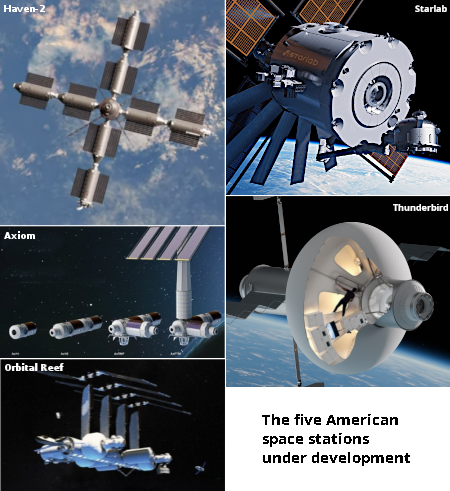
The American space stations under development

Bowing to the unanimous opposition by the three most advanced commercial space station startups, NASA official Bethany Stevens yesterday announced that it is abandoning its proposed core module space station concept and returning its commercial space station program to its original plan, whereby the private stations all compete independently.

Industry has provided extensive feedback making the case for a sustainable commercial market in which NASA is one customer among many, along with assurances regarding available transportation capabilities. The industry position will now shape the path forward as NASA proceeds with the original commercial strategy.

Over the coming weeks, NASA will work with stakeholders and industry to refine flexible requirements and acquisition plans, with a draft RFP expected later this month.

The original plan was for the private sector to compete for one or two major construction contracts from NASA. The core module approach, put forth under NASA administrator Jared Isaacman’s leadership in March, instead made them all part of a government space station, like ISS, at least initially. Under that plan the new commercial space stations would attach their first modules to a government-built core module that NASA would first build and own. Isaacman proposed this because he and NASA believed it didn’t have the budget to finance more than one commercial station, and that the agency didn’t think there was sufficient market to make up the difference.

Officials from Vast, Starlab, Axiom and elsewhere all expressed opposition to the core module plan, insisting there was sufficient market to finance their stations, even without NASA. They also opposed the core module plan because it would require major changes in their present designs, and they had great doubt NASA could build that core module quickly enough for their financial purposes.

Isaacman and NASA apparently listened to these objections, and were convinced their idea was a mistake and the industry was right. It is now reviewing its budget and will decide whether it can do what it originally hoped, award two stations a major contract.

Either way, the recent news from all these three stations suggests they are increasingly in a strong position, whether or not they win that NASA contract.

6 comments

Starlab gets another investor

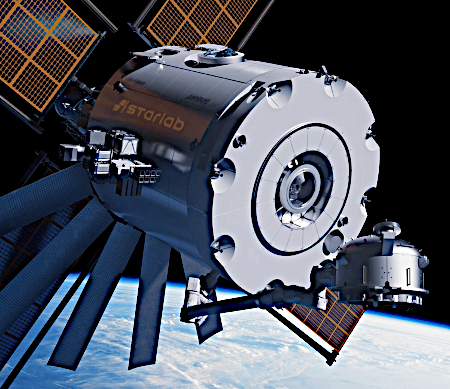
Starlab design as of December 2025

The consortium building the Starlab space station today announced that the investment firm 1789 Capital has made a “strategic investment” in the station’s construction, though neither would state the amount of that investment.

Starlab Space Stations and 1789 Capital announced 1789 Capital’s strategic investment in Starlab. The investment reflects mounting confidence that Starlab — the U.S.-led joint venture, next-generation commercial space station — represents a durable and commercially grounded cornerstone of the post-International Space Station (ISS) low-Earth orbit (LEO) economy.

…“America built the space age and must lead the next one,” said Omeed Malik, founder and president, 1789 Capital. “We invest in the next chapter of American exceptionalism, and Starlab is turning that vision into reality.” The firm’s investment in Starlab reflects its thesis that critical infrastructure — from the digital to the orbital — represents a generational opportunity where national interest and investor returns are aligned.

When asked, Starlab’s press office simply said “We are not disclosing the value at this time.” This has been the company’s policy when it comes to private investment. In January 2026 it announced another major investor without disclosing the amount invested.

Nonetheless, this new investment strengthens Starlab’s overall position, even if that support is tentative. In my rankings below of the five stations under development, Starlab, Vast, and Axiom remain essentially tied for first place..
» Read more

0 comments

Vast signs deal with Lithuania

Haven-1 with docked Dragon capsule
Artist rendering of Haven-1 with docked
Dragon capsule

The space station startup Vast earlier this week signed an agreement with Lithuania to work together on future space missions, either to ISS or its Haven-1 single-module station scheduled for launch next year.

Under the agreement, Vast and Innovation Agency Lithuania will explore opportunities for joint scientific research activities either in the International Space Station National Lab or Haven-1, scheduled to be the world’s first commercial space station, launching in 2027. The partnership also includes plans to further develop educational programs in Lithuania and deepen engagement with local industry.

This deal is similar to Vast’s earlier deals with the European Space Agency, the Czech Republic, Colombia, Uzbekistan, Japan, and the Maldives. All are structured so that should Haven-1 reach orbit and be proven operational and safe for occupancy, these countries could consider sending their own astronauts on missions there. All thus show there is an international market for a private space station, a market that Vast is working hard to capture.

In other space station news, Voyager Technologies, the lead company building the Starlab station, released its 2026 first quarter fiscal report, indicating a solid financial position resulting from its diversification into military-based space applications. Though the report notes that “Starlab does not generate revenue today, nor is expected to generate revenue in the near term,” the company’s overall strength lays a strong foundation for that station’s eventual construction.

In my rankings below of the five stations under development, these two stations remain essentially tied for first place, with Axiom a close third.
» Read more

3 comments

Two space station startups strengthen their positions

The American space stations under development

The startups building the commercial space stations Haven-1 and Starlab this week made deals that will further strengthen their positions both to win future NASA contracts while also making their own operations more functionally viable.

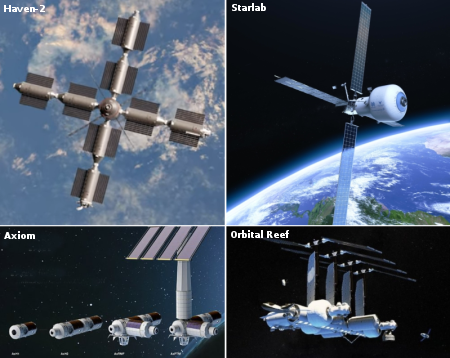
First, Vast, which hopes to launch its Haven-1 single module demonstration station next year and follow it up with its full Haven-2 station (as shown to the right), signed a deal with former NASA astronaut Sunita “Suni” Williams, making her the fifth astronaut to join the company’s astronaut advisory committee.

Former NASA astronaut and U.S. Navy Captain Sunita “Suni” L. Williams has joined Vast as an Astronaut Advisor. She joins Vast’s esteemed group of Astronaut Advisors led by Lead Astronaut Andrew Feustel, including Garrett Reisman, Megan McArthur, and former JAXA astronaut and Vast Japan General Manager Naoko Yamazaki.

It is clear each one of these former government astronauts sees the possibility of flying again to Vast’s Haven-1 station, which the company hopes to have occupied four times for two weeks during its three year mission. They are also hoping to be part of the much larger Haven-2 station to follow.

Vast in turn is now assembling a staff of very experienced professional astronauts it can use to lead all these proposed missions.

Next, Voyager Technologies, the lead company in the consortium building the single-module large Starlab station that will launch on Starship, signed an agreement with Yonsei University in Seoul, South Korea. While initially the deal will have the university do research at Voyager’s research facility in Ohio, it also lays the groundwork for the univesity to eventually get access on Starlab, once launched.

For Voyager this deal helps show NASA that there is a real market for these private stations, something NASA administrator Jared Isaacman has expressed doubts about.

In my rankings below of the five stations under development, the first three stations remain essentially tied for first place.
» Read more

1 comment

Voyager wins slot to fly tourist mission to ISS in 2028

Starlab design as of December 2025

NASA today announced that it has awarded Voyager Technologies a slot to fly a tourist mission to ISS in 2028.

The mission, named VOYG-1, is expected to spend as many as 14 days aboard the space station. A specific launch date will depend on overall spacecraft traffic at the orbital outpost and other planning considerations.

Voyager will submit four proposed crew members to NASA and its international partners for review. Once approved and confirmed, they will train with NASA, international partners, and the launch provider for their flight.

Voyager is the lead company in the consortium that is building the Starlab station, a single very large module to be launched on SpaceX’s Starship.

At this moment three of the five commercial stations that are developing private space stations — Axiom, Vast, and Voyager — now have deals to fly such missions to ISS. The two remaining likely didn’t pass muster with NASA, for different reasons. Max Space is a late comer to this competition, only declaring that it is building its own station this year. Orbital Reef, led by Blue Origin and Sierra Space, is apparently a dead project, with neither company doing anything to sell its project for the past year or so.

In my rankings below of the five American commercial space stations presently in development, the first three are essentially tied at this point.
» Read more

2 comments

Voyager to make “a multi-million-dollar strategic investment” in Max Space’s inflatable habitats

Voyager-Max lunar habitat
Click for original image.

In an expansion of a partnership announced last month, Voyager Technologies — the lead company in the consortium building the Starlab space station — today announced it is now making “a multi-million-dollar strategic investment” in Max Space’s inflatable habitats, aiming at winning contracts both for NASA’s proposed Moon base as well as any other “future deep space missions.”

The actual dollar amount has not yet been released, but my sources say it is in “the low eight figures,” or more than $10 million but probably less than $25 million.

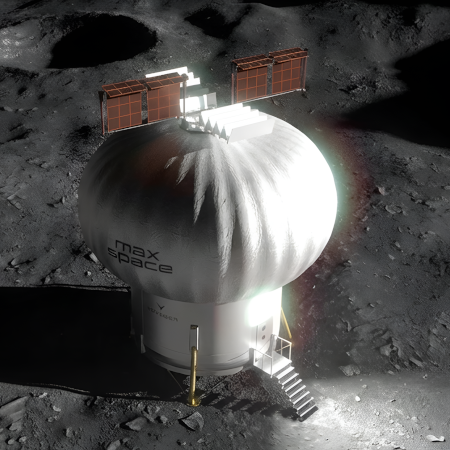
This partnership appears aimed not at NASA’s space station program nor enhancing Starlab. Instead, it is focused on providing NASA (and other commercial operations) inflatable habitats that can be launched and quickly established on the Moon and elsewhere, as shown by the artist’s rendering to the right. It appears Voyager will build the foundation, base, and airlock, while Max will provide the inflatable module above. From the press release:

This initiative directly supports NASA’s historical Artemis Program and aligns precisely with Administrator Isaacman’s announcement to be on the Moon to stay by 2028. Max Space delivers critical enabling infrastructure, maximizing livable volume, enhancing crew safety, and reducing the cost and complexity of surface deployment. It complements Voyager’s broader lunar roadmap, including cislunar mission management, surface logistics, propulsion, power systems, and future surface infrastructure, reinforcing a shared vision of the Moon as an operational domain, not a temporary destination.

In other words, the two companies are aiming to become major suppliers for NASA’s Artemis lunar base, and to do that by offering a way to get it quickly built and operational, at a reasonable cost.

I suspect it will be a few years before NASA issues any such contracts. It will first want to see both companies demonstrate success, both with Voyager’s Starlab and Max Space’s own demo station module scheduled for launch in ’27. Nonetheless, this announcement puts them on the map in the race to get those contracts, and begins to put some commercial reality to the American colonization of the solar system.

4 comments

Medical company making artificial retinas buys payload slots on Starlab

Starlab design as of December 2025

The medical company LambdaVision announced yesterday that has booked payload slots and commercial space on Starlab in order to manufacture “protein-based artificial retinas.”

LambdaVision leverages microgravity to improve the layer-by-layer production process of their artificial retina through alternating layers of the protein bacteriorhodopsin and a polymer, supported by a membrane of a synthetic fiber that has long been used by the medical community. Reduced gravity in an LEO environment improves homogeneity, stability, and performance of thin films like the protein-based artificial retina. By using proteins similar to the visual pigment rhodopsin naturally found in our eyes, LambdaVision’s protein-based artificial retina mimics the light-absorbing properties of human photoreceptors replacing the function of these damaged cells in the retinas of blind patients.

Starlab is the giant single module space station being built by a consortium led by Voyager Technologies that will be placed in orbit by a Superheavy/Starship launch.

While NASA allowed this kind of medical research on ISS, it never allowed the companies to manufacture any products on ISS for later sale on Earth. The new private space stations are decidedly opposed to that government restriction, and thus they are attracting customers like LambdaVision because they will allow it to make money on what it produces. The press release notes that while this first project is aimed at producing artificial retinas to restore vision in patients, the technology will be applicable to “sensitive biosensors, optical systems, tissue engineering, and drug delivery applications.”

In my rankings below of the five commercial American space station projects under development, the first three are basically tied, the fourth is simply late to the game, and the last, Blue Origin’s Orbital Reef, is hardly out of the starting gate.
» Read more

7 comments

Voyager wins four-year $24.5 million ISS management contract from NASA

The space station startup Voyager Technologies yesterday won a four-year $24.5 million contract from NASA to apparently manage the agency’s missions to ISS.

Under the task-order contract, Voyager will deliver end-to-end mission services spanning payload integration, mission operations, safety and compliance, and post-mission closeout. NASA may add options that extend the scope and value of the agreement over its life, providing Voyager with a multi-year framework for recurring mission execution. Voyager anticipates onboarding three payload missions over the next quarter, reflecting near-term demand and a steady pipeline of task orders supporting ongoing ISS operations.

The company has been doing similar ISS work for NASA at the Johnson Space Center in Texas, though this contract appears to expand that work considerably. This deal provides the company further experience operating space station missions, crucial for the Starlab station that Voyager is listed as the consortium’s lead company.

Of the five stations under development, Axiom has run tourist missions to ISS to demonstrate this capability, Vast is launching its own demo single module station to demonstrate this capability, and now Voyager is doing this work for NASA to demonstrate this capability.

Max Space, which only entered this race late last year, has no such contract or experience, but it has recently partnered with Voyager in other work, and plans to launch its own demo station module in ’27.

The last proposed space station, Orbital Reef, has no such deal as far as I know. Led by Blue Origin (partnered with Sierra Space), this station project continues to show no progress of any kind.

0 comments

Voyager Technologies and Max Space team up to develop inflatable planetary structures

The station designs as of the end of 2025

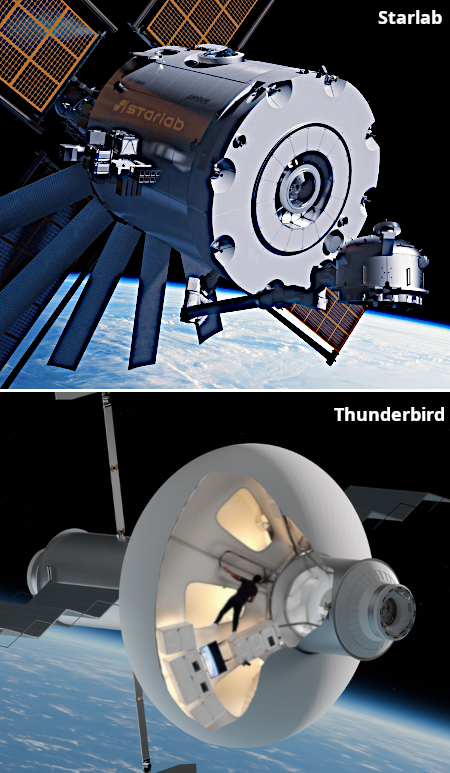
The space station startups Voyager Technologies, which is leading the consortium developing Starlab, and Max Space, which is developing its own inflatable Thunderbird station, have now partnered to use their combined talents to develop inflatable planetary structures for habitation and cargo.

In terms of their space stations, they are similar but different. Voyager’s Starlab station will be a single giant module launched on Starship. The consortium building this module had hired the interior decoration company Journey to design the interior, and yesterday showed off a mock-up of that interior.

Max Space’s Thunderbird is an equally large single module but because it uses inflatable technology it will launch on a Falcon 9. The company plans to launch a smaller demo module in ’27 to prove this technology.

Both companies will now use their skills together to begin design work on inflatable habitats that both NASA and SpaceX could use on the planned lunar and Mars colonies.

The phased development path includes ground validation and in-space demonstrations later this decade, with the goal of enabling operational lunar and Mars capabilities aligned with NASA’s exploration timelines. The partnership emphasizes early risk retirement, interoperability and commercial scalability as guiding principles.

In other words, these companies are expanding their business model to sell their products across a wider range of uses. This deal does not change my rankings of the five space stations currently under development, as shown below, but it is an interesting data point that suggests the technology of these space stations can be marketed in many other space-related areas.
» Read more

2 comments

German startup Spark Microgravity to build first space-based commercial cancer lab

The American space stations under construction
The American space stations under development

The German startup Spark Microgravity announced yesterday it is negotiating with two commercial space stations, one re-entry capsule company, and one French rocket startup to launch the first commercial cancer lab in space.

SPARK Microgravity is collaborating with Axiom Space and Voyager Technologies on commercial low Earth orbit (LEO) opportunities, with ATMOS Space Cargo supporting future return missions. A first flight demonstration with Swedish Space Corporation is scheduled in May. The cancer research will be launched in partnership with HyPrSpace, which developed Baguette-One, the first rocket to be launched from France.

Axiom hopes to launch its first modules in ’28, while Voyager’s Starlab station can’t launch until Starship is operational, possibly about the same time. ATMOS is a German startup developing a returnable capsule that can fly in orbit for several months. It has a deal with Hyperspace to fly a demo capsule on Baguette-1, which is a suborbital rocket.

Similar research has been done on ISS, but NASA’s rules forbid that research to produce a product for sale. Those rules won’t apply on the private stations, and Spark’s existence is a reflection of this new profit-oriented reality. Spark is going to attract investment capital from the pharmaceutical and academic communities, and thus is another profit center for the commercial space stations, outside of government funding.

The market for these new space stations is growing, making any NASA construction contracts less critical in the long run.

6 comments

Mitsubishi buys space on proposed Starlab space station

Starlab design in 2025
The Starlab design in 2025. Click
for original image.

The Japanese company Mitsubishi has now signed an agreement with the consortium building the large single module Starlab space station that will launch on Starship, reserving part of that station for the company’s own use while also increasing its financial investment in the project.

Starlab Space LLC today announced that Mitsubishi Corporation has reserved and pre-purchased capacity on Starlab’s commercial space station, becoming a foundational customer while simultaneously increasing their investment in the company and joining Starlab’s Board of Directors through representative Issei Shinohara.

The expanded partnership includes acquisition of usage rights for designated payload volume and utilization of on orbit laboratory facilities on Starlab, positioning Mitsubishi to accelerate space-based research opportunities for Japanese institutions. This customer commitment is accompanied by an expanded equity partnership that brings additional investment to support Starlab’s development.

Mitsubishi had in April 2024 already joined the Starlab partnership, though almost no details were announced at that time. Today’s announcement provides those details. It also appears Mitsubishi is bypassing Japan’s space agency JAXA, which in the past always ran such international projects. Instead Mitsubishi will directly “support Japanese space development objectives while contributing to advancements in areas such as life sciences research, advanced materials development, and next-generation manufacturing technologies.” In other words, it is telling JAXA to jump in the lake. It can do this better without that government third party, which by the way has not been very effective in recent years.

This deal continues Starlab’s aggressive momentum in recent months. Though Axiom is still listed above it in my rankings below of all the American space stations under development, I now consider the two essentially tied for second.
» Read more

0 comments

Space station Starlab gets major new investor

Starlab design in 2025
The Starlab design in 2025. Click
for original image.

The consortium led by Voyager Technologies that is building the Starlab space station announced last week that it has obtained a major new investor with more than a billion dollars in assets.

The investor, Seven Grand Managers, is based in New York. The announcement did not specify how much the firm had committed to the Starlab project, but it was clear from this statement that involved significant funds.

Starlab is being built to be commercially viable from Day One,” said Chris Fahy, founder and chief investment officer, Seven Grand. “Our investment recognizes that commercial infrastructure in the post-ISS era is not speculative, but tangible, bankable and poised for growth. Starlab’s world-class management team and strategic partners are unlocking the beginning of this enormous opportunity.” [emphasis ine]

The highlighted quote suggest Seven Grand was impressed with the Starlab concept, a single very large ready-to-go station launched on Starship. Most of the other stations will involve assembly of multiple modules on multiple launches before they are “ready-to-go.” The only other station launching as a single module, Max Space’s Thunderbird, has only recently entered the race, and is thus far behind.

Starlab had previously raised $383 million in a public stock offering, in addition to the $217.5 million provided by NASA. This new private investment capital further strengthens its future, and suggests the station could get built and launched, even if it fails to win a major station construction contract from NASA.

Below are my rankings of the five American space station projects:
» Read more

1 comment

ESA cancels call for commercial cargo services to ISS

European Space Agency logo

In what might be a larger decision by the European Space Agency (ESA) to pull back from support to ISS, the agency has cancelled a call for proposals that asked private commercial startups to provide cargo to ISS.

On 3 October, ESA published a call for proposals under its CSOC Cargo Commercially Procured Offset (3CPO) initiative, seeking commercial transport services to the ISS to deliver between 4,900 and 5,000 kilograms of pressurised cargo to the orbiting laboratory. According to the call, the mission was intended to act as a “strategic offset’ to secure flight opportunities for ESA astronauts. It did, however, stipulate that the prospective procurement would only proceed if member states agreed to fund the initiative at the agency’s Ministerial Council meeting on 26 and 27 November 2025.

Following the late November meeting, ESA announced that member states had “agreed to implement short-term actions to guarantee European astronauts’ access to the International Space Station until its planned end of exploitation in 2030.” While this initially appeared to signal a favourable decision on the 3CPO initiative, the agency formally cancelled the call on 17 December, citing “the implementation of programmatic adjustments.”

What makes me speculate that this decision is part of a larger strategy to pull back from ISS is based on other statements by ESA officials cited in the article. It appears ESA is also delaying the mission of one astronaut to ISS that had originally been planned for ’26, possibly by as much as two years.

Though that official said ESA had fully funded its commitments to ISS at its recently concluded ministerial council meetings, both of the above decisions suggest it is shifting its support elsewhere. It could very well be that ESA is beginning the process of transferring its support from ISS to the new commercial private stations, most especially Starlab, which it already has signed a partnership agreement. By delaying funding to ISS, it reserves that money for later use at the new stations.

1 comment

Japanese bank invests in Starlab

Starlab design in 2025
The Starlab design in 2025. Click
for original image.

The consortium building the Starlab space station today announced that the Sumitomo Mitsui Trust Bank of Japan has invested in the project.

Through this investment, SuMi TRUST Bank will support Starlab’s efforts to develop and commercialize space station technologies, while exploring opportunities for collaboration that contribute to the advancement of space-related industries and broader industrial development in Japan and globally.

The press release provided no other information, other than this boilerplate PR jargon. The amount invested was not mentioned.

Regardless, the investment tells us two things: First, Starlab has now raised more than $400 million in investment capital, and appears in a solid position to begin work on its large single module station to be launched on Starship.

Second, the investment in this American-based space project by this Japanese bank speaks volumes about the sad state of Japan’s own commercial space industry. Other than the lunar lander Ispace, Japan has seen little success from any other major rocket startups. One rocket startup, Interstellar, has obtained some investment capital, but the development of its rocket seemingly stopped for the past five years. Another, Space One, has had one launch failure. And though Honda has completed a successful vertical take-off and landing of a small rocket prototype, it doesn’t expect to attempt an orbital launch until 2030.

Meanwhile, the two rockets owned by Japan’s space agency JAXA, the H3 and Epsilon, are grounded because of launch failures.

It appears this bank believes it is more likely to earn profits from this American project than from these other Japanese space efforts.

4 comments

Starlab picks Leidos to assemble, integrate, and test its space station prior to launch

Starlab design in 2025
The Starlab design in 2025. Click
for original image.

The consortium building the large single-module Starlab space station (intended to launch on Starship) yesterday picked the American company Leidos to assemble, integrate, and test its station prior to launch.

Leidos will assemble and integrate the components of Starlab’s space station into a complete system, supporting compatibility and verifying performance through environmental, functional and performance testing in Alabama. Additional responsibilities under the agreement include safety and mission assurance and systems engineering.

Since the consortium’s lead company, Voyager Space, raised nearly $400 million in its first public stock offering in June, Starlab has been signing up a lot of new partners, many of which like Leidos are aimed at building the station itself. First it signed the company Journey to design the station’s interior. Then it signed the Louisiana space hardware company Vivace to build Starlab’s primary structure. Next, a Belgium software company specializing in payload integration joined the consortium. Finally Voyager last week acquired the satellite electric propulsion company Exoterra. Initially I thought this last acquisition was aimed at increasing Voyager’s ability to win military contracts, but it also could provide the station itself with a system for orientation and propulsion.

All in all, this activity continues to strengthen Starlab’s position in the competition to win major contracts and customers leading to the construction of the station itself. Below is my updated rankings of the four commercial stations under development:
» Read more

18 comments

Voyager Space buys satellite electric propulsion company Exoterra

Voyager Space announced yesterday that it has acquired Exoterra, a company that specializes in building electric propulsion engines for satellites.

ExoTerra’s proprietary technology delivers precise maneuvering, extended lifetimes and high efficiency delta-V – essential for spacecraft across national defense architecture layers that must be able to reposition, avoid threats and sustain mission advantage.

…ExoTerra’s Halo thruster technology is proven aboard DARPA Blackjack ACES spacecraft and the company recently supplied York Space Systems with 21 propulsion modules for the Space Development Agency Transport Layer. The company also has contracts with commercial companies and organizations such as NASA.

Voyager Space began as a space station startup, acting as the lead company in the consortium building the Starlab station. Since then it has diversified its operations to make money in other space-related areas. This acquisition appears aimed at increasing Voyager’s ability to win contracts in connection with the military’s Golden Dome project.

5 comments

Belgium company joins Starlab space station consortium

Starlab design in 2025
The Starlab design in 2025. Click
for original image.

The Starlab consortium, proposing to build its single-module large Starlab space station that will be launched on Starship, has now added the Belgium company Space Applications Services (SpaceApps) as both a partner and investor.

SpaceApps contributes deep experience in space systems, mission operations and payload integration with capabilities that include avionics, payload development, the end-to-end International Commercial Experiment Cubes (ICECubes) service, as well as mission integration and operations control software. The company also works closely with the European Space Agency and international partners, broadening Starlab’s access to global markets and research communities.

The Starlab consortium already includes the American companies Voyager Space and Northrop Grumman and the European company Airbus. It also has a partnership agreement with the European Space Agency. This new Belgium partnership further cements its place as Europe’s potential future space station after ISS is retired.

This deal is only one of several news stories in the past week signaling progress by this consortium. It has signed the American company Vivace to build the station’s main structure and its partner Northrop Grumman has successfully tested the rendezvous and docking technology its Cygnus cargo capsule will use to dock with Starlab. All in all this station appears to be assembling the pieces its needs.

Below is my updated rankings of the four commercial stations under development:
» Read more

0 comments

Starlab selects Vivace to build the primary structure of its proposed space station

The American space stations under construction
The American space stations under development

The Starlab consortium today announced that it has chosen the Louisiana space hardware company Vivace to build the primary structure of its proposed space station, designed to launch as one very large module inside SpaceX’s Starship.

The aluminum-based structure, one of the largest single spaceflight structures ever developed for launch, will be built at Vivace’s facility in New Orleans, La., with additional development and testing support from [NASA’s] Michoud Assembly Facility (MAF) in Louisiana.

…The program will use Vivace’s New Orleans facility at MAF for fabrication, with support from U.S. government partners for subject matter expertise, structural analysis and potential test infrastructure. MAF will also support specialized large-scale manufacturing and assembly operations.

It appears Starlab chose this subcontractor because of its extensive ties to NASA, likely in the hope this will increase the chances it will win the upcoming station construction contracts NASA is expected to issue in the next year or so.

The four commercial stations under development, ranked by me based on their present level of progress:
» Read more

2 comments

Space station startup Vast endorses NASA’s new strategy that no longer requires a continuous human presence in space

The American space stations under construction
The American space stations under development

Officials from the space station startup Vast revealed at a conference last week that they endorse NASA’s new strategy that, not only no longer requires the commercial stations to immediately establish a continuous human presence in space, will also award multiple development contracts to the commercial stations.

Speaking Sept. 11 at the Global Aerospace Summit, Max Haot [chief executive of Vast] endorsed NASA’s new strategy, announced more than a month ago, that calls for multiple Space Act Agreements to support development leading to a four-person, 30-day demonstration mission. “We think it’s really the right direction,” he said, noting it accelerates the award timeline. NASA said in a draft solicitation this month it expects to award multiple funded agreements by April 2026, months sooner than under earlier plans.

The original plan had been to choose at most two, but likely only one of the four consortiums/companies that are developing station proposals. The winner would have gotten a big contract that would have also required it to push hard for continuous full time occupation, from day one.

The new plan will instead award smaller development contracts to as many as three of the four station projects, aimed at getting them off the ground and operating, even if astronauts only fly in them intermittently. Eventually the hope is that their capabilities will expand quickly to permanent occupation, especially if they start earning revenue from the private sector, outside NASA. In fact, the smaller government contracts will force them to seek investment and profits elsewhere.

The four commercial stations under development, ranked by me based on their present level of progress:
» Read more

0 comments
1 2 3