
The space station race: Startup Max Space to establish factory at Kennedy in Florida
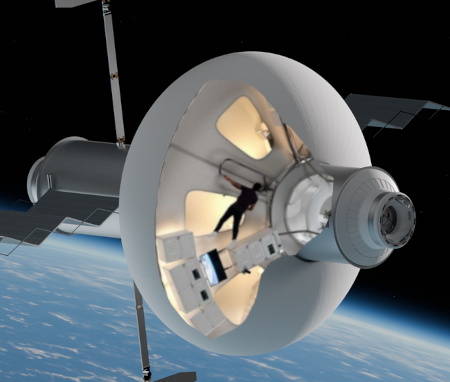
Thunderbird, with cut-out showing interior and person for scale
Max Space’s proposed Thunderbird station, with cut-out showing
interior and person for scale. Click for original images.

The space station startup Max Space has apparently decided to establish its manufacturing facility at the Kennedy Space Center in Florida, and expects to hire its first 30 to 50 employees there this year.

Currently working with Space Florida, Max Space is moving toward setting up operation in Exploration Park on Space Commerce Way, and has already begun hiring. While the company already has a address in Exploration Park, they are seeking to set up in an existing 20,000 to 30,000 square-foot manufacturing facility. This is where the large space habitat modules will be manufactured.

While Space Florida confirmed Max Space’s intentions to move into the area, no further details were provided. Max Space said they expect to bring 30 to 50 new hires onboard within the first half of 2026.

The company had previously positioned itself as the builder of modules that any one of the four other commercial private space stations could buy and add to their stations. It now appears it has decided to enter the competition as its own station, proposing Thunderbird as its bid. It is gearing up to fly a smaller demonstration mission in ’27 to prove its inflatable design that is based on the same technology used by the modules built by the now-defunct company Bigelow.

With this in mind, I have now added Max Space to my rankings of the commercial stations under construction, and have placed it ahead of Blue Origin’s Orbital Reef station, based on my impression of where both projects presently stand. Essentially, they are tied for last place, but I put Max Space ahead because it seems to have positive momentum, while the partnership of Blue Origin and Sierra Space appears to be faltering.
» Read more

Station module builder Max Space announces new Thunderbird inflatable module

Thunderbird, with cut-out showing interior and person for scale
Thunderbird, with cut-out showing interior and person
for scale. Click for original images.

The startup Max Space yesterday unveiled a new larger and upgraded inflatable module, dubbed Thunderbird, that it proposes to sell to the various space stations being built in the U.S. and globally.

Thunderbird Station is built to support 4 or more crew members continuously, with an incredible 350m³ of pressurized volume, more than triple that of a standard ISS module. Launched on a single standard Falcon 9 rocket, the full expandable habitat launches compactly and expands 20x once deployed in orbit, requiring no in-orbit assembly. The interior features a novel reconfigurable architecture, morphic interior structure,that allows astronauts to dynamically adapt the space for research, manufacturing, or living during a mission. The design was developed in collaboration with veteran astronauts to take full advantage of three-dimensional volume in microgravity, not just traditional floor and wall space, to create the most spacious and functional habitable volume ever built. [emphasis in original]

The company also announced that it plans to fly a much smaller demonstration mission of this inflatable module design in the first quarter of 2027, launching on a Falcon 9 rocket and dubbed Mission Evolution.

The primary objective is to test and verify the on-orbit deployment of the expandable module with its exceptional micrometeoroid protection layers. After many years of successful ground testing and development, the flight unit is in full production and is scheduled for launch Q1 2027 onboard a scheduled SpaceX launch.

Max Space first appeared in 2024 when it announced its intention to fly an inflatable demo mission by 2025. Obviously that schedule has undergone some significant delays, though it appears the company used the time to refine its designs considerably. Its management includes one former NASA astronaut and one former member of the Bigelow space station team that built the first private orbiting inflatable modules, Genesis-1, Genesis-2, and BEAM (still operating on ISS).

The company is not trying to build its own space stations. Instead, it is marketing its inflatable modules to all the other space station startups as a quick way to get an additional large module added to their stations.

Hat tip to BtB’s stringer Jay.

Lockheed Martin testing its own inflatable module design

Lockheed Martin recently successfully completed a test of its own inflatable module design, conceived in this case not as a full-scale module but as an airlock for ingress and egress from a space station.

In the Aug. 14 test, the inflatable airlock design was put through multiple, gas-in/gas-out cycles — essentially inflations and deflations with enough nitrogen gas to pressurize the airlock to the point it becomes as rigid as steel — to assess the extent to which its Vectran material strains over time, a process called creep. Knowing how creep affects a Vectran structure will allow Lockheed Martin to properly assess its operational life potential. Test engineers here have also put subscale softgoods habitat designs to the test, purposely bursting them to spotlight their robust nature and determine their pressure thresholds.

With the addition of Lockheed Martin, there are now at least four companies building inflatable modules for sale to space station companies. Sierra Space has the most developed module design, but a company in India recently announced it will build and sell its own. In addition, an American startup dubbed Max Space is building its own test module and hopes to launch next year.

Sierra Space successfully completes 2nd test-to-failure of a full scale LIFE inflatable module

Sierra Space's family of planned LIFE modules
Sierra Space’s family of planned LIFE modules. Click for original

Sierra Space today announced it has completed a second successful test-to-failure of a full scale version of its LIFE inflatable module, intended for use not only on Blue Origin’s proposed Orbital Reef space station, but also available for purchase by other space station.

The latest test by the numbers:

  • Company’s second Ultimate Burst Pressure test of a full-size, inflatable space station structure occurred on June 18
  • Test unit stood over 20’ tall and was comparable in size to an average family home
  • The article was 300 m³ in volume, or 1/3rd the volume of the International Space Station
  • Test results exceeded NASA’s recommended x4 safety levels by 22%
  • Two 4-ft x 4-ft steel blanking plates were integrated into the highest loaded cylinder section of the article; both were 50 lbs. lighter than the ones used in the first full-scale test and accommodate larger windows

The test article in the company’s historic first full-scale burst test last December peaked at 77 psi, which well exceeded (+27%) NASA’s recommended level of 60.8 psi (maximum operating pressure of 15.2 psi multiplied by a safety factor of four). This most recent test in June showed similar results – within five percent of the pressure loading of December’s test article – with this one reaching 74 psi, exceeding NASA’s 4x safety factor by 22 percent. These back-to-back test results accelerate Sierra Space’s path to flight certification, verifying scalability for 10 cubic-meter and up to 1,400 cubic-meter structures based on the company’s current softgoods inflatable architecture. Sierra Space is currently gearing up for a first test of its 500 cubic-meter space station technology next year.

Video of this test, dramatically edited with its own music soundtrack, can be seen at the link.

It is intriguing that the only developments related to Orbital Reef appear to come from Sierra Space. From Blue Origin — supposedly the lead company in that project — we hear almost nothing. Though Sierra Space has said the partnership is still solid, it has also made it clear it is building the LIFE module not just for Orbital Reef. I think it is hedging its bets, anticipating that Orbital Reef will be another Blue Origin dud, and wants to market itself to others.

Hat tip to stringer Jay for this story.

How NASA will use Bigelow’s privately built ISS module

Not much it seems. The key paragraph is this:

Once installed, BEAM will be largely sealed off from the rest of ISS, with astronauts entering it every four to six months to retrieve data from sensors inside it. Crusan suggested NASA will consider making greater use of the module over time as the agency becomes more comfortable with its performance. That would require additional work inside the module, he said, since it has no active life support system beyond some fans.

This story illustrates NASA’s sometimes incredibly over-cautious approach to new technology. I grant that space is difficult and that it is always wise to be careful and to test thoroughly any new technology, but NASA sometimes carries this too far. For example, it took NASA more than two decades of testing before it finally approved the use of ion engines on a planetary mission (Dawn). Similarly, inflatable modules were abandoned by NASA initially, and wouldn’t even exist if a private company, Bigelow, hadn’t grabbed the technology and flown it successfully.