
The 12th Starship/Superheavy test orbital flight now scheduled for May 19, 2026
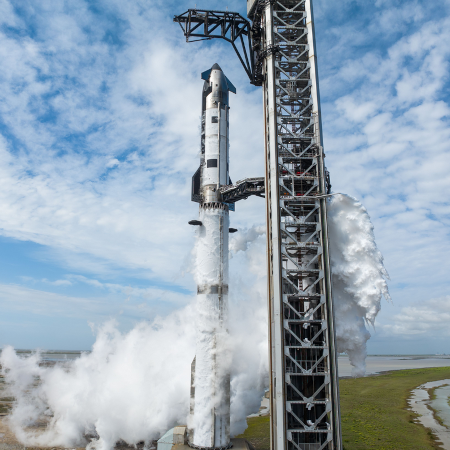
Starship/Superheavy (version 3) on launchpad
SpaceX yesterday announced that the 12th orbital test flight of its Starship/Superheavy rocket is now scheduled for May 19, 2026, with a launch window opening at 5:30 pm (Central).
The mission will be also be the first flight of what SpaceX calls Version 3 of both the booster and the spaceship, will include the first use of the Raptor-3 engine, and the first use of a completely redesigned launchpad.
The flight test’s primary goal will be to demonstrate each of these new pieces in the flight environment for the first time, with each element of the Starship architecture featuring significant redesigns to enable full and rapid reuse that incorporate learnings from years of development and test.
The booster’s primary test objective will be executing a successful launch, ascent, stage separation, boostback burn, and landing burn at an offshore landing point in the Gulf of America. As this is the first flight test of a significantly redesigned vehicle, the booster will not attempt a return to the launch site for catch.
The Starship upper stage will target multiple in-space and reentry objectives, including the deployment of 22 Starlink simulators, similar in size to next-generation Starlink satellites. The last two satellites deployed will scan Starship’s heat shield and transmit imagery down to operators to test methods of analyzing Starship’s heat shield readiness for return to launch site on future missions. Several tiles on Starship have been painted white to simulate missing tiles and serve as imaging targets in the test. The Starlink simulators will be on the same suborbital trajectory as Starship. A relight of a single Raptor engine while in space is also planned.
As an added potential test-to-failure, the company has also removed a single heat shield tile to test how Starship performs under this failure scenerio. The flight plan will be the same as the previous flights, designed to come down in the Indian Ocean.
A detailed description about the upgrades to Starship, Superheavy, and the ground systems can be found here.
The company will broadcast the launch live, which I will embed on Behind the Black once available.

On Christmas Eve 1968 three Americans became the first humans to visit another world. What they did to celebrate was unexpected and profound, and will be remembered throughout all human history. Genesis: the Story of Apollo 8, Robert Zimmerman's classic history of humanity's first journey to another world, tells that story, and it is now available as both an ebook and an audiobook, both with a foreword by Valerie Anders and a new introduction by Robert Zimmerman.
The print edition can be purchased at Amazon or from any other book seller. If you want an autographed copy the price is $60 for the hardback and $45 for the paperback, plus $8 shipping for each. Go here for purchasing details. The ebook is available everywhere for $5.99 (before discount) at amazon, or direct from my ebook publisher, ebookit. If you buy it from ebookit you don't support the big tech companies and the author gets a bigger cut much sooner.
The audiobook is also available at all these vendors, and is also free with a 30-day trial membership to Audible.
"Not simply about one mission, [Genesis] is also the history of America's quest for the moon... Zimmerman has done a masterful job of tying disparate events together into a solid account of one of America's greatest human triumphs."--San Antonio Express-News
If this flight is successful, I anticipate a quick ramp-up in Starship flight tests/ops during the rest of 2026 and into 2027. The next 18 months should see a lot of “boxes” checked anent Starship including some real biggies.
Sure seems like a very critical, make or break test. The ship especially cannot explode over the Caribbean. And there has to be clear evidence that it can survive reentry to the point of being reusable. Consider that with a $trillion+ valuation of SpaceX, investors will insist on not risking the lawsuits from a catastrophic sub orbital explosion.
There is so much money involved now. Elon no longer talks of Mars. Now the focus is AI data centers in space. Is Starship even the right sized vehicle for that work load?
Steve Richter,
You seem very concerned about Starship and the Caribbean, given your mention of it across multiple posts. Do you think SpaceX is being cavalier in Starship development? Do you believe SpaceX will no longer go to Mars? What does ‘right’ for data centers mean to you here?
The closeup photos of the complete stack I’ve seen at NASASpaceflight show a lot more improvements than listed above. There is much less “prototype” look to the craft. The edges where the last line of heat tiles are look vastly improved, the avionics bays are a lot more refined, the wing roots are more developed, the list goes on. It would seem that they expect to be putting V3 into mission use soon.
I remember back after IFT 11, some people here were expecting IFT 12 to be much sooner, possibly before the end of 2025, certainly in January. I got a lot of pushback when I was saying that Pad 2 would not be ready that soon and March or April was the more reasonable expectation, but even I wasn’t expecting the back half of May.
David Eastman: Your prediction about the timeline for this launch was the most correct, even if it turned out less accurate than you hoped.
No matter. What we all know about SpaceX is that if it needs to take a little extra time to do something, the time will be very well spent.
“…. You seem very concerned about Starship and the Caribbean, given your mention of it across multiple posts. Do you think SpaceX is being cavalier in Starship development? Do you believe SpaceX will no longer go to Mars? What does ‘right’ for data centers mean to you here? …”
I am not sure what to think. Back in the day of the Soviet Union I read that people would figure out what was happening in the world by reading Pravda and noticing what was not printed.
With SpaceX the space media is not reporting on whether a refueled Starship could explode when launching from orbit. There are no reports on whether raptor v3 engines should/could be tested with short hops, both booster and ship, from the launch pad and then back. Since everything is reusable, why stop at static fire? Fill the booster, launch up a few miles and come back.
Regarding Mars, Elon pretty much changed the focus to be the Moon and data centers. Are there engineering reasons for that change? I get most of my information from YouTube and can say for certain that I have no idea. No one is reporting on it.
Elon has been wonderful in past years by frequently speaking to the public, answering all questions about space engineering and the goals of SpaceX. Now, the last 12 months, even longer, his interview appearances are increasingly few. Just guessing, but possibly because the engineering is turning out to be more difficult and success is less definite?
I predict that flight 12 will be an outstanding success.
Also, that flight 12 will help supercharge the IPO.
And that 5 years from now, we will be still waiting on the massive improvements in flight rate and costs that are touted.
300 tons per flight with an hour turnaround at $10M or less according to some.
Steve Richter,
SpaceX tests engines in stages (no pun intended): testing components, then on the test stand, then integrated into a stage, then a vehicle static fire, then a full-fledged flight test. SpaceX has done a sufficient number of hop tests already to determine that they do not need to keep doing that in order to prove Raptor reliability. Further hop tests would not give them relevant information to Starship reliability versus suborbital, and in the future orbital, flights. As for what would happen if it exploded, there’s been plenty of discussion about it, but if you’re looking for such discussions in typical news, you’re not going to find much there. It’s just not the right forum for it, versus there being a conspiracy. What might happen? It really depends on what sort of failure there is. The biggest danger, assuming a Starship explodes, is debris, as it could generate a huge number of fragments that would threaten other spacecraft in orbit. SpaceX seems likely to do refills in a very low orbit, so most of the debris would deorbit within months, but it could be years before all of it did. But any spacecraft not within a few miles could maneuver to avoid fragments, so losses are also dependent on what’s nearby, how quickly debris’ ephemeris is tracked and updated (SpaceX has a great system that they’ve offered to everyone just for the purpose of having ephemeris data widely available), and what trajectories debris is ejected on.
I wouldn’t call it a change of focus so much as an additional step towards SpaceX’s ultimate goal. Musk has been talking about a lunar base for years already, and settling Mars will be extremely expensive. If AI data centers in orbit can increase SpaceX’s profitability, that benefits colonizing Mars. It’s not an engineering change at all.
No, I think you might be missing the talks he’s giving, and how his interactions with the public have simply shifted. You can always tweet to him on X, he’s often replying even to very small accounts on all sorts of questions. Much of SpaceX’s content has shifted to X instead of being available directly on YouTube, so if you only use the latter site you’ll miss a lot.
Steve Richter asks: “There is so much money involved now. Elon no longer talks of Mars. Now the focus is AI data centers in space. Is Starship even the right sized vehicle for that work load?”
Good response by Nate P.
I think choosing the moon as a first target is driven more by SpaceX development cycle than anything else. It became apparent to some of us that they weren’t going to make the Dec 2026 Mars window with Starship Block 3 last year. Block 3 needs to be operational (fully reusable, regular commercial flights, and refueling figured out) before they can launch the first few to Mars.
Moon is a great interim target because the trip time is 3 days one way rather than 6 months, better suited to their development cycle. Better yet, windows are monthly rather than every 24-26 months. Best of all is other than trip times, everything you need to learn to set up a permanent base on Mars can be learned doing the same thing on the moon.
Sounds like the plan for datacenters is a variation of the O’Neill High Frontier proposal to construct large solar power satellites from lunar materials launched off the moon via mass driver. SpaceX variation is talking about launch completed satellites rather than bags of rock.
First step is to make Starship operational and fully resuable. Cheers
Steve Richter asked: “Regarding Mars, Elon pretty much changed the focus to be the Moon and data centers. Are there engineering reasons for that change?”
No one repeats the explanation because it was stated when Musk “changed his focus.”
The reasoning was that traveling to Mars is best during the transit windows, which come every two years or so. SpaceX is going to miss this coming window, so the next time that they can shoot for Mars is almost three years from now. Even then, they are limited in what they can do, relative to developing Mars travel, because they have to start small (a few unmanned flights) and work up to big (manned colonization en masse).
Meanwhile, what are they to do while waiting for the next Mars transit window? Musk announced that decision. Think of it as an additional goal rather than a change of focus.
In addition, SpaceX has a contract to make a Human Landing System lunar lander, and that project must be ready for use before the next available Mars transit window. If there has been a change of focus, then that is the reason.
Back in the bad old days of government-run space, there were many arguments as to whether we should first put a base on the Moon and test out equipment that would be used at Mars or should we first step foot on Mars and worry about the Moon and development of Mars equipment later. I have had several of these arguments, and opinions were firm. agimarc‘s argument of faster and safer development (faster return time if there were a life threatening problem) was common. Musk’s argument was also common, that we might as well go for Mars first, because if not us, who? and if not now, when? and let the Moonbase come naturally through necessity. The choice between the Moon and Mars was necessary, because government didn’t have the money to perform either project, let alone both.
Now that We the People have free-market-run space, one company, Blue Origin, wanted to put a base on the Moon, and another company wanted to colonize Mars. Free-market space is so amazingly successful and profitable that we now have one company that may have the resources to do both!
“Elon has been wonderful in past years by frequently speaking to the public, answering all questions about space engineering and the goals of SpaceX. Now, the last 12 months, even longer, his interview appearances are increasingly few. Just guessing, but possibly because the engineering is turning out to be more difficult and success is less definite?”
Probably not. Success is far more certain, now. Musk may have little new to add to our knowledge without giving away proprietary information. He may not be being asked by the usual interviewers.
___________
John hare wrote: “And that 5 years from now, we will be still waiting on the massive improvements in flight rate and costs that are touted. 300 tons per flight with an hour turnaround at $10M or less according to some.”
“According to some” is the important phrase, here. SpaceX is not shooting for any of these goals. They think that 250 tons is a stretch goal, a flight every hour requires quite a few launchpads (their goal is 8 hours turnaround time per pad, or about 1,000 launches per pad per year), and $10 million or less is likely to be the cost to themselves, not the price they can ask. Can they do that in five years? Probably not, and there probably won’t be that much demand for orbital launches in five years, either.
SpaceX’s goal for a high launch rate comes from their desire to colonize Mars with a large number of flights during each transit window.
On the other hand, $17 per pound to orbit would be a nice price, if only we could get it.
Steve Richter,
The Caribbean need have no concerns anent Starship’s test flight 12. Its trajectory will be between Mexico and Cuba over the Yucatan Channel, not over the Caribbean. As this would also be the most useful launch path from a spaceport built on SpaceX’s hotly-rumored giant Louisiana land purchase, it simply makes those rumors more credible.
Elon has not abandoned Mars. As others here have noted, there simply isn’t anything new that Elon could usefully say about Mars at this point in time. The new orbiting AI data center projects are, in fact, the best guarantee that the Mars project will have adequate allocatable funds for its accomplishment at the point they are most needed.
john hare,
I share your expectations anent flight test 12.
The Starship launch rate will increase at whatever pace SpaceX can manage. Starting with flight 12 in May, we may well see additional flights at monthly intervals from Starbase Pad 2 during the rest of 2026. That would be eight Starship flights in 2026. At or before year-end 2026, the Starship launch complex at LC-39A should be ready to support flight ops too. It might even manage to add a flight or two to the 2026 total.
Next year will see the rebuilt Starbase Pad 1 and the two pads at Canaveral’s SLC-37 come on-line – Pad 1 early in 2027 and the other two later in that year. 2027 will probably average about one Starship launch per week – rather less than that rate early in the year and finishing with more than that by year’s end. 2028 should see Starship flight ops crack into triple-digits. Should the Pecan Island land purchase go through soon, 2028’s Starship launch total should include the first launches from facilities built there.
By decade’s end, with the SpaceX lunar project having gotten underway, annual Starship launch ops could well be approaching, or even surpassing 1,000.
300 tonnes to LEO in a single launch might be doable with a V4 tanker stack having 9 engines on the Ship and 35 on the Booster boosting at full throttle most of the way. The highest G-force achievable makes for the largest boostable load and propellant doesn’t care about G-forces.
As to costs, the cost per launch to SpaceX could well be below $10 million even fairly early-on. It won’t be passing any more of its savings on to customers than market forces require, though. Such market forces will depend upon what SpaceX’s competitors can provide in terms of both price and cadence. Right now, that is nothing. By decade’s end it could be considerable. Stoke will likely have the best economics of all SpaceX competitors, but has a much smaller vehicle and won’t be able to launch it nearly as often as Starship until Stoke can build out more launch facilities. I don’t foresee significant pricing pressure on SpaceX until at least sometime in the mid-2030s, if then.
Dick Eagleson,
You wrote: “300 tonnes to LEO in a single launch might be doable with a V4 tanker stack having 9 engines on the Ship and 35 on the Booster boosting at full throttle most of the way. The highest G-force achievable makes for the largest boostable load and propellant doesn’t care about G-forces.”
I agree that a rocket launching at a higher maximum G-force can launch heavier loads, largely due to the reduced gravity drag, but we all must keep in mind that higher Gs means that the rocket has to be built stronger, therefore heavier, leading to a point of diminishing returns. 300 tonnes (metric) could be possible, but there is a limit to what Starship can possibly do.
A great advantage to more propellants launched on each flight is that fewer flights would be needed for every mission above low Earth orbit. Tanker flights dedicated to either fuel or oxidizer would eliminate the weight of the common dome, allowing for a bit more propellant mass per flight. Orbital refueling depots would be a great help in reducing the number of propellant flights.
“the cost per launch to SpaceX could well be below $10 million even fairly early-on.”
Considering that an early estimate by SpaceX was $2 million per launch, I suspect that even after inflation and amortizing development costs and manufacturing costs, SpaceX may be able to launch Starship for a relatively low cost to themselves. Where their price point per launch finally falls will likely depend upon their supply of Starships and the demand for them.
Because SpaceX wants to send a large number of Starships to Mars every couple of years, the supply is likely to be fairly large during the off-season. So the question becomes: how many massive payloads will we have once the world comes to realize that there is a cheap launch vehicle for them, i.e. what will be the demand?
Starlab already is a customer, as is Superbird-9, and we already see a building demand for space manufacturing. Communication constellations are reality, and there are plans to make huge constellations of orbital data centers. Even so, I suspect that SpaceX is likely to have plenty of supply for any demand that develops, so they may have to price their launches fairly low just to keep the fleet busy.
Another question that I have been pondering, lately: when Starlink launches are shifted to Starship, will SpaceX have to drop the price of Dragon 9 launches in order to keep that fleet busy?
Edward,
I doubt it. SpaceX seems interested in switching over to Starship as fast as possible; the main launches that could not easily be shifted are Dragon launches to the ISS and to future tin can-style space stations. Others might need a new adapter, but other satellites can in principle launch aboard a future fairing-equipped Starship. Manned flights are something of a captive market, so it would take robust, cheap competition to force them out.
Edward,
Given that the payload of a Starship tanker mission will be incompressible fluid – which will spread stresses exceedingly evenly across the entirety of the payload tankage, it might well be the case that Tanker Starships can actually be built a bit more lightly than those with less internal pressure – and gas pressure at that – in the payload compartment to assist in maintaining structural integrity.
SpaceX’s planned lunar industrialization will keep the fleet busy between Mars departure windows, though I’m not sure how much overlap there will be in terms of actual ships – except for the LEO-orbiting propellant depot ships. The Mars-bound Starships, especially early-on, will be of a different design than any intended for Earth-Moon operations.
SpaceX has said it will keep the Falcons flying based on customer demand. NASA and the War Department will likely remain important Falcon customers at least into the very early 2030s. But this year’s seemingly reduced Falcon manifest suggests that Starlink missions on Falcons will be wound down as Starship Starlink deployment ops ramp up. 2027 could well see the final Falcon 9 Starlink launch.
SpaceX has very considerable pricing latitude anent the Falcons. Any retail or block-buy price reductions will be strictly in response to competitive developments – if any. I do not see any such as being likely during the remainder of this decade. And, by early in the coming decade, the Falcons will likely be retired.
Nate P,
That sounds like a reasonable answer. One vote for no. I ask the question for that very reason. Will SpaceX want to keep the Falcon fleet busy? I suspect that we will see fewer and fewer new Falcons built.
________
Dick Eagleson,
Higher internal pressure can mean more mass. It is why pressure-fed engines have a limit; they eventually become too heavy to be worth the simplicity. Either way, liquid propellant has weight that the lower part of the rocket’s structure must be strong enough to carry. My first guess is that the current Starship structure is good enough for a 300 tonne payload, but there are limits that affect the maximum payload that can be carried at any given acceleration.
“SpaceX’s planned lunar industrialization will keep the fleet busy between Mars departure windows”
I don’t know about that. It is either a whole lot of lunar industrialization or a smaller fleet than we imagine. If each Starship launch pad can launch every eight hours, three times a day, then each pad launches 1,000 times a year, and that gives us 5,000 launches for the five pads being build or that are currently planned. The idea seems to be to add even more Starship launch pads. That is a lot of lunar traffic, about 15 launches per day supporting at least one lunar trip per day, or a couple per day if the tankers can carry 300 tonnes.
Starship takes 1,500 tonnes of propellants, so seven and a half 200-tonne tanker flights are needed to retank a Starship, six 250-tonne tankers, or five 300-tonne tankers. There is some suggestion that retanking or propellant depots may be in a higher orbit, something closer to a geostationary transfer orbit, so the tanker capacity and number of retanking flights could be different.
“2027 could well see the final Falcon 9 Starlink launch.”
SpaceX may be counting upon that. I suspect that the last few years of the 2020s will see a temporary drop in the launch numbers presented in our host’s Global Launch Industry reports. That may make for some interesting commentary.
I’m not sure how much presence SpaceX will have in California after the Falcon’s retire. If they are purchasing some Louisiana territory for polar and sun-synchronous launches, Space X may even abandon the Vandenberg launch site. California has been business-hostile for some years, now.
“And, by early in the coming decade, the Falcons will likely be retired.”
With luck, they will be made obsolete by some of the newer launch vehicles, such as Blue Origin’s New Glenn, Rocket Lab’s Neutron, and Stoke Space’s Nova.