
Procol Harum – A Whiter Shade of Pale
An evening pause: Performed live, 2006, with the Danish National Concert Orchestra.
Hat tip Danae.
An evening pause: Performed live, 2006, with the Danish National Concert Orchestra.
Hat tip Danae.
The competition heats up: A Falcon 9 rocket today successfully put a NASA solar observation satellite into orbit.
They have also said that they have achieved splashdown of the first stage, though no details yet on how soft that splashdown was.
Update: SpaceX reports that “the first stage successfully soft landed in the Atlantic Ocean within 10 meters of its target. The vehicle was nicely vertical and the data captured during this test suggests a high probability of being able to land the stage on the drone ship in better weather.”
Because of high seas SpaceX will not attempt to land its Falcon 9 first stage on its floating barge today.
The drone ship was designed to operate in all but the most extreme weather. We are experiencing just such weather in the Atlantic with waves reaching up to three stories in height crashing over the decks. Also, only three of the drone ship’s four engines are functioning, making station-keeping in the face of such wave action extremely difficult.
They will still attempt a soft splashdown of the first stage in the ocean.
Though this kind of repeated soft splashdown test is essential to prove their ability to bring the first stage down safely, it certainly isn’t as exciting as landing the first stage on a barge. Nonetheless, in previous attempts they have been unable to get really good video of the soft splashdown. Maybe they will do better this time, though the high seas suggest it won’t be easy.
On Monday NOAA posted its monthly update of the solar cycle, showing the sunspot activity for the Sun in January. As I do every month, I am posting it here below the fold, with annotations to give it context.
As I have noted previously, the ramp down from solar maximum continues to track the 2009 prediction of the solar scientist community (indicated by the red curve) quite closely. As NOAA also notes,
While awaiting final confirmation, all evidence points to the most recent solar maximum having peaked at 82 in April, 2014. This was within the expected range for the peak, but occurred significantly later than predicted.
Since their graph doesn’t show the entire curves for their predictions, the above statement seems reasonable. However, looking at the graph with those curves inserted (see my annotated graph below the fold), it becomes clear that not only did the peak occur much later than predicted, the maximum’s overall activity was also generally less than predicted.
» Read more
Theft by government: The IRS has seized nearly $19,000 of a widow’s savings because it didn’t like the manner in which she deposited it in the bank.
After [an October policy change that was supposed to stop most of these kinds of cash confiscations], federal prosecutors in Iowa agreed to return money the IRS seized from two people accused of structuring, including a restaurant owner who had $33,000 taken and a doctor who fought to get back $344,000 in earnings from his medical practice. But prosecutors declined to drop the civil forfeiture case over $18,775 the IRS seized from [the widow Janet] Malone.
Instead, they added a misdemeanor criminal charge last week alleging she willfully violated the law, after her husband had been warned about the practice four years ago. Malone is expected to plead guilty next week and let the government keep the money, under a plea agreement filed Monday. The charge carries up to one year in jail and a $250,000 fine.
Note that in every one of these cases, no actual crime was every committed. The money was earned legally. The only issue was the manner in which the individuals deposited the money. The IRS didn’t like it.
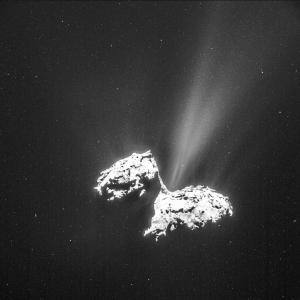
Cool image time! In preparation for a close fly-by of Comet 67P/C-G on Saturday — where it will zip past the comet less than three miles above its surface — Rosetta has eased away to a distance of about 60 miles, allowing its navigation camera to snap its first single frame image since the spacecraft’s initial close approach last summer.
The image brightness has been adjusted to make the plume more obvious. Also, if you look closely at the full resolution version of the image, it is possible to see the dusty material that forms the coma surrounding the nucleus.
In January the last two satellites in Russia’s ballistic missile warning system shut down, with the first of the next generation replacement constellation not scheduled to launch until June.
“Oko-1 was part of Russia’s missile warning system. The system employed six satellites on geostationary and highly elliptical orbits. The last geostationary satellite got out of order in April last year. The two remaining satellites on highly elliptical orbits could operate only several hours a day. In the beginning of January, they also went out of order,” Kommersant said.
The new generation early warning satellite Tundra was planned to be launched in 2013. However, the launch was postponed several times as the apparatus was not ready to be put into operation, sources in the aerospace industry told the daily.
Increasingly I am reminded of the Cold War, when our competition was the bloated, inefficient, and poorly managed Soviet Union. The communist nation was definitely a threat, as they got a lot accomplished through sheer brute force and determination. Their long term problem was that it was an amazingly inefficient system, guaranteed to eventually fall apart.
The competition heats up: Europe today successfully launched and landed its Intermediate Experimental Vehicle (IXV) space plane.
As of 9 pm (Eastern) Wednesday the recovery ship was still “hurrying” to reach the ship, which was being held afloat with “balloons.” Update: The spacecraft has been retrieved.
This prototype is not full scale. It is only about 16 feet long, and was built as a testbed. Whether Europe follows up with a full scale version remains completely unknown. I am skeptical, as this program reminds me of many deadend NASA experimental programs like it, used to try out cool engineering technologies as well as provide pork to Congressional districts without any plans to proceed to the real thing. In the case of IXV, the Italians got most of the pork.
A evening pause: Performed live, 1977.
Hat tip Tom Biggar.
After 29 days in space, Dragon returned safely to Earth today, splashing down in the Pacific.
Finding out what’s in it: Because of required Obamacare regulations and taxes on their union health plans, the unions representing workers at 29 west coast commercial ports are now threatening to strike and shut the ports down.
Obamacare imposes a 40 percent tax on health benefits deemed too generous by the government. Health benefits exceeding $10,200 a year in value for individuals or $27,500 for families are defined as “Cadillac” plans and are subject to the tax. Health benefits for longshoremen exceed $40,000 per employee, meaning the union would be served an enormous tax bill when the penalty is imposed in 2018. The longshoremen’s contract expired in July, 2014 and contract talks have stalled, in large part, over whether workers or employers will pay the new Obamacare tax.
But hey, these unions voted for and continue to support the Democratic Party without question, even as the Democratic Party continues to block any repeal or changes to Obamacare. To these union leaders, it all must be Bush’s fault!
At about T- 13 minutes today’s Falcon 9 launch was scrubbed because of high winds.
They will try again tomorrow at 6:03 pm (eastern).