Auld Land Syne – Freedom mix

An evening pause: This mix was apparently put together just after 9/11, and includes many of the most iconic sound-bites from the 20th century. One of the last lines however must speak to the new 21st century, as it appears many Americans have forgotten what it means to be an American.

“We’re not gonna be stopped! We’re not gonna be deterred! We’re not gonna stay at home! We’re not gonna be afraid!

“We’re gonna live our lives as Americans!”

God bless. Let us work to return freedom to America in 2021.

Auld Lang Syne – (Freedom mix) from Don Krasley on Vimeo.

28 comments

The state of the global rocket industry in the 21st century

With the year of 2020 coming to an end, it is time to look back to see how the world’s rocket industry fared in what was a truly difficult year for most. And with the 21st century now one fifth over, it is also time to take a wider view, to see what the trends have been for space exploration during this new century, and to see where those trends might lead.

Below is my annual updated table showing all successful orbital launches by every nation and company, beginning in 2000. While the table in my 2019 report last year had gone back to 1990, I decided to shorten the graph to just the 21st Century, in order to better focus on that century in particular.

» Read more

20 comments

Musk: Super Heavy will land on launchpad, caught by launch tower

Capitalism in space: In a series of tweets yesterday SpaceX founder Elon Musk revealed that the company is considering landing Starship’s first stage, Super Heavy, on its launchpad but rather than use landing legs it will be caught by the launch tower.

Instead, Musk says that SpaceX might be able to quite literally catch Super Heavy in mid-air, grabbing the booster before it can touch the ground by somehow slotting an elaborate “launch tower arm” underneath its steel grid fins. Although such a solution sounds about as complex and risky as it gets, it would technically preclude the need for any and all booster recovery infrastructure – even including the legs Super Heavy would otherwise need.

While true, catching Super Heavy by its grid fins would likely demand that control surfaces and the structures they attach to be substantially overbuilt – especially if Musk means that the crane arm mechanism would be able to catch anywhere along the deployed fins’ 7m (23 ft) length. Even more importantly, it seems extraordinarily unlikely that such a complex and unproven recovery method could be made to work reliably on the first one or several tries, implying that early boosters will still need some kind of rudimentary landing legs.

The idea is to save weight on the booster. It also would speed its reuse, as there would no longer be a need to transport it from a landing pad back to the launchpad.

Whether this will work will depend on the accuracy of SpaceX’s vertical landing software. That the company has repeatedly proven, from almost the first time it tried it, that it can bring its rockets down exactly where it intends suggests they will be able to be as accurate as necessary.

Nonetheless, expect more than a few launchpad crashes as they work out the kinks on another audacious engineering concept.

20 comments

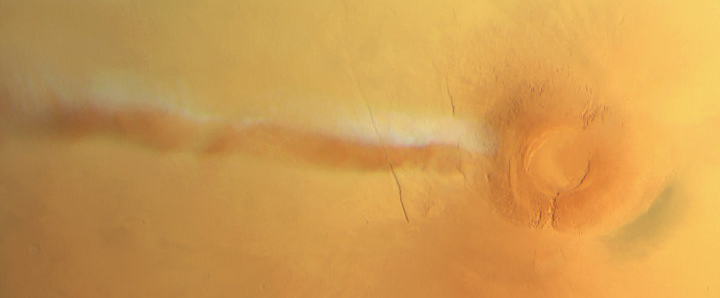
The seasonal cloud over Arsia Mons on Mars

Water-ice cloud over Arsia Mons
The cloud as seen in 2018.

Scientists have now documented the seasonal nature of the strangely elongated cloud that was first spotted in 2018 above the giant volcano Arsia Mons (the southernmost volcano of the three volcanoes east of Olympus Mons).

From their abstract:

We find that the AMEC [Arsia Mons Elongated Cloud] repeated regularly each morning for a number of months, and that it is an annually‐repeating phenomenon that takes place every Martian Year around the southern hemisphere spring and summer. The AMEC follows a rapid daily cycle: it starts to expand from Arsia Mons at dawn at an altitude of about ∼45 km, and for ∼2.5 hours it expands westward as fast as 170 m/s (around 600 km/h). The cloud then detaches from Arsia Mons and evaporates before noon. In previous Martian Years, few observations of this phenomenon are available because most cameras orbiting Mars are placed in orbits where they can only observe during the afternoon, whereas this cloud takes place in the early morning, when observational coverage is much lower.

They also state that they will outline their theories as to the cause of the cloud in a follow-up paper.

I can’t help wondering if it is related to other evidence that suggested past glacial activity on the western flanks of Arsia Mons. There are many pits surrounding this volcano, and many might contain residue ice. One wonders if, during the warm spring and summer months at dawn the arrival of the sun might cause this cloud to form, and then vanish as the day passes, just like the dew does on Earth.

That is my uneducated guess, and likely wrong. We shall have to wait for their theoretical paper for a more educated guess.

4 comments

Surprisingly low number of observation proposals from astronomers for Webb telescope

In preparation for the launch of the James Webb Space Telescope in ’21, the Space Telescope Science Institute (STScI) that will operate it has begun accepting observation proposals from astronomers, and has apparently discovered that the number of proposals, dubbed the subscription rate, is surprisingly low.

The stats of the James Webb space telescope cycle 1 proposal round came in the other day. In summary: an over subscription rate of 1:4. A little less even.

There was immediate spin how the stats were a good thing. Enthusiasm from around the globe! So many investigators! But that does not change that the 1:4 oversubscription is a disappointment. If I were part of the project, this would and should worry me.

If they got exactly the right number of proposals to precisely use all of the telescope’s observation time, the subscription rate would be 1. An oversubscription rate of 1.4 seems good, but in truth it is tiny compared to Hubble and other space telescopes, and horrible considering the cost of Webb (almost $10 billion, 20x what it was originally budgeted).

The author at the link provides some technical reasons for the low interest, some of which are the fault of the Webb management team (such as a very complicated proposal process) and some that are beyond their control (the Wuhan panic). He also provides suggestions that might help.

Either way, the relatively low interest I think is rooted in Webb’s initial genesis. It was pushed by the cosmological community and its design thus optimized for studying the early universe. Other astronomical fields were pushed aside or given a lower priority so that the telescope does not serve them as well.

The result is that a lot of astronomers have been finding other more appropriate and already functioning telescopes to do their work, bypassing Webb entirely. They are probably also bypassing Webb because it seems foolish to spend the inordinate amount of time putting together a proposal for a telescope a decade behind schedule that carries an enormous risk of failure once it is launched.

10 comments

Witness announces his team has hacked Georgia election runoff polling machines

During testimony today in Georgia investigating the possibility of election fraud on November 3rd, a witness announced that his team at that very moment had hacked into the voting machines being used for the Georgia senate runoff races and was communicating with the machines.

During a Senate hearing in Georgia over fraud in the 2020 presidential election, Jovan Pulitzer told the senate members, “At this very moment at a polling location in the county, not only do we now have access to the devices through the poll pad — the system — but we are in.”

Pulitzer told the senators this should not be able to happen, but his team was has able to hack into the voting system and has documented evidence to prove it. Pulitzer said the machines are connected to the internet and two-way communication is occurring in real-time. “It’s receiving data and sending data,” he said.

When questioned, Pulitzer said the polling place his team hacked into is a physical location, not a mobile station. Pulitzer said his team has access to the data from the Georgia Senate runoff race from the polling station.

The article provides a link to his testimony. This proves that the owners of Dominion have been lying when they say their machines are not connected to the internet. It also shows how easy it would be to falsify the results. As the witness noted, if you can download the data from the machines you can change it and then upload it again, and if no one suspected you were doing it (or was willfully blind to your tampering) no one would ever find out.

All election results in Georgia are thus suspect. If nothing is done, that I would be astonished if either Republican candidates won their run-offs.

In fact, I think this comedy movie clip provides a perfect description of our modern American culture:

36 comments

Air leak in Russian section of ISS continues

Dmitri Rogozon, the head of Roscosmos, yesterday announced that they will be sending to ISS special equipment for investigating a new air leak in the Russia section of ISS.

This apparently is not the 1-2 inch long crack in the Zvezda module that leaked previously and was found and sealed. Moreover, the article at the link admits that their astronauts found no sign of damage on the outside of Zvezda when they did a space walk in November, suggesting that this first leak was not caused by a micrometeorite hit.

All the known facts so far strongly suggest that the leaks are because of Zvezda’s 20-year-old age, and might be stress fractures caused by the three dozen or so dockings and undockings that have occurred there since its launch.

That the Russians are being so vague about the entire matter reinforces that conclusion. They have never released an image of the first leak, and provided no details about the equipment being sent to the station.

And if Zvezda is beginning to crack due to age, I am not sure what repairs they can do to stop it.

2 comments

Puerto Rican government commits $8 million to rebuild Arecibo

The government of Puerto Rico earlier this week announced that it has allocated $8 million to rebuild the Arecibo Observatory.

Via an executive order, Gov. Wanda Vazquez made reconstruction of the observatory public policy. In a ceremony at La Fortaleza, the seat of the island’s government, Vazquez said that the Puerto Rican government believes that the telescope’s collapse provides a great opportunity to redesign it, taking into account the lessons learned and recommendations from the scientific community so that it remains relevant for decades to come.

…Vazquez said that she and her administration want the scope to once again become a world class center and the $8 million being allocated for reconstruction includes funds to repair the environmental damage caused by the collapse, something that has already begun under the supervision of the National Science Foundation (NSF).

We shall see what happens. $8 million is not really enough to rebuild Arecibo. And the NSF has been trying to unload it from its budgetary responsibility for almost a decade. I would be shocked if that agency now suddenly decided to fund its reconstruction.

Only if Congress gets involved will this likely change, and that wouldn’t surprise me, considering how nonchalant our present Congress is about spending money that doesn’t exist.

7 comments

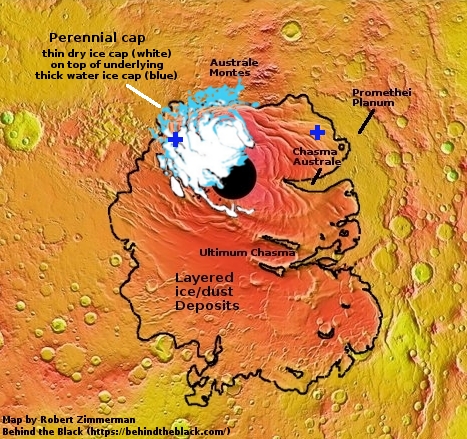
Summer at the Martian south pole

Overview of the Martian south pole

Today we have two cool images, both giving us a tiny glimpse at what it is like in the middle of summer on the fringes of Mars’ south pole ice cap. Their location is indicated by the blue crosses on the overview map on the right.

To review, the south pole on Mars is, like its north pole, mostly made up of a permanent icecap of water. In the south, this icecap is mostly mixed with dust and debris in the area outlined in black and dubbed the layered deposits. On top of this is a smaller thick water ice cap, indicated by light blue, which is in turn topped by a thin cap of frozen carbon dioxide, or dry ice, indicated by white. During the winter the entire pole, down to 60 degrees latitude also gets covered by a temporary mantle of dry ice, that sublimates away each spring.

Now for our cool images!
» Read more

0 comments
1 2 3 169