North Korea can launch nuclear bombs

Peace in our time! South Korean intelligence experts have concluded that North Korea now has both the rocket and miniaturized nuclear warhead capable of hitting Russian, China, Japan, and all of South Korea.

“We believe they have accomplished miniaturization of a nuclear warhead to mount it on a Rodong missile,” said the South Korean official, who has knowledge of South Korea’s assessment of the North’s nuclear program. The official spoke to a small group of reporters on condition of anonymity… The Rodong missile can fire a 1 tonne (1,100 lb) warhead a distance of up to 2,000 km (1,250 miles), the official said. That would put all of South Korea, most of Japan and parts of Russia and China in range.

But don’t worry. President Obama has eased tensions worldwide by his speech-making abilities!

3 comments

The supernovae that fertilized the Earth

A new study has pinned down the dates of two recent supernovae that showered the Earth with the heavier elements that make life here possible.

Many mainstream articles about this story have been implying that this research has discovered the existence of supernovae near the primordial Earth. This is false. Scientists have had evidence of these early supernovae for decades, from asteroids, in isotopes on Earth, and in the existence of the Local Bubble in which the Sun is presently traveling. What this study has done is narrow the location and the time of at least two of these supernovae, a significant discovery, though not the one much of the ignorant press is pushing.

0 comments

Ariane 6 delayed by tax and legal issues

In the heat of competition: Even as Airbus Safran claimed today that Ariane 6 will be price competitive with SpaceX’s Falcon 9, the company cannot begin work on the new rocket because of a turf war Arianespace and French tax collectors.

The tax issue is as follows:

Airbus and Safran had agreed that Safran would pay Airbus 800 million euros ($874 million) in cash, in addition to its rocket-engine manufacturing capability, to become a 50-50 ASL shareholder with Airbus. Airbus officials since the beginning of the year have been negotiating with French tax authorities to determine how to minimize the tax bite of the cash transfer, which industry officials could be as high as 500 million euros, leaving Airbus with a net of just 300 million euros.

Delays in the cash transfer have meant that ASL, which is expected to count 8,000 employees, has been operating with only around 400 employees. In addition, it has made it difficult for the initial ASL team to present a fixed-price Ariane 6 production proposal to the 22-nation European Space Agency, which is financing the majority of Ariane 6 development.

In addition, the merger is being reviewed by the European Commission, part of the European Union.

The commission is looking at whether Arianespace’s minority shareholders, who are Ariane 6 contractors, will be protected once Airbus Safran Launchers raises its Arianespace shareholding to 74 percent from today’s 39 percent. The commission is also reviewing concerns expressed by satellite builders that Airbus, which is a major manufacturer of commercial satellites, might give its own satellites preferential treatment in setting the Ariane 6 manufest.

Airbus Safran still insists they can get the new rocket launched by 2020, but somehow that doesn’t seem reasonable to me, especially because I expect the French and European government authorities here to carve out their piece of the action, thus making it harder for the private company to deliver on time.

1 comment

The sunspot decline continues

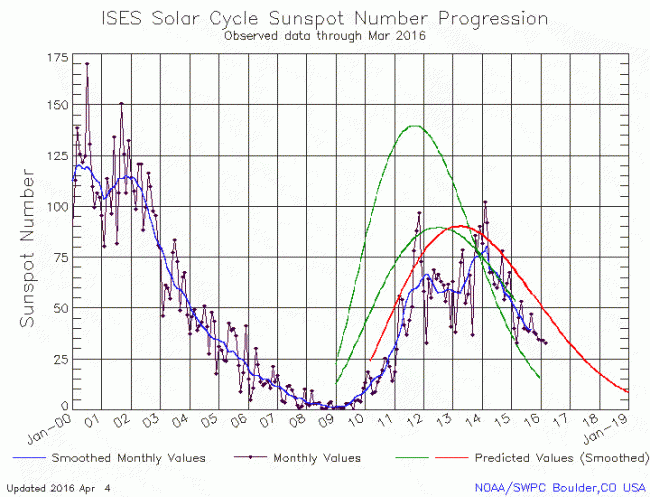
NOAA’s monthly update of the solar cycle was released today, showing the Sun’s sunspot activity in March. It is annotated and posted below.

March 2016 Solar Cycle graph

The graph above has been modified to show the predictions of the solar science community. The green curves show the community’s two original predictions from April 2007, with half the scientists predicting a very strong maximum and half predicting a weak one. The red curve is their revised May 2009 prediction.

For the fourth month in a row the change in the graph is so small you almost need a magnifying glass to see it. Despite this, the decline remains remarkably steady, tracking precisely the decline predicted by the low prediction of the 2007 predictions (indicated by the smaller green line curve).

Recently the number of sunspots has dropped enough that I suspect we are not far the moment when we will once again begin to see days where the Sun is blank of sunspots, a situation last seen in 2010 near the end of the previous solar minimum. When that happens, it will herald the beginning of the next solar minimum.

6 comments

Take-aways from Cruz’s win in Wisconsin

Link here. Key quote, which I think accurately predicts what will happen in the next few months:

Trump will not win 1237 delegates before the convention. The question is whether Cruz can catch him in a plurality or get close to it and win a mandate. It’s quite obvious that Trump’s victories during the first half of the race were a result of unprecedented name ID and a divided field. He would have lost most states had this been a one-on-one contest, which tells you that the majority of voters don’t want him. Thus, even if Cruz comes up short of a plurality, as long as he wins the aforementioned states, the Texas Senator will have a moral mandate when he likely wins a delegate race on the second ballot. Trump will argue that it doesn’t reflect the will of the voters, but it’s clear that 60% of voters in most states don’t want him. He only won in previous states because of Rubio, and the remaining wins come as a result of Kasich staying in the race or non-Republican voters.

The article has lots of good information and analysis. It correctly notes that if John Kasich would do the sensible and honorable thing and end his campaign now, Cruz’s path to the nomination would be significantly cleared.

14 comments

WISE completes another year of asteroid hunting

After being mothballed in space and then reactivated, NASA’s WISE infrared telescope (renamed NEOWISE for no good reason) has now completed its second year of observations, looking for near-Earth objects (NEOs).

NASA’s Near-Earth Object Wide-field Survey Explorer (NEOWISE) mission has released its second year of survey data. The spacecraft has now characterized a total of 439 NEOs since the mission was re-started in December 2013. Of these, 72 were new discoveries. Near-Earth Objects (NEOs) are comets and asteroids that have been nudged by the gravitational attraction of the giant planets in our solar system into orbits that allow them to enter Earth’s neighborhood. Eight of the objects discovered in the past year have been classified as potentially hazardous asteroids (PHAs), based on their size and how closely their orbits approach Earth. [emphasis mine]

Unfortunately, the press release does not provide any details about those eight potentially hazardous asteroids.

0 comments

India to test reusable mini-shuttle in May

The competition heats up: ISRO, India’s space agency, this week announced plans to conduct its first test flight of its half-scale prototype reusable launch vehicle in May.

The RLV, is a scaled-down prototype (some 21.3 feet in length or 6.5 meters) of a future uncrewed single-stage reusable spaceplane, known as Avatar, that is being designed by the ISRO. The May mission will be a technology demonstrator (RLV-TD) to test powered cruise flight, autonomous landing and hypersonic flight using an air-breathing propulsion system. The spacecraft, which resembles a small winged aircraft, will be launched from the first launchpad of the Satish Dhawan Space Centre to an altitude of 43 miles (70 km) atop a two-stage Rohini sounding rocket and then released. It will re-enter the atmosphere and travel back to Earth in a controlled descent, to be recovered from the Bay of Bengal. [emphasis mine]

This vehicle is kind of Inida’s version of the Air Force’s X-37B, except that it is also testing a hypersonic scramjet engine, a cutting edge design that the U.S. has barely been able to fly successfully. Should they succeed, it will place them smack dab in the middle of the elite club of space-faring nations.

1 comment

Boeing moves to block Russians from selling Sea Launch

In a reaction to news that the Russians have a potential buyer for Sea Launch, Boeing has sued to block the sale.

In a motion for a preliminary injunction filed with the U.S. District Court for the Central District of California April 2, Boeing argued that a sale of Sea Launch could hinder its ability to collect on a summary judgment issued last year against Energia of at least $300 million. “If Energia succeeds in selling these assets and moving all of the proceeds thereof to Russia, without paying the hundreds of millions of dollars that it owes, it would unquestionably complicate Boeing’s collection efforts,” the company’s lawyers stated in the court filing.

Energia has refused to pay that $300 million. However, since Sea Launch’s floating launch platform remains docked in California, Boeing retains a great deal of leverage in this legal dispute. I expect the court will eventually put a lock on those assets until the Russians pay up.

0 comments
1 131 132 133 134 135 171