
Trump budget proposal

The Trump administration today released its overall rough budget plan for 2018. This is not a detailed budget, but an summary of their plan, indicating where they wish to cut and where they wish to increase budgets. The proposal is also not complete, making no mention of the administration’s budget plans for many departments, such as the National Science Foundation.

Science research in the federal government is significantly impacted, but not as badly as most of the articles you will read in the mainstream anti-Trump, Democratic Party press. A few examples:

I must note that not all the news stories are blindly hostile to this budget proposal:

Of all the science agencies, NASA probably came off with the least change. The budget cuts only about 5% from the agency’s Earth science budget, while cutting some specific Earth science missions. The budget also supports SLS/Orion, though it finally puts the nail in the coffin of the asteroid redirect mission, an Obama proposal that has never garnered any interest from anyone else.
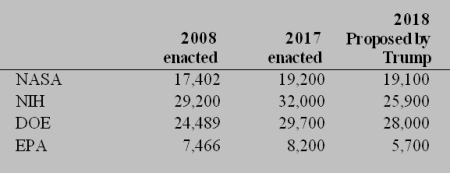
The Trump budget proposal in context

The key to understanding all these budget cuts is to see them in context, to compare the 2018 proposed budgets with the budgets these agencies received in the past. The table on the right gives some of this context (numbers shown are in millions) for several of the science agencies most effected by the proposal. The proposal is not detailed enough to pin down the changes for many other science agencies, but from this table it is clear that the Trump administration is not calling for the end of science, and is proposing some reasonable cost cutting, something that has been rare in government for many years.

What will be missed by most of the press about this Trump budget proposal is that it is not trying to trim the size of the federal government. While it cuts spending in many departments, those cuts are entirely aimed at providing room to raise the budget of the Defense Department by $54 billion. While I can applaud the desire of the Trump administration to be revenue neutral, the stark fact remains that by remaining revenue neutral Trump still leaves us with a gigantic annual federal deficit. They have made no effort to balance the overall budget.

Worse, this proposal would repeal the Budget Control Act of 2011, which imposed sequestration to the federal budget and has actually done the most in the past half century to bring that budget under control. Once this act is repealed, it will allow the spenders in Congress (of which the Republicans are as guilty as the Democrats) to open the floodgates once again. This will not be good.

Let me add one good aspect of the Trump budget. It proposes to eliminate a whole range of government political agencies that accomplish nothing but provide pork or to propagandize the Democratic Party’s positions:

The Budget also proposes to eliminate funding for other independent agencies, including: the African Development Foundation; the Appalachian Regional Commission; the Chemical Safety Board; the Corporation for National and Community Service; the Corporation for Public Broadcasting; the Delta Regional Authority; the Denali Commission; the Institute of Museum and Library Services; the Inter-American Foundation; the U.S. Trade and Development Agency; the Legal Services Corporation; the National Endowment for the Arts; the National Endowment for the Humanities; the Neighborhood Reinvestment Corporation; the Northern Border Regional Commission; the Overseas Private Investment Corporation; the United States Institute of Peace; the United States Interagency Council on Homelessness; and the Woodrow Wilson International Center for Scholars.

Getting these eliminated will at least be a start to cleaning up the mess in Washington.

48 comments

Want to watch a nuclear bomb go off? You can!

Engineers at Lawrence Livermore National Laboratory (LLNL) have obtained declassified films of many of the nuclear tests performed by the U.S. from 1945 to 1962 and are digitally scanning them and preserving them for posterity.

Conducted by LLNL weapon physicist Greg Spriggs and a team of film experts, archivists, and software developers, the project’s goal was to track down as many as possible of the ten-thousand 2,400 frames per second reels of film. This was because the cine film, and its immense historical and scientific value, was in danger of being lost for all time. The reels were mostly of acetate stock that was not stored under anything like ideal conditions and was slowly decaying or being attacked by fungus and microbes.

“You can smell vinegar when you open the cans, which is one of the byproducts of the decomposition process of these films,” says Spriggs. “We know that these films are on the brink of decomposing to the point where they’ll become useless. The data that we’re collecting now must be preserved in a digital form because no matter how well you treat the films, no matter how well you preserve or store them, they will decompose. They’re made out of organic material, and organic material decomposes. So this is it. We got to this project just in time to save the data.”

You can view a number of the films at the second link above. I have embedded below the fold just one, from Operation Teapot in 1955. This was a series of 14 tests in Nevada. In this particular video the explosion occurs in the air, and you can sense the incredible force of the explosion when the shock wave hits the ground and bounces back, producing the mushroom cloud. Not much would have survived that impact.
» Read more

18 comments

SpaceX successfully launches commercial satellite

The competition heats up: SpaceX tonight successfully launched Echostar 23.

This launch is almost four weeks after their last launch, which sent a Dragon capsule to ISS. Their goal this year has been to do one launch every two weeks, a goal they have not yet reached. The next launch, which will also place a commercial communications satellite into orbit, is tentatively set for March 27, and will also be the first launch that reuses a first stage. If they make that happen it will be first time they have hit the two week launch rate this year. They will then try to follow with another Dragon resupply mission, this time reusing a Dragon capsule for the first time.

5 comments

Less evidence of dark matter in early universe

The uncertainty of science: Astronomers have discovered less evidence of dark matter surrounding galaxies in early universe.

Stars in the outer regions of some far-off galaxies move more slowly than stars closer to the center, indicating a lack of dark matter, astronomer Reinhard Genzel and colleagues report online March 15 in Nature. If confirmed, the result could lead astronomers to reconsider the role dark matter played in early galaxy evolution and might also offer clues to how nearby elliptical galaxies evolved.

In contrast with these distant galaxies, stars orbiting on the outskirts of the Milky Way and other nearby galaxies move too fast for their velocities to result only from the gravity of gas and stars closer to the galactic center. If visible galactic matter is embedded in a cloud of invisible dark matter, though, gravity from the invisible matter can explain the high stellar velocities. Using stars’ orbital velocities in nearby galaxies as a reference, astronomers expected that stars in galaxies farther away would behave similarly. “Turns out that is not the case,” says study coauthor Stijn Wuyts of the University of Bath in England.

In other words, scientists at this moment really have no idea what causes the faster rotation in the outskirts of modern nearby galaxies.

17 comments

Titan’s fizzy oceans?

New research suggests that the hydrocarbon lakes of Titan might periodically fizz with nitrogen bubbles.

A recent NASA-funded study has shown how the hydrocarbon lakes and seas of Saturn’s moon Titan might occasionally erupt with dramatic patches of bubbles.

For the study, researchers at NASA’s Jet Propulsion Laboratory in Pasadena, California, simulated the frigid surface conditions on Titan, finding that significant amounts of nitrogen can be dissolved in the extremely cold liquid methane that rains from the skies and collects in rivers, lakes and seas. They demonstrated that slight changes in temperature, air pressure or composition can cause the nitrogen to rapidly separate out of solution, like the fizz that results when opening a bottle of carbonated soda.

These results might help explain the mysterious islands that seem to appear and disappear and then reappear in Titan’s lakes. Rather than islands, they might be patches of nitrogen bubbles.

2 comments

Minneapolis: another American city destroyed by Democrats

Link here. Democrats will see this as a partisan attack. It really isn’t. It is instead another attempt to point out the stark fact that the leftwing policies put forth by the Democratic Party in the past half century have been routinely disastrous.

But by 1988, then-mayor Donald Fraser—a member of the DFLP—had grown troubled by the stark contrast he saw between the majority of his city and who were thriving economically, and a number of African-American neighborhoods where crime, teenage pregnancy, and welfare dependency were experiencing a growth spurt. Taking a page out of the same playbook other big city Democrat mayors were using, Fraser believed that the cure was redistribution of income. He decided to revamp the way in which social-welfare expenditures were allocated and believed, specifically, that federal and local agencies needed to focus more of their resources on the economic problems confronting unwed mothers (who were disproportionately black) and their children.


Fraser’s successors as mayors of Minneapolis—Sharon Sayles Belton (1994-2001), R.T. Rybak (2002-2013), and Betsy Hodges (2014-present)—have shared this same core belief in the importance of massive public expenditures on social-welfare programs and wealth-redistribution initiatives.

The result has been disastrous. As of 2015, the poverty rate in Minneapolis was 25.3%, nearly twice the 14% statewide rate for Minnesota and the 14.3% rate for the United States as a whole. In 2010, a study of 142 metro areas in Minnesota found that only 15 bore a heavier property-tax burden than Minneapolis, and that was before the city raised its property taxes by 4.7% in 2011.

More recently, Minneapolis property taxes increased by 3.4% in 2016, and by a crippling 5.5% in 2017.

 Notwithstanding the growth in revenues generated by these taxes, the government of Minneapolis has been incapable of balancing its budget. In 2015, for example, the Minneapolis Public Housing Authority’s budget included $84 million in federal subsidies and grants. In 2017, the Metropolitan Council—which describes itself as “the regional policy-making body, planning agency, and provider of essential services for the Twin Cities metropolitan region”—received $91 million in federal funding. That same year, the Minneapolis Public Schools operated with a budget deficit of nearly $17 million.


This pattern has repeated itself throughout the United States. For the past half century almost every urban area has been dominated politically by Democrats. In that same time period, those urban areas have seen a distinct worsening of their economic situation. Even as these American cities have imposed a higher and higher tax burden on their successful citizens, they have seen higher and higher deficits. At the same time, poverty and economic failure has increased.

The important thing to note here is that the policies of the Democratic Party are a failure. Since that party seems incapable of changing those policies, it is essential that voters stop voting for it, either to force a change within that party or to remove that party from any position of power. Those are our choices, if we wish to improve the future of the United States.

9 comments

House leans to less regulation of commercial space

During a hearing on March 8 of the House subcommittee on space the representatives overall pushed for less regulation of commercial space activities.

The overall problem was once again dealing with the Outer Space Treaty:

At a March 8 hearing of the subcommittee, members and witnesses grappled with the issue of how the government should oversee emerging commercial space activities in order to comply with obligations to the Outer Space Treaty, including whether such oversight is, in fact, required. Such “authorization and continuing supervision,” as specified in Article 6 of the treaty, is handled today by various agencies for commercial communications and remote sensing satellites and for launch. It’s less clear who would regulate new activities, ranging from commercial lunar landers to satellite servicing efforts, creating uncertainty in industry about who, if anyone, could provide that authorization and continuing supervision.

An April 2016 report delivered to Congress by the White House’s Office of Science and Technology Policy, required by Section 108 of the Commercial Space Launch Competitiveness Act of 2015, recommended what it called a “mission authorization” approach for providing that oversight. This approach would be modeled on the payload reviews performed by the Federal Aviation Administration during the launch licensing process, including an interagency review of proposed missions. While the mission authorization concept had won support from many in industry, as well as the FAA and some members of Congress, a change of administrations and its approach to regulation has emboldened some who want to limit industry regulation.

“Unfortunately, the Obama administration issued a report last year that called for expansive regulations over all types of private space activities,” said Rep. Lamar Smith (R-Texas), chairman of the House Science Committee, at the hearing. He cited a “crisis of overregulation” in general as a reason to oppose the previous administration’s proposal.

The House members and the witnesses apparently rejected the regulatory proposals that had been put forth by the Obama administration, and were instead searching for ways to limit the amount of regulation required under the Outer Space Treaty.

I say, dump the treaty. Nothing in it helps the development of space by private individuals or companies. Everything in it encourages bureaucracy and the limitation of private property.

1 comment

SpaceX wins another Air Force launch contract

The competition heats up: SpaceX has been awarded a $96.5 million contract to launch an Air Force GPS satellite.

This price is about $14 million more than the last SpaceX Air Force launch contract. That’s probably because SpaceX was trying to undercut ULA’s price by as little as possible so that they could increase their profit. Until there are others in the business who can compete with SpaceX’s prices, the company is sitting pretty in any competitive bidding situation. Their costs are less, so they can always beat everyone else’s prices, while maximizing their profits.

12 comments
1 129 130 131 132 133 164