
NOAA claims it is streamlining its remote sensing licensing operations

We’re here to help you! The NOAA office that recently demanded that it has the legal power to regulate all camera images from space announced this week that it has vastly streamlined its licensing process.

Really? Let’s take a look at their own numbers:

Samira Patel, an analyst with the Aerospace Corporation supporting CRSRA [Commercial Remote Sensing Regulatory Affairs at NOAA], said that in 2015 the average review time for a license application was 210 days, with only 1 of 15 applications completed within the 120-day time limit established in federal law. In 2016, that decreased to an average of 140 days, with 5 of 12 applications reviewed within 120 days.

Last year, Patel said the office completed reviews of license applications on an average of 91 days. Only 2 of 16 applications took more than 120 days, she said, “and that was only by a few days.” [emphasis mine]

My heart be still. It now takes them only three months on average to get a permit approved. Imagine how fast they’ll do it when they have to approve every tourist image taken of Earth from the many proposed private space stations.

The article does note that the Trump administration is reviewing the entire permitting process for commercial space, and that this responsibility, as well as the FAA’s licensing responsibility, could soon be merged and moved to the Department of Commerce. I hope that, in the process of this rearrangement, they throw out this new power-grab. The government has no business licensing any image-taking by any private entity.

5 comments

NASA expands first manned Starliner mission

NASA has modified its contract with Boeing to allow its first manned Starliner test mission to add an astronaut and extend the mission’s length so that it more resembles an operational flight to ISS.

NASA is considering adding a third crew member to the Starliner’s “Crew Flight Test” and could extend its trip to the International Space Station from two weeks up to six months, the length of a typical ISS expedition. The potential changes, outlined in a contract modification with Boeing, could help NASA maintain its presence on the International Space Station through 2019 and beyond.

NASA’s last purchased ride aboard a Russian Soyuz spacecraft, upon which the U.S. has relied for access to the ISS since the shuttle’s retirement in 2011, is scheduled to launch in the fall of 2019.
Boeing’s new Starliner spacesuit features lightweight fabric, slim gloves and sneaker-like boots. But Boeing’s Starliner and SpaceX’s Crew Dragon may not be certified to fly four-person crews until after that. “This contract modification provides NASA with additional schedule margin if needed,” said Bill Gerstenmaier, head of human spaceflight operations at NASA headquarters in Washington. “We appreciate Boeing’s willingness to evolve its flight to ensure we have continued access to space for our astronauts.”

Doing this makes some sense, but I wonder why NASA chose to do it with Boeing’s Starliner instead of SpaceX’s Dragon. Starliner has never flown in any form, while the manned Dragon is based on SpaceX’s well tested design.

I suspect NASA will soon modify its SpaceX contract as well. It makes sense. Once you put humans on board, you might as well give yourself the option to do a full mission.

14 comments

Ariane 5 launches two satellites

Europe’s Ariane 5 rocket today successfully placed two communications satellites in orbit, its first launch since January when the rocket placed two satellites in the wrong orbit.

Arianespace did launch a Soyuz rocket in the interim, but this launch signals the return to flight for Ariane 5.

The leaders in the 2018 launch standings:

10 China
7 SpaceX
4 Russia
3 Japan
3 ULA
3 Europe

0 comments

First SpaceshipTwo powered flight since accident

Capitalism in space? Virgin Galactic today successfully completed the first powered test flight of VSS Unity, the first such test flight since the flight accident that destroyed the first SpaceShipTwo and killed on pilot in October 2014.

VSS Unity was dropped from its WhiteKnightTwo mothership from about 50,000 feet (15,000 meters) over the mountains about 20 miles (32 kilometers) north of the Mojave Air and Space Port in California. Pilots David Mackay and Mark “Forger” Stucky fired Unity’s hybrid engine for 30 seconds, boosting the vehicle to a top speed of Mach 1.87 and a maximum altitude of 84,271 feet (25,686 m) before gliding back to the runway at the spaceport, Virgin Galactic representatives said.

During the descent, the crew deployed SpaceShipTwo’s feather system, which reconfigures the ship into a high-drag shuttlecock by moving its twin tail booms. The feather will be used to soften the vehicle’s re-entry into the Earth’s atmosphere during spaceflight.

They say that they hope to begin commercial flights later this year, but I remain exceedingly skeptical.

3 comments

Another space station hotel company enters the market

Capitalism in space: A new space station hotel start-up, Orion Span, hopes to launch their first module by 2021, and begin accommodating guests by 2022.

Aurora Station will accommodate four paying guests and two crewmembers; these latter personnel will likely be former astronauts, Bunger said. Most of the guests will probably be private space tourists, at least initially, but Orion Span will be available to a variety of customers, including government space agencies, he added.

And the space hotel will get bigger over time, if everything goes according to plan. As demand grows, Orion Span will launch additional modules to link up with the original core outpost, Bunger said. “Our long-term vision is to sell actual space in those new modules,” he said. “We’re calling that a space condo. So, either for living or subleasing, that’s the future vision here — to create a long-term, sustainable human habitation in LEO [low Earth orbit].”

This makes three companies vying to build the first private space stations, with Bigelow and Axiom Space already in the game.

3 comments

Revisiting Biosphere 2

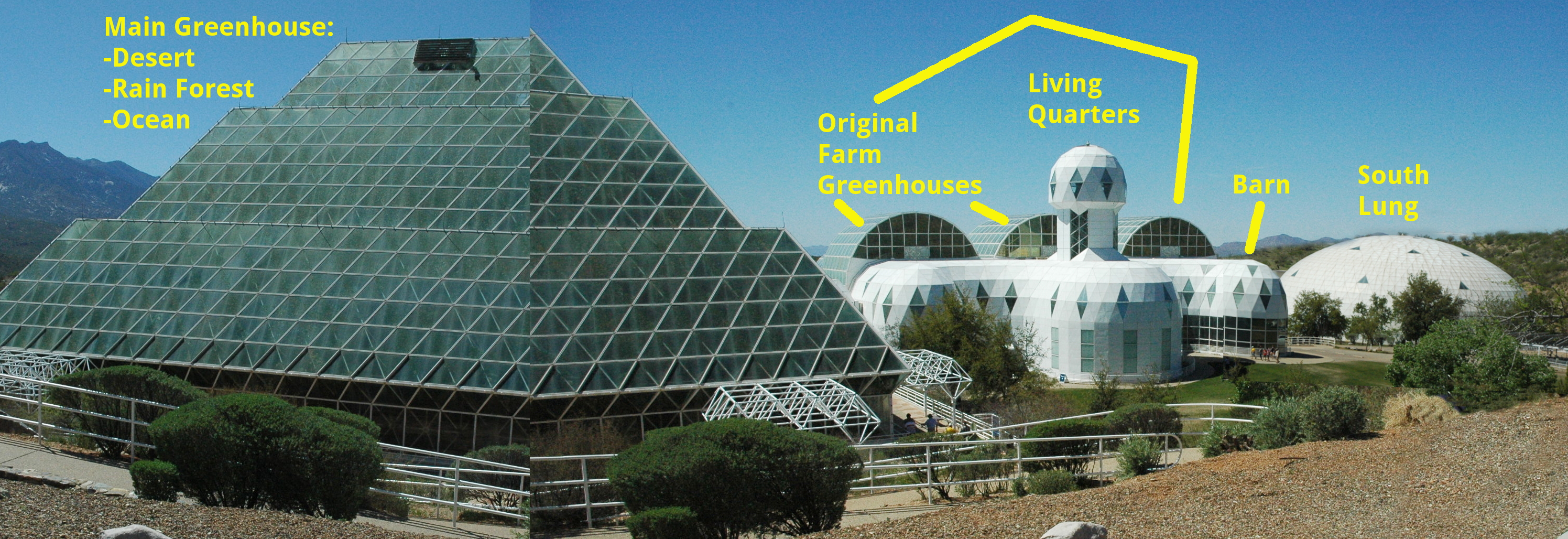
Biosphere 2

This week Diane and I have a friend visiting from back east. As locals generally do when guests visit, we used this visit as an excuse to go sightseeing at local attractions that we somehow never got the time to visit on our own.

So on Tuesday we drove north to take a tour of Biosphere 2, what has been called “a giant space-age ark in the middle of the desert.” The idea, as sold heavily to the public when it was built in the late 1980s and early 1990s, was that eight people would try to live in a closed system for two years, demonstrating the technology needed to both build colonies on other worlds as well as protect the environment here on Earth.

The system wasn’t really closed however (power came from outside), and during the first two year mission it seemed they were somewhat lax about keeping the system closed.

One Biospherian accidentally cut off the tip of her finger and left for medical care. When she returned, she carried in two duffle bags of supplies to the supposedly self-sustaining environment (which presumably would not have been feasible on, say, Mars).

There were also financial issues, as mentioned by our tour guide and confirmed by news stories. Its backer, Texas oil man Edward Bass, spent somewhere between $150 to $200 million. It seems however that the managers running Biosphere 2 didn’t keep good books, and when Bass asked for an accounting they couldn’t provide it. Instead, they attempted to sabotage the project’s second mission.
» Read more

8 comments

A spray of volcanic ejecta on Mars?

pit features on floor of crater

Time for some more weird Mars geology! Today the science team for the high resolution camera on Mars Reconnaissance Orbiter released its monthly batch of new images. There is a lot of interesting stuff buried therein, some of which I will feature periodically in the next month.

The image on the right, reduced in resolution to post here, is a good example. (If you click on the image you can see the full resolution version.) It shows a scattering of pits in three specific areas on the crater floor, all in a line going from the northeast to the southwest. Yet, the rest of the crater floor lacks similar pits, and is either very smooth or has a mottled appearance. Both the smooth and the mottled areas appear to have a very faint trend going from the northwest to the southeast, which to my eye appears caused by the general wind direction that flows across the crater floor.

Even more intriguing, the pits in these three areas appear to be mostly oblong and also trend from the northeast to the southwest, cutting across the general trend of the rest of the crater floor. You can see this in the cropped closeups from the full resolution image below, showing the two boxed areas indicated on the image on the right.
» Read more

0 comments

UN agreement reached on space sustainability

In February a UN committee helped negotiate a agreement with 87 nations for establishing rules for space sustainability.

The agreement was reached during a meeting of the United Nations Committee on the Peaceful Uses of Outer Space (COPUOS). COPUOS was created in 1959 as the main UN body to govern the exploration and use of space, and was instrumental in the creation of the five major space treaties. It has been the main multilateral forum where countries meet to discuss space issues and share updates on national activities and practices. As of 2018, those eighty-seven countries are formal members of COPUOS, with Bahrain, Denmark and Norway being the most recent additions. There are also nearly 40 observer organizations, including the Secure World Foundation.

…In 2016, the first set of 12 guidelines were agreed to by a consensus of all the members of COPUOS, and the mandate of the LTS Working Group was extended through 2018. The most recent meeting of STSC in February 2018 saw the LTS Working Group reach consensus on nine more guidelines and the preamble text, bringing the total to 21, as well as agreeing to review their implementation and potentially update them. The 21 guidelines represent countries’ best practices across a broad spectrum of space issues.

Though all of the guidelines essentially confirm policies that these nations have been following, they were reaffirmed by this agreement partly because of the Chinese anti-satellite test in 2007 that produced a lot of space junk.

A review of the guidelines reveals them to be mostly sensible and necessary. The problem is that this process is establishing the precedent that such rule-making should apply to all space activities, and it shall be imposed by UN committees of government bureaucrats here on Earth. For example, the process here appears to be entirely political, and involved none of the actual companies that build and produce rockets and satellites.

At some point in the future, such rule-making should be the responsibility of those who work and and live in space. I predict when that time comes, the UN and the political bureaucracies from these nations will be loath to give up this power. Stay tuned for the eventual rebellion that will follow.

0 comments

Astronomers find a dozen black holes near center of Milky Way

Astronomers have discovered a dozen smaller black holes orbiting near Sagittarius A* (pronounced “A-star”), the supermassive black hole at the center of the Milky Way.

Charles Hailey from Columbia University in New York and colleagues used archival data from Nasa’s Chandra X-ray telescope to come to their conclusions. They report the discovery of a dozen inactive and low-mass “binary systems”, in which a star orbits an unseen companion – the black hole.

The supermassive black hole at the centre of the Milky Way, known as Sagittarius A* (Sgr A*), is surrounded by a halo of gas and dust that provides the perfect breeding ground for the birth of massive stars. These stars live, die and could turn into black holes there. In addition, black holes from outside the halo are believed to fall under the influence of Sgr A* as they lose their energy, causing them to be pulled into its vicinity, where they are held captive by its force. Some of these bind – or “mate” – to passing stars, forming binary systems.

They have extrapolated their data to predict the existence of thousands more of these small black holes near the galaxy’s center.

1 comment
1 116 117 118 119 120 155