Astronomers measure the vibrations of a star 21 light years away

Using an instrument on the ground-based Keck telescope in Hawaii, astronomers have been able to measure the internal vibrations of a star 21 light years away, the equivalent of recording a star’s seismology.

Keck Observatory’s KPF instrument precisely measures the motion of the stellar surface towards and away from the observer. Over four consecutive nights, the team used KPF to collect over 2,000 ultra-precise velocity measurements of the star — enabling them to catch the star’s vibrations in action. This is the first asteroseismic inference of the age and radius for a cool star using KPF.

The astronomers next claim that this data allowed them to date the star’s age as 10.2 billion years old, and that it was about 4% smaller in diameter than measured by other observations. Both these conclusions carry uncertainties, but the former has implications if true for the present theories of stellar evolution, since this star appears to be behaving differently than expected for a star this old.

Astronomers have been doing this kind of stellar seismology for the Sun for several decades. To now have instruments sensitive enough to detect it on stars light years away is truly astonishing.

0 comments

Stratolaunch completes first hypersonic test flight for Pentagon

The military this week confirmed that Stratolaunch had successfully completed its first two hypersonic test flights for the Pentagon in December and March.

The hypersonic vehicle named Talon A2 exceeded Mach 5—the threshold for hypersonic speed—in two Pentagon-backed test flights conducted in December 2024 and March 2025, the Defense Department confirmed May 5.

The flights mark the first time since the X-15 program, which ended in 1968, that the U.S. has conducted reusable hypersonic testing.

At the moment the military’s hypersonic test program is really getting its money’s worth from private enterprise. Stratolaunch is doing tests using a reusable vehicle. Rocket Lab is doing suborbital flights using a revised version of its Electron rocket’s first stage. Varda will do hypersonic tests with its capsule when it returns from orbit. And startups Ursa Major and Radian have won contracts to do their own test flights.

For literally decades the military’s hypersonic test program had limped along, barely able to do tests more than once every few years. Then however it was run entirely by the government. Now that the military has stopped trying to be the designer and builder but simply a customer, it is getting what it needs fast and with a great deal of variety.

Ain’t freedom and competition and private enterprise wonderful?

2 comments

Australia’s first rocket company continues to be blocked by red tape

Australian commercial spaceports
Australia’s commercial spaceports. Click for original map.

The first rocket launch by Gilmour Space, Australia’s first rocket company, from its Bowen spaceport on the east coast of Australia has apparently been blocked by continuing bureaucratic regulatory red tape.

In February the company had announced a planned launch date in March, based on what appeared to be the issuance (after more than a year’s delay) of its launch licence. That launch however never happened, with no public explanation, until now. From the link above:

In an update on Sunday, the Queensland-based firm said it had received approval from CASA and is now waiting for final clearance from the Australian Space Agency.

…It had planned for an inaugural blast-off in April 2024 but faced a lengthy delay in obtaining its final permit from the Australian Space Agency.

In other words, the launch license had only been promised, but then was not issued, leaving the company stranded for several more months, with that license still buried in the government’s byzantine operations.

The article at the link says the Australian government is now moving to streamline its space regulatory system, but don’t believe it. The elections this week saw a resounding victory for the leftist coalition with the conservative party defeated handily. With the left now in firm control, expect the regulation to increase, not decrease. Leftwing governments almost never reduce regulation. It goes against their power-hungry genetics.

4 comments

ESA’s issues a non-reaction to Trump’s proposed NASA cuts

The European Space Agency (ESA) yesterday issued its first reaction to Trump’s proposed cuts to NASA’s Artemis program, including cancellation of the Orion capsule and Lunar Gateway station that ESA is building major components, and essentially said nothing.

NASA has briefed ESA about the Budget Request, and while some questions still remain about the full repercussions, follow-up meetings are already taking place with NASA. ESA remains open to cooperation with NASA on the programmes earmarked for a reduction or termination but is nevertheless assessing the impact with our Member States in preparation for ESA’s June Council.

ESA and NASA have a long history of successful partnership, particularly in exploration – a highly visible example of international cooperation – where we have many joint activities forging decades of strong bonds between American and European colleagues. Space exploration is an endeavour in which the collective can reach much farther than the individual. Thus, ESA has strong partnerships with space agencies from around the globe and is committed to not only being a reliable partner, but a strong and desirable partner.

Basically ESA is holding off any major response until they get more information from NASA and the Trump administration. It also notes that any more detailed response must wait until it holds its own meetings scheduled for June and later.

ESA’s problem is that it tied its manned space effort to NASA’s Orion capsule and Gateway station. On Orion it is building the service module, and has a number under construction that now might be unneeded if only two more Orions fly. As for Gateway, Europe is building major components of the station’s central habitation module. It is also building, in partnership with Japan, a second habitation module for their use. The cancellation of Gateway leaves these modules hanging with nowhere to go.

Though we should expect some pushback from Europe in an attempt to save Lunar Gateway, I expect these events will end up doing more for Europe’s nascent commercial launch industry. What the continent really needs is a private competitive aerospace industry making money in space. If it gets that, it will no longer have to rely on NASA, or ESA for that matter.

And based on the recent policy actions by ESA’s major partners (Germany, France, Italy, Spain, and the UK) to shift from a government-run centralized space program run by ESA’s Arianespace to encouraging the development of an independent competing private launch industry, I predict Europe will shift even more focus in this direction when they finally respond to the Trump cuts.

Expect European to call for more autonomy and European-built rockets and spacecrafts that do not rely on NASA or American proposals. This will not necessarily end its space partnership with the U.S., but it will be less beholden to it.


0 comments

May 5, 2025 Quick space links

Courtesy of BtB’s stringer Jay. This post is also an open thread. I welcome my readers to post any comments or additional links relating to any space issues, even if unrelated to the links below.

  • A video “tour” of Vast’s space station facility
    I put quotes around “tour” because I was very disappointed with this video. It provided very little real or new information, and instead acted more like a promotional for the company. Largely a waste of time.
7 comments

NASA engineers complete 17-day balloon flight, testing a new “super pressure” technology

Map of flight
Click for original map

NASA engineers have decided to end a flight test of a new “super pressure” balloon after flying for seventeen days and circling Antarctica.

While the mission successfully met its minimum requirements for qualification of the balloon, the team had been monitoring minor performance issues and suspected that the system had a small leak. The balloon was maintaining its predicted float altitude during daytime hours; however, it started to show considerable drops in altitude, especially as it passed through areas of colder temperatures like storm systems.

…Teams continued to closely monitor the health and performance of the balloon as it continued flight, and its ability to safely make it to the next predicted land crossing in South America for recovery of the balloon and payload. However, at approximately four additional days until land, all ballast expended to manage altitude stability, and recent altitude excursions during night periods down to 60,000 feet, continued flight became unlikely. NASA ultimately decided to terminate the flight to ensure the greatest level of control and safety during descent. “Due to the mission’s trajectory coupled with system performance, termination and recovery at the next land over flight was not possible due to unacceptable public risk,” said Garde.

This first flight is part of a two-flight test program this season, with the second super pressure balloon already in flight. Like the first, it is aiming for a 100 day flight circling the globe at the high mid-latitudes comparable to its launch site in New Zealand. You can track its flight in real time here.

As with all NASA test programs like this, the real question will be whether this technology will be used for any practical purpose once the program is completed, or whether it will be shelved away and forgotten. For most such programs, it is the latter that occurs. In this case however there are a number of companies attempting to make money selling tourists flights on less sophisticated high altitude balloons, and those companies might be interested in adopting this technology. There are also several balloon companies that provide surveillance data for the military which might be interested as well.

1 comment

It only took $22 billion and 19 years: Lockheed Martin proudly announces the completion of the first Orion capsule capable of manned flight

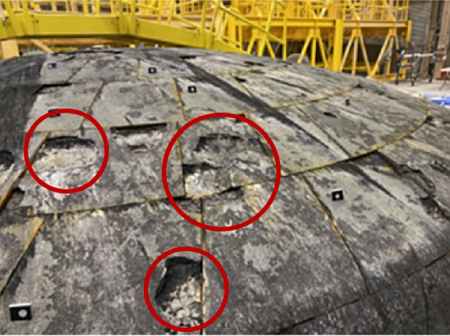
Orion's damage heat shield
Damage to Orion’s heat shield caused during re-entry in 2022,
including “cavities resulting from the loss of large chunks”.
Nor has this issue been fixed.

My heart be still. On May 1, 2025 Lockheed Martin proudly announced that it had finally completed assembly and testing of the first Orion capsule capable of taking human beings into space.

Lockheed Martin [NYSE: LMT] has completed assembly and testing of NASA’s Orion Artemis II spacecraft, transferring possession to NASA’s Exploration Ground Systems (EGS) team today. This milestone is a significant step for NASA and the Artemis industry team, as they prepare to launch a crew of four astronauts to further the agency’s mission in establishing a human presence on the Moon for exploration and scientific discovery. It will also help build the foundation for the first crewed missions to Mars.

Orion is the most advanced, human-rated, deep space spacecraft ever developed. Lockheed Martin is the prime contractor to NASA for Orion and built the crew module, crew module adaptor and launch abort system. “This achievement is a testament to our employees and suppliers who have worked tirelessly to get us to this important milestone,” said Kirk Shireman, vice president of Human Space Exploration and Orion program manager at Lockheed Martin. “The Orion spacecraft completion for Artemis II is a major step forward in our nation’s efforts to develop a long-term lunar presence. It’s exciting to think that soon, humans will see the Earth rise over the lunar horizon from our vehicle, while also traveling farther from Earth than ever before.”

What disgusting hogwash. First of all, Lockheed Martin was issued the contract to build two capsules, one for testing and one for manned flight, in 2006. It only took the company 19 years to build both. Second, that 2006 contract was supposed to only cost $3.9 billion. Instead, NASA has forked out more than $22 billion.

And what have we gotten? Two capsules, plus a handful of prototype test versions. Worse, this first capsule will be the first to ever carry the life support systems that keep humans alive, as Lockheed Martin admits in its press release:
» Read more

22 comments

SpaceX launches a record 29 Starlink satellites

SpaceX early this morning successfully launched 29 Starlink satellites (the most yet on a single launch), its Falcon 9 rocket lifting off from Kennedy Space Center in Florida.

The first stage completed its 20th flight, landing on a drone ship in the Atlantic.

The leaders in the 2025 launch race:

52 SpaceX
23 China
5 Rocket Lab
5 Russia

SpaceX now leads the rest of the world in successful launches, 52 to 40.

3 comments

Local voters approve establishing the town of Starbase at Boca Chica

By a vote of 212 to 6 (out of about 300 eligible voters), the residents at the previously unincorporated coastal land strip at Boca Chica have approved a proposal to create the town of Starbase, with a mayor and two city commissioners.

The three candidates were all running unopposed for those positions. All three either work at SpaceX now, have worked there in the past, or have relatives employed by the company.

The mayor will be Robert “Bobby” Peden, 36. He has worked for SpaceX for the past dozen years, first at its MacGregor engine test site and now at Starbase as a vice president of test and launch. The two council members are Jenna Petrzelka and Jordan Buss. Petrzelka, 39, worked for SpaceX from 2012 to 2024 as an engineer. Her husband, Joe Petrzelka, is presently a SpaceX vice president. Buss, 40, started working for SpaceX in 2023 as a senior director of environmental health and safety.

The vote shifts much of the civil management away from the larger local county to the residence who live in the town itself. It is quite evident they will establish this city with the needs of SpaceX in mind. It also appears that the residents are fully in support of this.

As for launches here, I will still refer to it as Boca Chica. The town might be named Starbase, but the actual location is still Boca Chica.

6 comments
1 119 120 121 122 123 182