
A small galaxy with lots of massive stars
Click for original image.
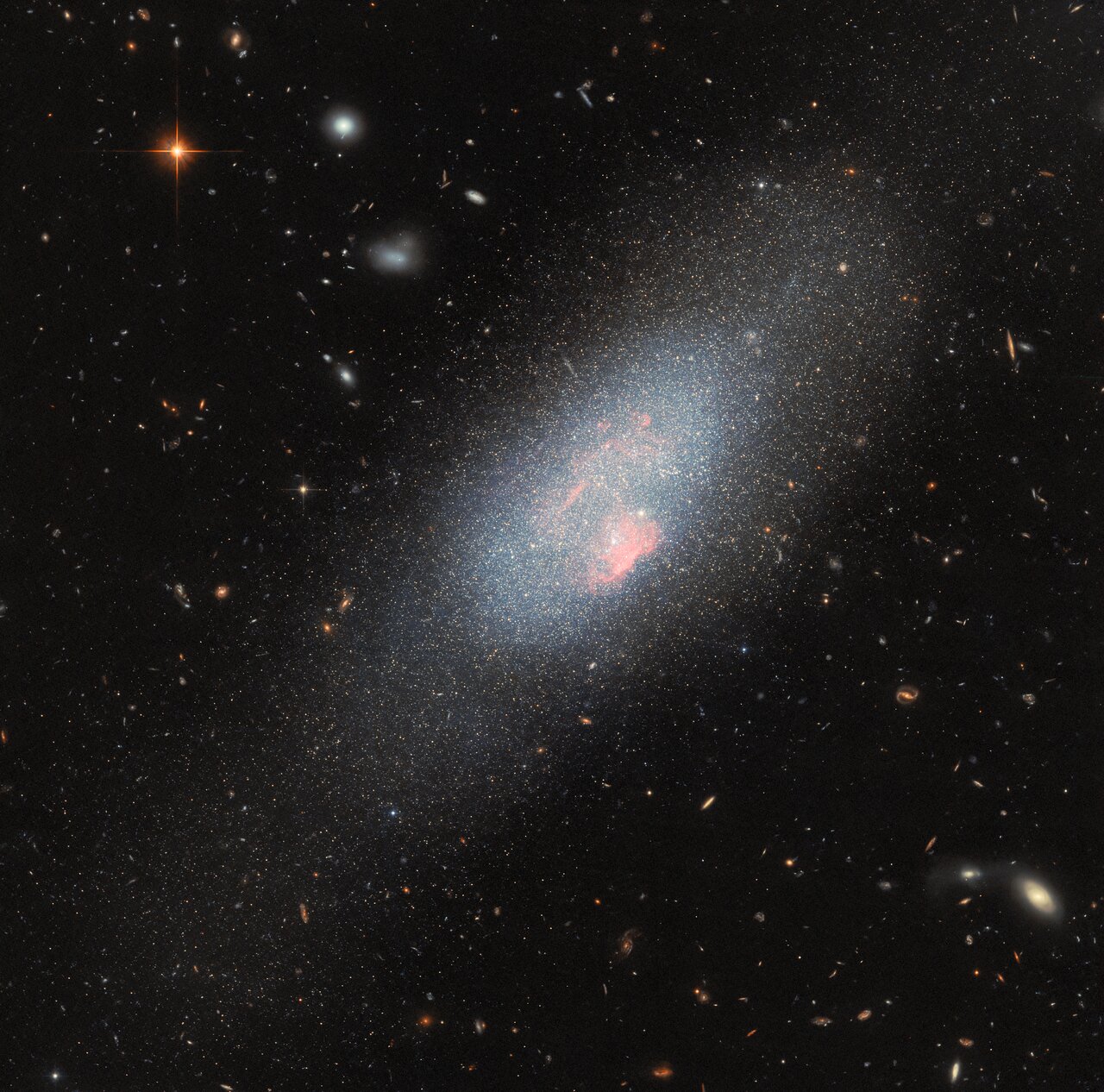
Cool image time! The picture to the right, cropped, reduced, and sharpened to post here, was taken by the Hubble Space Telescope and released this week as the European Space Agency’s (ESA) Hubble picture of the week.
This dwarf galaxy, 13 million light years away, is called Markarian 178 (Mrk 178). Though much smaller than the Milky Way, it is packed with massive stars. From the caption:
While the bulk of the galaxy is blue owing to an abundance of young, hot stars with little dust shrouding them, Mrk 178 gets a red hue from a collection of massive stars, which are especially concentrated in the brightest, reddish region near the galaxy’s edge. This azure cloud is home to a large number of rare objects called Wolf–Rayet stars. Wolf–Rayet stars are massive stars that are casting off their atmospheres through powerful winds. Because Mrk 178 contains so many Wolf–Rayet stars, the bright emission lines from these stars’ hot stellar winds are etched upon the galaxy’s spectrum. Particularly ionised hydrogen and oxygen appear as a red colour to Mrk 178 in this photo, observed using some of Hubble’s specialised light filters.
Massive stars enter the Wolf–Rayet phase just before they collapse into black holes or neutron stars. Because Wolf–Rayet stars last for only a few million years, researchers know that something must have triggered a recent burst of star formation in Mrk 178. At first glance, it’s not clear what could be the cause — Mrk 178 doesn’t seem to have any close galactic neighbours that could have stirred up its gas to form new stars. Astronomers believe that it was triggered by the interaction with a smaller satellite, as revealed by the presence of low surface brightness tidal features detected around Mrk 178 in deep imaging acquired with the Large Binocular Telescope.
And yet, these observations do not see this small satellite galaxy. It has either been completely absorbed into Mrk 178, or maybe this theory for explaining this dwarf galaxy’s make-up is flawed.

On Christmas Eve 1968 three Americans became the first humans to visit another world. What they did to celebrate was unexpected and profound, and will be remembered throughout all human history. Genesis: the Story of Apollo 8, Robert Zimmerman's classic history of humanity's first journey to another world, tells that story, and it is now available as both an ebook and an audiobook, both with a foreword by Valerie Anders and a new introduction by Robert Zimmerman.
The print edition can be purchased at Amazon or from any other book seller. If you want an autographed copy the price is $60 for the hardback and $45 for the paperback, plus $8 shipping for each. Go here for purchasing details. The ebook is available everywhere for $5.99 (before discount) at amazon, or direct from my ebook publisher, ebookit. If you buy it from ebookit you don't support the big tech companies and the author gets a bigger cut much sooner.
The audiobook is also available at all these vendors, and is also free with a 30-day trial membership to Audible.
"Not simply about one mission, [Genesis] is also the history of America's quest for the moon... Zimmerman has done a masterful job of tying disparate events together into a solid account of one of America's greatest human triumphs."--San Antonio Express-News
Cool image time indeed!
Also known as UGC 6541 in the constellation Ursa Major.