
The shoreline of Pluto’s frozen nitrogen sea
Click for full resolution. For original
images go here and here.


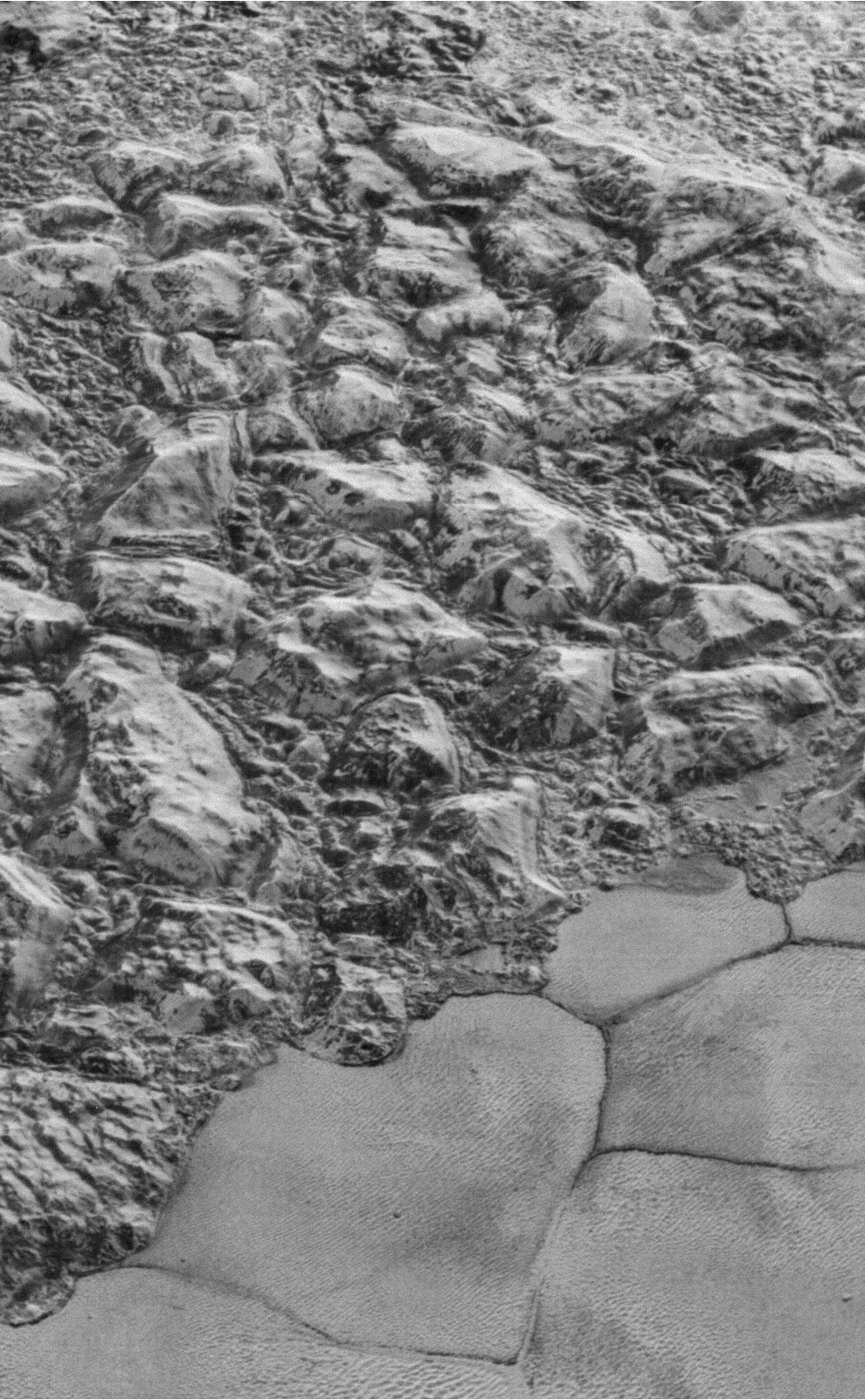
Cool image time! In my continuing exploration of the New Horizons’ image archive, I keep finding things that I do not remember ever seeing before. The two New Horizon pictures used to create the panorama to the right (here and here) were taken by the spacecraft only thirteen minutes before its closest approach to Pluto at 7,800 miles on July 14, 2015. It shows the Al-Idrisi mountains — thought to be made up of frozen ice as hard as granite — and the frozen nitrogen sea that pushes against those mountains and squeezes them into their jumbled shape. For scale, the image is estimated to be fifty miles wide.


In December 2015 the science team released a small section of one of two images, focused specifically at that nitrogen sea shoreline, noting:
Great blocks of Pluto’s water-ice crust appear jammed together in the informally named al-Idrisi mountains. Some mountain sides appear coated in dark material, while other sides are bright.
The team however did not release this wider panorama produced by both images, which I think gives a better perspective of what we are looking at.
I posted an even wider shot of this shoreline on January 29, 2026. If you look closely at that picture, you can spot the features to the right, but much smaller seen from a greater distance.
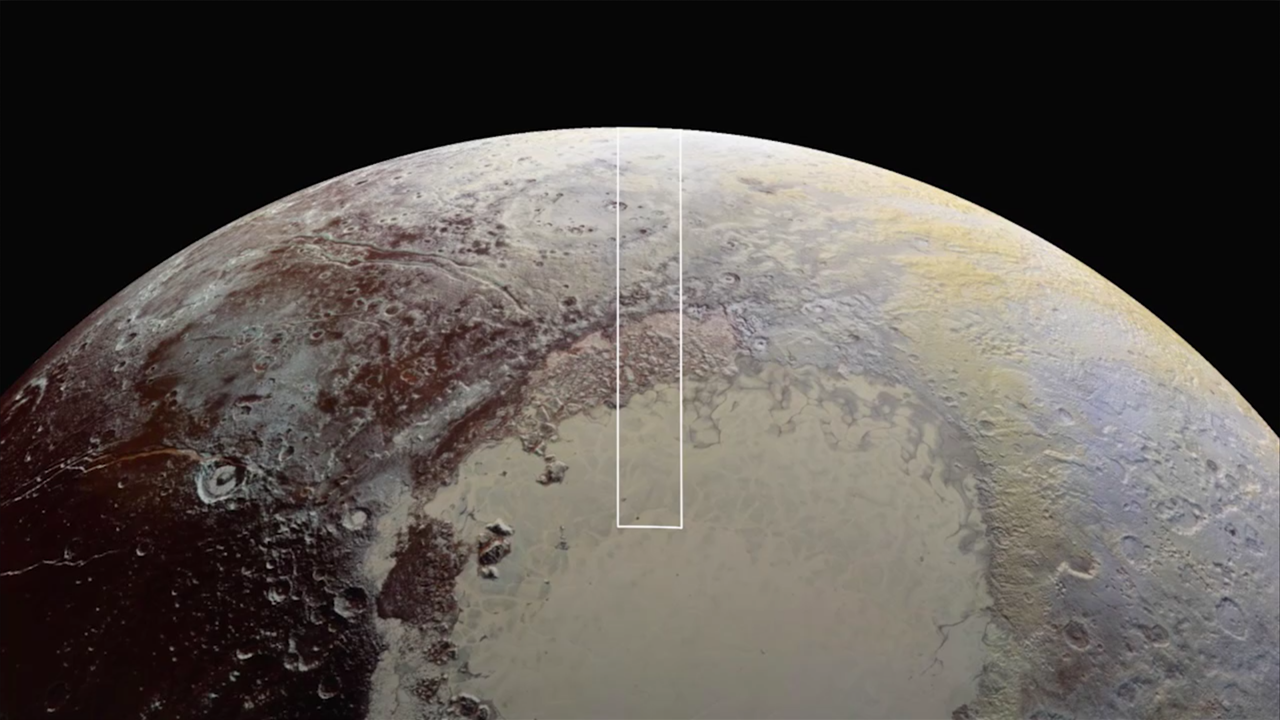
For the larger context, below is a wide shot of Pluto indicating the part of the planet where this image is located.

On Christmas Eve 1968 three Americans became the first humans to visit another world. What they did to celebrate was unexpected and profound, and will be remembered throughout all human history. Genesis: the Story of Apollo 8, Robert Zimmerman's classic history of humanity's first journey to another world, tells that story, and it is now available as both an ebook and an audiobook, both with a foreword by Valerie Anders and a new introduction by Robert Zimmerman.
The print edition can be purchased at Amazon or from any other book seller. If you want an autographed copy the price is $60 for the hardback and $45 for the paperback, plus $8 shipping for each. Go here for purchasing details. The ebook is available everywhere for $5.99 (before discount) at amazon, or direct from my ebook publisher, ebookit. If you buy it from ebookit you don't support the big tech companies and the author gets a bigger cut much sooner.
The audiobook is also available at all these vendors, and is also free with a 30-day trial membership to Audible.
"Not simply about one mission, [Genesis] is also the history of America's quest for the moon... Zimmerman has done a masterful job of tying disparate events together into a solid account of one of America's greatest human triumphs."--San Antonio Express-News
Floating ice mountains! Nitrogen seas! The Kuiper Belt might not be quite as weird as H.P. Lovecraft imagined (“The Whisperer in Darkness,” “The Fungi from Yuggoth”), but boy, on initial study it looks plenty weird already.
Extraordinary images. A question. Back in the day NASA used to issue “special publications” about its lunar and planetary missions — I still have some of these in my library — but what about Pluto? I can’t find any mention of such a book, and the closest thing that I have seen is a publication by the University of Arizona Press. https://uapress.arizona.edu/book/the-pluto-system-after-new-horizons
The Pluto System after New Horizons was published in 2021, and it would appear that much additional research based on the New Horizons mission data has taken place since then. Is this still the “best” single book about Pluto?
PS — Imagine what images might come from dedicated Uranus and Neptune missions. Aside from Pluto, it’s been a long dry spell in the
Outer Solar System. Imagine also (heart be still) that money saved by axing SLS / Artemis could be used to fund such missions.
Milt: That’s the book you want. It is written by the New Horizons team, based on what they learned.
“Wait It Out” Larry Niven 1968