
Have astronomers spotted the collision of two exoplanets around a Sunlike star?
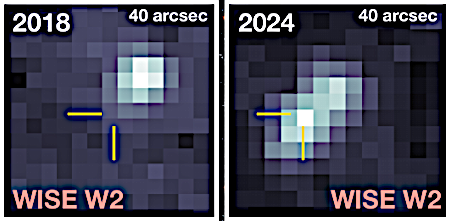
Using data from a number of orbiting space telescopes, astronomers think they have detected the collision of two exoplanets, producing debris that for about 200 days variably blocked the light from the system’s star.
The images to the right come from figure 1 of their published paper [pdf], showing changes in the infrared as detected by the WISE space telescope. From the press release:
The star, named Gaia20ehk, was about 11,000 light-years from Earth near the constellation Pupis. It was a stable “main sequence” star, much like our sun, which meant that it should emit steady, predictable light. Yet this star began to flicker wildly. “The star’s light output was nice and flat, but starting in 2016 it had these three dips in brightness. And then, right around 2021, it went completely bonkers,” said Tzanidakis, a doctoral candidate in astronomy at the University of Washington. “I can’t emphasize enough that stars like our sun don’t do that. So when we saw this one, we were like ‘Hello, what’s going on here?’”
The cause of the flickering had nothing to do with the star itself: Huge quantities of rocks and dust — seemingly from out of nowhere — were passing in front of the distant star as the material orbited the system, patchily dimming the light that reached Earth. The likely source of all that debris was even more remarkable: a catastrophic collision between two planets.
…“The infrared light curve was the complete opposite of the visible light,” Tzanidakis said. “As the visible light began to flicker and dim, the infrared light spiked. Which could mean that the material blocking the star is hot — so hot that it’s glowing in the infrared.”
A cataclysmic collision between planets would certainly produce enough heat to explain the infrared energy. What’s more, the right kind of collision could also explain those initial dips in light.
The data suggests the collision occurred at an orbit comparable to that of the Earth’s, and took more than a half a year to largely dissipate.
All of this is a reasonable hypothesis based on the data available. Though there is a lot of uncertainty in this conclusion, the researchers considered other explanations, such as variability in the star itself, and found them less credible.

On Christmas Eve 1968 three Americans became the first humans to visit another world. What they did to celebrate was unexpected and profound, and will be remembered throughout all human history. Genesis: the Story of Apollo 8, Robert Zimmerman's classic history of humanity's first journey to another world, tells that story, and it is now available as both an ebook and an audiobook, both with a foreword by Valerie Anders and a new introduction by Robert Zimmerman.
The print edition can be purchased at Amazon or from any other book seller. If you want an autographed copy the price is $60 for the hardback and $45 for the paperback, plus $8 shipping for each. Go here for purchasing details. The ebook is available everywhere for $5.99 (before discount) at amazon, or direct from my ebook publisher, ebookit. If you buy it from ebookit you don't support the big tech companies and the author gets a bigger cut much sooner.
The audiobook is also available at all these vendors, and is also free with a 30-day trial membership to Audible.
"Not simply about one mission, [Genesis] is also the history of America's quest for the moon... Zimmerman has done a masterful job of tying disparate events together into a solid account of one of America's greatest human triumphs."--San Antonio Express-News
‘When Worlds Collide’ for real. Hope no one was at home on either one.