
Falcon 9 upper stage to hit the Moon in August
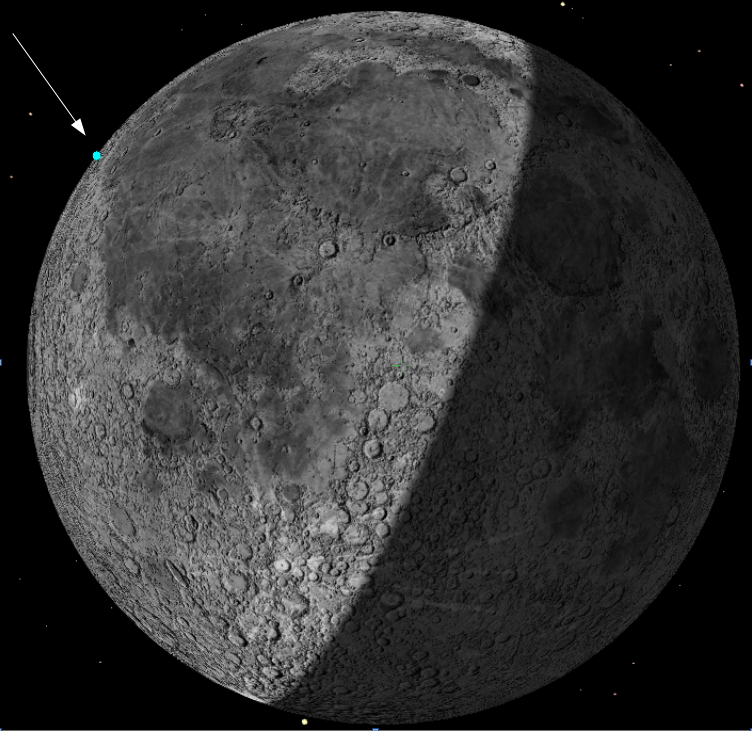
Click for original image.
According to astronomer Bill Gray, who also tracks orbital objects, the upper stage of the Falcon 9 that launched Firefly’s Blue Ghost and Ispace’s Hakuto-R2 lunar landers in January 2025 will hit the Moon on August 5, 2026.
For some time, I’ve provided some software tools astronomers can use to identify satellites in their data. I use the US military’s publicly available satellite data for many objects, and compute orbits for high-orbiting objects the military doesn’t track.
This object falls squarely in the latter category. In September 2025, my software for computing orbits analyzed the observations and projected an impact with the moon on 2026 August 5.
While this looked like a pretty solid prediction, I couldn’t be totally sure of it at the time. The motion of space junk is mostly quite predictable; it simply moves under the influence of the gravity of the earth, moon, sun, and planets. We know those with immense precision. If those were the only factors involved, I could probably tell you where and when this object would hit the moon to within a few meters and a fraction of a second.
The problem is that space junk in general, and 2025-010D in particular [the upper stage], is also pushed around by sunlight (“solar radiation pressure”). This is an extremely gentle force, but over months, it can really build up. And it’s not entirely predictable. As an object tumbles, it may catch more or less sunlight, and may reflect some of it sideways. So sunlight is mostly pushing the object away from the sun, but there’s a slight bit of pushing in other directions as well.
With enough data, we can actually figure out where the forces are pushing an object. But they do change a little over time in ways that aren’t perfectly predictable. So I can be sure it will impact near the time and place I’ve predicted, but those varying forces mean that the actual impact will be at least a little off from that time and place. That’s the largest source of uncertainty in all this, and there’s no way to correct for it; we just have to wait and see what actually happens. (But come August, we’ll have a quite precise idea of where it will hit.
At present, Gray predicts the impact will occur at 2:44 am (Eastern) on August 5, 2026. The image above is his present estimate of where it will hit, as seen from Earth. If this prediction holds, the impact itself will likely not be visible from Earth, as it will occur in daylight and at the very western limb of the Moon. This prediction however could change somewhat in the next few months.
When it hits Gray estimates the stage will be moving at about 5,400 miles per hour, or 1.51 miles per second. Expect the science team for Lunar Reconnaissance Orbiter (LRO) to try to image this impact after the fact.

On Christmas Eve 1968 three Americans became the first humans to visit another world. What they did to celebrate was unexpected and profound, and will be remembered throughout all human history. Genesis: the Story of Apollo 8, Robert Zimmerman's classic history of humanity's first journey to another world, tells that story, and it is now available as both an ebook and an audiobook, both with a foreword by Valerie Anders and a new introduction by Robert Zimmerman.
The print edition can be purchased at Amazon or from any other book seller. If you want an autographed copy the price is $60 for the hardback and $45 for the paperback, plus $8 shipping for each. Go here for purchasing details. The ebook is available everywhere for $5.99 (before discount) at amazon, or direct from my ebook publisher, ebookit. If you buy it from ebookit you don't support the big tech companies and the author gets a bigger cut much sooner.
The audiobook is also available at all these vendors, and is also free with a 30-day trial membership to Audible.
"Not simply about one mission, [Genesis] is also the history of America's quest for the moon... Zimmerman has done a masterful job of tying disparate events together into a solid account of one of America's greatest human triumphs."--San Antonio Express-News
On his most recent debris discussion, Eager Space had high praise for how Falcon second stages are de-orbiting, even after launching to Geo’s
I see these lunar impacts as potential opportunities, perhaps
Jeff Wright,
Thanks for the tip. I looked at those Eager Space videos. I knew SpaceX was pretty tidy about its operations, de-orbiting all of its 2nd stages after LEO satellite deployment runs and not even leaving those Starlink stack alignment rods in the VLEO deployment orbit anymore – they hinge out from the 2nd stage now, but stay attached and go down with the ship. But I did not know SpaceX had also figured out a protocol for doing the same things with 2nd stages from GTO deployments. Nifty. So pretty much the only Falcon upper stages still whizzing around upstairs are those from actual deep space deployments.
And now one of those is going to hit the Moon. The impact should be an opportunity for a bit of additional spectrographic data-taking, assuming any of the various suitably-equipped lunar orbiters are correctly positioned when the strike happens.
It’s no immediate priority or anything, but once Elon has Starship freighters shuttling to and from the Moon on a regular basis, it would be nice if one of them, instead of dead-heading back entirely empty, could winkle Apollo 11’s Eagle aboard and secure it for a return to Earth. Either Elon of one of the other space bros also needs to do likewise with Vanguard 1. The National Air and Space Museum can always use some new high-profile exhibits.
I think Eagle should remain where it is, as a monument to accomplishment. It can be a museum visited by Lunar Base inhabitants.
A catcher’s mitt is all you need for Vanguard….so…how to you call the strike zone…I mean, window?
Andi,
Most lunar orbits are not stable long-term. Best to rescue Eagle before it crashes.
Andi: 100%
Anybody know hoe the proposed – maybe operational -space junk removal companies are doing?