
Cubesat ultraviolet space telescope achieves first light
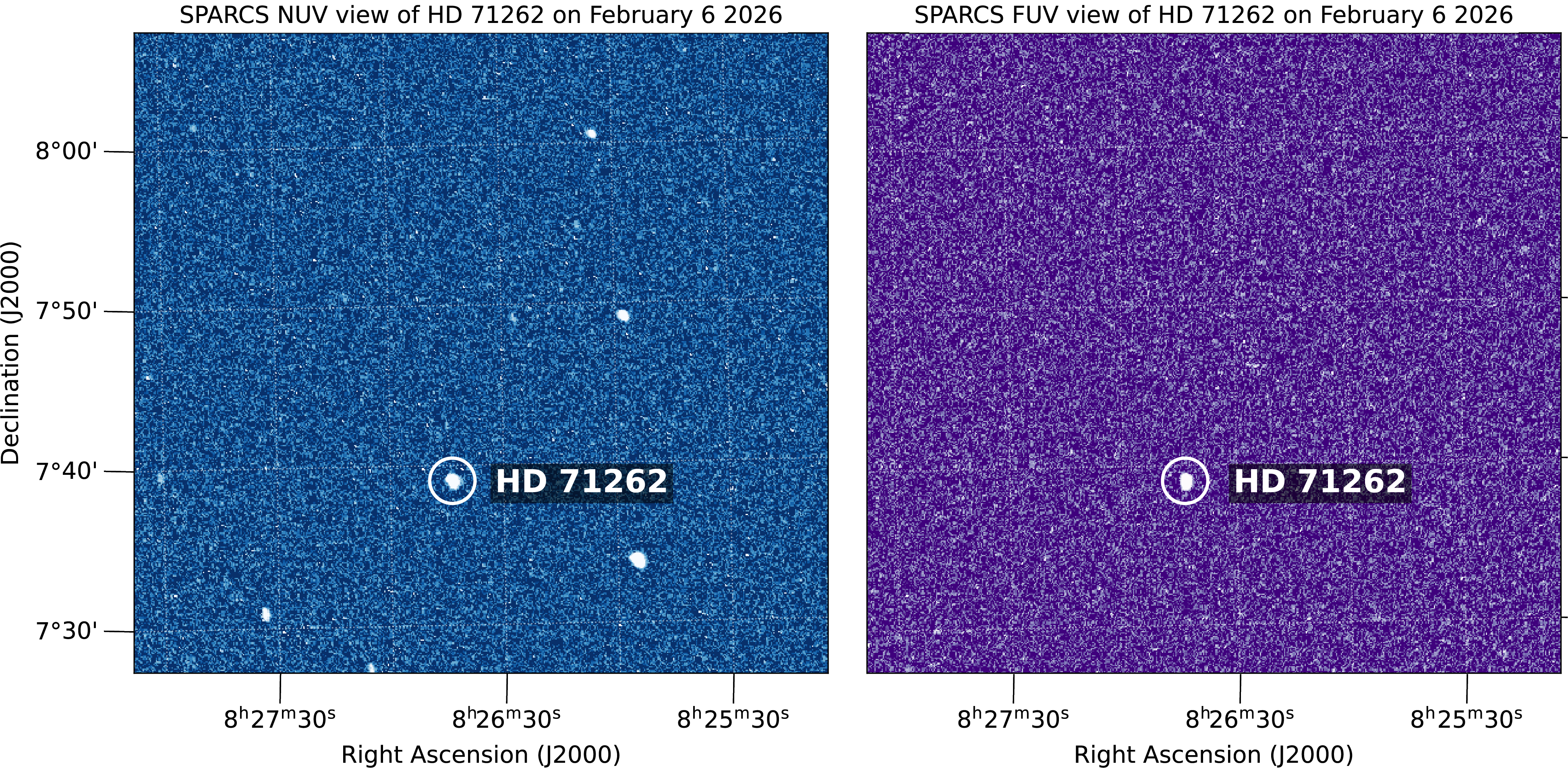
Click for original images.
A new low-cost cubesat-sized NASA ultraviolet space telescope, dubbed Sparcs, has achieved first light, successfully taking both near- and far-ultraviolet false-color images of a nearby star.
Those images are to the right, with the top the far-ultraviolet image and the bottom in the near ultraviolet. From the press release:
Roughly the size of a large cereal box, SPARCS will monitor flares and sunspot activity on low-mass stars — objects only 30% to 70% the mass of the Sun. These stars are among the most common in the Milky Way and host the majority of the galaxy’s roughly 50 billion habitable-zone terrestrial planets, which are rocky worlds close enough to their stars for temperatures that could allow liquid water and potentially support life.
The question astronomers will try to answer with this telescope is whether the solar activity on these stars is high enough to prevent life from forming in the star’s habitable zone. Because these stars are dim and small, the habitable zone is quite close to the star, which means solar activity has a higher impact on the planet. We don’t yet have sufficient data to determine the normal activity of such stars. Sparcs will provide a good first survey.
It will also demonstrate the viability of such small low-cost cubesats for this kind of research. If successful expect more such telescopes, some of which are likely to be private, like Blue Skies Space’s Mauve optical telescope already in orbit.

On Christmas Eve 1968 three Americans became the first humans to visit another world. What they did to celebrate was unexpected and profound, and will be remembered throughout all human history. Genesis: the Story of Apollo 8, Robert Zimmerman's classic history of humanity's first journey to another world, tells that story, and it is now available as both an ebook and an audiobook, both with a foreword by Valerie Anders and a new introduction by Robert Zimmerman.
The print edition can be purchased at Amazon or from any other book seller. If you want an autographed copy the price is $60 for the hardback and $45 for the paperback, plus $8 shipping for each. Go here for purchasing details. The ebook is available everywhere for $5.99 (before discount) at amazon, or direct from my ebook publisher, ebookit. If you buy it from ebookit you don't support the big tech companies and the author gets a bigger cut much sooner.
The audiobook is also available at all these vendors, and is also free with a 30-day trial membership to Audible.
"Not simply about one mission, [Genesis] is also the history of America's quest for the moon... Zimmerman has done a masterful job of tying disparate events together into a solid account of one of America's greatest human triumphs."--San Antonio Express-News