
Voyager-2’s only close-up image of Uranus’s moon Umbriel
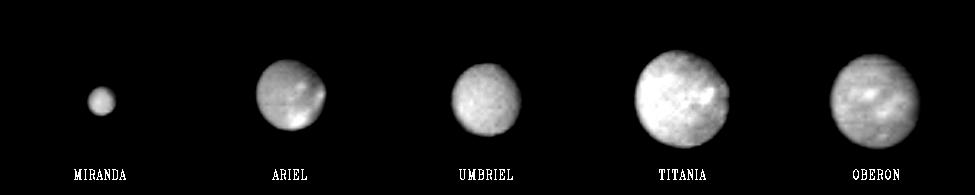 The historically known moons of Uranus. Click for original NASA press release.
Click for source.
Today’s cool image continues our tour of the five largest moons of Uranus, as seen by Voyager-2 in 1986 during its close-up visit. The family portrait above, taken from more than three million miles away during Voyager-2’s approach, shows the relative sizes of those five moons as well as their location relative to Uranus, with Miranda in the closest orbit and Oberon the farthest. I have already posted close-ups from Miranda and Ariel. Today’s image moves us outward to Umbriel.
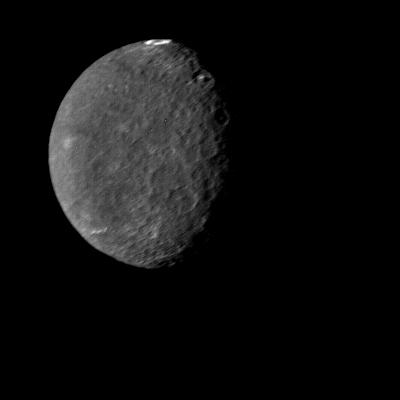
The image to the right is Voyager-2’s best picture. In fact, it is really Voyager-2’s only close-up image, and as you can see, it is not that close or sharp. I have not reduced it at all. This is how NASA released it. From the NASA press release:
The southern hemisphere of Umbriel displays heavy cratering in this Voyager 2 image, taken Jan. 24, 1986, from a distance of 346,000 miles. This frame, taken through the clear-filter of Voyager’s narrow-angle camera, is the most detailed image of Umbriel, with a resolution of about 6 miles.
Umbriel is the darkest of Uranus’ larger moons and the one that appears to have experienced the lowest level of geological activity. It has a diameter of about 750 miles and reflects only 16 percent of the light striking its surface; in the latter respect, Umbriel is similar to lunar highland areas. Umbriel is heavily cratered but lacks the numerous bright-ray craters seen on the other large Uranian satellites; this results in a relatively uniform surface albedo (reflectivity). The prominent crater on the terminator (upper right) is about 70 miles across and has a bright central peak.
The strangest feature in this image (at top) is a curious bright ring, the most reflective area seen on Umbriel. The ring is about 90 miles in diameter and lies near the satellite’s equator. The nature of the ring is not known, although it might be a frost deposit, perhaps associated with an impact crater. Spots against the black background are due to ‘noise’ in the data.
This lone picture of Umbriel by Voyager-2 illustrates even more starkly the very sparse data we have of Uranus and its moons. Voyager-2 is the only spacecraft to ever visit this planet, and it only did a quick fly-by, just long enough to give us this one dim snapshot view. It is forty years later, and no other missions have flown there, nor is any planned in the near future. There are proposals, but none are yet approved.

On Christmas Eve 1968 three Americans became the first humans to visit another world. What they did to celebrate was unexpected and profound, and will be remembered throughout all human history. Genesis: the Story of Apollo 8, Robert Zimmerman's classic history of humanity's first journey to another world, tells that story, and it is now available as both an ebook and an audiobook, both with a foreword by Valerie Anders and a new introduction by Robert Zimmerman.
The print edition can be purchased at Amazon or from any other book seller. If you want an autographed copy the price is $60 for the hardback and $45 for the paperback, plus $8 shipping for each. Go here for purchasing details. The ebook is available everywhere for $5.99 (before discount) at amazon, or direct from my ebook publisher, ebookit. If you buy it from ebookit you don't support the big tech companies and the author gets a bigger cut much sooner.
The audiobook is also available at all these vendors, and is also free with a 30-day trial membership to Audible.
"Not simply about one mission, [Genesis] is also the history of America's quest for the moon... Zimmerman has done a masterful job of tying disparate events together into a solid account of one of America's greatest human triumphs."--San Antonio Express-News
Do planetary scientists have a good explanation of how planets come to have moons? The Earth’s moon was from a collision after it was formed. I guess any moons the Earth had prior would have been sucked up by our very large moon. All the inner planets, Mercury to Mars are moonless with the exception of our moon and the two asteroids orbiting Mars. And our moon would have been classified as a planet before the Earth collision?
Asking Grok about this, it says planets have hill spheres. A hill sphere being the region around a planet where its gravity is greater than that of the Sun. I guess the outer edge of the hill sphere being the Lagrange points? The outer gas giants, being both giants and far from the Sun have large hill spheres in which passing stuff would have been captured and come to orbit the planet.
Bob, thank you for your recent coverage of solar system objects that get little attention elsewhere. The data is not new, but very interesting nonetheless. As for Umbriel, that bright ring is a curiosity, reminiscent of the bright spots on Ceres that evoked claims of an alien presence. The ring’s brightness may be due to camera overexposure, but the press release doesn’t elaborate.