
Solar scientists: We finally think we know the location of the Sun’s dynamo
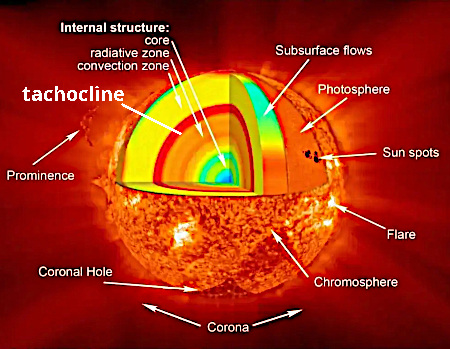
NASA graphic used in the press release and
annotated to post here.
The uncertainty of science: Using three decades of data gathered during the last three solar cycles, scientists now think they have finally determined the location of the Sun’s dynamo in its interior, at a transition point about 125,000 miles below the surface called the tachocline. From the abstract of their paper [pdf]:
The exact location of the solar dynamo remains uncertain–whether it operates primarily in the near-surface shear layer, throughout the entire convection zone, or near the tachocline – a region of sharp transition in the solar rotation, located at the base of the convection zone, approximately 200,000 km [125,000 miles] beneath the surface. Various studies have supported each of these possibilities.
…Our analysis reveals that the gradient of rotation displays ‘butterfly’–like behavior near the tachocline, which is similar to the magnetic butterfly diagram at the surface. This result supports the idea that the solar dynamo has a deep-seated origin, likely operating either near the tachocline or throughout the convection zone, thereby disfavoring the recent scenario of a shallow, near-surface dynamo. This finding may also have important implications for understanding how stellar dynamos operate in general. [emphasis mine]
Even though scientists have known for more than a century that the Sun’s eleven-year cycle of flipping the polarity of its magnetic field is the fundamental cause of the sunspot cycle, they actually know very little about the dynamo that causes that magnetic field, as this study implies. They not only don’t have any understanding of the fundamental processes that creates that dynamo or causes it to flip polarity every eleven years, they still aren’t entirely sure where it is located within the Sun.
Thus, the highlighted sentence above is one large understatement. Of course knowing the dynamos location will have “important implications for understanding stellar dynamics.” This study is a first good stab at the problem, but it also shows us how little we actually know.
Remember this when anyone tells you “the science is settled” about climate change. The Sun is the number one influence on the Earth’s climate, and its solar cycle appears to be an important factor in that influence. Until we have a better understanding of the Sun, its magnetic field, and the dynamo that creates it, no climate prediction will be worth anything. Such predictions will be all guesswork, and likely put forth for political reasons.

On Christmas Eve 1968 three Americans became the first humans to visit another world. What they did to celebrate was unexpected and profound, and will be remembered throughout all human history. Genesis: the Story of Apollo 8, Robert Zimmerman's classic history of humanity's first journey to another world, tells that story, and it is now available as both an ebook and an audiobook, both with a foreword by Valerie Anders and a new introduction by Robert Zimmerman.
The print edition can be purchased at Amazon or from any other book seller. If you want an autographed copy the price is $60 for the hardback and $45 for the paperback, plus $8 shipping for each. Go here for purchasing details. The ebook is available everywhere for $5.99 (before discount) at amazon, or direct from my ebook publisher, ebookit. If you buy it from ebookit you don't support the big tech companies and the author gets a bigger cut much sooner.
The audiobook is also available at all these vendors, and is also free with a 30-day trial membership to Audible.
"Not simply about one mission, [Genesis] is also the history of America's quest for the moon... Zimmerman has done a masterful job of tying disparate events together into a solid account of one of America's greatest human triumphs."--San Antonio Express-News
Some visualizations: https://svs.gsfc.nasa.gov/4124/
That statement cannot be emphasized enough!
Science being performed, canonized and publicized and;
“put forth for political reasons.”
Science based on political expediency with no relation to actual cause and affect of the scientific method.
I suppose that’s why I favor the theories of Eugene Parker. He was proven right in so many of his theories, and yet not all of them have been excepted. Still receiving pushback from the science community although the evidence is overwhelming.
Personally I believe the “thermal coupler affect” is not represented at all, and yet explains the low temperatures of the photosphere (as compared to the suns internal temperatures or the high temperatures of the Corona sphere).
The temperature imbalance enhanced by a high pH… and you can’t get a higher than a hydrogen sun… causes a massive electrical flow, with nano flares feeding upwards through the atmosphere in the path of least resistance to create the plasma ball that surrounds the sun in the corona-sphere. That’s why it’s millions of degrees hotter then the sun itself.
I’d rather go with a simple explanation that can be demonstrated through cause-and-effect science then the fantasy of a nuclear reaction with no radiation.
Every electrical flow produces a magnetic field, the recent mapping of Jupiters magnetic field, produced in its atmosphere is very telling… I believe our Sun’s magnetic field will be proven to be something similar only on a much grander scale. After all, we are bathed in the light from our Sun’s electrical output daily… proven to be consistent with an electrical flow through hydrogen atmosphere in spectral analysis.
Max wrote: “Science based on political expediency with no relation to actual cause and affect of the scientific method.”
Yes, and kind of no. When the government funds something, it is tainted by politics — even science. When a wealthy benefactor funds science, it could be tainted by politics, or it could be mere curiosity. Individual funding is how we got many of our greatest advancements, these past few centuries. Wealthy people curious about nature either did their own studies or were the patrons supporting scientists.
An excellent historical example of political science was Kepler trying to fit Brahe’s research into planetary orbits. Politically, it was better if the orbits were related to perfection, such as circles, and he also tried very hard to relate their relative orbits to perfect regular solids. Both were wrong, but the circles were close. He realized that the orbits fit ellipses, which are only related to circles. His conclusions violated politics of the time, including cementing the universe as being not geocentric.
Another example is Galileo’s reports on his observations of moons around Jupiter. His observations were politically unacceptable to the dominant church, so he was put under house arrest for trying to prevent the church being embarrassed by the truth of the universe. Fortunately for the church, it finally accepted that moons can orbit Jupiter — three hundred years later. In the meantime, politics tried to suppress science.
One of the problems with modern science is uncertainty. Robert is more correct about uncertainty than he probably realizes. It isn’t just the data collection and then the interpretation that creates uncertainty; the use of models propagates it. A model may use as input the output of a another model. The other model has uncertainty, but that is rarely forwarded to the first model, the one that produces the output that people will make decisions from. The decision makers are certain that the model is correct and make decisions that can have great consequences if they are poor decisions.
For instance, California could attempt to solve climate change global warming coming ice age by putting great expense upon its companies and citizens through a cap and trade system that adds huge costs with no benefits, not even climate ones. The result could be a flight of industry from California and a fleeing of its citizens to less expensive locations.* Fortunately, California’s leaders are not stupid enough to do such a stupid thing as cause the cost of living to skyrocket, because they know that with the fight or flight reflex, people would rather fight city hall than flee to better locations.
On the topic of global climate ice age, an example is the many climate models that are used to make decisions. They are a third of a century old, using a start point of 1992, but they all have predicted the future (now the present) poorly. Part of the reason is one of the inputs (there are many, and none take uncertainty into account), the record of the average global temperature. The averaging of these temperature on an annual basis is a model that is used to make additional models, some of which are used for prediction. The averaging of the global temperature does not include error bars, the uncertainty of the averages, for they would be fairly large. The construction of the prediction models did not account for the uncertainty and took the averages as gospel. Worse, that was not the model used for most of the climate prediction models, models that smoothed that date were often used, so the prediction models used a model of a model, again without error bars and with far more uncertainty.
In searching for a solar dynamo, which we cannot observe directly, these solar astrophysicists use various proxies, many or most of which we can observe directly. From these observations, inferences, interpretations, and conclusions are made, but once again, there is uncertainty in the observations.
However, scientists are bound by their benefactors to make conclusions, and the supporters would be unhappy to finance wishy-washy conclusions, so we come right back to politics — scientific reports sounding more certain than they actually are in order to satisfy the patrons that their money was well spent.
___________
* On an unrelated topic: New York seems to be finding out what happens when they eat the rich.
The state, and especially the city, told the rich that they didn’t belong there, so many have moved out. Now, the New York governor is saying that New York State needs to get their billionaires back in order to pay high taxes so that New York can afford its generous (her word) welfare state — paying people to not work and thus to not pay taxes.
She tried to invoke a sense of patriotism for New York, but her problem is that she demands loyalty when she and the rest of the state are not loyal to their citizens. Loyalty must go both ways, otherwise you do not have a healthy relationship between the ruling class and the people that they are failing to serve.
That is what happens when the rich can flee. If they are eaten (taxed into poverty or mediocrity), then there are no more rich people to coax back to the state in order to fund the generous welfare state, or whatever largess requires so much of other people’s money.
California is about to discover the same problem, now that its billionaires are fleeing due to merely proposing a one-time 5% wealth tax.
The worst part is that the Democrats want to do the same to the rest of the country.
Edward wrote, “One of the problems with modern science is uncertainty. Robert is more correct about uncertainty than he probably realizes. It isn’t just the data collection and then the interpretation that creates uncertainty; the use of models propagates it.”
I am quite aware. How many posts have I made noting the silliness of models? I even did a major post on the overuse of models in place of real observations and data.
New York and California are in bad shape, the news this morning of Seattle having 40% of its businesses in downtown district vacant. The talk is there going to start charging the owners of the buildings the taxes they should be earning as if they were occupied? Does that mean the write off to the federal government will simply be handed over to the state government? Will the state government take ownership if they fail to pay these taxes?
When I was thinking of “political science” this afternoon that carries weight and demands compensation is “global warming” (globull warming?) particularly the greenhouse effect. The fictional monster looming over our heads with all its baby succubus’s is draining the life out of our economy.
https://www.theguardian.com/environment/2026/mar/19/us-states-trump-climate-crisis-endangerment-finding
The UN has also declared that countries can sue other countries for failure to meet their global warming standards… Now they’re not receiving all that free money from us.
Years ago I posted a statement by NASA declaring that their has never been a “greenhouse occurrence” observed in nature, 40 years of satellite observation has never captured a single greenhouse event! It’s a failed theory that the political green dog won’t let go. I cannot think of a single aspect of climate change model and it’s remedies that isn’t complete fabrication with meaningless solutions meant only to spend money. The only thing I can think of that is worse for government payouts… is the thousands of child care centers with no children, millions of Medicare and Medicaid patients that don’t exist, thousands of hospice care facilities with no beds or patience, and the list goes on and on…
“The problem with socialism is that you eventually run out of other people’s money.”
Margaret Thatcher