
Psyche approaches Mars
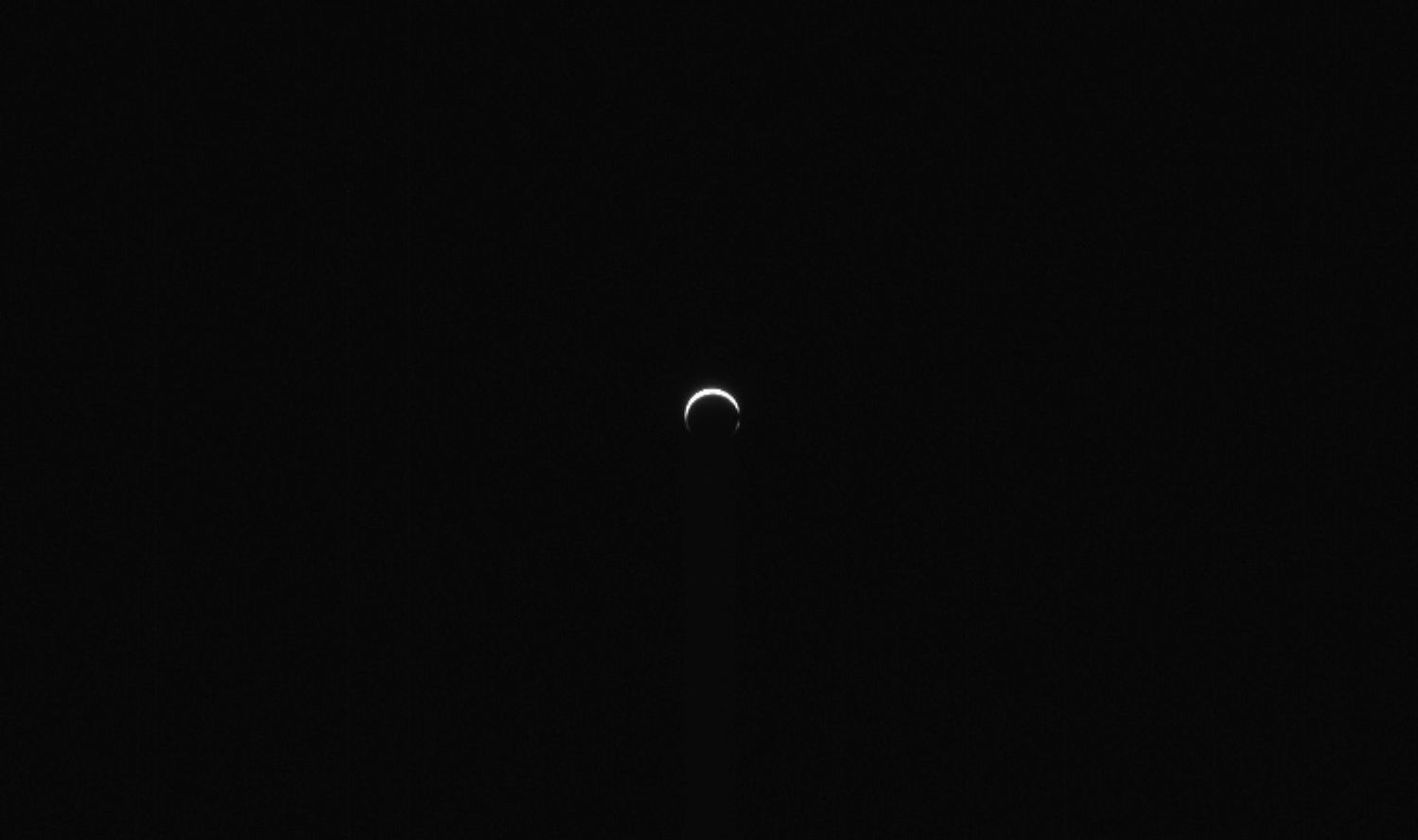
Click for original image.
The asteroid probe Psyche is now approaching Mars for a May 15, 2026 fly-by that will slingshot it out to the metal asteroid Psyche in 2029.
The image to the right, cropped and expanded to post here, was taken on May 3, 2026 when the spacecraft was still about three million miles away.
The observation was acquired by the multispectral imager instrument’s panchromatic or broadband filter, with an exposure time of just 2 milliseconds. Even with this very short exposure time, the crescent is extremely bright and parts of the image are oversaturated. The light seen here is sunlight reflected off the surface of Mars and also scattered by dust particles in its atmosphere. Because the quantity of dust in the atmosphere can vary rapidly over time, the anticipated brightness of the crescent was hard to predict before this early image was acquired.
The dustiness of Mars leads to sunlight being scattered by its atmosphere, making the crescent appear to extend farther around the planet than if it had no atmosphere (as with our Moon).Of note, on the right side of the extended crescent, there appears to be a gap, which coincides with the planet’s icy north polar cap. The cap is currently in winter and mission specialists hypothesize that seasonal clouds and hazes may be forming in that region, possibly blocking the atmospheric dust’s ability to scatter sunlight like it does elsewhere around the planet.
Though the spacecraft had had a thruster issue last year, all seems well at this time.

On Christmas Eve 1968 three Americans became the first humans to visit another world. What they did to celebrate was unexpected and profound, and will be remembered throughout all human history. Genesis: the Story of Apollo 8, Robert Zimmerman's classic history of humanity's first journey to another world, tells that story, and it is now available as both an ebook and an audiobook, both with a foreword by Valerie Anders and a new introduction by Robert Zimmerman.
The print edition can be purchased at Amazon or from any other book seller. If you want an autographed copy the price is $60 for the hardback and $45 for the paperback, plus $8 shipping for each. Go here for purchasing details. The ebook is available everywhere for $5.99 (before discount) at amazon, or direct from my ebook publisher, ebookit. If you buy it from ebookit you don't support the big tech companies and the author gets a bigger cut much sooner.
The audiobook is also available at all these vendors, and is also free with a 30-day trial membership to Audible.
"Not simply about one mission, [Genesis] is also the history of America's quest for the moon... Zimmerman has done a masterful job of tying disparate events together into a solid account of one of America's greatest human triumphs."--San Antonio Express-News
I am trying to understand how the gravity assist, which will accelerate the probe on its way to the asteroid, works.
The probe will approach Mars in a perpendicular direction and come around the back side of the planet in its orbit around the Sun? The speed gained by the probe as it approaches Mars is offset by speed lost as it flies away.
But as the probe curves around Mars, the planet pulls it with it. This pull speed is not offset by anything in the opposite direction because of the perpendicular approach of the probe towards Mars?
This video makes a good point by saying a space ship would not get a gravity assist from a Sun flyby.
https://youtu.be/5ceD56b1LD8?si=D9GKA64FZAPnOJCn
Something that might help me understand is to consider what happens motion wise if the probe is not moving relative to the Sun. Initially have the probe appear out of nowhere in a location beyond the orbit of Mars. So the probe starts being pulled towards the Sun. Then here comes Mars in its orbit around the Sun. The movement of the probe will no longer be a straight line towards the Sun, but depending on its starting point, the probe will start moving in the direction of the orbit of Mars.
Steve Richter,
Gravity assists from the Sun are certainly possible as the star itself is rotating around the center of the galaxy. It just isn’t really worth it when operating solely inside in the solar system. It’s not that the gravity isn’t offset, it’s that when all the forces are added up, the planet’s gravity wasn’t enough to overcome Psyche’s speed completely. Yes, assuming we could somehow (and there are ways, they’re just somewhat challenging) keep a spacecraft stationary in the Sun’s reference frame, and then let it go, it will be pulled inward by the sun’s gravity, but it will be in an arc, not a straight line. Its trajectory will not be affected by Mars unless it passes through Mars’ Hill sphere, roughly 1,342,000 miles in diameter. Pretty tiny, all things considered.
> Gravity assists from the Sun are certainly possible as the star itself is rotating around the
> center of the galaxy. It just isn’t really worth it when operating solely inside in the solar system.
Hi Nate. I kind of question this. An orbiting planet will pull the probe when it swings around it because the planet is moving independently of the probe. But the probe and the Sun are both rotating around the galaxy at the same speed and because of the same source of attraction. So when the probe swings around the Sun it is moving in the same direction around the galaxy as the Sun is. So there is no pull by the Sun on the probe as they are both equally orbiting the center of the galaxy.
It’s the exact same principle writ large. Think of the galactic core as the Sun in this instance, and the Sun as one of the outer planets. If this were not the case, it wouldn’t work inside the solar system either. It’s the reference frame that matters; you’ve got it regarding a heliocentric reference frame, but with interstellar travel we’d use a galactocentric reference frame, and with that we care about the spacecraft’s velocity relative to objects outside the Solar System.
Steve Richter asked: “I am trying to understand how the gravity assist, which will accelerate the probe on its way to the asteroid, works.”
Let’s get back to the more tangible example of a probe from Earth using Mars for a gravity assist to go to a farther-out place (asteroid, Jupiter, etc.).
From Mars’ perspective, the probe approaches at speed-1 and increases speed as it “falls” in the direction of the planet. At closest approach (periapsis or periareion) it is at its highest speed, speed-2, and swings around in a hyperbolic orbital path and travels away from Mars in a different direction than it approached, finally ending up again at speed-1 but in a new direction, a new vector (a vector is speed and direction). This is standard orbital mechanics.
But the Sun sees something different. Mars is already traveling around the Sun at speed-fast, and the probe approaches Mars from one direction and leaves Mars in another direction, but from the Sun’s perspective, the probe picked up some speed, possibly as much as speed-1, and this extra speed in the new direction can eventually gets the probe close to its intended target.
The important point is that it is viewed with respect to the Sun, around which the planets and asteroids travel, not with respect to Mars. If you only view it from respect to Mars, you miss the benefit of the maneuver.
Wikipedia also explains it:
https://en.wikipedia.org/wiki/Gravity_assist#Explanation
The animation titled Example encountermay help visualize it.
https://en.wikipedia.org/wiki/File:GravAssis.gif
An interstellar asteroid can get a gravity assist from the Sun in the same way, but this time the assist is with respect to the galactic center.
Additional explanation: you can also use gravity assist to slow down. When the probe passes behind Mars, goes where Mars was just a few minutes ago, then it tends to come away from Mars going faster relative to the Sun. When it passes in front of Mars, it tends to end up going slower relative to the Sun, a slowing maneuver.
Apollo’s free return trajectory was a pass in front of the Moon, so Apollo slowed down relative to the Earth, which made it then travel toward the Earth, falling lower into the gravity well. A probe that uses the Moon to speed up and go out toward Mars would pass behind the Moon.
___________
Bonus information: The Oberth Effect
An engine burn at closest approach, at periapsis, has even more added benefit. By adding more speed at periapsis, there is less time for gravity to reduce the speed as the probe leaves the planet’s gravity well, so you get more speed than if you had only used the gravity assist and more speed than if you had only fired the engine without proximity to the planet. It is a more efficient use of propellants.
https://en.wikipedia.org/wiki/Oberth_effect
Edward: Your explanation is excellent. The main purpose of the slingshot flyby maneuver is NOT to gain speed, it is to use it to change the spacecraft’s direction of travel. Without the slingshot it would require a lot more energy to propel the spacecraft directly to where it wants to go.
Robert,
“Your explanation is excellent.”
Thank you. I have been explaining this concept to people for two or three decades, so over that time I have refined the explanation a bit. I find it difficult to do without a white board or pencil and paper. I didn’t find a good video that properly explains why it works, but Wikipedia does an OK job.
The major concept for why it works is the source of Steve Richter’s original confusion, the hyperbolic flyby trajectory. A second source of the confusion is the reference frame. Engineers study dynamics, a class that emphasizes reference frames. When astronomers used the Earth as the reference frame (geocentric universe), the solar system didn’t make sense, even with epicycles. Once Copernicus introduced the Sun as the reference frame (Sun-centric universe), Kepler was able to make sense of the solar system. (Huh. It seems that everything was relative even before Einstein’s theory.)
Direction is right. A gain in speed allows the probe to go farther out from the Sun, but if the direction is wrong, then the probe will miss the target. Passes with Venus and even the Earth have also been used to direct probes to their proper destinations. Sometimes multiple passes have been used. The Parker probe, directed closer to the Sun, used Venus more than once.
We often think of our solar system in two dimensions, but like Khan of Star Trek fame, we need to think in three dimensions, too. When a probe needs to go to an asteroid or comet that is out of the plane that the planets lie in (known as the plane of the ecliptic), a gravity assist by going past a planet’s southern hemisphere will change the probe’s direction up above the plane.
When I say “the plane that the planets lie in,” I don’t mean Pluto, because it travels well out of the plane of the ecliptic. If the International Astronomical Union had defined planets as lying in one plane (plus or minus a degree or so), then they would have a better case for demoting Pluto, but they didn’t, so they don’t.
“… The important point is that it is viewed with respect to the Sun, around which the planets and asteroids travel, not with respect to Mars. If you only view it from respect to Mars, you miss the benefit of the maneuver. …”
Would Psyche, the probe, gain any speed with respect to the Galaxy by sling shotting around the Sun? As I understand it, since the probe and the Sun are both orbiting the Galaxy, the answer is no. But Voyager 1, which is on its way to the constellation Ophiuchus, will get there quicker because it picked up speed by sling shotting around the outer planets.
“… From Mars’ perspective, the probe approaches at speed-1 and increases speed as it “falls” in the direction of the planet. At closest approach (periapsis or periareion) it is at its highest speed, speed-2, and swings around in a hyperbolic orbital path and travels away from Mars in a different direction than it approached, finally ending up again at speed-1 but in a new direction, a new vector (a vector is speed and direction). This is standard orbital mechanics. …”
What if a probe is launched from Earth and placed into a solar orbit close to Mars, but headed in the opposite way. And the probe starts out on the other side of the Sun from Mars. Within 3 months of the Mars year, Mars and the probe will pass each other. As viewed from the MRO, will not the probe have its direction and speed changed dramatically as Mars goes roaring past the probe?
Steve Richter,
You asked: “Would Psyche, the probe, gain any speed with respect to the Galaxy by sling shotting around the Sun?”
Because Psyche is in an elliptical solar orbit, there would be no change to its orbit at perihelion. Psyche would remain trapped in orbit around the Sun. However, this is exactly the kind of thing that the Oberth effect is intended for.
“What if a probe is launched from Earth and placed into a solar orbit close to Mars, but headed in the opposite way. And the probe starts out on the other side of the Sun from Mars. Within 3 months of the Mars year, Mars and the probe will pass each other. As viewed from the MRO, will not the probe have its direction and speed changed dramatically as Mars goes roaring past the probe?”
Yes, the probe’s speed and direction would be changed. The closer the approach to Mars, the more dramatic the change. However, from the perspective of someone on Mars, the departure speed would be the same as the approach speed, but the direction would be different.
The difference between these two questions is that in the first, the orbit is elliptical, an orbit trapped by the Sun. In the second, the orbit is hyperbolic, relative to Mars. The probe appears to be coming from infinitely far away and appears to be heading to infinitely far away in a different direction. Relative to the Sun, the probe starts in a solar orbit and likely ends up in a polar orbit.
However, there is a possibility that a probe interacting with a massive enough planet could gain enough speed in a direction that puts the probe at solar escape velocity.
The reason that gravity assist works is that a probe or asteroid has to come from “infinity,” which is to say that it must not be an elliptical or circular orbit; it must be a hyperbolic or parabolic orbit. These last two orbits are open, they exceed escape velocity (hyperbolic) — the pull of gravity drops off faster than the probe slows down — or are exactly at escape velocity (parabolic) — the pull of gravity drops off exactly as fast as the probe slows down. It means that the velocity after the encounter will still be fast enough to never return to the planet’s vicinity — that there is no apoapsis or farthest distance from the planet. It comes from infinity and goes to infinity.
Gravity assist does not work when the orbits do not escape the planet’s gravitational pull — the orbit is closed and the probe will return to the periapsis. This is the case for your first question, which is why gravity assist does not work (without using the engine to employ the Oberth effect).
Earthlings have seen three asteroids come from outside the solar system, and all three have been on trajectories that also leave the solar system in trajectories that are different than their arrival. These three asteroids have, by default, experienced an unintentional gravity assist, either faster or slower relative to the galactic center, and into a different direction.