
Scientists compile catalog of the 69 known rocky exoplanets in the habitable zone
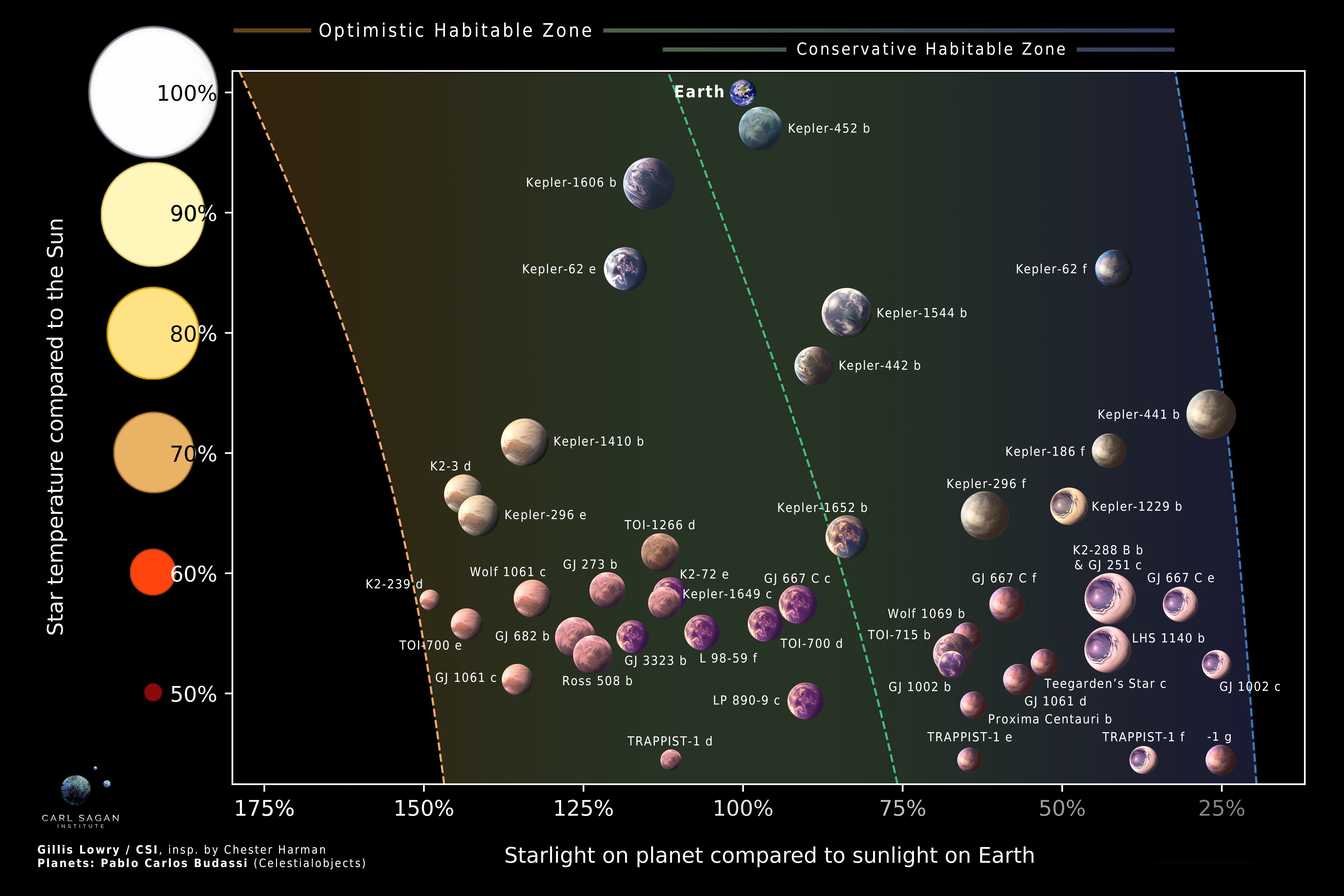
Credit: Gillis Lowry / Pablo Carlos Budassi.
Click for original at full resolution.
Scientists reviewing the more than 6,000 exoplanets so far discovered have now compiled a detailed catalog describing the 69 known rocky exoplanets that are also in the habitable zone.
The graph to the right, cropped and reduced to post here, shows the 45 exoplanets most likely to be habitable, with the amount of energy they get from their star measured relative to that of Earth and the Sun (shown center top). You can read their paper here. From the press release:
The researchers pinpointed 45 rocky worlds that may support life in the habitable zone, and another 24 in a narrower 3D habitable zone that makes a more conservative assumption of how much heat a planet can take before it loses its habitability.
They include some famous exoplanets, including Proxima Centauri b, TRAPPIST-1f and Kepler 186f, as well as others that are not as well known, such as TOI-715 b. The most interesting planets of those listed, according to the authors, are TRAPPIST-1 d, e, f and g, which are 40 light-years from Earth, as well as LHS 1140 b, which is 48 light-years away. Whether these planets could have liquid water depends in part if they can hold an atmosphere.
The worlds that get light from their stars most similar to what modern Earth receives from the Sun are the transiting planets TRAPPIST-1 e, TOI-715 b, Kepler-1652 b, Kepler-442 b, Kepler-1544 b and the planets Proxima Centauri b, GJ 1061 d, GJ 1002 b, and Wolf 1069 b, which make their stars wobble.
The paper includes tables listing the best exoplanets that do transits of their stars, the best with the oldest estimated ages, and the best for testing the limits of the habitable zone itself. As the researchers say in their abstract:
The resulting list of rocky exoplanet targets in the HZ will allow observers to shape and optimize search strategies with space- and ground-based telescopes – such as the James Webb Space Telescope (JWST), Extremely Large Telescope (ELT), Habitable Worlds Observatory (HWO), and Large Interferometer For Exoplanets (LIFE) – and design new observing strategies and instruments to explore these worlds, addressing the question of the limits of exoplanet surface habitability.
In other words, the focus of exoplanet research is now shifting from simply finding these planets to studying them directly, with the potentially habitable worlds listed above the most interesting of all. Astronomers might not find alien life or civilizations on these worlds, but at a minimum they will be doing the first preliminary scouting for humanity’s the first interstellar missions, with the Trappist-1 solar system appearing to head the list.

On Christmas Eve 1968 three Americans became the first humans to visit another world. What they did to celebrate was unexpected and profound, and will be remembered throughout all human history. Genesis: the Story of Apollo 8, Robert Zimmerman's classic history of humanity's first journey to another world, tells that story, and it is now available as both an ebook and an audiobook, both with a foreword by Valerie Anders and a new introduction by Robert Zimmerman.
The print edition can be purchased at Amazon or from any other book seller. If you want an autographed copy the price is $60 for the hardback and $45 for the paperback, plus $8 shipping for each. Go here for purchasing details. The ebook is available everywhere for $5.99 (before discount) at amazon, or direct from my ebook publisher, ebookit. If you buy it from ebookit you don't support the big tech companies and the author gets a bigger cut much sooner.
The audiobook is also available at all these vendors, and is also free with a 30-day trial membership to Audible.
"Not simply about one mission, [Genesis] is also the history of America's quest for the moon... Zimmerman has done a masterful job of tying disparate events together into a solid account of one of America's greatest human triumphs."--San Antonio Express-News
47 Ursae Majoris should have been added to the list…with an asterisk.
There is a gas giant there that is a bit more massive than Jupiter, but closer to its star—about where our asteroid belt would be.
Not only is that Jovian world closer, but the star there is brighter than our Sun…so the effective insolation distance is perhaps that of Mars, taking into consideration that the closer gas giant could reflect light from that bright star on its version of Europa (if any).
Between tidal heating any moons there would experience and greater warmth from other sources, this might make for the abode of life.
Impacts, rings, other moons–a busier sky than ours…like a mobile above a child’s crib. The more toys, the more likely the toddler is to reach up.
Any moon would still be a bit on the cold side, perhaps smaller than Earth, which would allow any mammal like life to grow large and (like the Dilbians of Spacepaw)…furry?
How fitting it would be if alien bears actually lived in the constellation of the Bear.
Perhaps the cosmos is winking at us.
Anything larger than Earth in the “optimistic” (hot) zone, 70%+ luminosity, may be safely classed as a super-Venus. We’re looking at the upper cloud deck of sulfuric acid.
I expect this to hold of most larger-than-Earths around those 70%+ stars in fact, but k-186 and k-62 might be in zones cold-enough that their atmo will balance them out. Unless they are wholly ocean worlds with a steam atmo…
Below 70%, the planets in (what for us is) HZ are tidally-locked and the light curve (infrared v ultraviolet) is shifted to the red. So these planets will be very different. Their HZ could be wider than we think, since each planet will have its own HZ, that ribbon between cold and hot.