
The space station startups: NASA’s new space station plan is mistaken
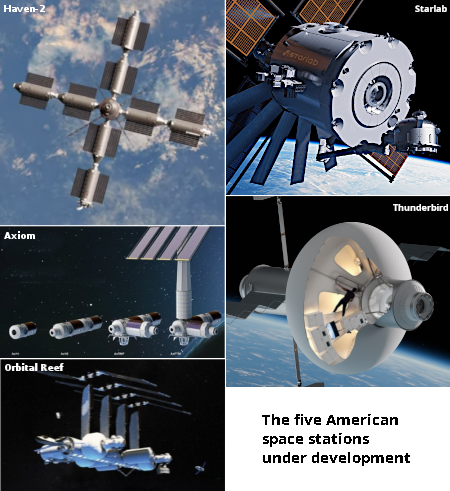
At a conference event this week officials from three of the five American space station startups expressed strong disagreement with NASA’s new space station plan.
The new plan would have NASA build and launch its own new core module, dock it with ISS, and have the new stations attach their first modules to it prior to flying freely. NASA proposed this plan because it does not believe there is enough market to sustain the stations independently and NASA doesn’t have the budget to fully fund them.
The officials repeatedly disagreed about the market issue.
“We believe not only we can be ready by 2030” when the International Space Station is slated to be retired, “but we also believe that we can be profitable on the current market, not waiting for the future market we all will develop and will be successful at,” said Max Haot, CEO of Vast [building the Haven-1 and Haven-2 stations].
…Haot and executives from Axiom Space and Starlab Space said their responses to NASA’s request for information — which were due April 8 — show otherwise. “We put in 390 pages of independent analysis, research studies, datas, contracts, those types of things,” said Marshall Smith, CEO of Starlab Space, which is targeting 2029 for its station to be on orbit. “We’re being very clear and what we can do and how that works.”
One prominent revenue stream the panelists pointed to is other space agencies and nations eager to send their astronauts and payloads to space. “We’ve flown 12 people to space that paid us money to do that,” said Jonathan Cirtain, CEO of Axiom Space, referring to the four private astronaut missions it’s conducted to ISS. “We’ve flown 166 payloads today. All of those are paying payloads that generate revenue for the company.” The Texas company plans to begin operating in 2028 when its first two station modules are slated to be in orbit, then gradually grow the station to five modules.
The officials also said the core module idea would actually slow things down. NASA would have to first build and launch it, and would be starting from scratch to do so. It takes years to build such a thing, and it will certainly not be ready by 2030, when ISS is presently supposed to be retired. Moreover, forcing them to dock to this module would force them all to completely change their own plans, something they all find counter-productive.
In announcing NASA’s core module plan, NASA administrator Jared Isaacman also stated that he was open to industry feedback. I suspect that his core module proposal is going to die, and be replaced with the more direct transition from ISS to these private stations, the approach these companies favor.
I should add that the three startups that spoke up at this conference are also the three that are in the lead to build their stations, according to my rankings below. As far as I can tell, they are all tied for first place, with their station development very robust and well financed.
- Haven-1 and Haven-2, being built by Vast, with no NASA funds. The company plans to launch its single module Haven-1 demo station in 2027 for a three-year period during which it will be occupied by at least four 2-week-long manned missions. It also plans a manned mission to ISS in ’28. The company is already testing an unmanned small demo module in orbit. It has also made preliminary deals with Colombia, Uzbekistan, Japan, and the Maldives for possible astronaut flights to Haven-1. It has also raised more than a billion in cash for this work.
- Axiom, being built by Axiom, has launched four tourist flights to ISS, with the fourth carrying government passengers from India, Hungary, and Poland. A fifth mission is now planned for ’27. The company has now raised $450 million in private investment capital. The development of its first two modules has been proceeding, though the first module launch is now delayed until 2028. It has also signed Redwire to build that module’s solar panels.
- Starlab, being built by a consortium led by Voyager Space, Airbus, and Northrop Grumman, with extensive partnership agreements with the European Space Agency, Mitsubishi, and others. Though no construction has yet begun on its NASA-approved design, it has raised $383 million in a public stock offering, the $217.5 million provided by NASA, and an unstated amount from private capital. It has also begun signing up station customers, as well as a number of companies to build the station’s hardware. It also plans a mission to ISS in ’28.
- Thunderbird, proposed by the startup Max Space. It is building a smaller demo test station to launch in ’27 on a Falcon 9 rocket, and has begun work on its manufacturing facility at Kennedy in Florida. Its management includes one former NASA astronaut and one former member of the Bigelow space station team that built the first private orbiting inflatable modules, Genesis-1, Genesis-2, and BEAM (still operating on ISS).
- Orbital Reef, being built by a consortium led by Blue Origin and Sierra Space. This station looks increasingly dead in the water. Blue Origin has built almost nothing, as seems normal for this company. And while Sierra Space has successfully tested its inflatable modules, including a full scale version, its reputation is soured by its failure in getting its Dream Chaser cargo mini-shuttle launched to ISS.

On Christmas Eve 1968 three Americans became the first humans to visit another world. What they did to celebrate was unexpected and profound, and will be remembered throughout all human history. Genesis: the Story of Apollo 8, Robert Zimmerman's classic history of humanity's first journey to another world, tells that story, and it is now available as both an ebook and an audiobook, both with a foreword by Valerie Anders and a new introduction by Robert Zimmerman.
The print edition can be purchased at Amazon or from any other book seller. If you want an autographed copy the price is $60 for the hardback and $45 for the paperback, plus $8 shipping for each. Go here for purchasing details. The ebook is available everywhere for $5.99 (before discount) at amazon, or direct from my ebook publisher, ebookit. If you buy it from ebookit you don't support the big tech companies and the author gets a bigger cut much sooner.
The audiobook is also available at all these vendors, and is also free with a 30-day trial membership to Audible.
"Not simply about one mission, [Genesis] is also the history of America's quest for the moon... Zimmerman has done a masterful job of tying disparate events together into a solid account of one of America's greatest human triumphs."--San Antonio Express-News
I’m thinking the should just go ahead without NASA.
Not having ISS huge solar panels would be a mistake.
Best to keep that truss.
Now, what would be best is to see humans off ISS at the time it is to go into the drink. Private labs accumulate.
The smaller stations can have humans, so any jarring/jiggling doesn’t get in the way of crystal growth
Vast should get the truss otherwise. The ISS modules I could care less about.
Just a simple question: Is any one of these contraptions finally going to be able to create artificial gravity?
Phil Berardelli: Haven-2 is expressly designed to test spin for artificial gravity. Starlab and Thunderbird both can test it as well, though not as efficiently.
VAST’s biggest concept was just a long bar, though I have seen other designd
https://www.nextbigfuture.com/2023/05/vast-has-big-orbital-space-station-plans.html
ISS is more properly what I would call a space platform.
Ring designs are what I call space stations.
Back when people truly dreamed big…
https://www.secretprojects.co.uk/threads/space-station-concepts.4117/page-5#post-897985
Could someone duplicate the ISS’s power generating capabilities at a much lower cost? My guess is they could. At least, a lot of smart people seem to think so, or space data centers would not be a thing. The ISS, in general, may be more trouble than it is worth to a new space station developer.
Isaacman may think there is not enough commercial money to build the new stations, but why the heck would he say so publicly? He just makes it that much harder for those trying to do so, regardless of the plan chosen. Perhaps he just wants NASA to abandon government sponsored manned spaceflight to low earth orbit. If so, what he is saying would advance that goal. He can’t argue for that honestly, because that is political suicide.
“Could someone duplicate the ISS’s power generating capabilities at a much lower cost?”
Redwire is actually doing that for NASA as we speak on the ISS, with the new Roll Out Solar Arrays that are being installed on ISS:
https://en.wikipedia.org/wiki/Roll_Out_Solar_Array
Those were rolled on on the truss. More mass equals more stability.
To Cloudy,
What you see on display in NewSpace circles is denial.
SLS is a waste because it is expendable…but go ahead and splash ISS which cost more.
The reason people hate ISS is that it is seen as government–boo-hiss. When I point out that I actually don’t want to throw SLS cores away either…using them as a wet workshop (perfect for spools of filament even exposed to vacuum)–New Spacers belittle it. One SLS core can put more floor space in orbit in one shot than all ISS, even if it actually did cost four bil’
Now, it is hopeless trying to argue with NewSpacers trained like Pavlov’s dog–so I want to ask a question to you alone, Cloudy…which is tougher….putting fins and TPS on a grain silo and trying to recover it?
Or just keeping a tank in orbit with an airlock and maybe a spread to go over foam popcorning?
Active matter
https://techxplore.com/news/2026-04-restless-materials-dont-pressure-snap.html
That may be useful for arrays, robots, etc.
Given that more than half of what NASA spends on ISS every year is for crew and cargo logistics, the new would-be players need to directly address those costs if they expect to make a go of their current projects. It’s beyond the reach of any one of the aspiring LEO space station operators to solve this problem on its own, but, in combination, they could make a case to SpaceX for a rideshare-like LEO logistics service based on Starship. They should get cracking on exactly that.
Jeff Wright,
You wrote: “Not having ISS huge solar panels would be a mistake.”
Unless having them is a bigger mistake. Their mass and large size adds to the attitude control load on the new space stations, and if the solar panels provide more power than the commercial stations need, then that could be a problem for them. Solar array sizes are chosen carefully to provide the correct amount of power at end of life but not so large as to burden the spacecraft unnecessarily.
“When I point out that I actually don’t want to throw SLS cores away either…using them as a wet workshop (perfect for spools of filament even exposed to vacuum)–New Spacers belittle it.”
Perhaps, you can tell us why no one has a plan to reuse SLS cores as wet workshops. It isn’t because workshops or space stations of that size are a bad idea.
If you were to suggest an upper stage (e.g. Centaur) as a wet workshop, then you might get some attention.
___________
Dick Eagleson wrote: “Given that more than half of what NASA spends on ISS every year is for crew and cargo logistics, the new would-be players need to directly address those costs if they expect to make a go of their current projects.”
NASA has a large standing army working on logistics. The question that commercial space stations need to answer is: how few people do they need for logistical support?
Much of the logistics is likely to fall to the space agencies that rent space on a commercial space station. They are the ones, after all, who are taking the experiments up for their own use, so the responsibility for those experiments fall on the renters, not the space station owner. The cost to the space agencies will be more than just the space station rent and the crew and cargo transportation. It will include training and the cost of the experiments, which do not fall under the space station owner.
Jeff,
“More mass equals more stability.”
More mass also means more delta-v needed for station keeping.
All of the proposed commercial stations have solar arrays, and they all would be much more efficient than ISS’s, because (and this was my original point) there have been major advances in solar cell technology over the past quarter century.
And they don’t need a giant truss structure to deploy them!
“Given that more than half of what NASA spends on ISS every year is for crew and cargo logistics, the new would-be players need to directly address those costs if they expect to make a go of their current projects.”
Yeah. That’s the point Eager Space, among others, has been trying to make about the commercial space stations. The price point of getting people and cargo to and from stations needs to come down.
Cloudy,
That’s not what Isaacman said. He said NASA doesn’t have the budget to fund multiple CLD providers, which is rather different.
Richard M,
Yeah, that’s a lot of parasitical mass that doesn’t need to exist. Perhaps future, much larger stations might use a truss of some sort, but it would likely end up as a far smaller fraction of total station mass.
Jeff Wright,
The ISS is getting old, it’s extremely expensive to operate, and we’ve learned a lot over the years. It’s not ‘denial,’ but an appraisal of what we get from the ISS versus what we spend on it.
The ISS was extremely valuable because through COTS it helped save SpaceX. As for SLS-based wet workshops, they’re a nonstarter because of cost, no market, and no core availability. Smaller programs like what Varda is doing do have a market, but they take time to prove to people outside the space sector, whereas your proposal would lose someone billions of dollars and likely make them go out of business.
Insulting people because you think they’re mindless animals isn’t a good way to win support; and your question is comparing two very different things. The real answer, of course, is that reusing that ‘grain silo’ is far more valuable than trying to use an SLS core as a wet workshop.
Hi Nate,
It’s kinda both, though, isn’t it? He pretty clearly has a more pessimistic assessment of the market for space station services than the commercial space station companies do. And after all, that assessment also informs just how much money NASA decides it needs to give these companies in the form of contracts in order to ensure that they have a fighting chance to stay in business while operating them!
And that all said . . . look, if the NASA Administrator were anyone other than Jared Isaacman — if his name was Charlie Bolden, or Bill Nelson, Mike Griffin, or even Jim Bridenstine — I would be more inclined to dismiss the assessment of the NASA Administrator out of hand. But as Jared himself notes, he has been one of the most prominent customers of orbital crewed services on the entire planet over the last few years, so he’s got some grounds for thinking he knows what he is talking about. He might still be wrong, but I’d really like to see the evidence that the commercial providers have assembled to make the counter argument before I can feel I have any way to make my own assessment.
Nate is a true believer no different from me.
The only difference is that his choice of rocket wallows about 100 miles up, where an SLS core block flies higher than Polaris Dawn.
That performance needs to be embraced, not attacked.
That folks don’t support wet workshops is their failure of imagination. They want Starship to be the better choice. Axiom actually looked at wet-workshops. Convair Atlas stations would have kerosene to deal with. You want real floorspace…apart from VAST, everyone else is just playing around.
Stage-and-a-half allows amazing performance. Now, do I wish someone besides Boeing was building it? Sure.
Richard M,
To a degree, but I think regarding commercial services, most of the space station operators will find non-manned opportunities to be far richer earlier on than flying people. If we’re evaluating it solely on how many people are willing to go right now, I agree the picture is murkier.
Jeff Wright,
Can you take a break with the trolling for once? Try to understand others instead of assuming they’re dumb, playing around, all the belittling comments that you no doubt think of as true and unobjectionable, but only serve to distort discussion.
Nate P: You should realize that Jeff Wright does not read you comments, or anyone’s, with the slightest intention of learning anything. It is a waste of time trying to debate him.
I don’t ban him because his comments — entirely lacking in the slightest understanding of economics — do a great job in inspiring good intelligent responses, something the site needs as well as the nation. There are a lot of Jeff Wrights out there. Some don’t comment so they are not invested in their uneducated ideas like he is. They will read the good responses and will learn.
Your trick is not to let him impact you emotionally. Respond with the goal of educating everyone else, by pointing out Jeff Wright’s errors. No point trying to educate him.
Richard M,
You wrote: “And after all, that assessment also informs just how much money NASA decides it needs to give these companies in the form of contracts in order to ensure that they have a fighting chance to stay in business while operating them!”
Does this mean that NASA believes that only the companies receiving the next Commercial LEO (low Earth orbit) Destinations (CLD) contracts are the only ones with a fighting chance to stay in the space station business? This would necessarily mean that NASA believes it will choose the winners and the losers in the commercial space station industry, at least for the next decade or so.
__________
Jeff Wright,
You wrote: “That performance needs to be embraced, not attacked.”
It isn’t the performance of the SLS rocket that anyone gripes about. It is the cost, the low launch cadence, and the inappropriateness for the mission assigned to it. As a rocket, it performs admirably.
“That folks don’t support wet workshops is their failure of imagination.”
Actually, not. As you noted, Axiom had seriously proposed exactly this kind of space station, half a decade or so ago. They actively chose to not pursue this option. This option may not yet be ready for prime time, but it would be nice if we eventually stop wasting our upper stages and start putting them to good reuse. What this tells me is that our lessons learned on our previous government-owned space stations have not prepared us for this option.
If there is any failure of imagination, it is on the side of NASA, not We the People.
“They want Starship to be the better choice.”
Not “want.” Starship is the available choice, right now, and it is not the optimal method. This is why we build dedicated space stations — a more optimal solution — rather than continue using the Space Shuttle methodology, which is what Starship provides.
We get excited over what is available or what soon will be. That is why so many people were so excited over Mercury, Gemini, Apollo, the Space Shuttle, Ares, and SLS. They each had their limitations, but they were what we had available. At least Ares was designed for the mission it was given.
“You want real floorspace…apart from VAST, everyone else is just playing around.”
Do we need real floorspace (working volume) right now? Even Vast plans to expand into the number of modules that are useful. Start small and simple and grow into the demand. Don’t do as NASA did and design big, build big, and hope that the world fills the available space. This is how you end up spending way too much. A government can do this without fear of bankruptcy, because they just increase the taxes (tyranny-style), borrow money (causing higher interest rates), or print money (causing inflation).
“Stage-and-a-half allows amazing performance. Now, do I wish someone besides Boeing was building it? Sure.”
Several rockets have used stage-and-a-half, from the Atlas, to the Space Shuttle, to Delta (two-and-a-half-stages), to SLS (two-and-a-half-stages), to Falcon Heavy (two-and-a-half-stages). Why doesn’t Starship use it? Because it slows down the reusability cadence and adds to the cost.
Performance sometimes has to be sacrificed for affordability or economy, which sometimes have to be sacrificed for performance. We went to the Moon through performance, not through economy, which is a major reason why Apollo was cancelled (safety being another major reason). This time, we are trying to make moonshots economical so that we can afford to continue them. SLS does not fit that bill.
It would be nice if the most economical solutions were also the ones with the best performance, but life, engineering, and business are full of trade-offs. Unfortunately, we do not live in a dreamworld but in a real-world, and we must make real-world compromises. That is the difference between a true believer and a pragmatist.
Engineers start with the dream, come up with ideas that come as close as possible to that dream, work out the compromises, and find solutions that are workable and economical while still as close to the dream as possible. Price and availability trump the dreamworld every time, and were two of the most common questions that I asked when I was in design.
Robert Zimmerman,
It’s true, it’s probably long past that I give up my stubbornness even with him.
Fair enough.
And what form that reuse takes can vary. Most of the time with transport we don’t try to reuse it as living quarters or factory space-there are exceptions, but compared to using transport just to move goods or people that’s rare. I think space will be like other arenas-most homes, offices, factories, etc. are much larger than any form of transport that we build, though there are overlapping segments (battleships being larger than a family home, for example); and the form factor of vehicles like Starship may not be preferable for a particular job. The same is true for a wet workshop. Just because we can in principle turn a stage into a human-accessible volume doesn’t mean it’s well suited to whatever jobs we can envision for it.
The other thing is that these aren’t competing methods of reuse. Wet workshops don’t address the core challenge of space launch, which is lowering the cost of access. In theory we could greatly expand core production, but then new challenges arise-what do we do with all these stages left on orbit? Without cheap access to space, how do we refurbish them into something usable? How long will all that take? How much will it cost? Who will pay for it? The government shows no inclination to do so, and the private sector has actively rejected the concept.
I’d love to see large habitats, vast factories, as much as anyone, but this is a key point-nobody needs them right now. Want? Sure. But as you rightly note, Edward, the way the government has approached it has cost more than it’s worth.
Yes, just because the private sector produces more wealth than the government taxes, and the government can in principle spend a greater sum on the SLS, doesn’t make the SLS affordable. NASA’s budget has rarely risen higher than about $25 billion/year for decades now, which tells us that there’s not much public or political drive to spend more on the agency; because NASA’s ESM directorate gets about $7.5 billion per year, doubling that means gutting other parts of NASA, and because there’s no realistic path to halving the cost of the SLS and Orion without firing much of their workforces-which would slow down construction even more-we must conclude that to do things economically in space, alternatives are mandatory.
Yes. one hundred percent. I am an engineer, and if something is available and affordable, that generally trumps other considerations, so long as it can still do the job. Some materials we just don’t use, or use much of, because they either cost far more, or we’d have to wait far longer to get them, and we have deadlines. As for space, just because SpaceX is tackling reuse in one fashion doesn’t meant it’s the only workable or affordable option, and they may well end up outcompeted by someone with a brilliant idea. But the market, in the form of all the people who have to make purchasing decisions, will decide that, not us deciding here by fiat.
Edward and Nate P: Everything you both say is valid. But you are both engineers, and look at this from the engineering perspective. Let me give a non-engineer’s perspective from someone who focuses on larger culture issues.
To get all the engineering things you guys contemplate, we need a thriving, competitive industry of many companies run by many different people. Each will focus on what works best for them — to make a profit. Over time, if you have many companies and people free to innovate and compete, they will diversify and begin providing all the those things you contemplate, and they will do by providing a needed service that makes money.
That is the bottom line. No government policy or greater plan will work. It has to happen naturally, under the umbrella of freedom, so that the invisible hand can find what works best, for the most profit.
This is exactly what happened with the automobile industry. At first, the car companies provided servicing and fueling. Then others came along to offer gas stations and repair shops. Soon others made a living selling used cars. And that was only the beginning.
So, if you have cool engineering idea, you need to find a company that needs it, and sell it to them. The more that happens, the sooner we will get it all.
Robert Zimmerman,
Somewhat relatedly, yesterday I was thinking about the difference between a market economy when providing goods versus a command economy. While the Soviet Union was able to accomplish some impressive feats, and it could throw a lot of resources (comparatively) at a given arena, it was never able to supply the variety and richness of goods that America’s private sector could without government controls (and the US could ultimately muster a much greater manufacturing and research base). I have seen no real justification other than a desire for power and a mistaken belief that only the government represents the people for us to continue imitating Soviet-style top-down control of spaceflight in the US. The government is better suited to providing military support and the rule of law.
On that note, a way that might all work out in the future is if SpaceX and/or Blue Origin establish a base at the lunar South Pole. Harvesting water ice, launching AI satellites, whatever, they’ll need to build quite a lot in order to support their CEOs’ dreams, and in the process other users can piggyback off their efforts, making use of the energy and communications grids they’ll have to build; shipping cargo via the logistics loops they’ll need; access to radiation-shielded habitats, heavy equipment, perhaps a robotic workforce. Instead of needing hundreds of millions to billions of dollars to perform great science, scientists may only need millions to hundreds of millions, depending on what their specific goals are. I don’t see the US government ever building such a base, especially not if it has to use rare, expensive launch to build and supply it, but Musk or Bezos? Absolutely.
Nate P wrote: “And what form that reuse takes can vary.”
This is true. There are only so many space stations that are needed, but some of the upper stages could conceivably be turned into tugs. ULA had a dream of doing this with its upper stages, calling it ACES, and creating XEUS from it, but abandoned these ideas. Even these ideas have limits as to how many upper stages could be reused these ways. Perhaps upper stages can eventually be scrapped in low Earth orbit for use in manufacturing other items, similar to what we do to obsolete ships and scrap cars. This idea is also not yet ready for prime time, as we do not yet have the space manufacturing industry that this material could feed.
However, another course of action is to create reusable upper stages that reenter the atmosphere for use on another rocket. This is the immediate purpose for the Starship, and other companies are pondering the same technique, too. This is a desirable form of reuse.
“NASA’s budget has rarely risen higher than about $25 billion/year for decades now, which tells us that there’s not much public or political drive to spend more on the agency; …”
NASA does not produce as much prosperity as our commercial companies. Prosperity is not NASA’s mission, but it is the mission of the commercial companies. Commercial companies sell prosperity, which is what sells best, because this is what each individual wants for himself.
“As for space, just because SpaceX is tackling reuse in one fashion doesn’t meant it’s the only workable or affordable option, and they may well end up outcompeted by someone with a brilliant idea.”
I’m not sure that the competition has to be so brilliant. In developing the Falcons, SpaceX has made compromises that have left much on the table for additional efficiency. Blue Origin is already competing with the Falcons and Rocket Lab will have its competitive entry flying in the next several months.
_________
Robert Zimmerman, wrote: “To get all the engineering things you guys contemplate, we need a thriving, competitive industry of many companies run by many different people.”
As with all our most successful industries. Each person finds his own ways to solve other people’s problems, and by charging for these solutions he makes a living, and we all learn which solutions work best while other people find new solutions that are even more efficient.
“ No government policy or greater plan will work. It has to happen naturally, under the umbrella of freedom, so that the invisible hand can find what works best, for the most profit. ”
(I apologize for the crude, unthought-out tone of this comment. I have believed this way for decades, but this is the first time I am trying to put my thoughts into words.)
ARRRGH!!! That “invisible hand! ” It is understandable that Adam Smith used that analogy, because people naturally associate results with an individual’s actions rather than the cumulative actions of individuals in an economy or ecology. Unless divine intervention is the prime cause, nature and economies move and change due to the actions of individuals all acting in their own self interests (enlightened or not).
The concept of an invisible hand feeds right into the thought processes of governments, or more correctly, those who think of themselves as professional policy makers. These are people who think that they know what is best for the whole, and as such, what is best for the individuals to do, say, be, wear, go, think, drive, buy, and any number of other verbs that make up the actions and existence of a community.
Those who think of themselves as professional policy makers truly feel that they are the correct ones to make the choices of societies and the choices for the people within those societies. They think that they should choose the winners and the losers in an economy. They were trained to make right decisions, to choose wisely. They were trained to hold contempt for the rest of us. They make up the government that interferes with the rest of us, that removes our freedoms, because when we are free to choose, we choose wrong, every single time.
https://www.youtube.com/watch?v=YkZcEJBcLmU#t=89 (6 seconds)
Or so they feel. They feel that they should be the invisible hand that guides the economy and us, by lure or by force. That is not what works. They are not an invisible hand. It is the freedom to choose, the freedom for us to decide what is best for us individually, and therefore what is best as a group, to find our own prosperity. There is no invisible hand. There is no collective conscience that guides, there is only the results that can be observed from what is done by the people who make up the economy. Some do this, and some do that, and the results of the overall actions are observable in various ways.
Observing these results collectively may seem like an invisible hand is responsible, but that implies a single thought process made the hand cause the action that created the results. It is not a single thought. It is not a collective thought. It is thousands or millions of individuals, each with his own thought, his own freedom, and his own hand, some pulling in this direction and some pushing in that direction on a myriad of things that move about with the arbitrariness of each actor, producing a variety of results that, when observed from far away enough to look like a single organism moving through the economy, is misinterpreted as the result of one hand, unseen by the observer.
Professional policy makers are trained to be idiots, not invisible hands.
Right now, Uncle Sam is still NewSpace’s best customer what with Space Force having as much if not more funds available than NASA.
I understand economics better than you think I do.
P. J. O’Rourke wasn’t an economist –but he turned out to be right about a few things because Sowell was just as brainwashed on the Right as the Bernie’s are on the left.
P.J. understood that CULTURE MATTERS.
That is why Russia fell where China hasn’t, despite Mr. Eagleson’s prediction.
Military uses for private space stations are now more possible than ever:
https://techxplore.com/news/2026-04-invisible-device-disturb-metamaterial-shell.html
But–more importantly–there are a handful of folks from the USAF that are as sick about the death of the Manned Orbital Observatory (MOL) as I am about the death of the Saturn IB that should have launched it.
The success of Artemis II has given Americans a touch of space fever…and that coupled with stealth fighter pilots and (remote) drone-drivers having their rides shot out from under them by Iranian half-wits means mil-space advocates have a bit more intellectual currency than EVER before.
Here is the thing, though: all it takes is one Nate P to ruin everything by saying “you don’t need manned military stations.”
Yes, the KH-11 Hubble-style spysats had advantages over MOL, but it also cost America some swagger….mojo.
You cannot put a price tag on such things!
I used to hate sports. Scholars Bowls never had the same level of support as college football. But the latter keeps people engaged, see.
Nate needs to grow up and get his face out of economics textbooks and live a little.
Jeff Wright,
You wrote:”I understand economics better than you think I do.”
Dream on. Here’s why you don’t:
“Right now, Uncle Sam is still NewSpace’s best customer what with Space Force having as much if not more funds available than NASA.”
Right now, there are far more commercial launches than government launches, with far more commercial launches to come. You may have been right five or six years ago, but not right now.
Right now, there are far more commercial satellites operating than government satellites. On average, these commercial satellites generate a great deal of revenue and pay for themselves fairly quickly.
Right now, there is far more money spent building commercial satellites than government satellites.
“That is why Russia fell where China hasn’t, despite Mr. Eagleson’s prediction.”
China hasn’t fallen yet, because they moved slightly toward free markets and especially toward capitalism. It is why their rocket industry is doing so well.
“Here is the thing, though: all it takes is one Nate P to ruin everything by saying ‘you don’t need manned military stations.’”
Considering that we have done very well without them for the past two-thirds of a century, the empirical evidence is that Nate P is correct. We don’t need manned military stations. Want, maybe. Need, no.
“You cannot put a price tag on such things!”
And yet the government does. Otherwise Apollo would not have been cancelled. The price in lives and dollars was just too high for the government.
End of today’s economics lesson.
Pop quiz time: What did you learn today?
Edward,
Right now, there are far more commercial launches than government launches, with far more commercial launches to come. You may have been right five or six years ago, but not right now.
Right now, there are far more commercial satellites operating than government satellites. On average, these commercial satellites generate a great deal of revenue and pay for themselves fairly quickly.
Right now, there is far more money spent building commercial satellites than government satellites. I think even with Golden Dome that the private sector will still outstrip government spending and launches. Should data centers, orbital manufacturing, asteroid mining et al. pan out, the number of commercial launches will only skyrocket, and the virtuous cycle all of those require to succeed will enable all sorts of other dreams that were unaffordable or at the least of dubious value previously.
China hasn’t fallen yet, because they moved slightly toward free markets and especially toward capitalism. It is why their rocket industry is doing so well. And then they hamstrung their private sector, with the Chinese economy growing only fifteen percent in from 2021-2024 compared to the twenty five percent growth in the United States, and Chinese capital markets having contracted while US markets have surged.
Considering that we have done very well without them for the past two-thirds of a century, the empirical evidence is that Nate P is correct. We don’t need manned military stations. Want, maybe. Need, no. Bingo. Want and need are not synonyms.
Jeff Wright,
I recall before Artemis I SLS advocates enthusiastically predicting a massive swell of support for the agency. It did not materialize. So far, nothing has changed re: Artemis II. There is also no evidence that ‘mil-space advocates’ have any stronger a position today than they did six months ago. I think you are again seeing what you want to see.
If manned military space stations had justifiable roles, they’d get funding. I do think within a couple of decades we’ll start building them, but they are not justifiable now. As Edward wrote, it’s the difference between want and need. You want, but we do not need, and I think you do not recognize the difference.
You’re welcome to join me swing dancing, if you can work up the courage to ask a woman to dance with you. Social dancing is alive and well and a lot of fun.
Jeff Wright,
NewSpace is its own best customer, specifically SpaceX and Starlink. Then there will be even more broadband Starlinks, Starlink Mobile 5G cell phone birds and AI data center birds. Plus all of the launches anent Moon missions to build industry – and vastly more AI data center birds – there. Even with Golden Dome in the picture, government demand is never going to catch commercial demand again – most of it self-generated.
PJ O’Rourke did know a lot of stuff. I’d be fascinated to know what you think he knew that Tom Sowell didn’t. It certainly wasn’t that Culture Matters.
The PRC is in the position of the man who, having fallen off the Empire State Building, calls out as he passes the 50th floor, “Everything’s fine so far!”
That the Soviet Union fell at all came as a literal shock to many – especially on the academic left – who were serenely confident it would last indefinitely and absorb the West. “Historical Inevitability” didn’t work out any better than the “Thousand-Year Reich.”
Now, of course, we’ve got a whole new generation of arrogant and ignorant simpletons saying the same sorts of things about the PRC. They haven’t looked under the hood. There’s no giant engine there, just a lot of hamster wheels. And the hamsters are getting old and dying off without having any kids.
The whole thing is seriously metastable. There’s no way to know just what will precipitate the fall of the PRC or exactly when it will happen, but it will happen. And, as with the Soviet Union, it will be a relatively quick process – probably faster than the roughly 2.5 years it took the Soviet Union’s empire to go from first rumblings in late 1Q 1989 to utter collapse in mid-3Q 1991.
And, once again, the academic left will be wearing thousand-yard stares and losing voluntary sphincter control.