The desert below Mt. St. Helens
On May 18, 1980, Mt. St. Helens erupted, the blast throwing the north slope of the mountain out and downward in a terribly hot wave of ash, rock, and magma. All life in its path was destroyed. Forests were ripped to the ground, then buried. The force of the wave tore into Spirit Lake, pushing the water sideways so that it sent its own wave 500 feet up the side of the opposite mountain. The mountain then dumped so much material into the lake that it actually doubled in size, its shores raised 200 feet.
It is now thirty years later. After years of slowly oozing out two large lava domes into its shattered crater, Mt. St. Helens had finally quieted down enough for the National Park Service to permit hikers to once again return. Not only do trails now criss-cross the blast zone below the crater, if you make arrangements in advance you can actually hike up the mountain’s south face and look down into the crater.
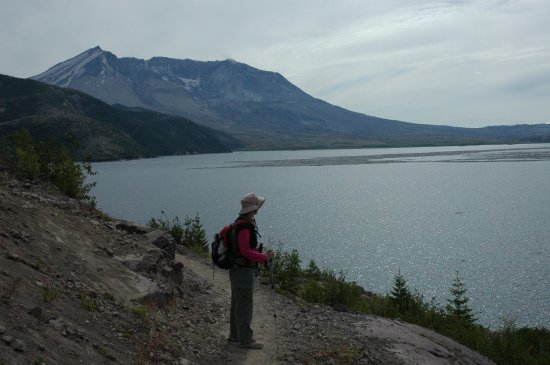
Our hike yesterday at Mt. St. Helens consisted of two parts. The first took us down onto the Loowit Trail, the closest the National Park Service permits hikers to get to the volcano’s lava domes. The second part was a short hike down to the shoreline of Spirit Lake.
Two things stood out in both these hikes. First, I was astonished how much of the surrounding landscape remains devastated, barren, and desert-like, decades after the eruption. I come from the East, where you expect a barren field to quickly become overgrown with life. Yet, even in the rainy climate of the northwest the destruction left by the volcano is so profound it is going to take many more decades for the forest to reclaim its former glory.
Thus, the land between the mountain and Spirit Lake more resembles the deserts of the American southwest than the lush, wet forests of the Cascade mountains. At one point I even noted to Diane how the Loowit trail reminded me of the Tonto Plateau trail in the Grand Canyon — a wide shadeless terrain crossing periodic dry gullys.
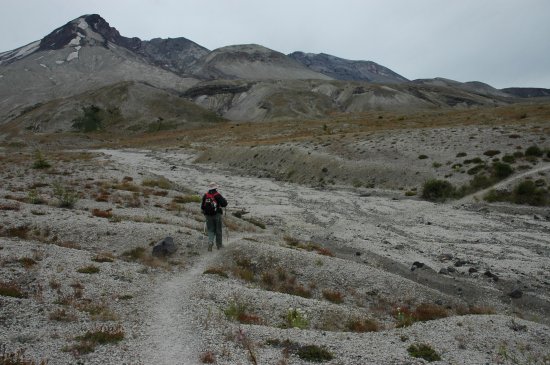
Still, in what had been a dead zone thirty years ago, small life has reappeared, from chipmunks to a variety of scrubs and grasses. There are even a scattering a small young evergreens, signaling the eventual return of the forest.
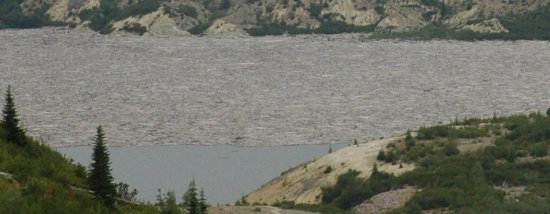
At Spirit Lake, farther from the volcano, the landscape showed even more life. Yet, the lake was still half covered with a mat of dead logs, left over from the blast. And the hillsides were littered with the blown-down logs. Though many have rotted away in the ensuing decades, many remain, scattered about like giant toothpicks.
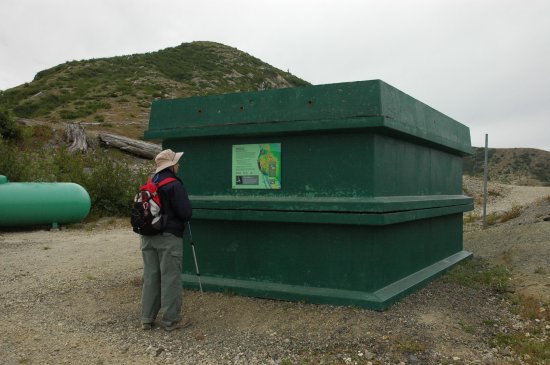
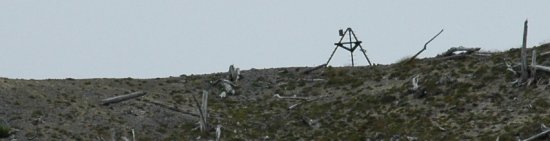
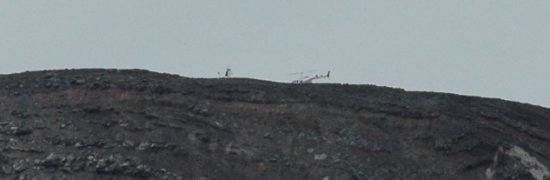
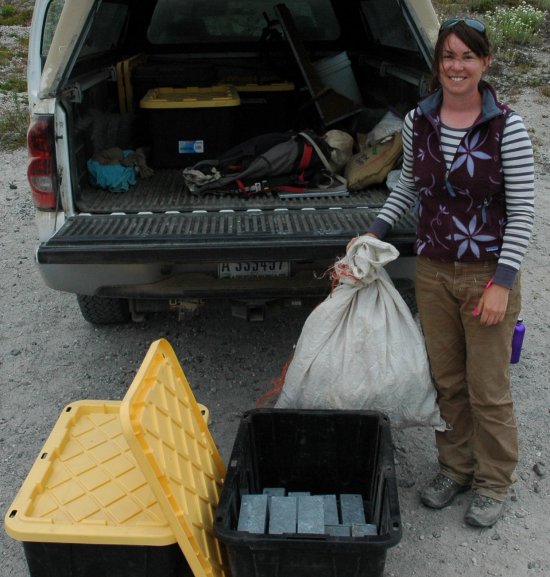
The second thing notable was how much the barren landscape of Mt. St. Helens was dominated by the research work of scientists. Wherever we looked we saw evidence of it. Instruments and sensors could be spotted everywhere. Helicopters transporting scientists flew over repeatedly. We even met a young researcher gathering animal traps, part of the continuing census of life in the blast zone. As she explained to me, they are tracking the changing species as life re-enters and repopulates the dead zone.
From a human perspective, this research is profound. Though natural disasters such as the Mt. St. Helens eruption are not unusual things in the history of our planet, humans have never had an opportunity to study the aftermath of one in such detail. The knowledge gained will be priceless beyond measure. And that we as a society are willing to dedicate the funds to do this work will speak very well of us to future generations.