
Shells of dust surrounding massive binary star
Click for full image.
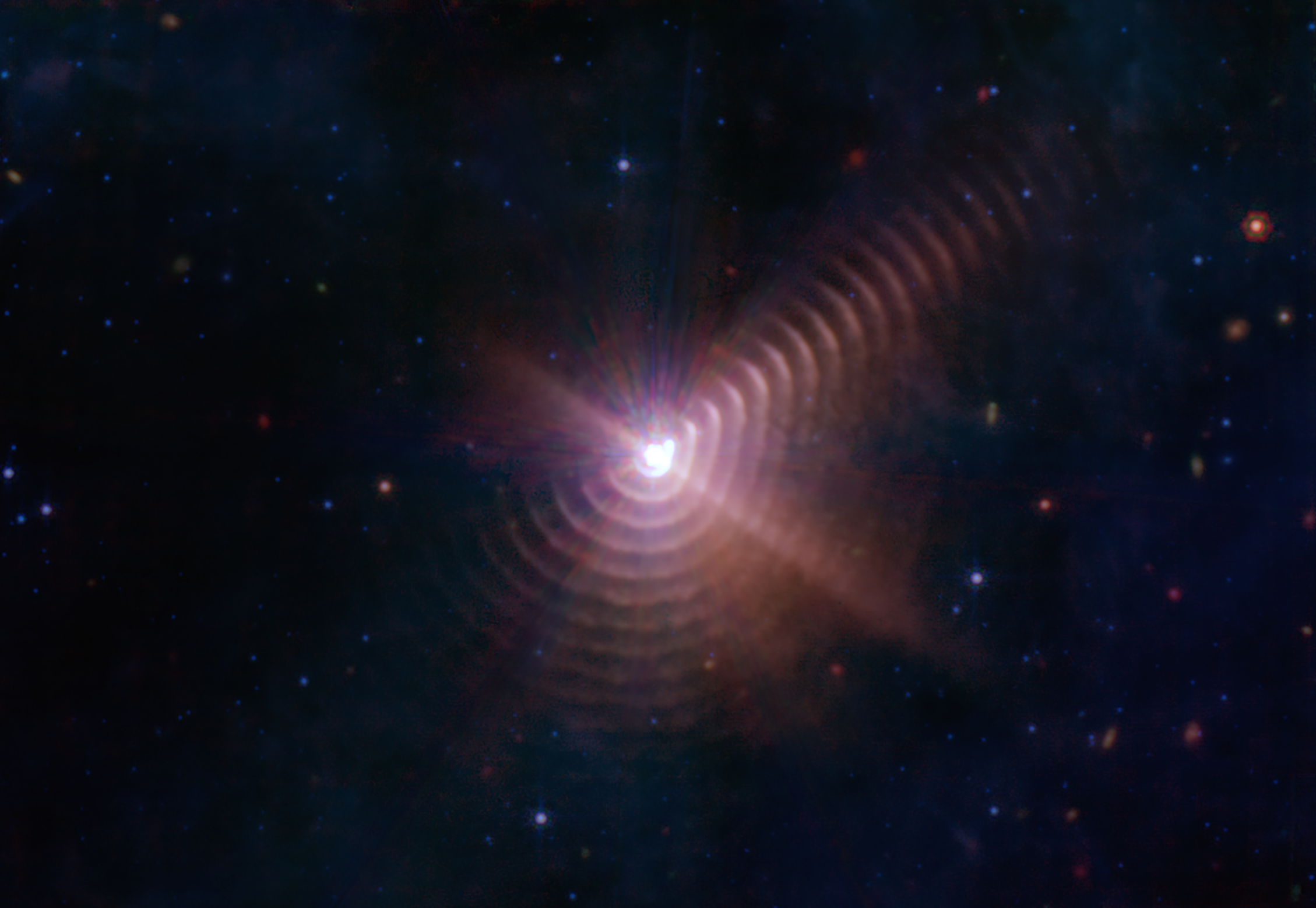
Cool image time! Using the Webb telescope, astronomers have detected a series of concentric shells surrounding the massive binary star dubbed Wolf-Rayet 140.
The infrared image to the right shows these shells quite clearly. As noted by astronomer Ryan Lau:
“On the night that my team’s Early Release Science observations of the dust-forming massive binary star Wolf-Rayet (WR) 140 were taken, I was puzzled by what I saw in the preview images from the Mid-Infrared Instrument (MIRI). There seemed to be a strange-looking diffraction pattern, and I worried that it was a visual effect created by the stars’ extreme brightness. However, as soon as I downloaded the final data I realized that I was not looking at a diffraction pattern, but instead rings of dust surrounding WR 140 – at least 17 of them.
“I was amazed. Although they resemble rings in the image, the true 3D geometry of those semi-circular features is better described as a shell. The shells of dust are formed each time the stars reach a point in their orbit where they are closest to each other and their stellar winds interact. The even spacing between the shells indicates that dust formation events are occurring like clockwork, once in each eight-year orbit. In this case, the 17 shells can be counted like tree rings, showing more than 130 years of dust formation. Our confidence in this interpretation of the image was strengthened by comparing our findings to the geometric dust models by Yinuo Han, a doctoral student at the University of Cambridge, which showed a near-perfect match to our observations.
Furthermore, the spectroscopy from Webb says these dust shells are carbon-enriched, showing that the dust released by these aged massive stars is a significant source of the carbon in the universe, the fundamental atom needed for life.

On Christmas Eve 1968 three Americans became the first humans to visit another world. What they did to celebrate was unexpected and profound, and will be remembered throughout all human history. Genesis: the Story of Apollo 8, Robert Zimmerman's classic history of humanity's first journey to another world, tells that story, and it is now available as both an ebook and an audiobook, both with a foreword by Valerie Anders and a new introduction by Robert Zimmerman.
The print edition can be purchased at Amazon or from any other book seller. If you want an autographed copy the price is $60 for the hardback and $45 for the paperback, plus $8 shipping for each. Go here for purchasing details. The ebook is available everywhere for $5.99 (before discount) at amazon, or direct from my ebook publisher, ebookit. If you buy it from ebookit you don't support the big tech companies and the author gets a bigger cut much sooner.
The audiobook is also available at all these vendors, and is also free with a 30-day trial membership to Audible.
"Not simply about one mission, [Genesis] is also the history of America's quest for the moon... Zimmerman has done a masterful job of tying disparate events together into a solid account of one of America's greatest human triumphs."--San Antonio Express-News
I wonder if all that carbon is truly releasing from the stars as dust. That is a lot of carbon.
In stars large enough to create a carbon layer(via fusion), that carbon is 2 or three layers down, below the H and He. Convection can cause some of it to churn up and be released.
I would think it more likely that most of the dust was collected or left over from initial formation.
Still it does bring questions to mind. Does the nature of the binary system, and the interactions of the gravity of the two, prevent consolidation of the dust into objects such as asteroids and planets?
Binary stars are incredibly common. The answer the above question has an impact on the estimate for potential life elsewhere.
sippin_bourbon: I should make it clear that a Wolf-Rayet star is not one that is favorable to life. It is a massive star in the late stages of a relatively very short life, producing frequent eruptions (usually triggered by the close approach of an orbiting star). Hence, the dust shells.
The dust and carbon material this star is spewing will enter interstellar space, become part of a large molecular cloud that someday might coalesce into a less massive star, like our Sun. It is in that process that the carbon could become the seed for new biological life.
The non circular rings individually look like the patterns created by those Spirograph toys.
This might indicate an extreme orbit causing the odd shape.
I get it. It could be that the gravity prevents planetoid formation.
Or tore existing ones apart.
Even late stage stars can have planets. They have confirmed one around a white dwarf.
I also wonder if the varying proximity of the stars results in on again/off again siphoning of stellar mass.
“Our confidence in this interpretation of the image was strengthened by comparing our findings to the geometric dust models by Yinuo Han, a doctoral student at the University of Cambridge, which showed a near-perfect match to our observations.”
It appears the observation is more a validation of soon-to-be Dr Han’s theories and modeling.