The headwaters of an ancient Martian channel
Click for original image.
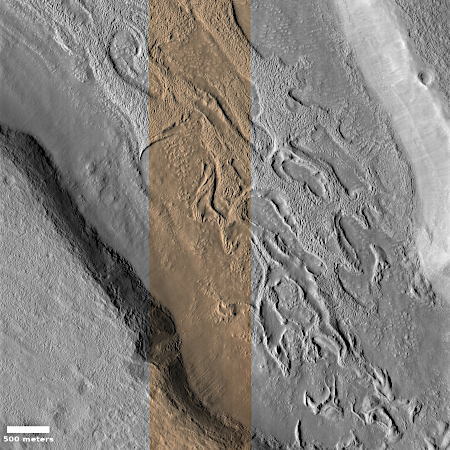
Cool image time! The picture to the right, rotated, cropped, reduced, and sharpened to post here, was taken on October 24, 2025 by the high resolution camera on Mars Reconnaissance Orbiter (MRO).
The science team labels this simply as “irregular terrain.” It is far more than that. We are looking at a three-mile-wide shallow canyon, with what appear to be eroding glacial features on the canyon floor.
The location is at 35 degrees north latitude, so finding glacial features here is entirely unsurprising, especially because this location is the southern edge of the 2,000-mile-long mid-latitude strip in Mar’ northern hemisphere I label glacier country, because almost every picture shows such glacial features.
In this case, the channel also suggests a much more complex geological history, that could involve flowing water though flowing glaciers are increasingly becoming an alternative explanation.
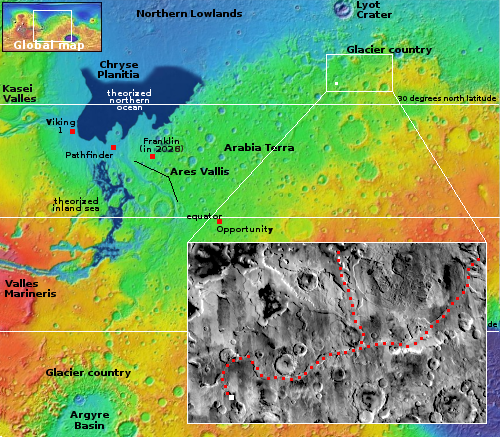
The white dot on the overview map to the right marks the location, in the southern portion of glacier country. The red dotted line in the inset traces a long drainage channel that appears to begin at the picture above and travel about 650 miles to the east and drain into the midst of glacier country at the beginnings of the northern lowland plains.
Research in 2016 had found evidence of lakes and steams in this region, produced not by long term wet/warm conditions but by intermittent melting ice and snow. In many cases that drainage came from craters.
The red dotted line indicates one of the longer drainage channels created during that time. At first glance it appears to have been formed by flowing water, but if so it was for short periods, and was helped by long term glacial flows.

On Christmas Eve 1968 three Americans became the first humans to visit another world. What they did to celebrate was unexpected and profound, and will be remembered throughout all human history. Genesis: the Story of Apollo 8, Robert Zimmerman's classic history of humanity's first journey to another world, tells that story, and it is now available as both an ebook and an audiobook, both with a foreword by Valerie Anders and a new introduction by Robert Zimmerman.
The print edition can be purchased at Amazon or from any other book seller. If you want an autographed copy the price is $60 for the hardback and $45 for the paperback, plus $8 shipping for each. Go here for purchasing details. The ebook is available everywhere for $5.99 (before discount) at amazon, or direct from my ebook publisher, ebookit. If you buy it from ebookit you don't support the big tech companies and the author gets a bigger cut much sooner.
The audiobook is also available at all these vendors, and is also free with a 30-day trial membership to Audible.
"Not simply about one mission, [Genesis] is also the history of America's quest for the moon... Zimmerman has done a masterful job of tying disparate events together into a solid account of one of America's greatest human triumphs."--San Antonio Express-News

Click for original image.
Cool image time! The picture to the right, rotated, cropped, reduced, and sharpened to post here, was taken on October 24, 2025 by the high resolution camera on Mars Reconnaissance Orbiter (MRO).
The science team labels this simply as “irregular terrain.” It is far more than that. We are looking at a three-mile-wide shallow canyon, with what appear to be eroding glacial features on the canyon floor.
The location is at 35 degrees north latitude, so finding glacial features here is entirely unsurprising, especially because this location is the southern edge of the 2,000-mile-long mid-latitude strip in Mar’ northern hemisphere I label glacier country, because almost every picture shows such glacial features.
In this case, the channel also suggests a much more complex geological history, that could involve flowing water though flowing glaciers are increasingly becoming an alternative explanation.
The white dot on the overview map to the right marks the location, in the southern portion of glacier country. The red dotted line in the inset traces a long drainage channel that appears to begin at the picture above and travel about 650 miles to the east and drain into the midst of glacier country at the beginnings of the northern lowland plains.
Research in 2016 had found evidence of lakes and steams in this region, produced not by long term wet/warm conditions but by intermittent melting ice and snow. In many cases that drainage came from craters.
The red dotted line indicates one of the longer drainage channels created during that time. At first glance it appears to have been formed by flowing water, but if so it was for short periods, and was helped by long term glacial flows.
On Christmas Eve 1968 three Americans became the first humans to visit another world. What they did to celebrate was unexpected and profound, and will be remembered throughout all human history. Genesis: the Story of Apollo 8, Robert Zimmerman's classic history of humanity's first journey to another world, tells that story, and it is now available as both an ebook and an audiobook, both with a foreword by Valerie Anders and a new introduction by Robert Zimmerman.
The print edition can be purchased at Amazon or from any other book seller. If you want an autographed copy the price is $60 for the hardback and $45 for the paperback, plus $8 shipping for each. Go here for purchasing details. The ebook is available everywhere for $5.99 (before discount) at amazon, or direct from my ebook publisher, ebookit. If you buy it from ebookit you don't support the big tech companies and the author gets a bigger cut much sooner.
The audiobook is also available at all these vendors, and is also free with a 30-day trial membership to Audible.
"Not simply about one mission, [Genesis] is also the history of America's quest for the moon... Zimmerman has done a masterful job of tying disparate events together into a solid account of one of America's greatest human triumphs."--San Antonio Express-News