
Voyager-2’s most detailed look at Neptune’s moon Triton
Click for original image.
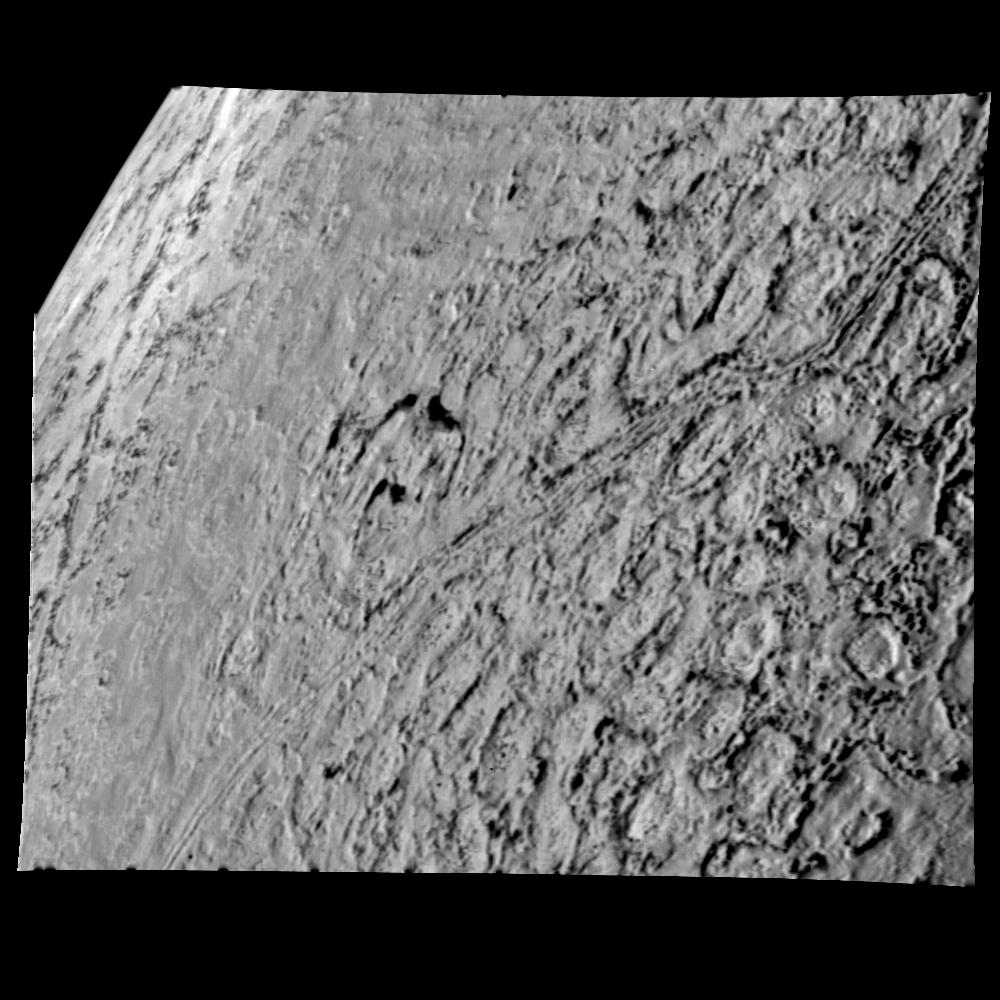
Today we conclude our tour of the Voyager-2 fly-bys of Uranus in 1986 and Neptune in 1989 with what is the most detailed look at the alien surface of Neptune’s moon Triton, taken on August 25, 1989 and shown to the right, cropped, rotated, reduced, and sharpened to post here.
Taken from a distance of only 25,000 miles, the frame is about 140 miles across and shows details as small as [a half mile in width]. Most of the area is covered by a peculiar landscape of roughly circular depressions separated by rugged ridges. This type of terrain, which covers large tracts of Triton’s northern hemisphere, is unlike anything seen elsewhere in the solar system. The depressions are probably not impact craters: They are too similar in size and too regularly spaced. Their origin is still unknown, but may involve local melting and collapse of the icy surface.
A conspicuous set of grooves and ridges cuts across the landscape, indicating fracturing and deformation of Triton’s surface. The rarity of impact craters suggests a young surface by solar system standards, probably less than a few billion years old.
What this photograph as well as the handful of other Voyager-2 images of Triton tell us is that we only have gotten a tiny taste of what’s there, only enough to tell us we don’t understand what we are seeing in the slightest. This is a truly alien world, cold, dark, and composed of materials far different then that found in the inner solar system. Its formation is a mystery, and its subsequent geological history a cypher. Scientists have made some guesses, but to get a real understanding we need to go back, and be there for a long time.
In fact, this is the final conclusion of all of the Voyager-2 images from both Uranus and Neptune. That probe gave humanity its first good close look at these distant worlds, but the look was still a quick and very superficial one. The images and data left us with far more questions than answers.
Unfortunately, there is at present no mission approved and under development to go to either Uranus or Neptune, though several have been proposed. Thus, it will likely be at least two decades before any mission gets there, if that soon.

On Christmas Eve 1968 three Americans became the first humans to visit another world. What they did to celebrate was unexpected and profound, and will be remembered throughout all human history. Genesis: the Story of Apollo 8, Robert Zimmerman's classic history of humanity's first journey to another world, tells that story, and it is now available as both an ebook and an audiobook, both with a foreword by Valerie Anders and a new introduction by Robert Zimmerman.
The print edition can be purchased at Amazon or from any other book seller. If you want an autographed copy the price is $60 for the hardback and $45 for the paperback, plus $8 shipping for each. Go here for purchasing details. The ebook is available everywhere for $5.99 (before discount) at amazon, or direct from my ebook publisher, ebookit. If you buy it from ebookit you don't support the big tech companies and the author gets a bigger cut much sooner.
The audiobook is also available at all these vendors, and is also free with a 30-day trial membership to Audible.
"Not simply about one mission, [Genesis] is also the history of America's quest for the moon... Zimmerman has done a masterful job of tying disparate events together into a solid account of one of America's greatest human triumphs."--San Antonio Express-News
The circular spots on the terrain could be convection cells., just as we see on the sun’s surface, and in the pot on your stove with (nearly) boiling water in it. Not sure how “heat” flow works at -390F, but if there are tidal forces involved, the heat has to flow upward to the surface somewhere.
Interesting but irrelevant to our actual needs & goal here on Earth.
Margaret: You are right of course, but there was once a time when our actual needs and goals went beyond politics because our politics generally respected individual liberty and the rights of citizens, and acted to protect those rights. Then, we as a nation thus had time to consider larger more esoteric questions, such as the strange alien geology of Triton.
Increasingly we no longer have time for that. We instead must focus solely on defending those rights from those who wish to rule and treat us all like slaves. That fight is of course necessary and proper, but I find this to still be a very sad state of affairs.
“irrelevant to our actual needs & goal here on Earth.”
And what are those? And when has any ever been permanently solved? Hasn’t every solved problem resulted in another unsolved problem? The “need” will always and forever be with us, and is usually caused by politics and war and greed, with other needs which are fake! just to scam you out of what you do have for a perceived problem that doesn’t exist.
The exploration of our local planetary environment may find a solution to some of those needs, even alternative to perceived needs. Just as the discovery of the New World with food like corn and potatoes helped alleviate hunger in the old world, who knows what we will find out there, that’ll change our life here.
It would be so sad that the solution to your “need” was never discovered because of lack of trying.
I will take “hope” over “hopelessness”.
Robert was more charitable to Margaret than I would have been.
Exploration is what makes us human
https://www.youtube.com/watch?v=TUbPbK1zwVQ&t=1s
Margaret,
Life is much more than about basic needs; mankind can survive without art, potato chips, lipstick, music, dancing, beautiful architecture, all sorts of things that make life worthwhile. We spend dramatically more on welfare payments and healthcare than we do on spaceflight, so you won’t have much more to give to the needy even if you shut down space travel entirely, and it won’t appreciably change their circumstances, because spending isn’t the limiting factor in helping the poor, the sick, etc.