
Chile asks NASA for advice on keeping trapped miners alive
Chile asks NASA for advice on keeping the 33 trapped miners alive in the weeks to months required to dig a rescue shaft.
Chile asks NASA for advice on keeping the 33 trapped miners alive in the weeks to months required to dig a rescue shaft.
An evening pause: Let’s take another hike in a place most people wouldn’t want to go. This time, to Mount Huashan in central China. This is a holy mountain with a temple at the top. To get there you need to climb up a lot of steps along an exposed ridgeline. Eventually, you must also put on a harness and do what is called the plank walk. Enjoy!
Our government in action: The EPA is considering a ban on lead in ammunition.
Freedom of speech alert! A Tennessee middle school football coach has been fired because he, on his own time, wrote and posted a song on Youtube critical of Barack Obama. Watch the song and tell me if there is anything here that is either untrue or unreasonable.
The publication of the results of the material found within the Hayabusa capsule has been delayed until December. The researchers have found that the particles in the capsule are smaller than expected, and they need more time to study them properly.
Amateurs tracking the X-37B military test shuttle have discovered that it has made two orbital maneuvers. Since the Air Force refuses to discuss the flight program, the reasons behind these maneuvers remains unknown.
Exoplanet news! Scientists today announced the discovery of a host of planets, all orbiting a single star similar to the Sun. Though five are Neptune-sized, a sixth (not yet confirmed) might be the size of Earth. What makes this even more exciting is that the astronomers made the discovery using a ground-based telescope.
But wait, there’s more! Thursday NASA will hold a press conference about a new discovery by Kepler!
An evening pause: An American hymn, How can I keep from singing?
Today we did an 11.5 mile hike up to the high country to the north of Mt. St. Helens. This hike, following Boundary Trail #1 from Norway Pass to the summit of Mt. Margaret, provides the best views of the volcano of any hike, at least according to the two books on hiking in Washington that I used, 100 Classic Hikes in Washington and Washington Hiking. Based on our experience today I would have to agree.
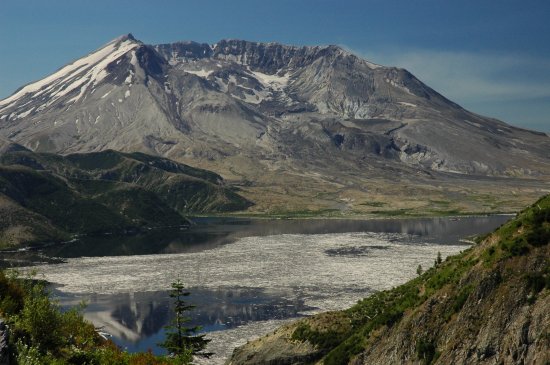
The view of Mt. St. Helens and Spirit Lake from Norway Pass
The Boundary Trail runs through country directly hit by the 1980 eruption. Not surprisingly, there is much evidence of the devastation caused by the blast wave.
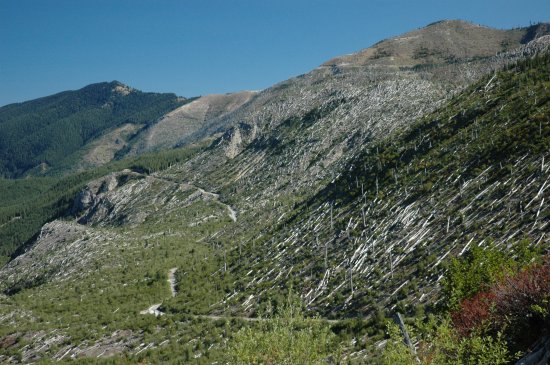
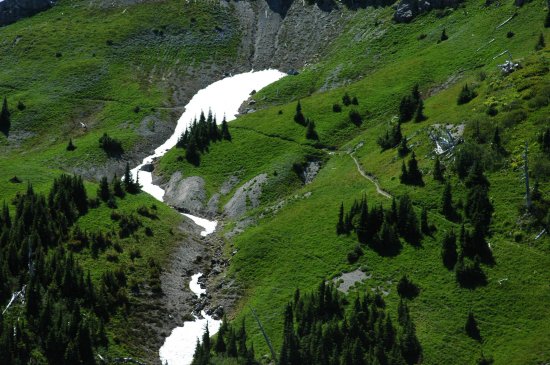
However, these high mountains have recovered far better than the plains at the base of the volcano. Many slopes looked like any typical Alpine forest, with many young evergreens and the ground covered with thick brush, grass, and flowers.
One final thought about the scientific research that I described at Mt. St. Helens yesterday. The one thing I forgot to note is how much the 1980 eruption changed volcano research in the United States. When it occurred, the only active volcano observatory in the United States was in Hawaii. Now there is a whole network of additional observatories in the Northwest, Alaska, the Sierra Nevada and Yellowstone.
When the next mainland volcano finally decides to erupt — as did Mt. St. Helens — the geologists who study these things will therefore be far more prepared to tackle the event than they were in 1980. And because of this readiness the next explosion should be a far more amazing event for ordinary citizens to watch as well.
Two Danish inventors are about to test fly their own privately financed suborbital rocket, designed to eventually carry humans. Key quote:
It is due to launch from a submarine in the Baltic Sea on August 30th and, if successful, they will repeat it with a human passenger on board as soon as possible.
Not only have amateur skywatchers photographed the X-37B military space plane presently in orbit, they use a smart phone app for tracking satellites and available to all to tell them when to look.
More information on the recently discovered fireball that impacted Jupiter on August 20, including images.