December 20, 2023 Zimmerman/Batchelor podcast
Embedded below the fold in two parts.
To listen to all of John Batchelor’s podcasts, go here.
» Read more
Very brief descriptions, with appropriate links, of current or recent news items.
Embedded below the fold in two parts.
To listen to all of John Batchelor’s podcasts, go here.
» Read more
Cool image time! The picture to the right, cropped, reduced, and sharpened to post here, was taken on August 20, 2023 by the high resolution camera on Mars Reconnaissance Orbiter (MRO). It features a 250-foot-high north-south cliff that appears to have numerous horizontal layers within it.
Moreover, both on the plateau above the cliff as well as the floor below it, the entire surface seems to resemble a thick snow/ice field, made even more evident by the distortion of many craters and the apparent glacial material inside each crater.
The layers suggest that this ice was laid down in a series of cycles. During cold periods snow fell and accumulated as ice over time. When things became warmer some of that ice sublimated away, but not all. With the next cold cycle a new layer was put down.
The many layers suggest many climate cycles on Mars, none of which were caused by SUVs or coal-firing electrical power stations.
» Read more
UPDATE: See this December 26, 2023 post for more accurate information.
Original post:
————————–
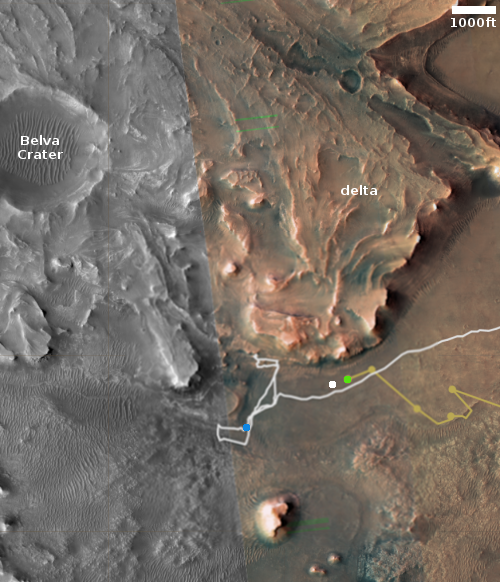
According to a recent update to the flight log of the Mars helicopter Ingenuity, it finally completed its 68th flight on December 15, 2023, not on December 9, 2023 as announced in the flight plan on December 8th.
More significantly, the flight only traveled 1,289 feet (393 meters), not the 2,716 feet (828 meters) intended. The flight was supposed to travel out to the northeast and then return to its take-off point, indicated by the green dot on the map above, completing a “flight test” as well as scouting the ground below. It appears it did not do this, but where the 68th flight actually went and landed has as yet not been released. According to the flight plan, Ingenuity likely landed somewhere in Neretva Vallis to the northeast, as indicated by the green line.
What we do know is that the engineering team knows enough about Ingenuity’s condition to release today the flight plan for the 69th flight, which was actually scheduled to occur yesterday. That flight plan calls for Ingenuity to travel about 2,300 feet to the east-northeast and then return to its take-off point.
Meanwhile, Perseverance (the blue dot) is working its way west back to its planned route, the red dotted line.
The Senate yesterday passed a short term extension of the regulatory “learning period” at the FAA that limits its ability to regulate commercial space.
[The Senate] quickly passed an extension of the FAA’s authorization, a final piece of “must pass” legislation before the end of the year. The bill (H.R. 6503) passed the House on December 11. Among other things, it extends the “learning period” for commercial human spaceflight until March 9, 2024 that otherwise would have expired on January 1. The learning period, or “moratorium,” prohibits the FAA from promulgating new regulations on commercial human spaceflight while the industry is in its infancy.
The president still needs to sign this bill, but that is expected.
Originally passed in 2004 as an eight-year period, this “learning period” has been extended several times since. The industry wants a longer extension, as it still considers itself quite rightly to be in an experimental test phase, not operational in the sense of airplane manufacture.
Not that this extension matters. It appears in the past two years that the regulators at the FAA have decided to ignore the law and make believe this learning period really doesn’t exist, based on how that agency has treated test launches by SpaceX and others. Rather than let their launches proceed quickly as tests, the FAA has begun to treat each test as an operational flight that requires a long investigation before further launch approvals are given.
Unless there is a major change in leadership in the White House, we should expect a major slow-down of the American launch industry in the coming years, regardless of whether this “learning period” is extended or not.
Cool image time! The picture to the right, cropped and reduced to post here, was released today by the science team of the Hubble Space Telescope, and shows an irregular dwarf galaxy that is about seven million light years away.
Twelve camera filters were combined to produce this image, with light from the mid-ultraviolet through to the red end of the visible spectrum. The red patches are likely interstellar hydrogen molecules that are glowing because they have been excited by the light from hot, energetic stars. The other sparkles on show in this image are a mix of older stars. An array of distant, diverse galaxies appear in the background, captured by Hubble’s sharp view.
The data used in this image were taken by Hubble’s Wide Field Camera 3 and the Advanced Camera for Surveys from 2006 to 2021.
The picture was taken as part of a study of dwarf galaxies, their make-up, and how their mergers eventually create the larger galaxies like the Milky Way.
After 20 years of development, the first eighteen segments of Europe’s Extremely Large Telescope (ELT) have now shipped to Chile, with another 780 more segments to go.
The assembly of the telescope’s massive mirrors will take place over the next 4 years. This week, the first segments of what will be the main mirror – called ‘M1’ – arrived in Chile.
Once complete in 2028, these segments will create a primary mirror 40 meters across, about 131 feet, four times larger than the 10.4 meter Gran Telescopio in the Canary Islands, presently the largest telescope in operation.
Because of scheduling conflicts impacting other SpaceX launches now, SpaceX and Intuitive Machines have delayed the launch of the latter’s Nova-C lunar lander from a mid-January to a mid-February launch window.
The conflict involves the use of the launchpad, that the Falcon Heavy also uses. Technical issues had forced SpaceX to reschedule its next launch to December 28, 2023, leaving little time afterward to reconfigure the pad for the Falcon 9 Nova-C mid-January launch window. Any Falcon Heavy launch delays due to weather would likely make that mid-January window impossible, so the companies have decided better to reschedule now.
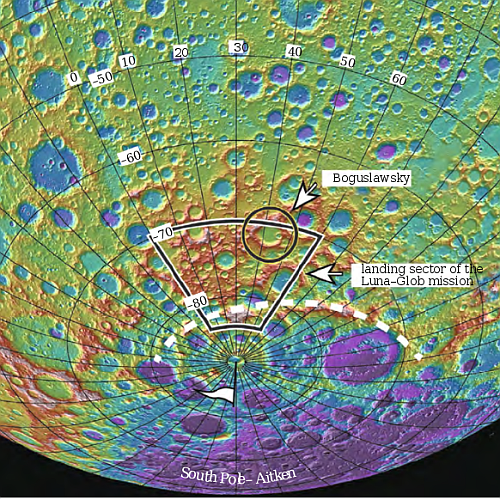
Nova-C is targeting a crater rim near the Moon’s south pole, as shown on the map to the right. The floor of that crater is thought to be permanently shadowed, but Nova-C does not have the capability to enter it. This mission is mostly an engineering test mission, to prove Intuitive Machine’s design. If it works, it will operate on the Moon surface for one lunar day, about two weeks. The company then has two more lunar missions contracted with NASA, with the next mission aiming to fly in 2024 as well.
Courtesy of BtB’s stringer Jay.
The mission was unmanned. The link is cued to just before launch. More information about this flight here.
The antenna can also be retracted.
Though it appears there are no objects close enough for it to fly past, it is still gathering a lot of detailed information of the outer parts of the solar system.
Failure theater: In a deal worked out suddenly between the board of regents at the University of Wisconsin and the state legislature, the university will get $800 million for infrastructure improvements and pay raises in exchange for imposing some limited reductions in its Diversity, Inclusion, and Equity (DEI) programs.
The deal also requires UW system campuses to refrain from adding new DEI positions through December 2026. Administrators must also reassign at least one third of their current DEI-focused employees to roles dedicated to academic and student success. Mandatory DEI statements in admissions and hiring are also to be abolished under the deal, and efforts to fund a conservative professorship at UW-Madison must be launched, according to the terms.
You can read the actual language of this deal here [pdf]. The deal also requires the university to replace its Target of Opportunity Program (TOP) — which established systems to favor hiring minorities over others — with a new “alternative program focused on recruiting faculty (regardless of their identity or ethnic/racial background) who have demonstrated the ability to mentor ‘at risk’ and/or underrepresented students to achieve academic success and who have demonstrated academic and research excellence.”
Does this deal do what it appears to, reduce or eliminate the very racist DEI program at the University of Wisconsin? Hardly. » Read more
Cool image time! The picture to the right, cropped, reduced, and sharpened to post here, was taken on October 4, 2023 by the high resolution camera on Mars Reconnaissance Orbiter (MRO). Labeled a “terrain sample” by the science team, it was likely shot not as part of any specific research project but to fill a gap in the schedule so as to maintain the camera’s proper temperature. When the camera team has to do this they try to pick targets that are of some interest. Usually they succeed, considering the enormous gaps we presently have of Mars’ geological history.
This picture is no different. It shows a land of buttes and mesas, all ranging from 20 to 200 feet high, surrounded by canyons filled with ripple dunes of Martian dust. If you look at the floor of those canyons closely, you will notice that where there are no ripple dunes the ground is slightly higher and smooth. It is as if that ground was a kind of sandstone that was eroded away by wind into sand, which then formed the dunes.
» Read more
Link here. The article provides a detailed description of the history leading up to the formation in March 2023 of Spain’s new space agency, Agencia Espacial Española (AEE) (the Spanish Space Agency in English).
It appears the goal was to consolidate Spain’s government space operations from eleven different agencies so as to better coordinate that government’s work with the nation’s burgeoning new commercial space sector.
By law, Spain has created the AEE without any increase in public spending. The new agency has been allocated an initial budget of 700 million euros per year, which was primarily drawn from funding for ESA [European Space Agency] participation, the CDTI, and INTA [two other Spanish agencies]. However, it is expected that the AEE will receive higher budgets in the future for the development of its own programs outside those directly linked to the ESA. The task of financing space activity public and private alike is of utmost importance, and one of the agency’s roles should be to create mechanisms for making investment attractive and effective, either directly or through public-private partnerships — a model that is producing excellent results in several countries around the world, like the United States. [emphasis mine]
It appears the goal is to emulate the policies followed by NASA in the past few years, buy services and products from the private sector rather than build these things within the government. If so, AEE will likely help jumpstart that new space industry. Whether it can stay focused on this goal, or shift into a typical government empire-building operation that sucks the life out of everything, will be its real fundamental test.
Firefly has now scheduled the second launch of its Alpha rocket in 2023, with a launch window of about 20 minutes on the morning of Decmeber 20, 2023.
The payload is a smallsat from Lockheed Martin testing new antenna technology, but the launch is for the Space Force. Like the previous September 15, 2023 launch, it is designed to test the ability of Firefly to get a payload into orbit quickly, from assembly to launch.