
“It’s a free country. I wish it weren’t.”
Here is what one elected governor thinks of freedom of speech: “It’s a free country. I wish it weren’t.”
Here is what one elected governor thinks of freedom of speech: “It’s a free country. I wish it weren’t.”
NASA might not be able to build any rockets, but its outreach to the Muslim community continues.

On Christmas Eve 1968 three Americans became the first humans to visit another world. What they did to celebrate was unexpected and profound, and will be remembered throughout all human history. Genesis: the Story of Apollo 8, Robert Zimmerman's classic history of humanity's first journey to another world, tells that story, and it is now available as both an ebook and an audiobook, both with a foreword by Valerie Anders and a new introduction by Robert Zimmerman.
The print edition can be purchased at Amazon or any other book seller. If you want an autographed copy the price is $60 for the hardback and $45 for the paperback, plus $8 shipping for each. Go here for purchasing details. The ebook is available everywhere for $5.99 (before discount) at amazon, or direct from my ebook publisher, ebookit. If you buy it from ebookit you don't support the big tech companies and the author gets a bigger cut much sooner.
"Not simply about one mission, [Genesis] is also the history of America's quest for the moon... Zimmerman has done a masterful job of tying disparate events together into a solid account of one of America's greatest human triumphs."--San Antonio Express-News
An evening pause: Lawrence of Arabia (1962). One of the greatest epic films ever made. And though the story is heavily dramatized, it captures quite accurately the substance and reality of T.E. Lawrence’s time in the Middle East during World War I. Sadly, I wonder if anything has changed.
Not my idea of reasoned debate: A man was arrested on Saturday after he threatened to shoot two pro-life demonstrators outside an abortion clinic.
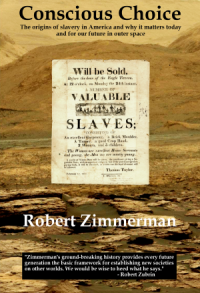
Now available in hardback and paperback as well as ebook!
From the press release: In this ground-breaking new history of early America, historian Robert Zimmerman not only exposes the lie behind The New York Times 1619 Project that falsely claims slavery is central to the history of the United States, he also provides profound lessons about the nature of human societies, lessons important for Americans today as well as for all future settlers on Mars and elsewhere in space.
“Zimmerman’s ground-breaking history provides every future generation the basic framework for establishing new societies on other worlds. We would be wise to heed what he says.” —Robert Zubrin, founder of the Mars Society.
All editions are available at Amazon, Barnes & Noble, and all book vendors, with the ebook priced at $5.99 before discount. All editions can also be purchased direct from the ebook publisher, ebookit, in which case you don't support the big tech companies and the author gets a bigger cut much sooner.
Autographed printed copies are also available at discount directly from the author (hardback $29.95; paperback $14.95; Shipping cost for either: $6.00). Just send an email to zimmerman @ nasw dot org.
Government gone wild! The town of Barre, Vermont, is about to pass a law requiring all cats to be on a leash.
The space war continues. Now a group of 30 Nobel Laureates, astronauts, former NASA officials, and others have sent a letter to the House Science Committee, supporting Obama’s proposals for NASA’s budget and criticizing the House’s own budget plans.
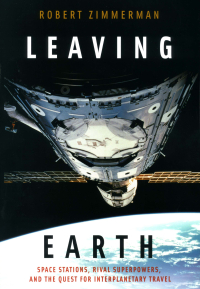
Leaving Earth: Space Stations, Rival Superpowers, and the Quest for Interplanetary Travel, can be purchased as an ebook everywhere for only $3.99 (before discount) at amazon, Barnes & Noble, all ebook vendors, or direct from my ebook publisher, ebookit.
If you buy it from ebookit you don't support the big oppressive tech companies and I get a bigger cut much sooner.
"Leaving Earth is one of the best and certainly the most comprehensive summary of our drive into space that I have ever read. It will be invaluable to future scholars because it will tell them how the next chapter of human history opened." -- Arthur C. Clarke
Better late than never. An independent academic panel has concluded that the IPCC needs reform.
The solid rocket first stage of the Ares I rocket successfully completed its second test fire yesterday.
It appears that the Chinese have successfully maneuvered two unmanned satellites to a rendezvous in space. It is even possible that they might have touched!
An evening pause: Bugs Bunny in Water Water Every Hare. “In my business you meet so many interesting people.”
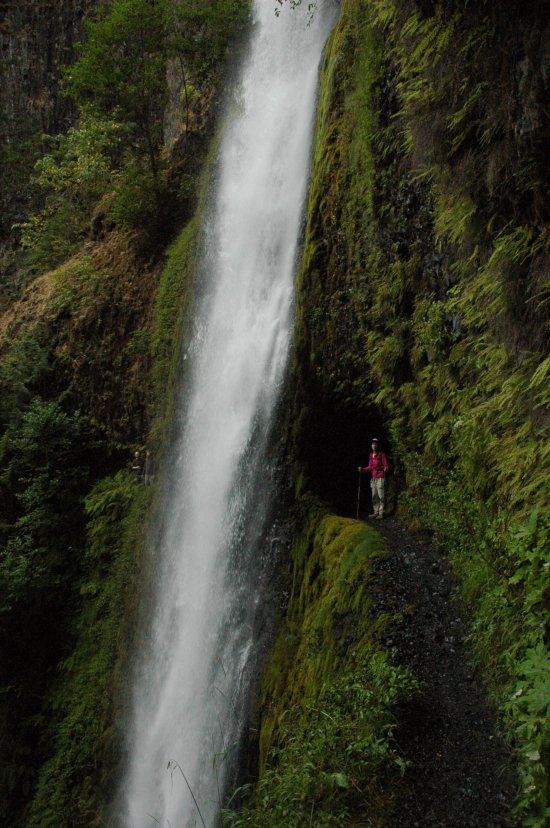
Because yesterday’s hike up Eagle Creek to Tunnel Falls (see picture below) was particularly long, 12.5 miles, I took a break from posting when I got home. Today (Monday), however, was a more easy-going day, as we did more ordinary tourist stuff, driving from place to place with only short strolls at each stop.
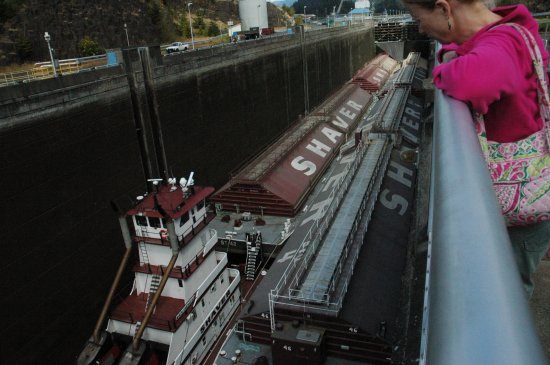
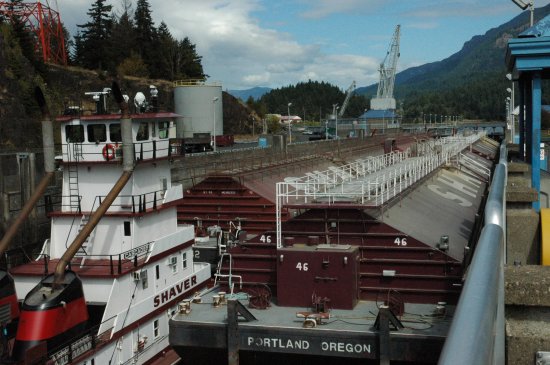
The most fascinating tourist stop of the day was by far Bonneville Dam. Just as the security guard at the gate let the car in front of us through, her phone rang. When she was finished and came up to our car, she explained that we would have to wait about a half hour before going to the visitor center, as they needed to open the swing bridge so that a barge could go through the locks. At first I thought this was very unfortunate timing. In the end, it turned out to be fortuitous indeed. We parked at the viewing area above the locks and watched five barges, tied tightly together as a unit and pushed upstream by a tug, slide gently into the lock with barely inches on either side. Neither Diane or I could believe how little spare room the tugboat captain had to pilot this massive object. The gigantic downstream doors then closed (while I quipped that music from Star Wars should be playing) and the lock was quickly filled with water, raising the barges/tugboat up almost a hundred feet. The upstream doors than opened and the barge headed out. All told, the whole operation took less than 45 minutes.
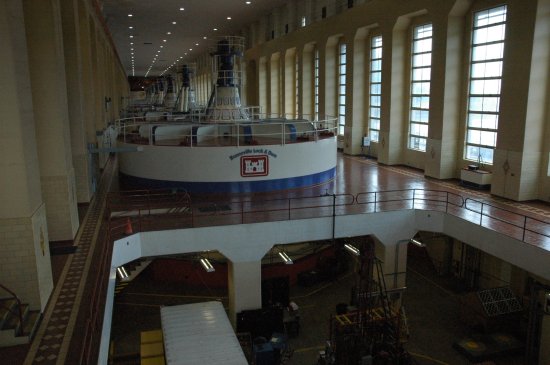
We then took a tour of the dam’s first power station, with its ten turbines all in a row. Unfortunately, none were operating at the moment. Nonetheless, whenever I see places like this (such as when I visited Hoover Dam back in 2005), I can’t help but be reminded of the scene from the science fiction movie Forbidden Planet, when Walter Pigeon gives us a tour of the Krell underground machine. Unlike the Krell, however, it didn’t take millions of years for us to learn how to build such breath-taking big dams and power stations. We did it less than 150 years after the discovery of electricity!
This guy is thinking ahead: a paper extolling the scientific benefits of interstellar space travel (published in a 2009 issue of the Journal of the British Interplanetary Society) was made available today on the Los Alamos astro-ph website. Fun quote from the abstract:
Significant benefits are identified in the fields of interstellar medium studies, stellar astrophysics, planetary science and astrobiology. In the latter three areas the benefits would be considerably enhanced if the interstellar vehicle is able to decelerate from its interstellar cruise velocity to rest relative to the target system. Although this will greatly complicate the mission architecture, and extend the overall travel time, the scientific benefits are such that this option should be considered seriously in future studies.