Bolden interview with al-Jazeera

This interview of Charles Bolden, NASA administrator, is another example (in a long list of examples) of the clearly misplaced priorities of the Obama administration when it comes to NASA and space exploration.

The key quote is in the first two minutes of the interview [emphasis mine]:

Bolden: When I became the NASA Administrator – before I became the NASA Administrator – [President Obama] charged me with three things: One was that he wanted me to re-inspire children to want to get into science and math, that he wanted me to expand our international relationships, and third, and perhaps foremost, he wanted me to find a way to reach out to the Muslim world and engage much more with predominantly Muslim nations to help them feel good about their historic contribution to science, math, and engineering.

Though all three of these priorities (inspire kids, international cooperation, and help the Muslim world develop) sound nice, none have anything to do with space exploration. More specifically, they have absolutely nothing to do with NASA’s original charter, which was to explore the solar system and encourage the development of the American aerospace industry.

At about 9:50, Bolden then states that “We’re not going to go anywhere beyond low Earth orbit as a single entity. The United States can’t do it. China can’t do it. No single nation is going to go to a place like Mars alone.”

Gee, I wonder what international consortium put those men on the Moon? I always thought the U.S. did it alone. According to Bolden, however, that was impossible: No single nation can do anything alone beyond Earth orbit.

There are more inanities in this interview. Listen for example to his clueless discussion of solar flares at around 19:00 and his statement at 20:30 where he claims an asteroid made of “sand” poses no threat to the Earth.

With leadership like this, the future does not look good for the American aerospace industry.

1 comment

Genesis cover

On Christmas Eve 1968 three Americans became the first humans to visit another world. What they did to celebrate was unexpected and profound, and will be remembered throughout all human history. Genesis: the Story of Apollo 8, Robert Zimmerman's classic history of humanity's first journey to another world, tells that story, and it is now available as both an ebook and an audiobook, both with a foreword by Valerie Anders and a new introduction by Robert Zimmerman.

The print edition can be purchased at Amazon or any other book seller. If you want an autographed copy the price is $60 for the hardback and $45 for the paperback, plus $8 shipping for each. Go here for purchasing details. The ebook is available everywhere for $5.99 (before discount) at amazon, or direct from my ebook publisher, ebookit. If you buy it from ebookit you don't support the big tech companies and the author gets a bigger cut much sooner.


The audiobook is also available at all these vendors, and is also free with a 30-day trial membership to Audible.
 

"Not simply about one mission, [Genesis] is also the history of America's quest for the moon... Zimmerman has done a masterful job of tying disparate events together into a solid account of one of America's greatest human triumphs."--San Antonio Express-News

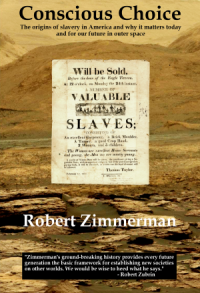
Conscious Choice cover

Now available in hardback and paperback as well as ebook!

From the press release: In this ground-breaking new history of early America, historian Robert Zimmerman not only exposes the lie behind The New York Times 1619 Project that falsely claims slavery is central to the history of the United States, he also provides profound lessons about the nature of human societies, lessons important for Americans today as well as for all future settlers on Mars and elsewhere in space.

 
Conscious Choice: The origins of slavery in America and why it matters today and for our future in outer space, is a riveting page-turning story that documents how slavery slowly became pervasive in the southern British colonies of North America, colonies founded by a people and culture that not only did not allow slavery but in every way were hostile to the practice.  
Conscious Choice does more however. In telling the tragic history of the Virginia colony and the rise of slavery there, Zimmerman lays out the proper path for creating healthy societies in places like the Moon and Mars.


โ€œZimmermanโ€™s ground-breaking history provides every future generation the basic framework for establishing new societies on other worlds. We would be wise to heed what he says.โ€ โ€”Robert Zubrin, founder of the Mars Society.


All editions are available at Amazon, Barnes & Noble, and all book vendors, with the ebook priced at $5.99 before discount. All editions can also be purchased direct from the ebook publisher, ebookit, in which case you don't support the big tech companies and the author gets a bigger cut much sooner.


Autographed printed copies are also available at discount directly from the author (hardback $29.95; paperback $14.95; Shipping cost for either: $6.00). Just send an email to zimmerman @ nasw dot org.

Avalanches on Mars

Saturday’s weekly dump of publications from the American Geophysical Union also included a paper that showed visual proof of avalanches on Mars! In this case, the location is Russell Crater, “a large crater in the southern hemisphere that exposes a large dune field in its center.” The avalanches occur because a frost layer made up of dry ice and a little bit of frozen water builds up on the crest of the dunes. When that frost melts, dark streaks about three to six feet wide and about 150 feet long appear, flowing downhill. The scientists believe these are avalanches made up of “a mixing of sand, dust, and unstable CO2 gas.”

wide shot of before and after
Before and after shots of the dark streaks flowing down the dune.

close-up, before and after
Close-ups of the streaks, before and after.

0 comments

A complete survey of nearby sunlike stars

A very long (182 pages) and detailed preprint paper was published today on the Los Alamos astro-ph website, describing the completion of a survey of just about all the sunlike stars within approximately 82 light years of the Earth. I haven’t had time to read the whole thing, but the abstract made these notable points:

  • The study found that more the fifty percent of all sunlike stars are single stars.
  • Among double and triple systems, the bell curve for the orbital periods peaked at 300 years.
  • The more heavy elements the star has (atoms more complex than hydrogen and helium), the more likely it will have planets.
  • The very intriguing conclusion: “The fraction of planet hosts among single, binary, and multiple systems are statistically indistinguishable, suggesting that planets are as likely to form around single stars as they are around components of binary or multiple systems with sufficiently wide separations. This, along with the preference of long orbital periods among stellar systems, increases the space around stars conducive for planet formation, and perhaps life.” [You need to download the full pdf to see this quote in the unabridged abstract.]

In other words, the evidence continues to suggest that solar systems like ours are very common.

0 comments

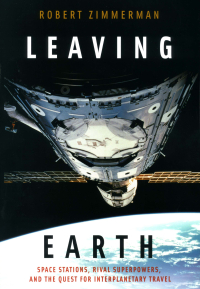
Leaving Earth cover

Leaving Earth: Space Stations, Rival Superpowers, and the Quest for Interplanetary Travel, can be purchased as an ebook everywhere for only $3.99 (before discount) at amazon, Barnes & Noble, all ebook vendors, or direct from my ebook publisher, ebookit.

If you buy it from ebookit you don't support the big oppressive tech companies and I get a bigger cut much sooner.


Winner of the 2003 Eugene M. Emme Award of the American Astronautical Society.

 
"Leaving Earth is one of the best and certainly the most comprehensive summary of our drive into space that I have ever read. It will be invaluable to future scholars because it will tell them how the next chapter of human history opened." -- Arthur C. Clarke

Finding underground water on Mars

For those who fantasize that Mars might still have vast underground lakes with fish, the recent data is unfortunately not encouraging. A paper published today by the American Geophysical Union suggests that if groundwater exists on Mars, it is going to be increasingly difficult to find, possibly only in the low latitudes at low elevations. These paragraphs from the conclusion of the paper say it all:

Various lines of evidence suggest that at the time of the Late Hesperian, Mars possessed a planetary inventory of water equal to a global ocean ~0.5 km deep, much of which is believed to have been stored as ground ice and groundwater in the subsurface. The potential survival of groundwater to the present-day has important implications for understanding the geological, hydrological and mineralogical evolution of the planet, as well as the potential survival of native Martian life. The two most important factors affecting the persistence of groundwater on Mars are the depth and pore volume of the cryosphere.

To date, the orbital radar sounding data from MARSIS [an instrument on Mars Orbital Express] has provided little evidence of any deep reflectors potentially indicative of subpermafrost groundwater. Here we have examined two (of several) possible explanations for this lack of evidence: (1) that subpermafrost groundwater no longer survives on Mars or (2) that groundwater is present, but that a thicker than expected cryosphere has restricted its occurrence to depths that exceed the estimated ~3 km maximum sounding depth of MARSIS.

[snip]

Which one (or combination) of explanations discussed here is responsible for the lack of deep reflectors on Mars is unknown. But our revised estimates of cryosphere depth suggest that a successful detection of subpermafrost groundwater, outside of those areas on Mars that combine low latitude and low elevation, is unlikely. In an effort to better constrain this problem, a more comprehensive investigation of the MARSIS sounding data obtained over Athabasca Valles, and four other low-elevation, near-equatorial sites, is currently underway.

0 comments

Co-hosting the John Batchelor Show tonight

Tonight, from 9 pm to 1 am (EDT), I will be on the John Batchelor Show. John is off tonight, so the guest host is Simon Constable, with yours truly acting as his co-host. For my part, I’ve arranged four guests:

  • Dr. Roy Spencer, climatogist and former NASA scientist, who will discuss the recently published global warming black list as well as other climate change issues.

Then I have brought in three guests to talk about the Obama administration’s new space policy and the space war developing between the administration and Congress over the administration’s effort to cancel the Constellation program:

  • Scott “Doc” Horowitz, former astronaut and designer of the Ares rocket. He will offer his reasons for opposing the Obama space proposals.
  • Dr. Charles Lurio, space analyst and publisher of the Lurio Report. He will outline reasons to support the Obama proposals.
  • Dr. David Livingston, host of the Space Show. He will fill us in on the state of the aerospace community and what it thinks of the Obama proposals.

Each will have his own 15 minute segment to express his views. Should be a fun time tonight.

0 comments
1 2,910 2,911 2,912 2,913 2,914 2,927