Voyager-1 has computer issues

According to the Voyager-1 science team, the probe has developed a problem with one of its three onboard computers, called the flight data system (FDS), that is preventing it from sending back useable data.

Among other things, the FDS is designed to collect data from the science instruments as well as engineering data about the health and status of the spacecraft. It then combines that information into a single data “package” to be sent back to Earth by the TMU. The data is in the form of ones and zeros, or binary code. Varying combinations of the two numbers are the basis of all computer language.

Recently, the TMU began transmitting a repeating pattern of ones and zeros as if it were “stuck.” After ruling out other possibilities, the Voyager team determined that the source of the issue is the FDS. This past weekend the team tried to restart the FDS and return it to the state it was in before the issue began, but the spacecraft still isn’t returning useable data.

Engineers are trouble-shooting the problem, and expect it will take several weeks at best to identify and then fix the issue. The 22-hour travel time for communications to reach the spacecraft, now beyond the edge of the solar system more than 15 billion miles away, means that it will at minimum take about two days to find out if a transmitted fix works.

As the spacecraft was launched in 1977, most of the engineers now working on it were not even born then, and must deal with a technology that was designed before personal computers, no less smart phones, even existed. Like the entire 1960s space race, the two Voyager craft now beyond the solar system were built by engineers using slide rules.

Voyager-2 also had problems in August that engineers were able to fix, so the prognosis here is not bad.

5 comments

Genesis cover

On Christmas Eve 1968 three Americans became the first humans to visit another world. What they did to celebrate was unexpected and profound, and will be remembered throughout all human history. Genesis: the Story of Apollo 8, Robert Zimmerman's classic history of humanity's first journey to another world, tells that story, and it is now available as both an ebook and an audiobook, both with a foreword by Valerie Anders and a new introduction by Robert Zimmerman.

The print edition can be purchased at Amazon or any other book seller. If you want an autographed copy the price is $60 for the hardback and $45 for the paperback, plus $8 shipping for each. Go here for purchasing details. The ebook is available everywhere for $5.99 (before discount) at amazon, or direct from my ebook publisher, ebookit. If you buy it from ebookit you don't support the big tech companies and the author gets a bigger cut much sooner.


The audiobook is also available at all these vendors, and is also free with a 30-day trial membership to Audible.
 

"Not simply about one mission, [Genesis] is also the history of America's quest for the moon... Zimmerman has done a masterful job of tying disparate events together into a solid account of one of America's greatest human triumphs."--San Antonio Express-News

December 11, 2023 Quick space links

Courtesy of BtB’s stringer Jay.


  • Ghana in Africa warns its citizens not to use Starlink illegally
  • Heavy fines are threatened. Ghana is the fourth African country to issue such a warning, after South Africa, Zimbabwe, and Senegal. Apparently the citizens of those countries are tired of bad phone and internet service, and have been bypassing their incompetent government to get it on the black market from private enterprise. In other words, they are exercising independence, and we can’t have that!


3 comments

Craters in a row

Craters in a row
Click for original image.

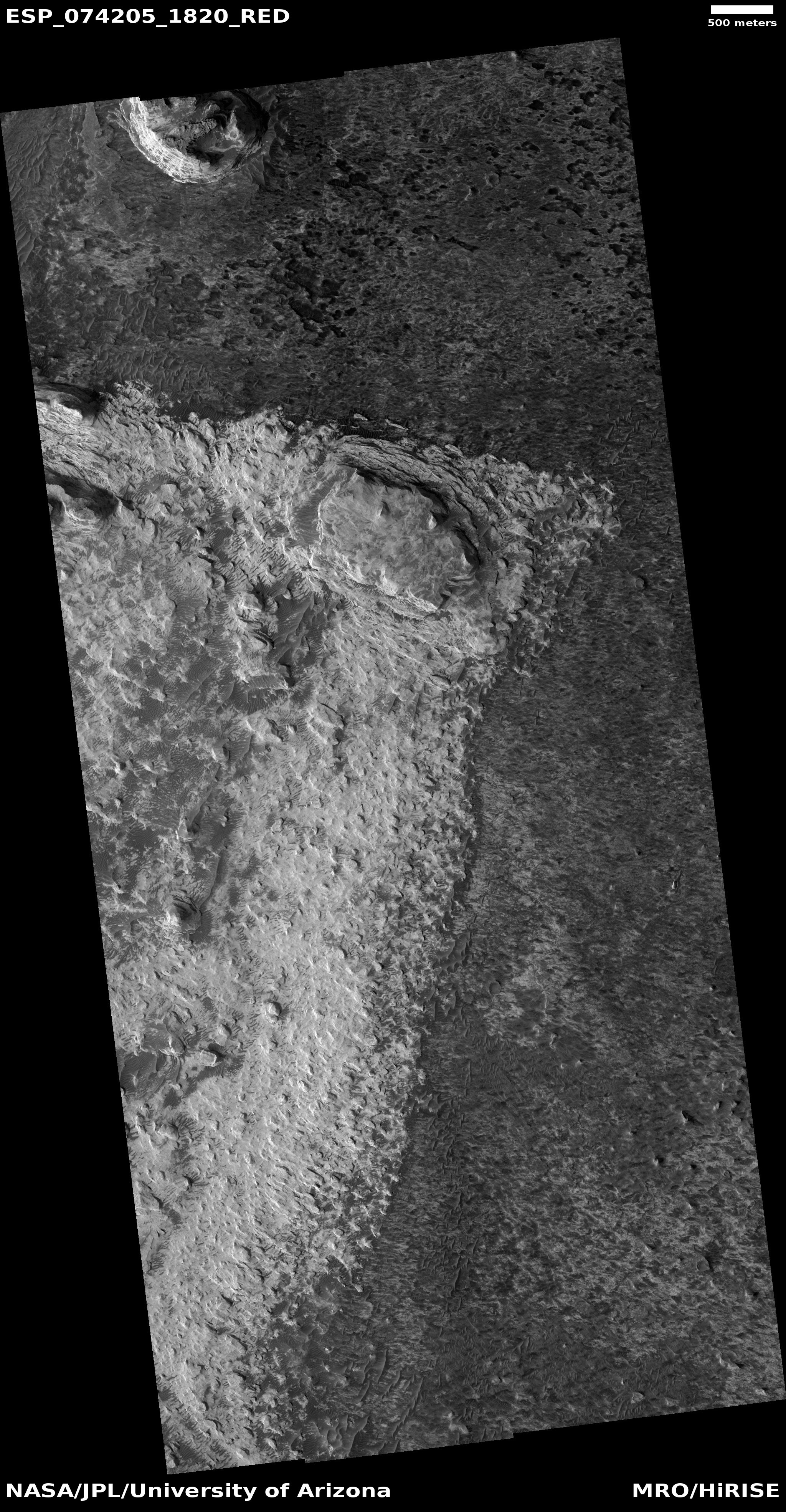
Cool image time from Mars! The picture to the right, rotated, cropped, reduced, and sharpened to post here, was taken on October 13, 2023 by the high resolution camera on Mars Reconnaissance Orbiter (MRO). It highlights a string of craters, all lined up in an almost straight line.

Were these craters caused by the impact of an asteroid that broke up as it burned its way through the thin Martian atmosphere? The lack of any raised rims argues instead that these are sinks produced not from impact but from a collapse into a void below, possibly a fault line.

Yet, almost all of the craters in this image, even those not part of this crater string, show no raised rims. If sinks, the voids below don’t seem to follow any pattern, which once again argues in favor of random impacts, with the string produced by a bolide breaking up just prior to hitting the ground.
» Read more

3 comments

Conscious Choice cover

Now available in hardback and paperback as well as ebook!

From the press release: In this ground-breaking new history of early America, historian Robert Zimmerman not only exposes the lie behind The New York Times 1619 Project that falsely claims slavery is central to the history of the United States, he also provides profound lessons about the nature of human societies, lessons important for Americans today as well as for all future settlers on Mars and elsewhere in space.

 
Conscious Choice: The origins of slavery in America and why it matters today and for our future in outer space, is a riveting page-turning story that documents how slavery slowly became pervasive in the southern British colonies of North America, colonies founded by a people and culture that not only did not allow slavery but in every way were hostile to the practice.  
Conscious Choice does more however. In telling the tragic history of the Virginia colony and the rise of slavery there, Zimmerman lays out the proper path for creating healthy societies in places like the Moon and Mars.


“Zimmerman’s ground-breaking history provides every future generation the basic framework for establishing new societies on other worlds. We would be wise to heed what he says.” —Robert Zubrin, founder of the Mars Society.


All editions are available at Amazon, Barnes & Noble, and all book vendors, with the ebook priced at $5.99 before discount. All editions can also be purchased direct from the ebook publisher, ebookit, in which case you don't support the big tech companies and the author gets a bigger cut much sooner.


Autographed printed copies are also available at discount directly from the author (hardback $29.95; paperback $14.95; Shipping cost for either: $6.00). Just send an email to zimmerman @ nasw dot org.

Galaxies in a row

Galaxies in a row
Click for original image.

Cool image time from Hubble! The picture to the right, cropped, reduced, and sharpened to post here, was taken by the Hubble Space Telescope as part of a survey of nearby “pecular” galaxies. What makes it unusual is the line of distant galaxies below the largest on the left.

The wonderful quality of this image also reveals several further galaxies, not associated with this system but fortuitously positioned in such a way that they appear to be forming a line that approaches the leftmost (in this image) component of Arp-Madore 2105-332, which is known individually as 2MASX J21080752-3314337. The rightmost galaxy, meanwhile, is known as 2MASX J21080362-3313196. These hefty names do not lend themselves to easy memorisation, but they do actually contain valuable information: they are coordinates in the right ascension and declination system used widely by astronomers to locate astronomical objects.

Both larger galaxies are thought to be about 200 million light years away, with the smaller ones far more distant. If you look at the full resolution image, you will see that there are at least six galaxies in that line, one that appears to be an elliptical galaxy with all the rest a variety of different types of spiral galaxies. The detail provided by Hubble is truly astonishing.

Though they are not linked to the larger galaxies, it is not clear if they are linked to each other.

2 comments

Webb takes infrared false-color image of supernova remnant Cassiopeia A

Cass A in infrared
Click for original image.

Using the Webb Space Telescope, astronomers have obtained the first wide full infrared view of the supernova remnant Cassiopeia A, the remains of a supernova that occurred about 11,000 years ago. That image is to the right, reduced to post here.

The most noticeable colors in Webb’s newest image are clumps represented in bright orange and light pink that make up the inner shell of the supernova remnant. Webb’s razor-sharp view can detect the tiniest knots of gas, comprised of sulfur, oxygen, argon, and neon from the star itself. Embedded in this gas is a mixture of dust and molecules, which will eventually become components of new stars and planetary systems. Some filaments of debris are too tiny to be resolved by even Webb, meaning they are comparable to or less than 10 billion miles across (around 100 astronomical units). In comparison, the entirety of Cas A spans 10 light-years across, or 60 trillion miles.

…When comparing Webb’s new near-infrared view of Cas A with the mid-infrared view, its inner cavity and outermost shell are curiously devoid of color. The outskirts of the main inner shell, which appeared as a deep orange and red in the MIRI image, now look like smoke from a campfire. This marks where the supernova blast wave is ramming into surrounding circumstellar material. The dust in the circumstellar material is too cool to be detected directly at near-infrared wavelengths, but lights up in the mid-infrared.

The four rectangles mark specific features of particular interest, with #4, dubbed by the scientists Baby Cas, the most intriguing.

This is a light echo, where light from the star’s long-ago explosion has reached and is warming distant dust, which is glowing as it cools down. The intricacy of the dust pattern, and Baby Cas A’s apparent proximity to Cas A itself, are particularly intriguing to researchers. In actuality, Baby Cas A is located about 170 light-years behind the supernova remnant.

By comparing this infrared view with Hubble’s optical and Chandra’s X-ray views, astronomers will be able to better decipher Cas A’s make-up and geometry.

0 comments

Leaving Earth cover

Leaving Earth: Space Stations, Rival Superpowers, and the Quest for Interplanetary Travel, can be purchased as an ebook everywhere for only $3.99 (before discount) at amazon, Barnes & Noble, all ebook vendors, or direct from my ebook publisher, ebookit.

If you buy it from ebookit you don't support the big oppressive tech companies and I get a bigger cut much sooner.


Winner of the 2003 Eugene M. Emme Award of the American Astronautical Society.

 
"Leaving Earth is one of the best and certainly the most comprehensive summary of our drive into space that I have ever read. It will be invaluable to future scholars because it will tell them how the next chapter of human history opened." -- Arthur C. Clarke

ULA likely to delay first Vulcan launch to January launch window

According to a tweet yesterday by ULA’s CEO, Tory Bruno, the final dress rehearsal countdown of its new Vulcan rocket had some “routine” issues that will require a redo and thus prevent the planned launch on December 24, 2023.

WDR [wet dress rehearsal] update: Vehicle performed well. Ground system had a couple of (routine) issues, (being corrected). Ran the timeline long so we didn’t quite finish. I’d like a FULL WDR before our first flight, so XMAS eve is likely out. Next Peregrine window is 8 Jan.

Peregrine is Astrobotic’s lunar lander, which must launch within certain time frames to get to the Moon as planned.

As many news sites are noting (almost certainly because they read my launch race reports), ULA will likely complete 2023 with only three launches, its lowest total since it was formed in 2007 from a merger of the launch divisions of Boeing and Lockheed Martin. Prior to 2017 the company had averaged about one launch per month. In 2017 however SpaceX’s Falcon 9 rocket finally reached full operations, hitting 18 launches and steadily since then increasing that total. Its success (and lower prices) shifted the business from ULA, causing its annual launch totals to drop significantly, as shown in my 2022 global report.

Once Vulcan begins launching finally ULA should recover, especially because of its large contract with Amazon to launch the Kuiper constellation totalling almost fifty launches. A large percentage of those launches must be completed before 2026 for Amazon to meet the requirements of its FCC license.

0 comments

China’s Long March 2D rocket launches classified remote sensing satellite

Early on December 10, 2023 (Chinese time) China successfully launched a classified remote sensing satellite, its Long March 2D rocket lifting off from its Xichang spaceport in the south of China.

The state-run Chinese press released almost no information. Nor did it say where within China the lower stages of the rocket, using toxic hypergolic fuels, crashed.

As expected, China’s launch pace in December has picked up, as it has routinely in recent years. The leaders in the 2023 launch race:

91 SpaceX
58 China
16 Russia
7 Rocket Lab
7 India

American private enterprise still leads China in successful launches, 103 to 58, and the entire world combined 103 to 92. SpaceX by itself now trails the rest of the world (excluding other American companies), 91 to 92, though it plans two launches on December 10th.

5 comments

Momentus fails to deploy three satellites on SpaceX’s multi-smallsat launch

The orbital tug company Momentus failed to deploy the satellites of three of its customers following November’s SpaceX multi-smallsat Transporter launch.

Momentus announced Dec. 5 that three of the five satellites that it flew on the Transporter-9 launch Nov. 11 did not appear to deploy from the Falcon 9’s upper stage. The company used a third-party deployer, rather than its own Vigoride tug, on that mission, and said that it was able to confirm that the Hello Test 1 and 2 satellites from Turkish company Hello Space were released.

The Momentus deployer remained attached to SpaceX’s upper stage, which as planned fired a de-orbit burn after completing the deployment schedule of its 90 satellites. All the satellites that used SpaceX’s deployment system apparently deployed properly.

In 2022 Momentus’s own orbital tug, Vigoride, had problems deploying some satellites on its first test launch, though its second flight in July 2023 was completely successful.

The failure here will not only pose problems for that third-party deployment company as well as Momentus, it will do serious harm to the startups that launched the three lost satellites. One was American, while the other two were South Korean and Polish. The American company, Lunasonde, has been trying to develop a constellation of satellites designed to look for underground resources.

1 comment

China launches three satellites using methane-fueled rocket

China's spaceports
China’s spaceports

The Chinese pseudo-company Landspace yesterday successfully used its methane-fueled Zhuque-2 rocket for the third time, placing three satellites into orbit from China’s Jiuquan spaceport in northwest China.

As China’s state-run press is now consistently doing, its report fails to mention this pseudo-company at all, recognizing the reality that it is actually controlled and owned by the Chinese government, though structured to function like a private company to enhance competition within China.

No word on where the rocket’s lower stages crashed inside China.

The leaders in the 2023 launch race:

91 SpaceX
57 China
16 Russia
7 Rocket Lab
7 India

American private enterprise now leads China in successful launches, 103 to 57, and the entire world combined 103 to 91. SpaceX by itself is now tied with the rest of the world (excluding other American companies), 91 to 91, though it plans two launches tomorrow.

10 comments
1 458 459 460 461 462 2,930