China’s Long March 3B rocket successfully launches two GPS-type satellites

The new colonial movement: China today successfully launched two more of its Beidou GPS-type satellites, using its Long March 3B rocket.

The rocket launched from the Xichang Satellite Launch Center in southwest China, and almost certainly dropped its stages near habitable regions, as happened in June. The question is whether China has successfully clamped down on the distribution of any images of such events, taken by local residents. It failed to do so in June.

The leaders in the 2018 launch race:

25 China
16 SpaceX
8 Russia
7 ULA
5 Europe (Arianespace)

This launch puts China once again in the lead over the U.S. in the national rankings, 25 to 24. Moreover, with every launch this year China extends its new record for the most launches by that nation in a year.

0 comments

Second Chinese company completes suborbital rocket test

For the second time this week, a Chinese “private” company successfully completed a suborbital rocket test.

This time the launch was by OneSpace, which should not be confused with the other company, iSpace. As with iSpace, the rocket used was a solid rocket, which once again makes me think it is doing work for the Chinese military, and is therefore not as independent or as private as Americans normally consider private companies.

Moreover, the launch was filmed by one of China’s spy satellites, also suggesting the military’s interest in this rocket company’s development. You can see both a ground-based and that satellite’s view of the launch at the link.

7 comments

China launches ocean survey satellite

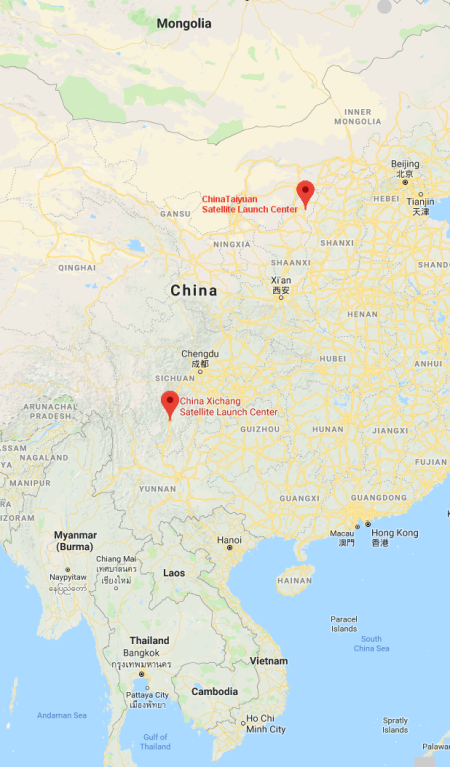
Locations of two of China's launchsites

China today launched the third satellite in a constellation of ocean-observing satellites, using its Long March 2C rocket.

Though this is the same rocket that dropped its upper stage near a Chinese town in June, the launch came from the Taiyuan launch site, not the Xichang launchsite used in June, so it is unclear if the upper stages fell near populated areas. I would expect so, however, since Taiyuan is located in the middle of China even closer to populated areas than Xichang, as shown on the map to the right.

If the launch went north from Taiyuan, then those upper stages probably landed in Mongolia. I wonder if China has worked out an agreement with that country about dropping toxic first stages onto its territory.

Regardless, in the 2018 launch standings, China now leads the U.S. 24-22. The leaders in the race, with the leading U.S. companies broken out, are as follows:

24 China
15 SpaceX
8 Russia
6 ULA
5 Europe

As mentioned previously, with every launch for the rest of the year China will set a new annual record for itself.

5 comments

More details about Chinese suborbital launch earlier this week

Link here. The article really only provides one new detail about the flight itself, that the rocket used solid rocket motors. This fact, plus the overall secrecy, suggest to me that the company, iSpace, is doing its work for the Chinese military.

The article at the link also provides a good overview of the entire Chinese “private” smallsat rocket industry.

China is still run from the top, so any “private” rocket company must have the approval and support of the government. What makes China different from Russia, also ruled from the top, is the Chinese government’s willingness to encourage competitive independent operations, something the Russians has not done. The result is that China’s rocket industry is not stagnating, but growing.

0 comments

China reveals landing site for Chang’e-5 lunar sample return mission

The new colonial movement: In a recent paper Chinese scientists revealed their landing plans for the Chang’e-5 lunar sample return mission, presently scheduled for at 2019 launch.

If all goes according to plan, the robotic Chang’e 5 will land in the Rรผmker region, which lies within a huge basaltic lunar plain called Oceanus Procellarum (Latin for “Ocean of Storms”).

A recent paper lays out the scientific significance of this site, and what Chang’e 5 may be able to find there. “Recent studies find that the geological features and volcanic history of the moon are far more complex than previously thought, and many of the most interesting areas have been neither explored nor sampled,” states the study, which was led by Yuqi Qian of the School of Earth Sciences at the China University of Geosciences in Wuhan. “One such area is the northern Oceanus Procellarum region, which consists of very young (<2 Ga) [less than 2 billion years old] mare materials and hosts one of the largest volcanic complexes on the moon (Mons Rรผmker)."
For the study, the research team conducted a detailed geological mapping of the Rรผmker region using imagery, spectral and altimetry data.

Chang’e-5 should not be confused with Chang’e-4, which is set to launch in the fall to land on the Moon’s far side.

The choice of the volcanic region around the Ocean of Storms is significant, as it indicates that, for at least this mission, China is not focused on the possibly more valuable polar regions where water-ice might be present for future lunar bases. Instead, they are giving a priority to science and geology with this probe. They likely also picked this site because it is near the equator and therefore a bit easier to reach on this first daring sample return mission.

It does appear however that China is taking the long view. The landing choice here suggests to me that they plan many more missions to the Moon, and do not see anyone else in a position to compete with them for territory. The U.S., Russia, and Europe appear to be throwing their eggs into the basket of (F)LOP-G, which will merely orbit the Moon and eat up resources preventing these countries from planning and building any landing missions, for decades. India meanwhile might be a competitor, but at the moment it is far behind.

0 comments

China unveils next lunar rover

The new colonial movement: In unveiling its next lunar rover, China today also announced they will hold a contest to name it.

Images displayed at Wednesday’s press conference showed the rover was a rectangular box with two foldable solar panels and six wheels. It is 1.5 meters long, 1 meter wide and 1.1 meters high.

Wu Weiren, the chief designer of China’s lunar probe program, said the Chang’e-4 rover largely kept the shape and conditions of its predecessor, Yutu (Jade Rabbit), China’s first lunar rover for the Chang’e-3 lunar probe in 2013. However, it also has adaptable parts and an adjustable payload configuration to deal with the complex terrain on the far side of the moon, the demand of relay communication, and the actual needs of the scientific objectives, according to space scientists.

Like Yutu, the rover will be equipped with four scientific payloads, including a panoramic camera, infrared imaging spectrometer and radar measurement devices, to obtain images of moon’s surface and detect lunar soil and structure.

The Chang’e-4 lunar probe will land on the Aitken Basin of the lunar south pole region on the far side of the moon, which is a hot spot for scientific and space exploration. Direct communication with the far side of the moon, however, is not possible, which is one of the many challenges for the Chang’e-4 lunar probe mission. China launched a relay satellite, named Queqiao, in May, to set up a communication link between the Earth and Chang’e-4 lunar probe.

I am not sure what they mean by “adaptable parts and an adjustable payload configuration.” That sounds like they upgraded this rover’s design to allow them to use it to build many similar rovers for use elsewhere, not just on the Moon. This sounds good, but the conditions on other planets are so different I’m not sure a direct transfer of the rover will work very well.

Chang’e-4’s launch is presently scheduled for December.

4 comments

An update on China’s private smallsat rocket companies

Link here. The article describes the most recent news from OneSpace (which recently secured $44 million in financing), Landspace (building larger rockets), and Exspace (next launch planned for September).

While these companies are structured like American private companies, in China nothing having anything to do with space is really private. None of these companies can do anything without the full approval of China’s authoritarian communist government. Unlike Russia, however, China, has decided to allow competition to drive its space industry, not central control. It is encouraging small independent operations to come up with their own ideas and to compete with each other.

In the end, they will all be co-opted by the government, but for now this policy is producing for China some real results.

0 comments

A Chinese skyscraper with a waterfall

Link here. The builders literally included a 350 foot high waterfall that exits the skyscraper and falls down the building’s side.

A spokesperson for the property, Mr Cheng, told Kan Kan News that the main water source is from recycled tap water, rain water or from other channels. ‘Our building has a four-storey underground water storage and drainage system, from which the water is pumped and recycled,’ Mr Cheng said.

The electricity bill for just one hour of operation is a whopping 800 yuan (ยฃ89), he added. ‘That’s why we don’t switch on the waterfall every day – only for special festivities in the city,’ he said. And each time, the waterfall is set to run for only about 10 to 20 minutes to save electricity.

Architects for skyscrapers are getting increasingly creative. They have added trees, vines, greenery everywhere. A waterfall, however, is really clever, though I’m not sure how practical this will be, in the long run. Water falling that distance can do a lot of damage over time.

1 comment
1 83 84 85 86 87 118