
“The bear population is not in crisis as people believed.”

“The [polar] bear population is not in crisis as people believed.”

The number of bears along the western shore of Hudson Bay, believed to be among the most threatened bear subpopulations, stands at 1,013 and could be even higher, according to the results of an aerial survey released Wednesday by the Government of Nunavut. That’s 66 per cent higher than estimates by other researchers who forecasted the numbers would fall to as low as 610 because of warming temperatures that melt ice faster and ruin bears’ ability to hunt. The Hudson Bay region, which straddles Nunavut and Manitoba, is critical because it’s considered a bellwether for how polar bears are doing elsewhere in the Arctic. [emphasis mine]

The study here illustrates again the unreliability of another prediction by scientists advocating global warming. The polar bear population might be under threat, but the evidence so far doesn’t yet support that theory.
1 comment

New research shows that the Medieval Warm Period was a global event, reaching all the way to Antarctica.

New research shows that the Medieval Warm Period was a global event, reaching all the way to Antarctica.

Pseudo-scientists and global warming activists like Phil Jones and Michael Mann had argued that the warming was local, limited to Europe and parts of North America. The new data proves them wrong. Instead, the evidence shows that in the recent past, before the input of human technology, the Earth’s climate has naturally varied on global scales by significant amounts. And the most likely known cause for the Medieval Warm Period (c1000) and the Little Ice Age (c1600) that followed appears to be related to the Sun.

4 comments

The Met Office in the UK has issued an updated temperature record for the past 150 years, suggesting that the climate has warmed 0.75 degrees Celsius since 1900.

The Met Office in the UK has issued an updated temperature record for the past 150 years, suggesting that the climate has warmed 0.75 degrees Celsius since 1900.

I remain suspicious of this announcement, as the scientists issuing this report are the same scientists who participated in climategate, including Phil Jones of the Climate Research Unit of East Anglia University. With that in mind, before I will believe these numbers I will wait for some vetting of this new data by those who have shown themselves to be a bit more skeptical, a bit more open-minded, and a lot more honest.

One more point: to really understand the importance of an increase of 0.75 degrees Celsius over 112 years, we would need some context, something this news article does not give us. For example, how do these numbers compare with the numbers predicted by the various climate models? Also, this is the overall change. How have things changed from year to year? Is there any evidence in this data for a cooling during the past decade, as indicated by other climate measurements?

1 comment

Lord Monckton tries to educate a college professor and his students.

Lord Monckton tries to educate a college professor and his students about the science of climate change.

This is why:

“We shall lose the West unless we can restore the use of reason to pre-eminence in our institutions of what was once learning. It was the age of reason that built the West and made it prosperous and free. The age of reason gave you your great Constitution of liberty. It is the power of reason, the second of the three great powers of the soul in Christian theology, that marks our species out from the rest of the visible creation, and makes us closest to the image and likeness of our Creator. I cannot stand by and let the forces of darkness drive us unprotesting into a new Dark Age.”

0 comments

An up and down Sun

close-up

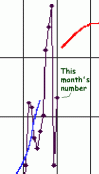
Late last week NOAA’s Space Weather Prediction Center released its monthly update of the ongoing solar cycle sunspot activity, covering February 2012. Though I am slightly late in posting it, as I do every month, you can now see the full graph below the fold. I have also created a close-up of the graph’s relevant area, shown on the left, because it is hard to decipher what is happening on the full graph.

Since the Sun began it ramp up to solar maximum back in 2009, the pattern has been consistent, two steps forward, one step back. First there are several months in a row in which the number of sunspots show a steep rise, followed immediately by several months in which the sunspot numbers decline just as steeply, though by not as much. All told, since 2009 we have seen this pattern repeat four times.

February’s numbers have continued that pattern.
» Read more

0 comments

After spending $130 billion on solar power subsidizes, Germany has found the effort to be a monumental waste of money.

After spending $130 billion on solar power subsidies, Germany has found the effort to be a monumental waste of money.

Despite the massive investment, solar power accounts for only about 0.3% of Germany’s total energy. This is one of the key reasons why Germans now pay the second-highest price for electricity in the developed world (exceeded only by Denmark, which aims to be the “world wind-energy champion”). Germans pay three times more than their American counterparts.

Moreover, this sizeable investment does remarkably little to counter global warming. Even with unrealistically generous assumptions, the unimpressive net effect is that solar power reduces Germany’s CO2 emissions by roughly eight million metric tons – or about 1% – for the next 20 years. When the effects are calculated in a standard climate model, the result is a reduction in average temperature of 0.00005oC (one twenty-thousandth of a degree Celsius, or one ten-thousandth of a degree Fahrenheit). To put it another way: by the end of the century, Germany’s $130 billion solar panel subsidies will have postponed temperature increases by 23 hours.

Using solar, Germany is paying about $1,000 per ton of CO2 reduced. The current CO2 price in Europe is $8. Germany could have cut 131 times as much CO2 for the same price. Instead, the Germans are wasting more than 99 cents of every euro that they plow into solar panels.

Rather than invest in the pie-in-the-sky pipe dreams of politicians, wouldn’t it be smarter to let the market figure out the most efficient form of energy? At first glance that efficiency might not appear “green-friendly”, but if it is more efficient I suspect it is almost certainly going to have the least overall effect on the environment.

0 comments

Comparing all the global warming climate models for the past twenty years with the actual data.

A scientist compares all the global warming climate models developed during the past twenty years with the actual data:

We’ve checked all the main predictions of the climate models against the best data. The climate models get them all wrong. … Therefore:

  • The climate models are fundamentally flawed. Their assumed threefold amplification by feedbacks does not in fact exist.
  • The climate models overestimate temperature rises due to CO2 by at least a factor of three.

Read the whole article. Not only does Evans outline the failures of all the climate models, he also clearly and distinctly describes the actual debate that has been going on in the climate field for the past three decades. It isn’t the effects of carbon dioxide that climate scientists have been arguing about, but, as Richard Lindzen explained to the UK Parliament last week, whether other climate factors, called feedbacks, will amplify or suppress the warming produced by CO2.

0 comments

Dissecting the bad arguments on both sides of the climate debate.

Dissecting the bad arguments on both sides of the climate debate.

What I find intriguing about Singer’s analysis is that the bad arguments from the global warming camp seem to come from noted scientists writing for the IPCC, while the bad arguments on the skeptical side mostly come from non-scientists on the fringes.

In either case, they remain bad arguments, but it is tragic that so many scientists participate in it.

2 comments

How environmentalists are losing the climate change war

How environmentalists are losing the climate change war.

Having made wildly inflated claims, and then been so publicly contradicted by solid science, Hansen and McKibben will find their credibility has taken a big hit. And they can be sure that the next time they make any claim about the oilsands, or anything else, this will be flung at them from every direction. They won a tactical victory. But it cost them a strategic defeat.

And as the writer, who appears to be a believer in human-caused global warming, also notes, “This is an old story in the environmental movement.” The result: no one believes them anymore.

0 comments
1 54 55 56 57 58 84