
Roy Clark on the Odd Couple
An evening pause: These clips come from an episode of the 1970s television situation comedy, The Odd Couple, and showcases the incredible ability Roy Clark had to play almost anything.
Hat tip Mike Nelson.
An evening pause: These clips come from an episode of the 1970s television situation comedy, The Odd Couple, and showcases the incredible ability Roy Clark had to play almost anything.
Hat tip Mike Nelson.
The competition heats up: Sierra Nevada today signed a deal with the United Nations to fly a 14-day mission in 2021 using Dream Chaser.
The first-ever United Nations space mission is intended to launch in 2021 and will allow United Nations Member States to participate in a 14-day flight to low-Earth orbit (LEO) on SNC’s Dream Chaser spacecraft. “One of UNOOSA’s core responsibilities is to promote international cooperation in the peaceful use of outer space,” said Simonetta Di Pippo, director of UNOOSA. “I am proud to say that one of the ways UNOOSA will achieve this, in cooperation with our partner SNC, is by dedicating an entire microgravity mission to United Nations Member States, many of which do not have the infrastructure or financial backing to have a standalone space program.”
According to Ms. Di Pippo, funding of the mission will come from multiple sources. “We will continue to work closely with SNC to define the parameters of this mission which, in turn, will provide United Nations Member States with the ability to access space in a cost-effective and collaborative manner within a few short years. The possibilities are endless.” Countries selected to provide mission payloads will be asked to pay a pro-rated portion of the mission cost, based on the resources required to host the payload and their ability to pay. In addition, major sponsors are being sought to finance a large portion of the mission costs.
While the press today is in a feeding frenzy writing stories about Elon Musk’s speech, they are ignoring this story. Yet, this deal between the UN and Sierra Nevada is actually far more important. Musk’s proposals, while exciting and important in how they move the conversation of space exploration forward, are mostly Powerpoint fantasies. He does not have customers for his interplanetary transportation system. He does not have a rocket. All he has is the Raptor engine, which is only beginning its design testing. It will be years before any of his proposals here become real.
This UN/Sierra Nevada deal however is reality. A private American company is building a spaceship that it is now selling successfully to third world nations. Actual money will change hands. Profit will be earned. And Sierra Nevada will be in a position to use those earnings to upgrade and advance its designs. This will be the future, far sooner than Elon Musk’s International Transportation System.
The competition heats up: A Russian airline owner has signed a deal with the Russian government to buy Sea Launch.
Whether this guy can make the company viable again is a big question. He has to settle the court suit with Boeing and he also has to settle with either Russia or Ukraine about what rocket to use.
An evening pause: Hat tip Lee Stevenson.
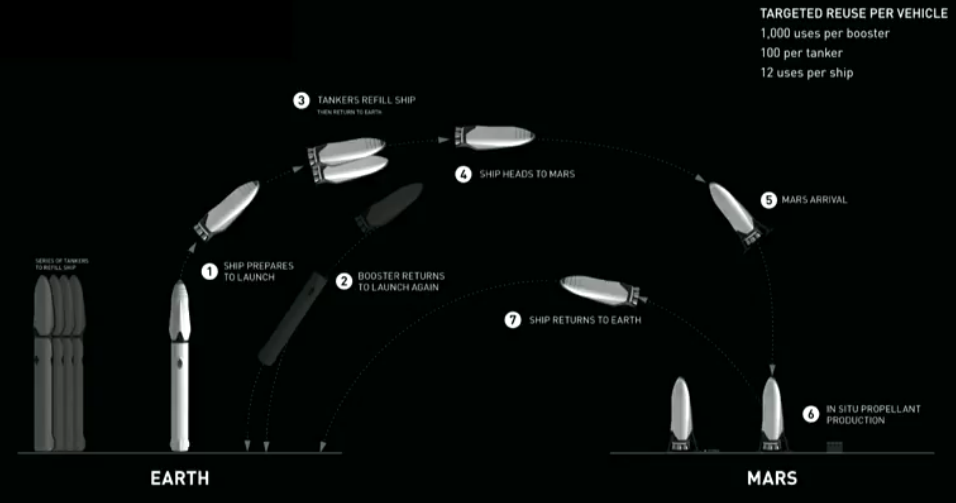
Today Elon Musk gave a speech at the International Astronautical Congress in Guadalajara, Mexico. The speech laid out SpaceX’s proposed architecture for building what he presently calls his interplanetary transport system. The image on the right is one of his talk slides, showing the basic concept, which is built around using the company’s new Raptor engine — still under development — which only got its first test firing this past week.
The plan is ambitious and visionary, which from Musk is not surprising. It is also aimed to be as practical and as cost effective as possible, which also is not surprising coming from Musk. The rocket itself will be larger than both the Saturn 5 and SLS, but not significantly more. Compared to those government rockets however it will be far cheaper and faster to build, though Musk’s hope that they will be launching their first test flights in four years is almost certainly too optimistic. The concept is to use what they have learned with the Falcon 9 to build a bigger rocket with a reusable first stage that launches a large second stage that is either the spaceship taking people to Mars or a giant tanker for refueling that spaceship.
In one of Musk’s early slides he noted something that I have been arguing for decades. “Speading the required lift capacity across multiple launches substantially reduces development costs and compresses schedule.” Though he is still proposing a heavy-lift rocket, he is also following in the footsteps of Wernher Von Braun by proposing that any Mars mission will require some assembly in orbit.
The plan is also aimed at making space travel as affordable as possible. Musk structured the design in as many ways as possible to make it as efficient and as inexpensive as possible. It still won’t be cheap, at about $140K per ton, but at that price it will be affordable to a lot of people. He also mentioned that it include free passage back to Earth.
I doubt we will see this system built as outlined today in the time span predicted by Musk. At the same time, I would not be surprised if we do see some variation of it, and see it built within the near future. In 2011 Musk proposed recovering his Falcon 9 first stages by landing them vertically. The idea seems radical. He got it done in four years. There is every reason to believe he will make this Mars proposal happen as well.
The competition heats up: In a series of tweets Jeff Bezos on Monday released the first images Blue Origin’s next rocket, New Glenn, showing a scale-model being during wind tunnel tests.
They were testing the rocket’s aerodynamics during launch and return, and were apparently happy with the results.
The competition heats up: One of the smallsats launched by India’s PSLV rocket this weekend, Pathfinder 1, has successfully begun communicating with the ground as well as transmitting data.
This is a test demonstration flight of this new smallsat Earth observation imaging satellite. As the company notes,
The on-orbit demonstration of the BlackSky Pathfinder spacecraft validates the future vision of real-time global observation and understanding. Specifically, BlackSky’s Pathfinder spacecraft is unique and revolutionary in its size, cost and performance. By comparison, Digital Globe’s WorldView 4 spacecraft — which has truly impressive resolution and spectral diversity — weighs 2,500 kg and costs $750M to put on orbit. Pathfinder represents the pinnacle in rethinking spacecraft design and economics. Our spacecraft, complete with propulsion system and high gain communications, can provide high resolution (1 meter) imagery in a 50 kg package that will fit in a middle seat on a commercial airplane – all for less than $7.5M on orbit. It’s this unique combination of size, cost and performance that enables us to orbit a constellation of 60 spacecraft for less than the cost of a single Digital Globe spacecraft.
As I’ve mentioned several times in the past year, the space industry is diverging into two streams, smallsats for unmanned communications and research satellites, and big spacecraft for human exploration. Tomorrow, Elon Musk will give us his vision of the big spacecraft stream in his much hyped speech at the International Astronautical Congress.
The competition heats up: Rocket Lab today announced the completion of its first launch complex at its launch site in New Zealand.
Air traffic near the launch complex site is fairly sparse, which the company says will allow it to achieve the “highest frequency of launches in history,” according to a statement from the company obtained by Space.com. Peter Beck, Rocket Lab’s CEO, told Space.com in an interview that the complex is licensed to conduct a launch as frequently as every 72 hours. However, the company expects to carry out a launch about four to five times per month, he said.
The statement from Rocket Lab declared its new facility “the world’s first private orbital launch complex.” The private spaceflight company Blue Origin operates a private launch facility in Texas, but has only used that facility for suborbital flights. The private spaceflight company SpaceX has not yet completed construction on its private orbital launch facility in Texas.
They say they will begin test launches before the end of the year.
<An evening pause: Recorded live on television sometime in the 1960s. Paul Desmond (alto sax), Joe Morello (drums), Eugene Wright (bass) and Dave Brubeck (piano).
Hat tip Willi Kusche.
The competition heats up: Though details remain vague, SpaceX has announced that it has successfully completed the first static test firing of its Raptor engine.
The competition heats up: India’s space agency ISRO has successfully used its PSLV rocket to launch eight satellites into two different orbits.
After the successful separation of SCATSAT-1, the PSLV-C35 mission continued. Still carrying the seven co-passenger satellites, the fourth stage of PSLV coasted over the South polar region and then started ascending towards the Northern hemisphere. A safe distance between the orbiting SCATSAT-1 and PSLV-C35 fourth stage was maintained by suitably manoeuvring the stage.
At 1 hour 22 minutes and 38 seconds after lift-off as the fourth stage was in the North polar region, the two engines of PSLV fourth stage were reignited and fired for 20 seconds. As a result of this, it entered into an elliptical orbit measuring 725 km on one side of the Earth and 670 km on the other. And 50 minutes later, as the PSLV fourth stage was again coasting near the south pole, its engines were fired for another 20 seconds. This second firing made the fourth stage to enter into a circular orbit of 669 km height inclined at an angle of 98.2 degree to the equator. 37 seconds later, the Dual Launch Adapter was successfully separated from the PSLV-C35 fourth stage. 30 seconds after this event, ALSAT-1N was the first co-passenger satellite to be separated successfully. Following this, the NLS-19, PRATHAM, PISAT, ALSAT-1B, ALSAT-2B, and Pathfinder-1 were separated from the PSLV fourth stage in a predetermined sequence thereby successfully completing PSLV-C35 mission.
This launch was also the 36th successful PSLV launch in a row.
On September 23, SpaceX released an update outlining the status of its investigation into the September 1 Falcon 9 launchpad explosion.
The report noted the following:
…the Falcon Support Building adjacent to the pad was unaffected, and per standard procedure was unoccupied at the time of the anomaly. The new liquid oxygen farm – e.g. the tanks and plumbing that hold our super-chilled liquid oxygen – was unaffected and remains in good working order. The RP-1 (kerosene) fuel farm was also largely unaffected. The pad’s control systems are also in relatively good condition.
While this report suggests they have made some progress, the fundamental cause of the explosion remains unknown.