
Dream Chaser to fly 14-day UN mission in 2021

The competition heats up: Sierra Nevada today signed a deal with the United Nations to fly a 14-day mission in 2021 using Dream Chaser.

The first-ever United Nations space mission is intended to launch in 2021 and will allow United Nations Member States to participate in a 14-day flight to low-Earth orbit (LEO) on SNC’s Dream Chaser spacecraft. “One of UNOOSA’s core responsibilities is to promote international cooperation in the peaceful use of outer space,” said Simonetta Di Pippo, director of UNOOSA. “I am proud to say that one of the ways UNOOSA will achieve this, in cooperation with our partner SNC, is by dedicating an entire microgravity mission to United Nations Member States, many of which do not have the infrastructure or financial backing to have a standalone space program.”

According to Ms. Di Pippo, funding of the mission will come from multiple sources. “We will continue to work closely with SNC to define the parameters of this mission which, in turn, will provide United Nations Member States with the ability to access space in a cost-effective and collaborative manner within a few short years. The possibilities are endless.” Countries selected to provide mission payloads will be asked to pay a pro-rated portion of the mission cost, based on the resources required to host the payload and their ability to pay. In addition, major sponsors are being sought to finance a large portion of the mission costs.

While the press today is in a feeding frenzy writing stories about Elon Musk’s speech, they are ignoring this story. Yet, this deal between the UN and Sierra Nevada is actually far more important. Musk’s proposals, while exciting and important in how they move the conversation of space exploration forward, are mostly Powerpoint fantasies. He does not have customers for his interplanetary transportation system. He does not have a rocket. All he has is the Raptor engine, which is only beginning its design testing. It will be years before any of his proposals here become real.

This UN/Sierra Nevada deal however is reality. A private American company is building a spaceship that it is now selling successfully to third world nations. Actual money will change hands. Profit will be earned. And Sierra Nevada will be in a position to use those earnings to upgrade and advance its designs. This will be the future, far sooner than Elon Musk’s International Transportation System.
6 comments

Musk’s Mars plan

Musk's Mars plan

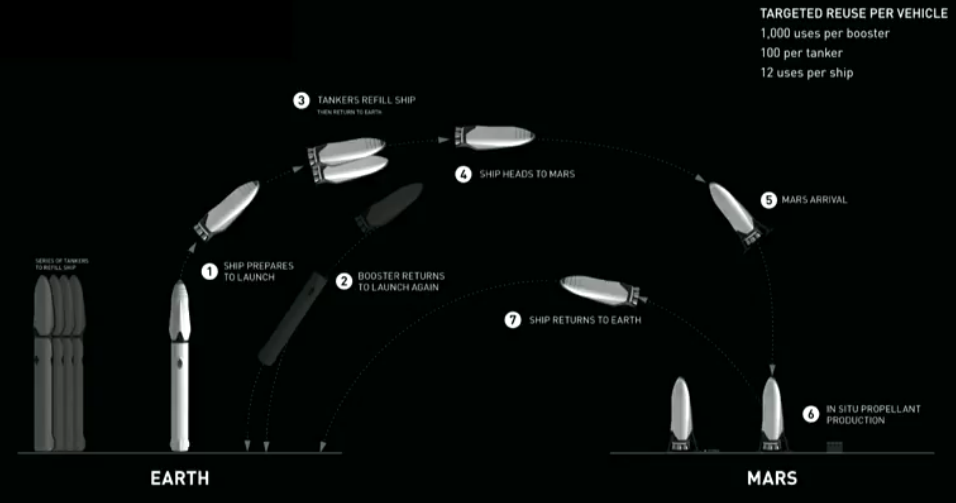
Today Elon Musk gave a speech at the International Astronautical Congress in Guadalajara, Mexico. The speech laid out SpaceX’s proposed architecture for building what he presently calls his interplanetary transport system. The image on the right is one of his talk slides, showing the basic concept, which is built around using the company’s new Raptor engine — still under development — which only got its first test firing this past week.

The plan is ambitious and visionary, which from Musk is not surprising. It is also aimed to be as practical and as cost effective as possible, which also is not surprising coming from Musk. The rocket itself will be larger than both the Saturn 5 and SLS, but not significantly more. Compared to those government rockets however it will be far cheaper and faster to build, though Musk’s hope that they will be launching their first test flights in four years is almost certainly too optimistic. The concept is to use what they have learned with the Falcon 9 to build a bigger rocket with a reusable first stage that launches a large second stage that is either the spaceship taking people to Mars or a giant tanker for refueling that spaceship.

In one of Musk’s early slides he noted something that I have been arguing for decades. “Speading the required lift capacity across multiple launches substantially reduces development costs and compresses schedule.” Though he is still proposing a heavy-lift rocket, he is also following in the footsteps of Wernher Von Braun by proposing that any Mars mission will require some assembly in orbit.

The plan is also aimed at making space travel as affordable as possible. Musk structured the design in as many ways as possible to make it as efficient and as inexpensive as possible. It still won’t be cheap, at about $140K per ton, but at that price it will be affordable to a lot of people. He also mentioned that it include free passage back to Earth.

I doubt we will see this system built as outlined today in the time span predicted by Musk. At the same time, I would not be surprised if we do see some variation of it, and see it built within the near future. In 2011 Musk proposed recovering his Falcon 9 first stages by landing them vertically. The idea seems radical. He got it done in four years. There is every reason to believe he will make this Mars proposal happen as well.

14 comments

Pathfinder 1 communications confirmed

The competition heats up: One of the smallsats launched by India’s PSLV rocket this weekend, Pathfinder 1, has successfully begun communicating with the ground as well as transmitting data.

This is a test demonstration flight of this new smallsat Earth observation imaging satellite. As the company notes,

The on-orbit demonstration of the BlackSky Pathfinder spacecraft validates the future vision of real-time global observation and understanding. Specifically, BlackSky’s Pathfinder spacecraft is unique and revolutionary in its size, cost and performance. By comparison, Digital Globe’s WorldView 4 spacecraft — which has truly impressive resolution and spectral diversity — weighs 2,500 kg and costs $750M to put on orbit. Pathfinder represents the pinnacle in rethinking spacecraft design and economics. Our spacecraft, complete with propulsion system and high gain communications, can provide high resolution (1 meter) imagery in a 50 kg package that will fit in a middle seat on a commercial airplane – all for less than $7.5M on orbit. It’s this unique combination of size, cost and performance that enables us to orbit a constellation of 60 spacecraft for less than the cost of a single Digital Globe spacecraft.

As I’ve mentioned several times in the past year, the space industry is diverging into two streams, smallsats for unmanned communications and research satellites, and big spacecraft for human exploration. Tomorrow, Elon Musk will give us his vision of the big spacecraft stream in his much hyped speech at the International Astronautical Congress.

1 comment

Rocket Lab completes construction of first launchpad

The competition heats up: Rocket Lab today announced the completion of its first launch complex at its launch site in New Zealand.

Air traffic near the launch complex site is fairly sparse, which the company says will allow it to achieve the “highest frequency of launches in history,” according to a statement from the company obtained by Space.com. Peter Beck, Rocket Lab’s CEO, told Space.com in an interview that the complex is licensed to conduct a launch as frequently as every 72 hours. However, the company expects to carry out a launch about four to five times per month, he said.

The statement from Rocket Lab declared its new facility “the world’s first private orbital launch complex.” The private spaceflight company Blue Origin operates a private launch facility in Texas, but has only used that facility for suborbital flights. The private spaceflight company SpaceX has not yet completed construction on its private orbital launch facility in Texas.

They say they will begin test launches before the end of the year.

1 comment

PSLV places multiple satellites into different orbits

The competition heats up: India’s space agency ISRO has successfully used its PSLV rocket to launch eight satellites into two different orbits.

After the successful separation of SCATSAT-1, the PSLV-C35 mission continued. Still carrying the seven co-passenger satellites, the fourth stage of PSLV coasted over the South polar region and then started ascending towards the Northern hemisphere. A safe distance between the orbiting SCATSAT-1 and PSLV-C35 fourth stage was maintained by suitably manoeuvring the stage.

At 1 hour 22 minutes and 38 seconds after lift-off as the fourth stage was in the North polar region, the two engines of PSLV fourth stage were reignited and fired for 20 seconds. As a result of this, it entered into an elliptical orbit measuring 725 km on one side of the Earth and 670 km on the other. And 50 minutes later, as the PSLV fourth stage was again coasting near the south pole, its engines were fired for another 20 seconds. This second firing made the fourth stage to enter into a circular orbit of 669 km height inclined at an angle of 98.2 degree to the equator. 37 seconds later, the Dual Launch Adapter was successfully separated from the PSLV-C35 fourth stage. 30 seconds after this event, ALSAT-1N was the first co-passenger satellite to be separated successfully. Following this, the NLS-19, PRATHAM, PISAT, ALSAT-1B, ALSAT-2B, and Pathfinder-1 were separated from the PSLV fourth stage in a predetermined sequence thereby successfully completing PSLV-C35 mission.

This launch was also the 36th successful PSLV launch in a row.

0 comments

SpaceX update on launchpad explosion investigation

On September 23, SpaceX released an update outlining the status of its investigation into the September 1 Falcon 9 launchpad explosion.

The report noted the following:

  • The data points to “a large breach in the cryogenic helium system of the second stage liquid oxygen tank” as the source of the explosion, though what caused the breach remains as yet unknown.
  • The cause of this failure and the previous launch failure in June 2015 are not related.
  • The report summarized some of the launchpad damage, noting that while the pad itself needs extensive repairs,

    …the Falcon Support Building adjacent to the pad was unaffected, and per standard procedure was unoccupied at the time of the anomaly. The new liquid oxygen farm – e.g. the tanks and plumbing that hold our super-chilled liquid oxygen – was unaffected and remains in good working order. The RP-1 (kerosene) fuel farm was also largely unaffected. The pad’s control systems are also in relatively good condition.

  • The report also noted that, “pending the results of the investigation, we anticipate returning to flight as early as the November timeframe.”

While this report suggests they have made some progress, the fundamental cause of the explosion remains unknown.

3 comments

Stratolaunch loses top executive

Today it was revealed that Vulcan Aerospace, the company building Stratolaunch, is losing one of its top executives.

Aerospace veteran Chuck Beames is leaving his post as president of Microsoft co-founder Paul Allen’s spaceflight company, Vulcan Aerospace. Word of Beames’ departure came from Allen in an internal email that was sent to Vulcan employees and obtained by GeekWire today. Allen said Jean Floyd, the CEO of Vulcan’s Stratolaunch Systems, will expand his role to become Vulcan Aerospace’s interim executive director as well.

Allen’s email, which you can read in its entirety at the link, also called Orbital ATK “a valued partner.” The last we had heard of this partnership, however, was that Orbital ATK had backed out of it. Allen’s email instead suggests that some renegotiations are going on, and the partnership is not quite dead.

2 comments

Russia to break safety rules to repair Soyuz capsule

In order to replace a burnt capsule quickly in its Soyuz capsule, Russia will ignore its own safety rules and allow the engineers to work without draining the capsule of its propellants and gases.

Sources close to investigation told RussianSpaceWeb.com that a cable located behind the cosmonaut seats inside the Descent Module of the Vehicle No. 732 had accidentally been bent severely enough to damage its insulation. As it turned out, the problem had nothing to do with the encapsulation of the spacecraft inside its payload fairing on September 15, as was initially thought.

Replacing the damaged cable is relatively straight forward, but it now has to be conducted on the vehicle fully loaded with toxic propellants and pressurized gases. Such an attempt would violate usual safety rules, but draining the spacecraft off its propellants and gases would likely be even more unprecedented and require lengthy repairs.

The big issue here is not the willingness of Roscosmos management to break its safety rules. In fact, believe it or not, those rules are possibly too strict. The repairs are taking place inside the capsule where the astronauts sit. If it is too dangerous for engineers to be there with the capsule fueled, then it would be too dangerous for the astronauts. Granted, engineers don’t usually sign up for those kinds of dangers, but then, if you are an engineer in the field of rocket science I suspect you did sign up, and expect them.

No, what is significant about this story is the bent cable and its damaged insulation, which was bad enough that the cable actually burnt, based on other reports. It suggests a variety of issues in the construction of this capsule, all of which are worrisome. First and foremost, how is it possible for insulation to break simply by bending a cable? Is the insulation that badly made? Or have they such low tolerances for the insulation (possibly to save weight) that it requires a very careful installation that in this case was done badly?

This is also only the second launch of an upgraded Soyuz capsule. Could it be that they haven’t worked out all the kinks in its design? If not, they have been making Soyuz capsules for literally decades. One would think that the people that install this wiring would know its tolerances and not make such a mistake.

I know I am being somewhat harsh here, but that harshness comes after seeing repeated quality control problems in a variety of Russian-built aerospace hardware in recent years. In the previous cases, however, the problems did not involve a manned flight. This one did, and if those same quality control problems are now showing up with Soyuz, that is a very bad thing.

7 comments

Orbital ATK aims for October 9-13 Antares launch

Orbital ATK and NASA have now scheduled the first Antares/Cygnus launch since the rocket’s failure in October 2014 for no earlier than October 9.

Orbital ATK is targeting Oct. 9-13 for the launch of the company’s upgraded Antares 230 rocket. Liftoff will occur from the Mid-Atlantic Regional Spaceport to send the OA-5 Cygnus spacecraft, called S.S. Alan G. Poindexter, to the International Space Station (ISS). According to a news release from the company, a more specific date and time will be selected upon completion of final operational milestones and technical reviews. Launch times on these dates range from 10:47 p.m. EDT Oct. 9 to 9:30 p.m. EDT Oct. 13 (2:47 GMT Oct. 10 to 1:30 GMT Oct. 14).

2 comments
1 590 591 592 593 594 785