Moon Express gets FAA approval for Moon landing

The competition heats up: Moon Express, one of the leading private competitors in the Google Lunar X-Prize, has gotten FAA approval for its planned 2017 Moon landing.

It is looking like 2017-2018 will be very exciting years for private space. We will not only see the first launches of privately-built manned spacecraft, we will see the first privately-built and -funded missions to both the Moon and Mars.

8 comments

Vector completes suborbital test launch, signs contract

The competition heats up: The smallsat rocket company Vector Space Systems successfully completed its first suborbital test launch on July 30 as part of the signing of a new contract for 21 launches.

This company is moving quickly. In April they obtained financing, In July they revealed their launch schedule, with the first launch set for 2018. Mere weeks later, they complete their first test flight and announce a major launch contract.

0 comments

Design problems for Starliner

In the heat of competition: Boeing is working to correct two serious design problems that cropped up during the construction of its Starliner manned capsule.

First the thing was weighing too much:

One issue involved the mass of the crew capsule, which outgrew the lift capability of the United Launch Alliance Atlas 5 rocket selected to put it into orbit. The CST-100 Starliner will ride an Atlas 5 rocket with two solid rocket boosters and a dual-engine Centaur upper stage, and although Boeing and ULA engineers considered adding a third strap-on motor to compensate for the capsule’s extra weight, managers now have the spacecraft back under its mass allowance, Ferguson said.

Second, the capsule has a shape problem:

Ferguson said Boeing has a model of the Atlas 5 rocket and CST-100 Starliner in a wind tunnel to verify a change to capsule’s outer shape devised to overcome higher-than-expected aerodynamic launch loads discovered in testing. “They had one issue, a non-linear aerodynamic loads issue, where they were getting some high acoustic loads right behind the spacecraft,” said Phil McAlister, head of NASA’s commercial spaceflight development office in Washington.

Something here is rotten. It seems to me that Boeing shouldn’t be having these very basic problems right off the bat. In the past, under the older cost-plus contracts NASA used to routinely hand out, these kinds of problems would simply have meant that Boeing would have gotten more money from NASA, This time, however the contract is fixed-price. If Boeing has problems or delays, the company will have to bear the cost, not NASA. I suspect these problems might have occurred because of some cultural laziness at Boeing. Their management is used to not having to eat the cost of these kinds of mistakes. Now, they will. I expect the culture to therefore begin changing.

5 comments

Angara gets a customer

The competition heats up: Russia has signed its first international contract for its new still-underdevelopment Angara rocket.

Leading Russian rocket developer, GKNPTs Khrunichev, signed up the first foreign commercial passenger for the light version of its new-generation Angara rocket. The South-Korean Kompsat-6 remote-sensing satellite (a.k.a. Arirang) was booked for a ride on the Angara-1.2 launch vehicle from Plesetsk around 2020. Equipped with a Synthetic Aperture Radar, SAR, the 1.7 ton spacecraft should be inserted into the Sun-synchronous orbit.

More here.

0 comments

Sierra Nevada preps for Dream Chaser glide tests

The competition heats up: In preparing its Dream Chaser engineering test vehicle for glide tests in California this fall, Sierra Nevada unveiled it to the press yesterday.

This is essentially the test vehicle’s first public viewing since its one glide test, when the front landing gear did not deploy correctly and the vehicle was damaged during landing. Since the landing gears were not the gears being developed for the flight craft, and since the glide test itself went well, both the company and NASA considered that glide test to be a success.

It has now been refurbished for new tests in conjunction with the company’s contract to use Dream Chaser as a cargo ship for NASA.

0 comments

SpaceX test fires one of its recovered first stages

The competition heats up: SpaceX has completed a full duration test firing of one of its recovered first stages.

The JCSAT-14 stage [which was the third recovered stage and the second to land on a barge] isn’t expected to fly again due to the initial evaluations into damage received via its high-velocity return. However, it will still provide useful test data. “Most recent rocket took max damage, due to very high entry velocity,” noted Elon Musk. “Will be our life leader for ground tests to confirm others are good.”

That testing on the JCSAT-14 booster began on Thursday, with the stage placed on the test stand at McGregor – ironically after the stand was vacated by the JCSAT-16 first stage – which recently completed testing and has since been shipped to Florida for its launch next month. The returned stage is also sported a new cap, which may be providing some simulated weight to aid the required data gathering during the test firing.

The booster conducted a long firing of 2 minutes 30 seconds (the duration of first stage flight), that began around 7pm local time on Thursday (per L2 McGregor), which will provide vital data on the returned stage as SpaceX continue preparations for validating one of its recovered booster for a re-launch later this year.

It is once again important to point out that SpaceX’s engineers here have an enormous advantage over every other rocket engineer who has ever lived. They have in hand a recovered first stage that was actually used to launch a satellite into orbit, giving them the ability to test it and find out precisely how such equipment fares during launch. This will give them the ability, unavailable to others, to make engineering improvements that will make future first stages even more reliable and reusable.

3 comments

Atlas 5 successfully launches U.S. surveillance satellite

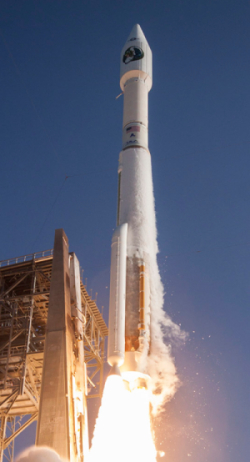
Atlas 5

The competition heats up: A ULA Atlas 5 rocket today successfully launched a National Reconnaissance Office (NRO) surveillance satellite, dubbed NROL-61.

The image on the right is courtesy of Orbital ATK. From the link above:

NROL-61, however, launched atop an Atlas V 421 rocket, a configuration that has not previously been used by the NRO. The spacecraft itself was encapsulated within an Extra-Extended Payload Fairing (XEPF) – at 14 metres (46 feet) in length the longest of three available four-metre (13-foot) diameter fairings – which has also never before been used for an NRO mission.

…The most likely explanation is that NROL-61 will be the first in a new generation of Quasar satellite; which would appear to be larger in both size and mass than its predecessors. Quasar, also known as the Satellite Data System, or SDS, is a constellation of communications satellites operated by the NRO to support its other intelligence-gathering activities; relaying data from other satellites to the ground in real-time, without having to wait for the intelligence-gathering satellites to pass over ground stations on friendly territory. If NROL-61 represents a new version of Quasar, it will be the fourth generation of the constellation.

2 comments

NASA guesses SpaceX’s Dragon-Mars mission will cost $300 million

At a meeting of NASA’s Advisory Council yesterday a NASA official estimated that SpaceX will probably spend about $300 million on its Dragon mission to Mars.

Asked by the committee how much SpaceX was spending, Reuter indicated that the company’s investment was 10 times that of NASA. “They did talk to us about a 10-to-1 arrangement in terms of cost: theirs 10, ours 1,” he said. “I think that’s in the ballpark.” Given NASA’s investment, that implies SpaceX is spending around $300 million on Red Dragon.

SpaceX has not disclosed its estimated cost of the mission, or how it will pay for it. “I have no knowledge” of how the company is financing the mission, Reuter said when asked by the committee.

I suspect that the guess is significantly wrong. NASA is providing $32 million. SpaceX plans to charge customers $90 million for a single Falcon Heavy launch, which means its cost for that launch is likely half that, say $45 million. That adds up to $77 million. The cost for a Dragon capsule is not even close to $223 million, which is what remains if NASA’s guess is right, which based on this rough estimate I seriously doubt. I would bet that a single Dragon probably costs far less than $20 million. Remember, they are nothing more than basic manned capsules, and SpaceX is building enough of them to almost have an assembly line going.

So, let’s round up and say that the cost for the mission is really about $100 million (including NASA’s contribution). Other costs, such as the staff to run the mission for at least a year, will increase this cost, but not enough to bring the total to NASA’s guess of $300 million. I suspect that SpaceX will not spend anything close to $100 million of its own money for this Dragon mission to Mars.

All in all, this amount of investment seems reasonable, based on the scale of costs in the launch industry. And SpaceX’s willingness to invest some of its own money for this mission is probably wise. In publicity alone it is priceless.

9 comments
1 598 599 600 601 602 785