
The space program is dead, long live the space industry!

The news following the midterm election results have not sounded good for NASA. Two stories on Monday alone signaled the bad news:

Earlier stories last week were no more encouraging:

While Republicans have, since the 1970s, generally been more enthusiastic than Democrats about NASA and manned space exploration, the new Republican Congress has a tone that seems decidedly different from past years. Above all, it appears the public is finally becoming aware of the recent explosion in the federal debt, as illustrated by the graph below. (hat tip to Gateway Pundit and The Captain’s Comments.)
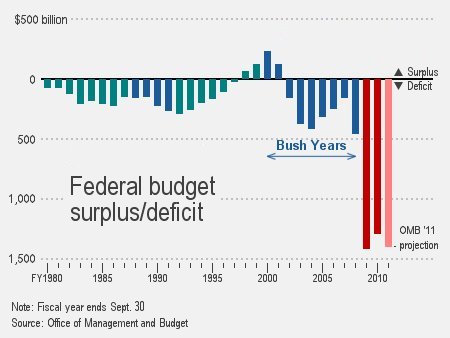
Federal deficit

The public’s growing concern about these numbers was clearly reflected in the election results. First, there was the success of many tea party candidates advocating fiscal responsibility and a radical shrinking of government. Even in cases where conservatives lost, the closeness of the election in districts or states where liberals have rarely in the past been challenged suggests the mood of the electorate is decidedly shifting in a direction against federal spending.

Second, the electorate seemed surprisingly hostile to pork, expressing little interest in being brought off with baubles for their home districts. Thus, candidates who ran against pork seemed to get far more enthusiastic attention and positive publicity than those elected officials famous for “bringing home the bacon.”

In such an atmosphere, the priorities of Congress will be forced to change. The outlook therefore does not look good for the type of pork funding represented by the NASA authorization bill passed on September 29, with its billions of subsidies for the aerospace industry.

We can see an indication of this new tone by some of the initial plans announced by the Republican leadership. As a first step, the Republicans have proposed cutting the federal budget back 2008 levels. This change alone would reduce NASA’s annual budget by about $2 billion, or 10%.

This solution, however, will not close the budget gap, only shrink it slightly. The Republicans will still be faced with massive amounts of red ink and a public demanding that they deal with it. To prove they mean what they say, the new House leadership will be forced to propose some additional draconian cuts.

Unfortunately, the circumstances at this moment has made NASA a prime budget-cutting target. » Read more

4 comments

Squeal like a pig

Let’s take a trip into the future, looking past Tuesday’s midterm election.

For the sake of argument, let’s assume that, come Tuesday, the Republicans take both houses, in a stunning landslide not seen in more than a century. Let’s also assume that the changes in Congress are going to point decidedly away from the recent liberal policies of large government (by both parties). Instead, every indication suggests that the new Congress will lean heavily towards a return to the principles of small government, low taxes, and less regulation.

These assumptions are not unreasonable. Not only do the polls indicate that one or both of the houses of Congress will switch from Democratic to Republican control, the numerous and unexpected primary upsets of established incumbents from both parties — as well the many protests over the past year by large numbers of ordinary citizens — make it clear that the public is not interested in half measures. Come January, the tone and direction of Congress is going to undergo a shocking change.

Anyway, based on these assumptions, we should then expect next year’s Congress to propose unprecedented cuts to the federal budget, including the elimination of many hallowed programs. The recent calls to defund NPR and the Corporation for Public Broadcastings are only one example.

When Congress attempts this, however, the vested interests that have depended on this funding for decades are not going to take the cuts lightly. Or to put it more bluntly, they are going to squeal like pigs, throwing temper tantrums so loud and insane that they will make the complaints of a typical three-year-old seem truly statesman-like. And they will do so in the hope that they will garner sympathy and support from the general voting public, thereby making the cuts difficult to carry out.

The real question then is not whether the new Congress will propose the cuts required to bring the federal government under control, but whether they, as well as the public, will have the courage to follow through, to defy the howls from these spoiled brats, and do what must be done. » Read more

4 comments

Why this election is important

Mark Steyn explains why next week’s midterm election and what the next Congress does has very special significance. Key quote:

In a two-party system, you have to work with whatโ€™s available. In America, one party is openly committed to driving the nation off the cliff, and the other party is full of guys content to go along for the ride as long as we shift down to third gear. Thatโ€™s no longer enough of a choice. If your candidate isnโ€™t committed to fewer government agencies with fewer employees on lower rates of pay, heโ€™s part of the problem. This is the last chance for the GOP to restore its credentials. If it blows it, all bets are off for 2012.

0 comments

Charles Lollar vs Steny Hoyer

Steny Hoyer must be in trouble. At the Charles County Candidate Forum on Wednesday, he lowered himself to actually debate his opponents for the upcoming Congressional election, the first time I have seen this happen since I moved to his district in 1999. However, his Republican opponent, Charles Lollar, got the last word, and made Hoyer look bad.

0 comments

Obama signs the NASA authorization bill

Obama signed the NASA authorization bill today.

Update and bumped: This Spaceflight Now article includes this quote from Senator Bill Nelson (D-Florida):

“What is in this bill is $11.5 billion over the next six years, anticipated, even though it’s a three-year authorization, for development and testing of a heavy lift rocket. Now if we can’t develop a new rocket for $11.5 billion, building on a lot of the technologies that were already developed in spending $9 billion (on the Constellation program’s Ares rockets), if we can’t do it for that, then we ought to question whether or not we can build a rocket.”

Based on NASA’s track record in trying to build a replacement to the shuttle, I remain very skeptical indeed whether NASA can build this rocket. I do hope, however, that my skepticism is proven wrong.

Note also that the funding for this authorization bill is as yet not appropriated. Plans to do so during the lame duck session of Congress after the elections remain fraught with problems.

0 comments
1 98 99 100 101 102 105