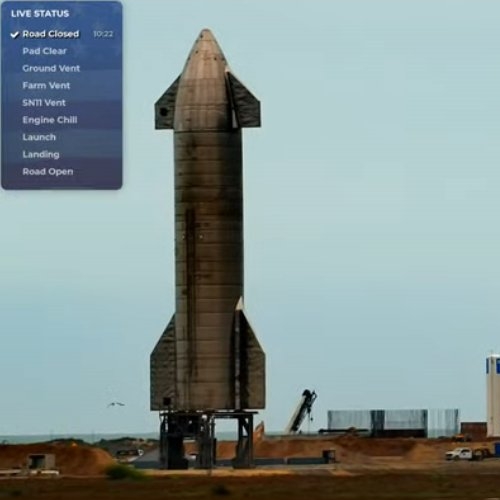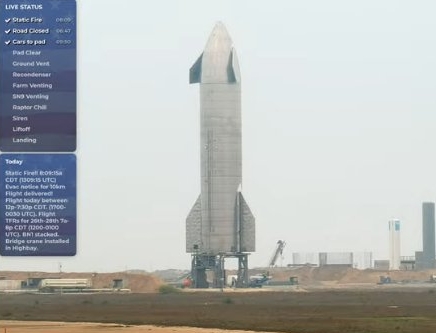
Three aborted static fire tests yesterday for Starship prototype #9

Capitalism in space: After switching out three Raptor engines following successful static fire tests last week, SpaceX attempted three times to complete a new static fire test of Starship prototype #9 yesterday, only to have all three attempts abort just before ignition.

No word on the cause of the aborts, or what SpaceX’s next step will be. The article at the link speculates that SpaceX is merely being cautious, which doesn’t sound right to me. It could be there are specific issues with prototype #9 that are causing the problems. Remember, this is the prototype that tipped over in the assembly building and needed repairs.

6 comments

An empty Biden inauguration for a false victory

Comparing crowds at presidential inaugurations
Photos from here.

For those who still think Joe Biden won his election legitimately and with popular support, you need only look at the two screen captures to the right, comparing the crowds at the previous presidential inauguration (at the top) and the crowd today at Biden’s inauguration.

It is also important to note that the Trump crowd in 2017 was totally normal, comparable to every past public inauguration since such events became occasions of grand splendor.

For Democrat Joe Biden, however, the lack of a crowd is essentially unprecedented. While past inaugurations were greeted with large enthusiastic crowds of citizens coming to celebrate the democratic and peaceful transition of power, today’s event was heralded by wartime security, barbed wire fences, military checkpoints, and a military police guard of 25,000 troops. Biden officials claimed this tight security was necessary because of the threat of violence.

I ask however: If 80 million voters swarmed the polls on November 3rd to elect Joe Biden, why does his new administration feel so afraid of the American people? No president in the past was this terrified of taking his oath of office in front of a gigantic crowd. Even Abraham Lincoln did so before a huge crowd in 1865, even as the Civil War still raged, as the photo below shows most emphatically.
» Read more

58 comments

Hints that NASA will redo the SLS static fire test

While NASA has not yet announced any decision on whether it will redo the full static fire test of its SLS core stage — following the January 16th abort — there are hints coming from industry sources that the agency is leaning to doing another test.

According to sources at the agency, program managers are in fact leaning toward conducting a second hot-fire test in Mississippi. Due to the need to obtain more propellant at the test site, conduct minor refurbishment to the vehicle, and possibly change the erratic sensor on Engine 4, the agency estimates it will require about three to four weeks before conducting another test.

Based on that schedule, the actual Artemis 1 unmanned flight, now set for November, will likely have to be delayed one month to December, since after the static fire test it will take several months to disassembly and prep the core stage for shipment to Florida and then reassembly it and prepare it for launch. That November launch date was predicated on a successful completion of the static fire test by January.

NASA and Boeing (the lead contractor building SLS) do not have much schedule margin however. They have begun stacking the solid rocket boosters that strap-on to the core stage. Once this is done the boosters supposedly have a life span of approximately one year, which means the launch must occur by about January ’22 though I would not be surprised if NASA waives that use-by-date if it needs to.

I am in a betting mood this morning. Want to bet SpaceX’s Starship completes its first orbital flight before SLS, even though it has been in development for one tenth the time (2 years vs 20) and for one thirtieth the cost ($2 billion vs $60)? I think the odds right now are very very likely. One way or the other, the race will definitely be neck-and-neck.

14 comments

SpaceX buys two floating oil rigs for Starship/Super Heavy

Capitalism in space: As has been expected now since June, SpaceX has now officially purchased two floating oil rigs to be used for the launch and landing of its Starship/Super Heavy reusable heavy-lift rocket.

Named Phobos and Deimos, after the two moons of Mars, they are currently undergoing modifications to support Starship launch operations.

SpaceX has long been hinting at future floating launch and landing sites for their Starship launch system. The super heavy lift launch vehicle will have a large blast danger area and pose noise concerns if launched frequently near populated areas. Therefore, sea launch platforms will play a key role in the launch cadence SpaceX plans to reach with Starship, including on-orbit refueling flights for deep space missions and transportation from one place to another on Earth.

Job postings by SpaceX have indicated that work on offshore launch platforms has begun in Brownsville, Texas, near their Starship manufacturing and launch facilities in Boca Chica. Positions included crane operators, electricians, and offshore operations engineers, and several of the job listings specified that the position was part of the company’s Starship program. Job descriptions for these positions included responsibilities like “designing and building an operational offshore rocket launch facility” and required the “ability to work on an offshore platform in Brownsville, Texas.”

Out of work because you live in a fascist Democratic Party-controlled state and have had your job destroyed by their tyrannical policies? Move to Texas and go to work for SpaceX! At the moment at least the United States remains a collection of 50 sovereign states, with the ability of citizens to move from one to the other freely to improve their lives. Some states, such as Texas and Florida, are moving forward under the American concepts of freedom and private enterprise. Others, such as California and New York, are not.

Want to bet which ones will prosper in the coming decade? I pick Texas and Florida. Anyone willing to bet me?

8 comments

SpaceX and Rocket Lab complete launches

Capitalism in space: Two successfully launches this morning.

First Rocket Lab used its Electron rocket to launch a German cubesat thought to be a prototype for a Chinese communications constellation, though no information has been publicly released. No recovery attempts were made on the rocket’s first stage.

Then SpaceX successfully completed its 17th Starlink launch and second launch in 2021. This puts about 950 Starlink satellites in orbit. The booster for this flight landed on the drone ship, completing its record eighth flight.

The 2021 launch race:

2 SpaceX
1 Virgin Orbit
1 China
1 Rocket Lab

The U.S. now leads China 4 to 1 in the national rankings.

3 comments

New daily record for search engine DuckDuckGo

DuckDuckGo, the search engine that respects the privacy of its users, has set a new record for use with more than a 100 million daily search requests for the first time.

Privacy-focused search engine DuckDuckGo reached a major milestone in its 12-year-old history this week when it recorded on Monday its first-ever day with more than 100 million user search queries.

The achievement comes after a period of sustained growth the company has been seeing for the past two years, and especially since August 2020, when the search engine began seeing more than 2 billion search queries a month on a regular basis. The numbers are small in comparison to Google’s 5 billion daily search queries but it’s a positive sign that users are looking for alternatives.

The numbers are still too small. Why is anyone who reads this still using Google? It is incredibly trivial to switch. More important, you will find that you are getting better information in your searches, as DuckDuckGo does not play favorites nor does it squelch results from some websites because it disagrees with their politics.

And best of all, your privacy will be better protected.

44 comments

Pioneers and the future

The asteroid mining ship Dream Watcher docked on the Mars space station.
From Pioneer: The asteroid mining ship Dream Watcher docked
on the Mars space station Landville, c2183.

When I first wrote my sole science fiction book, Pioneer, back in the mid-1980s, I strongly believed (and still do) that for the human race to prosper in space and truly build new civilizations on other worlds, freedom, private enterprise, and courage would be required.

It was for this reason there is absolute no mention of NASA in the book. Unlike most modern movies that idolize this mostly dysfunctional government agency and see it as the only solution for accomplishing anything in space (watch The Martian again to see what I mean), I knew that while government will be strongly involved in space exploration for the foreseeable future, for anything to get done quickly those governments will best step aside and figure out how to let their citizens both freely do it and also own what they do.

This weekend’s aborted SLS static fire test illustrates my point perfectly. Rather than depend on private enterprise to get this rocket built, both George Bush Jr. and Congress decided to give the job to their government bureaucrats. The result has been nothing for now over a decade.
» Read more

20 comments

Virgin Orbit’s LauncherOne successfully reaches orbit

Capitalism in space: After eight years of development, Virgin Orbit has finally used its LauncherOne air-launched rocket to successfully put ten satellites into orbit.

After an eight month stand down to resolve issues revealed during the first mission of Virgin Orbit’s LauncherOne rocket, the company made their second orbital launch attempt on Sunday, January 17. The air-launched rocket successfully carried ten CubeSats to their target orbit for NASA’s Educational Launch of Nanosatellites (ELaNa) program.

This makes Virgin Orbit the second smallsat rocket company to achieve orbit, following Rocket Lab. They have beat out a large number of startups, and are now well positioned to gain some of the market share in this new component of the launch market.

They have also made true my September 2016 prediction that Virgin Orbit would complete its first commercial launch before Virgin Galactic’s first suborbital commercial flight, even though Virgin Galactic’s SpaceShipTwo began development eight years earlier.

As for the 2021 launch race, right now only SpaceX and Virgin Orbit have launched in 2021. They are tied for the lead, and also combine to put the U.S. ahead 2 to nothing over everyone else.

4 comments

Blue Origin aims for first manned suborbital flight in April

Capitalism in space: According to this CNBC report, Blue Origin is now targeting its first manned suborbital flight of New Shepard by April, after completing one more unmanned test flight in late February.

Blue Origin on Thursday completed the fourteenth test flight of its New Shepard rocket booster and capsule. Called NS-14, the successful test flight featured the debut of a new booster and an upgraded capsule. Beyond the upgrades, CNBC has learned that NS-14 also marked one of the last remaining steps before Blue Origin flies its first crew to space.

The flight was the first of two “stable configuration” test flights, people familiar with Blue Origin’s plans told CNBC. Stable configuration means that the company plans to avoid making major changes between this flight and the next. Additionally, those people said that Blue Origin aims to launch the second test flight within six weeks, or by late February, and the first crewed flight six weeks after that, or by early April.

We shall see. The sources are anonymous, and thus not entirely reliable. Furthermore, this schedule is far faster than the pace that Blue Origin has traditionally set.

At the same time, the competition to get those first suborbital passengers in space is heating up, as Virgin Galactic is rumored to have a somewhat similar schedule. Moreover, the first entirely private manned orbital tourist mission by SpaceX is presently set for October. If these two suborbital companies fail to begin manned flights before SpaceX their ability to garner customers will be sorely damaged.

2 comments

Live stream of New Shepard flight: Successful flight

UPDATE: The flight has completed successfully, with the capsule reaching a height of about 66 miles, or about 107 kilometers. The booster was doing its first flight, with the capsule doing its eighth flight.

Original post:
——————–
Capitalism in space: I have embedded the live stream of today’s New Shepard suborbital flight by Blue Origin. The countdown is just under T-19 as I write this.

Watch if you want, though you will have deal with Blue Origin’s pr, including their somewhat noxious anchor, who spends much of her narration telling us how wonderful and breath-taking and amazing everything is, no matter what happens.
» Read more

9 comments

Starship prototype #9 completes three static fire tests in one day

Capitalism in space: SpaceX engineers today successfully completed three static fire tests of their Starship prototype #9, all within a space of just over three hours.

The three-engine SN9 vehicle performed its second, third and fourth “static fire” tests in quick succession today (Jan. 13) at SpaceX’s South Texas facilities, near the Gulf Coast village of Boca Chica. The engines lit up briefly at 1:28 p.m. EST (1828 GMT), again at 3:22 p.m. EST (2022 GMT) and then yet again at 4:36 p.m. EST (2136 GMT).

During static fires, engines blaze briefly while a vehicle remains tethered to the ground. SN9 already had one such test under its belt, having completed a short static fire on Jan. 6.

In each case they likely practiced their countdown and fueling procedures, followed by procedures allowing for a quick recycle should they have to abort a countdown but have time to still launch that day.

All this strengthens the reliability and overall design and operation of the rocket as they develop it.

The actual hop could occur, based on road closure announcements, on Friday. It is also possible the company will do additional static fire tests beforehand.

I think it also pertinent to once again compare SpaceX’s development approach to that of Boeing and NASA in their development of SLS. SpaceX is aggressively doing a lot of tests of hardware, continually. They then redesign and rebuild based on those tests. The pace is fast and compressed, and gets things built at a remarkable low cost, considering. It also forces them to design things in a way that makes redesign easy and fast.

Boeing and NASA have done no such tests in building SLS. Instead, they designed it by computer, giving themselves large safety margins in design. This might have reduced or eliminated the need for tests, but it raises the cost of the rocket while stretching out the development time enormously. And it carries great risk. In two days they will attempt their very first static fire test of SLS’s core stage, after almost a decade of development. The actual launch is planned for within a year.

If that static fire test has any issues, the whole SLS project will face serious problems that will, based on its design, be very difficult to fix.

3 comments

Blue Origin announces next New Shepard flight for January 14th

Capitalism in space: Blue Origin today announced that it will launch its fourteenth New Shepard flight tomorrow, at 9:45 am (Central).

This will be the eighth flight for this particular New Shepard capsule.

The link above takes you to their live stream, which will go live 30 minutes before launch. From the press release:

For this mission, the crew capsule will be outfitted with upgrades for the astronaut experience as the program nears human space flight. The upgrades include improvements to environmental features such as acoustics and temperature regulation inside the capsule, crew display panels, and speakers with a microphone and push-to-talk button at each seat. The mission will also test a number of astronaut communication and safety alert systems. The capsule will be outfitted with six seats, including one occupied by Mannequin Skywalker. Also inside the capsule, Blue Origin’s nonprofit Club for the Future will fly more than 50,000 postcards to space and back from students around the globe.

The last flight New Shepard flight was in October. The company had earlier promised manned flights would begin in 2020, but that did not happen. Today’s announcement makes no mention of later flights or future plans.

While I do expect Blue Origin will eventually fly humans on a New Shepard capsule, more and more it looks like it will be more a public relations operation for the company rather than a real profit center. They might make money on it, but the focus of space tourism is shifting to orbital flights. Doing a suborbital flight will still be cool, but it will no longer have the pizazz that it would have had, had the flight been two, three, five, or ten years ago. This shift I think is reflected in the slow pace of New Shepard launches in the past three years.

0 comments

Starlink begins rollout in United Kingdom; blocked in Russia

Capitalism in space: SpaceX’s Starlink internet service has now begun providing its service in the United Kingdom, following approval by the government there.

Because the British government is now also an owner of Starlink’s direct competitor, OneWeb, this creates an interesting conflict of interest that fortunately has so far not impeded SpaceX. We shall have to see whether this changes with time.

Meanwhile, in Russia a similar conflict of interest has resulted in some government action against Starlink.

Russia’s legislative body, the State Duma, is considering fines for individuals and companies in the country that use Western-based satellite Internet services. The proposed law seeks to prevent accessing the Internet by means of SpaceX’s Starlink service, OneWeb, or other non-Russian satellite constellations under development.

…In the Russian-language article, translated for Ars by Robinson Mitchell, members of the Duma assert that accessing the Internet independently would bypass the country’s System of Operational Search Measures, which monitors Internet use and mobile communications. As part of the country’s tight control on media and communications, all Russian Internet traffic must pass through a Russian communications provider.

It is not surprising that Russia would take steps to block Starlink service—the country’s space chief, Dmitry Rogozin, views SpaceX as a chief rival in spaceflight. Rogozin has been critical of both NASA and the US Department of Defense for subsidizing SpaceX through government contracts. (While it is true that SpaceX has received launch contracts from the US government worth several billion dollars, it has also provided launch services at a significant discount compared to other providers.) More recently Rogozin has said Starlink is little more than a scheme to provide US Special Forces with uninterrupted communications.

That the legislation is also aimed at blocking OneWeb however is strange, considering that OneWeb is quite literally Rogozin’s only remaining commercial customer for Roscosmos’s launch services.

In the end, such laws will only end up doing more damage to Russia than to SpaceX. When you don’t allow competition you basically don’t allow any achievements at all. Russia will sink into a second-class status, not because its people are second-class but because its government is.

Tragically it appears the U.S. federal government is now in a race with Russia to the bottom.

1 comment

Dream Chaser first flight delayed to ’22

Officials from Sierra Nevada today revealed they have now delayed the first flight of their mini-reusable Dream Chaser shuttle Tenacity until ’22 rather than late this year.

They claim the cause of the delay is the Wuhan flu.

Sierra Nevada has not announced when in 2022 Dream Chaser will attempt to make its first flight, but Lindsey described how pandemic restrictions prevented engineers from being on site for structural testing of the cargo model. Instead, engineers remotely oversaw the tests from a mission control center in Colorado. While the workaround allowed testing to continue, it took three or four times as long as it should have, Lindsey said.

Other delays came from supplier shutdowns due to COVID-19 outbreaks. Technical challenges not related to the pandemic also caused problems, though Lindsey did not elaborate. “All of those things have conspired to move the date a little bit,” Lindsey said.

The first issue is a management decision by the company. I note that SpaceX does not create these kinds of restrictions, and has therefore not experienced any slowdown in its launches or Starship development. It also appears to be experiencing no significant issues with COVID-19 infections.

The second issue is also in a sense a management decision. Sierra Nevada is subcontracting a lot of its work, and thus is at the mercy of other companies. Once again, SpaceX made a decision years ago to do as much as possible in-house. Thus, they are at no one’s mercy, and can push forward even as others cower in fear.

Overall, the pace of development at Sierra Nevada has not been impressive, but then, much of their work is being done by others, such as Lockheed Martin.

4 comments

Update of Starship prototype #9: Flight delayed until January 15

Link here. It appears that because the engine static fire test ended prematurely, SpaceX engineers want to do another before attempting the ninth prototype’s first the 50,000 foot flight.

[Yesterday] SpaceX delivered notices confirming that the next SN9 static fire attempt was now scheduled no earlier than (NET) 8 am to 5 pm CST (UTC-6) on Tuesday, January 12th. Whether SN9 actually pulls off a full-duration static fire, weather forecasts remain unfavorable for a low-velocity, high-altitude launch. Cancelled FAA Temporary Flight Restrictions (TFRs) more or less confirmed SpaceX’s agreement with those forecasts, leaving Starship SN9’s 12.5 km (~7.8 mi) launch debut scheduled no earlier than Friday, January 15th or Saturday, January 16th.

As far as I know, the company has not said whether it will live stream the flight, though I expect they will. I will embed that live stream here when the schedule firms up.

0 comments

We are about to find out who our real friends are

Sergei Krikalev on the space shuttle
Russian Sergei Krikalev on the space shuttle, February 1994.

When in 2002 I was writing my space history, Leaving Earth, I spent more than a month interviewing Russian astronauts in Moscow. Many of those individuals had also flown on the American space shuttle during the initial Mir-Shuttle joint missions followed by the start of the assembly of ISS, which had given them a unique opportunity to get an outsider’s perspective on American culture.

One man Sergei Krikalov, was especially unique. He not only was the first Russian to train at the Johnson Space Center in Houston, he was the first Russian to fly on the space shuttle, and the first to enter ISS’s first module after launch. Because of that experience, he also spoke excellent English, which meant he could describe his experiences to me directly, and not through an interpreter.

When it came to American culture, he noted how as a Russian, he was appalled at the empty nature of American friendships.
» Read more

76 comments

Congress frees Europa Clipper from SLS

It appears that Congress has at last removed its requirement that the unmanned probe Europa Clipper must be launched on the continually delayed and very expensive SLS rocket.

Almost unnoticed, tucked into the 2021 fiscal NASA funding section of the recently passed omnibus spending bill, is a provision that would seem to liberate the upcoming Europa Clipper mission from the Space Launch System (SLS).

According to Space News, the mandate that the Europa Clipper mission be launched on an SLS remains in place only if the behind-schedule and overpriced heavy lift rocket is available and if concerns about hardware compatibility between the probe and the launcher are resolved. Otherwise, NASA is free to search for commercial alternatives to get the Europa Clipper to Jupiter’s ice-shrouded moon.

Not only will this secure Europa Clipper’s launch schedule, which had deadlines imposed by orbital mechanics that SLS was not going to meet, the more than $1 billion in savings by using a SpaceX Falcon Heavy will allow the probe to do more while giving NASA more money for other planetary missions.

This is excellent news. It signals that Congress’s long love affair with SLS because of the ample pork it sends to many districts might finally be waning. If so, there is a good chance it will finally be killed, freeing up its bloated budget.

Sadly, in a sane world some of those savings would be used to reduce the overall federal deficit even as some was also used to expand NASA’s space effort. We are not in a sane world, however, so expect no reduction in the federal budget, at all.

Still, this is a move by Congress towards some fiscal responsibility that will make NASA’s efforts more efficient. For that small improvement we should be grateful.

3 comments

Another new rocket startup, ABL Space, to launch its rocket in ’21

Capitalism in space: ABL Space, another one of the many startups attempting to enter the launch market using private investment capital, now predicts it will attempt its first orbital launch sometime before June of this year.

The company was formed by veterans of SpaceX and Wall Street, and uses that company’s philosophy of building as much of the rocket in-house as possible. That rocket is also more powerful than Rocket Lab’s, aiming for bigger payloads, and is designed with a very simple launchpad arrangement, so that it can launch from practically anywhere there is a concrete pad and do it quickly.

ABL now has about 105 employees, with about 90,000 square feet of space in several buildings in El Segundo, as well as testing facilities at Edwards Air Force Base and at Spaceport America in New Mexico. “We can build and ship a launch vehicle about every 30 days, based on infrastructure we have now,” Piemont said. “We’re tracking towards eight or nine [rockets] a year based on existing infrastructure.”

While ABL has significant contracts and relationships with the Pentagon, Piemont said the company’s customer pipeline is 60% private, or commercial, versus 40% government payloads. The company has customers lined up to launch payloads on its first few missions, although ABL may fly mass simulators, which are often a slab of concrete to represent a spacecraft’s weight, for the first RS1 launch.

By my count, this makes seven new rocket companies — Virgin Orbit, Firefly, Astra, Relativity Space, Aevum, ABL Space, and Blue Origin — all planning their inaugural launches in ’21. The competition for business thus should be very fierce, which is all to the good, as it will encourage these companies to all find ways to cut costs.

6 comments

Updates on Starship development: next 50K foot flight this weekend?

Two different updates yesterday and today on the development of Starship by SpaceX suggest strongly that the company is aiming for its next test flight to about 50,000 feet as early as this coming weekend.

The second story notes how the company has apparently decided it was not worthwhile keeping much of the debris left over from the crash of the eighth Starship prototype after its successful test flight on December 9th. They have instead focused entirely on clearing the landing pad as quickly as possible, even if it meant destroying some of the prototype’s remains.

The first story outlines the ongoing pressure tests for the ninth prototype, now on the launchpad, and how those tests have so far proceeded very smoothly. All that remains is SpaceX’s standard dress rehearsal countdown ending in a static fire test of the prototype. This is presently scheduled for tomorrow. Once it is accomplished, the test flight can follow quickly, probably no more than a week later, depending on weather, the data from the static fire test, and the innumerable uncertainties that routinely occur in a robust test program such as this.

8 comments
1 192 193 194 195 196 411