SpaceX competitors lobbying to kill FCC subsidy for Starlink

A lobbying effort instigated by some of SpaceX competitors in the rural internet service business is now working to kill the $886 million subsidy the FCC had awarded the company for developing its Starlink internet constellation.

The losers in the awards process apparently are teaming up with the Democrats to challenge all the awards, with SpaceX their main target.

The [award to SpaceX was] made when Trump administration appointees still controlled the FCC and now the agency is led by Biden appointees who could cut off applicants it considers dubious. Last month, 160 House and Senate members urged the FCC to scrutinize recipients, in part because network construction takes time. “We fear that we will not know whether funds were improperly spent for years to come,” said the lawmakers.

There is a “a need for proper upfront assessment,” Representative Jim Clyburn, of South Carolina, the No. 3 House Democrat, said in an email. He said many applicants claim to be able to deliver faster service to new customers than they are delivering to current subscribers.

This is a fight for government hand-outs, period. The losers are now using political pressure to change the decision. And since the Democrats generally hate SpaceX (and Elon Musk) because it is so successful at actually achieving what it sets out to do, they are glad to help them. Not only will it bring these politicians campaign donations (called bribes if you are honest), it will destroy the one space company that is proving that capitalism and freedom works.

From my perspective, no one, including SpaceX, should get these funds. SpaceX is proving they aren’t necessary to get the job done (bringing fast internet service to rural communities). Moreover, the federal government really doesn’t have the cash, deep in debt as it is.

But then, my perspective is now considered quaint, even “raaaaaaacist”, in our modern corrupt Marxist society.

3 comments

SpaceX launches another 60 Starlink satellites

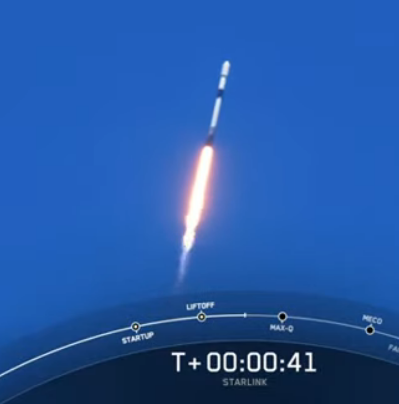
Capitalism in space: SpaceX tonight successfully launched another 60 Starlink satellites using its Falcon 9 rocket.

The first stage completed its fifth flight, landing successfully on the drone ship in the Atlantic. Both fairings were also used.

The 2021 launch race:

4 SpaceX
2 China
1 Rocket Lab
1 Virgin Orbit
1 Russia

The U.S. now leads China 6 to 2 in the national rankings. SpaceX had planned another launch later this morning, but they have delayed that launch one day until tomorrow.

5 comments

Hans Koenigsmann, 4th person hired by Musk at SpaceX, retiring

The fourth person Elon Musk ever hired when he was starting SpaceX, Hans Koenigsmann, has announced that he is retiring.

SpaceX vice president of build and flight reliability Hans Koenigsmann is retiring and has begun transitioning his role to former top NASA official William “Bill” Gerstenmaier, according to note to employees that was seen by CNBC.

Essentially, Koenigsmann and Gerstenmaier will be trading places. Gerstenmaier has been a consultant at SpaceX, will now move into Koenigsmann’s position, while Koenigsmann will become a technical advisor similar to what Gerstenmaier has been.

Without doubt Koenigsmann is one the the main reasons why SpaceX has become as successful as it has. I am sure Elon Musk will miss him.

While I have heard sources in the space community happy about the choice of Gersternmaier to replace him, I have reservations. Gersternmaier was in charge of NASA’s manned space program for almost the entire period it was trying to build SLS and Orion, and was the key planner behind its numerous delays and problems. While he started out well at NASA, those later years make me think of him as a typical Washington bureaucrat, spinning problems to defuse negative publicity rather than fixing them quickly. It was this spinning over the problems with SLS that I think finally got him fired by the Trump administration.

I hope I am wrong. I also know that if I am not, the odds are high that Gerstenmaier will not last long in this position. Musk does not tolerate spin.

5 comments

Bell Labs – The Transistor

An evening pause: This 9-minute documentary, made in 1952 by Bell Labs, provides a short and clear history of the transistor as well as its predecessor, the vacuum tube. It also tries to imagine the future that such a new invention might bring. As the youtube page notes,

While The Transistor’s vision of the future seems somewhat quaint in retrospect, it captures a moment in time before the transistor became ubiquitous; a time when Bell Labs wanted the world to know that something important had occurred, something that was about to bring tremendous change to everyone’s daily lives.

Hat tip Jim Mallamace.

5 comments

Jeff Bezos to step down as Amazon CEO

Capitalism in space: Jeff Bezos announced today that he is stepping down as Amazon CEO to focus his efforts more on his other political and space-related activities.

From the email he sent to Amazon employees:

As Exec Chair I will stay engaged in important Amazon initiatives but also have the time and energy I need to focus on the Day 1 Fund, the Bezos Earth Fund, Blue Origin, The Washington Post, and my other passions,” Bezos wrote. “I’ve never had more energy, and this isn’t about retiring. I’m super passionate about the impact I think these organizations can have

I think this quote from the story above however explains a great deal about Blue Origin in the past three years:

Bezos is said to devote one day a week to Blue Origin (reportedly, Wednesdays), plus at least $1 billion worth of the annual proceeds from his sales of Amazon shares. He’s presided over high-profile publicity events including the unveiling of the Blue Moon lunar lander. But when it comes to the day-to-day business, he handed that responsibility over to veteran aerospace executive Bob Smith, who became Blue Origin’s CEO in 2017.

It was around 2017 that the pace of Blue Origin’s effort seemed to slow to a crawl. It was also about that time that the company became dedicated to becoming a government contractor, doing whatever the government required even if it meant that development of their New Glenn rocket would slow (which it did).

Whether this action will increase Bezos’ participation with Blue Origin however is unclear. In the last year he has seemed more interested in leftist environmental causes and leftist politics. We shall have to wait and see.

15 comments

Smallsat rocket company Astra to go public

Capitalism in space: A merger with a major investment capital company, bringing in $500 million, will result in the smallsat rocket company Astra going public.

Small launch vehicle developer Astra will go public by merging with a special-purpose acquisition company (SPAC), providing the company with nearly $500 million in cash and valuing it at more than $2 billion.

Astra announced Feb. 2 an agreement to merge with Holicity, a SPAC established last year by Craig McCaw. That merger, expected to close in the second quarter, will turn Astra into a publicly traded company on the Nasdaq exchange with the ticker symbol ASTR. McCaw, chairman and chief executive of Holicity, will join Astra’s board as part of the deal.

Astra expects to raise $489 million through the merger with Holicity, a total that includes a $200 million private investment in public equity (PIPE) led by BlackRock and $30 million from a concurrent Series C round, company executives said in an investor call. The deal will value Astra at $2.1 billion.

In the article Astra’s head claimed the company already has contracts for its first fifty flights, but did not provide any details. At this moment Astra has yet to complete a successful orbital launch, and has two attempted orbital tests which both failed.

4 comments

SpaceX live feed of Starship #9 flight

Just before landing
Just before landing.

Just after landing.
Just after landing.

The test is over. All went perfectly until the landing, when the spacecraft once again crashed on the launchpad. They hit the target, but just too hard.

This time the problem occurred early in the landing maneuver. It appeared the spacecraft was unable to get completely vertical and hit the ground without firing its engines.

Right now we have no idea what the issue was, or what will be involved in fixing it. Starship #10 sits on its launchpad, ready to go. Assuming they do not have to make major changes or redesigns to correct the issue, I would expect it to launch within six weeks.

Of course, that assumes the Biden administration doesn’t ramp up its regulatory enforcement effort against SpaceX. And I have every expectation that will be the goal of the Democrats now in charge of the federal government.

Meanwhile, the FAA is now claiming the launch license approval delay last week was related to SpaceX violating it license approval during the December test flight of Starship prototype #8.

In a Feb. 2 statement, the FAA said that SpaceX had requested a waiver to its FAA license for suborbital test flights of its Starship vehicle before the Dec. 9 flight of the Starship SN8 vehicle. That waiver, the FAA said, would have allowed SpaceX to “exceed the maximum public risk allowed by federal safety regulations.”

The FAA denied the request, but SpaceX went ahead with the launch. SpaceX considered the flight successful, although the vehicle exploded upon landing. No injuries or third-party damage was reported during the flight, but the FAA determined that SpaceX violated the conditions of its license by proceeding without the waiver.

“As a result of this non-compliance, the FAA required SpaceX to conduct an investigation of the incident,” the agency stated. “All testing that could affect public safety at the Boca Chica, Texas, launch site was suspended until the investigation was completed and the FAA approved the company’s corrective actions to protect public safety.”

This could be true but personally, I don’t buy it. To me this sounds like government spin to justify their own incompetence in blocking last week’s flight. It also sounds like the kind of spin used by government bureaucrats when they want to enlarge their power. Today’s landing crash of prototype #9 now gives the FAA and Biden administration wonderful ammunition to clamp down hard on SpaceX.

20 comments

Virgin Galactic almost lost its 2nd SpaceShipTwo in 2019 flight

Capitalism in space: According to a book to be published in May, Virgin Galactic had serious previously unrevealed problems during its 2019 manned flight of VSS Unity, ist 2nd SpaceShipTwo suborbital spaceship, problems that could have killed all on board.

[W]hen the ground crew wheeled the suborbital spacecraft back into the hangar, company officials discovered that a seal running along a stabilizer on the wing designed to keep the space plane flying straight had come undone — a potentially serious safety hazard. “The structural integrity of the entire stabilizer was compromised,” Todd Ericson, a test pilot who also served as a vice president for safety and test, said, according to a soon-to-be-published book. “I don’t know how we didn’t lose the vehicle and kill three people.”

Much more at the link. It does appear that the company was not doing due diligence prior to the flight, signing off inspections without actually doing those inspections.

The issue caused the long delay since that flight. That it was kept secret as the company went public and offered its stock for sale likely breaks some SEC laws.

1 comment

Watching Starship #9’s flight, take 2

LabPadre's Starship 24/7 live feed, at 9:12 am (Central), February 2,, 2021
LabPadre’s Starship 24/7 live feed, 9:12 am (Central), February 2,, 2021.
Click to go to it.

Capitalism in space: It appears that SpaceX has finally gotten approval from our benevolent government to attempt today a flight of the ninth prototype of its Starship. to a height of approximately 33,000 feet. The screen capture to the right from this morning shows Starship’s #9 and #10, both on their own launchpads. I think #9 is the one on the right.

As the company’s Starship website still notes,

Similar to the high-altitude flight test of Starship serial number 8 (SN8), SN9 will be powered through ascent by three Raptor engines, each shutting down in sequence prior to the vehicle reaching apogee – approximately 10 km in altitude. SN9 will perform a propellant transition to the internal header tanks, which hold landing propellant, before reorienting itself for reentry and a controlled aerodynamic descent.

The Starship prototype will descend under active aerodynamic control, accomplished by independent movement of two forward and two aft flaps on the vehicle. All four flaps are actuated by an onboard flight computer to control Starship’s attitude during flight and enable precise landing at the intended location. SN9’s Raptor engines will then reignite as the vehicle attempts a landing flip maneuver immediately before touching down on the landing pad adjacent to the launch mount.

SpaceX will be providing a live stream, which I shall embed here at Behind the Black once it becomes available about ten minutes before launch. In addition, there are these live streams available:

The SpaceX live feed will provide the best visuals, but that will not go live until just before launch. Right now I think the Labpadre live feed is my preferred choice because it provides a quick checklist on the screen telling you the countdown status, which in turn gives you an idea how soon the launch might be. For example, when the sirens sound, it means they are approximately 10 minutes to launch.

While this flight will likely be as epic as the flight of Starship #8, there is no guarantee it will occur today. Until they actually lights the candle, much of the action today will be like watching paint dry.

9 comments

Billionaire buys of entire SpaceX launch for tourist flight and charity

Capitalism in space: An American billionaire has purchased an entire SpaceX Dragon flight and Falcon 9 launch, set for sometime in October ’21, with the goal of using the publicity of the flight to raise money for St. Jude Children’s Research Hospital.

Besides fulfilling his dream of flying in space, Jared Isaacman announced Monday that he aims to use the private trip to raise $200 million for St. Jude Children’s Research Hospital, half coming from his own pockets.

A health care worker for St. Jude already has been selected for the mission. Anyone donating to St. Jude in February will be entered into a random drawing for seat No. 3. The fourth seat will go to a business owner who uses Shift4 Payments, Isaacman’s credit card processing company in Allentown, Pennsylvania

This flight means that SpaceX is likely going to have at about five commercial manned flights in the next year, three by NASA, one by Axiom to ISS, and Isaacman’s above. Moreover, none include the flights by various entertainers and reality show producers who have been rumored as being interesting in buying tickets. Nor does this include the tourism flights the Russians are planning in the next year.

All told, these flights strongly suggest that there is a very healthy market for commercial manned spaceflight, a market that can only grow once Boeing finally enters the market with its Starliner capsule.

I must also add that we have been waiting for commercial space tourism flights for almost sixteen years, since Richard Branson began promising them on his suborbital SpaceShipTwo back in 2004. Never happened, and now seems very second class in comparison to the pending orbital flights. As the article at the link says disparagingly about Virgin Galactic and Blue Origin’s suborbital craft, they “will just briefly skim the surface of space.”

Both Branson and Bezos had a window to make suborbital space tourism pay off. Neither stepped through it.

0 comments

FAA bureaucrats block SpaceX Starship test flight

Capitalism in space? It is now confirmed that the test flight of SpaceX’s ninth prototype of its Starship rocket was scrubbed because of the FAA’s refusal to approve the license. To quote the FAA:

We will continue working with SpaceX to resolve outstanding safety issues before we approve the next test flight.

Typically vague bureaucratic language. There is no word on why the government did this. The flight of Starship prototype #8 proved SpaceX has full control over its vehicle, to the point they could put it down right on target. Why the FAA should now suddenly get cold feet is inexplicable.

There is one difference between now and the December 9th flight of Starship prototype #8. Then the president was Republican Donald Trump, and the Senate was controlled by the Republicans. Now the president is Democrat Joe Biden, and both houses of Congress are in Democratic Party control. It would not surprise me in the least if some Biden officials called the FAA and demanded they impose stricter safety restrictions on SpaceX, and that they did so at the very last minute.

Or to put it another way, someone in the Biden administration essentially wanted to tell SpaceX, “Nice rocket company you got here. Sure would be a shame if something happened to it.”

29 comments

Watching Starship #9’s flight

LabPadre's Starship 24/7 live feed, at 8:12 am (Central), January 28, 2021
LabPadre’s Starship 24/7 live feed, at 8:12 am (Central), January 28, 2021.
Click to go to it.

BUMPED AND UPDATED: It is now confirmed that the launch was scrubbed by the FAA’s refusal to approve the license. Though SpaceX seemed to go through a fueling and countdown procedure, they have since detanked the ship.

UPDATE: It appears from several live feeds that they have scrubbed today’s launch because of high winds, and will try again tomorrow. There are also rumors, not yet confirmed, that the launch was scrubbed because the FAA denied the launch license at the last minute.

Capitalism in space: SpaceX today will make an attempt to fly the ninth prototype of its Starship to a height of approximately 33,000 feet. As the company’s Starship website notes,

Similar to the high-altitude flight test of Starship serial number 8 (SN8), SN9 will be powered through ascent by three Raptor engines, each shutting down in sequence prior to the vehicle reaching apogee – approximately 10 km in altitude. SN9 will perform a propellant transition to the internal header tanks, which hold landing propellant, before reorienting itself for reentry and a controlled aerodynamic descent.

The Starship prototype will descend under active aerodynamic control, accomplished by independent movement of two forward and two aft flaps on the vehicle. All four flaps are actuated by an onboard flight computer to control Starship’s attitude during flight and enable precise landing at the intended location. SN9’s Raptor engines will then reignite as the vehicle attempts a landing flip maneuver immediately before touching down on the landing pad adjacent to the launch mount.

SpaceX will be providing a live stream, which I shall embed here at Behind the Black once it becomes available. In addition, there are these live streams available:

Without question the SpaceX live feed will provide the best visuals, but that will not go live until just before launch. Right now I think the Labpadre live feed is my preferred choice because it provides a quick checklist on the screen telling you the countdown status, which in turn gives you an idea how soon the launch might be. For example, when the sirens sound, it means they are approximately 10 minutes to launch.

Stay tuned. This flight, which will likely be as epic as the flight of prototype #8, could make today a fun day in the history of spaceflight.

6 comments

Blue Origin reveals full throttle long duration test of its BE-4 engine

Capitalism in space: Jeff Bezos today revealed that Blue Origin has successfully completed a full throttle long duration test of its BE-4 engine to be used by both its New Glenn Rocket and ULA’s Vulcan rocket.

“Perfect night,” Amazon CEO Jeff Bezos, who created the Blue Origin space venture more than two decades ago, wrote in an Instagram post. “Sitting in the back of my pickup truck under the moon and stars, watching another long-duration, full-thrust hot-fire test of Blue Origin’s BE-4 engine.”

The post featured a shot of Bezos and other spectators looking on at the rising rocket plume from afar, as well as a video with closer perspectives of the firing.

The company has delivered two engines to ULA designed for ground testing, and says it will deliver soon the flight ready engines for Vulcan’s first launch later this year. Blue Origin also needs to get flight ready engines finished this year for New Glenn, which is also supposed to make it inaugural flight in ’21.

Personally, I think both Blue Origin and ULA are cutting it close. I will not be surprised if this tight schedule means that the first launches of both rockets get delayed into ’22.

Nonetheless, it is great news that the BE-4 appears to finally working as planned after what appeared to be problems for the past few years.

8 comments

SpaceX and Amazon in cat-fight over internet satellite constellations

Capitalism in space: Even as SpaceX is rolling out the internet service from its growing Starlink satellite constellation while Amazon’s own Kuiper constellation languishes in development, the two companies are in a battle over the orbits of their respective constellations.

SpaceX CEO Elon Musk took to Twitter on Tuesday, as his company works to persuade Federal Communications Commission officials that it should allow SpaceX to move some of its Starlink satellites to lower altitudes than originally planned.

Jeff Bezos’ Amazon has been among companies that have disputed SpaceX’s request, on the grounds that the modification would interfere with other satellites.

“It does not serve the public to hamstring Starlink today for an Amazon satellite system that is at best several years away from operation,” Musk said in a tweet.

Amazon responded to Musk’s comment in a statement to CNBC. “The facts are simple. We designed the Kuiper System to avoid interference with Starlink, and now SpaceX wants to change the design of its system. Those changes not only create a more dangerous environment for collisions in space, but they also increase radio interference for customers. Despite what SpaceX posts on Twitter, it is SpaceX’s proposed changes that would hamstring competition among satellite systems. It is clearly in SpaceX’s interest to smother competition in the cradle if they can, but it is certainly not in the public’s interest,” an Amazon spokesperson said.

SpaceX in its own response to the FCC has noted “that Amazon representatives have had ’30 meetings to oppose SpaceX’ but ‘no meetings to authorize its own system,’ arguing that the technology giant is attempting ‘to stifle competition.'”

Both companies appear to have a point. Amazon is planning its system under an agreed-to arrangement where its orbits would not conflict with SpaceX’s. To permit SpaceX to change the deal and expand its orbital territory into Amazon’s threatens their system.

At the same time, that Amazon has been so slow to launch its system is something the FCC will not take kindly to. Companies get FCC licensing approval on the condition that they deliver within a certain time frame. Amazon appears to be taking a bit too much time, and SpaceX is trying to take advantage of this fact.

I suspect the FCC will deny SpaceX’s request, but will also tell Amazon that it had better start launching its satellites soon, or else the FCC will change its mind and give SpaceX that orbital territory.

Overall, the slowness of Amazon to launch Kuiper seems to fit the operational pace of Jeff Bezos’ other space company, Blue Origin. Lots of talk, but relatively little action. At some point the talk has to stop and Bezos’ companies have got to start delivering.

20 comments

Axiom’s first passengers to ISS paying $55 million each

Capitalism in space: The three non-Axiom employees who will fly as part of the crew for the company’s first private manned mission to ISS are paying $55 million each for the privilege.

The first private space station crew was introduced Tuesday: Three men who are each paying $55 million to fly on a SpaceX rocket. They’ll be led by a former NASA astronaut now working for Axiom Space, the Houston company that arranged the trip for next January.

“This is the first private flight to the International Space Station. It’s never been done before,” said Axiom’s chief executive and president Mike Suffredini, a former space station program manager for NASA. While mission commander Michael Lopez-Alegria is well known in space circles, “the other three guys are just people who want to be able to go to space, and we’re providing that opportunity,” Suffredini told The Associated Press.

The first crew will spend eight days at the space station, and will take one or two days to get there aboard a SpaceX Dragon capsule following liftoff from Cape Canaveral.

The initial press release made it appear that all four men were crew members and not passengers. And though Axiom and these passengers are both continuing to de-emphasize the tourist nature of their flight, claiming they will each be tasked with science research and that it “is 100% not a vacation for these guys,” the simple fact remains that they are paying customers, flying in space for the fun of it.

Why Axiom and these passengers feel obliged to misconstrue the tourist nature of their flight puzzles me. There is no reason for them to be ashamed of their desire to fly in space. Nor should they feel any guilt about having the money that allows them to pay for the privilege. This is what freedom is all about. They earned their wealth, and it now allows them the chance to do something grand. All power to them.

The actual ticket-price is also intriguing. At $55 million it is far more than the $35 million paid by the last tourist flown on a Russian Soyuz to ISS, though less than the $75 to $90 million the Russians were charging NASA. Overall it appears the price per ticket for an orbital flight has gone up, though the emerging competition is likely stabilizing the price at a lower plateau.

The announcement is also interesting in that so little is mentioned of SpaceX. Though the flight has been sold as an Axiom one, this particular tourist flight will depend entirely on SpaceX hardware to get to and from ISS. Axiom has merely acted as the broker for the flight.

Eventually Axiom will have its own in-space habitable space, first attached to ISS as new modules and later flying free as its own space station after ISS is retired. Right now however the real achievement is coming from SpaceX. This detail must be recognized.

3 comments

Axiom names crew for its first private manned mission to ISS

Capitalism in space: The private company Axiom today revealed the names of the four-person crew that will fly a SpaceX Dragon capsule to ISS on the first wholly private manned spaceflight.

The four members of the Axiom Space Ax-1 crew: Michael Lopez-Alegria, former NASA astronaut, Axiom Space vice president and Ax-1 commander; Larry Connor, U.S. real estate entrepreneur and Ax-1 pilot; Mark Pathy, Canadian investor and philanthropist; and Eytan Stibbe, Israeli businessman and fighter pilot.

The crew of the first entirely-private orbital space mission will include the second oldest person to launch into space, the second Israeli in space, the 11th Canadian to fly into space and the first former NASA astronaut to return to the International Space Station, the company organizing the history-making flight has announced.

The launch date has also been delayed from the fall to early ’22.

It is unclear if these four men are the entire passenger list. Dragon can carry up to seven passagers, and earlier rumors had hinted that Tom Cruise and a movie director were buying two seats on this private mission in order to film scenes for a movie.

It is also unclear why the flight was delayed, other than a suggestion that it was due to scheduling conflicts with getting to ISS.

1 comment

Starship update: Next test flight set for tomorrow

Capitalism in space: After scrubbing the flight yesterday due to high winds, it appears that SpaceX is now planning the 50,000 foot flight for Starship prototype #9 for sometime tomorrow.

Unlike the 7.7 mile flight of prototype #8, SpaceX does not appear to be providing a live stream for #9’s flight. Nor has the company clearly stated how high it will fly, suggesting it will go higher than #8.

Unless SpaceX provides a live stream, the only coverage will be from the two live streams provided by LabPadre and NASASpaceflight.

7 comments

Japan’s new H3 rocket is almost ready for launch in ’21

The H3 rocket, jointly made by Mitsubishi and Japan’s space agency JAXA, is almost ready for launch and will be shipped to is launch site shortly for a launch later this year.

According to the link, it will cut the cost of launch by half when compared with Japan’s H2A rocket. They hope this cost reduction will garner them international customers, though I wonder as the rocket is not reusable. To get those international customers they have done something interesting. Rather than putting “Nippon” on the side of the rocket, which is what the Japanese call their country, they have put “Japan” on it instead.

3 comments

Falcon 9 successfully places 143 satellites into orbit

Capitalism in space: SpaceX this morning successfully launched its Falcon 9 rocket carrying a record 143 smallsats into orbit.

As I write this they are in the process of deploying the satellites, which will take time as the upper stage circles the Earth. This launch of 143 satellites beats the former record of the most satellites deployed on a single launch, 104, set by India in 2017.

The first stage landed successfully, completing its fifth flight. They also recovered both fairing halves.

The standings in the 2021 launch race:

3 SpaceX
1 Rocket Lab
1 Virgin Orbit
1 China

The U.S. now leads China 5 to 1 in the national rankings.

8 comments

“The solar system is open for business”

Link here. The article gives an independent look at the surging capitalism that appears to be driving the resurgent rocket and space industry in the U.S. and elsewhere.

As the author notes in his conclusion:

There was a time when space enthusiasts waited on taxpayer-funded space programs to realize their dreams of routine spaceflight and humanity’s expansion into the cosmos. It’s been a very long wait. Now, privatized launch services are opening up access to space. A new wave of exploration missions is widening human knowledge of the solar system. It’s only a matter of time before entrepreneurs, particularly those with deep pockets, figure out how to make money out there.

I plug this article not because he quotes me extensively, but because he came to these conclusions independent of me, and only called me for comments because he thought I might add depth to his conclusions. That the ideas I have been pushing since the late 1990s are now percolating into the larger culture is a very very good sign.

While in those early days the reporters I spoke to were routinely horrified by the idea of a privately financed space mission and wondered if the government should even allow it (they really would say this), today the idea is now considered the right way to go.

This is progress, even in this time of blacklists and a government focused on crushing its citizens.

5 comments
1 191 192 193 194 195 411