
Flying on empty to a comet
Flying on empty to a comet.
Flying on empty to a comet.
Oink! Scientists rail against senator who belittled research.
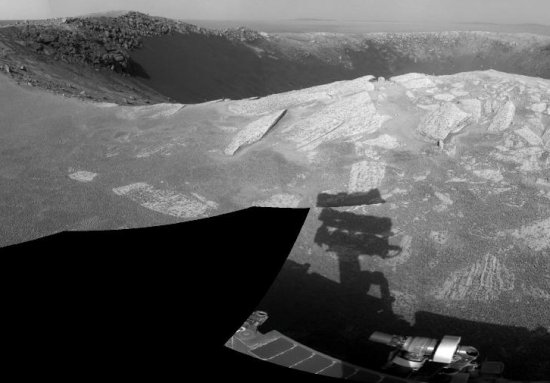
In its 14 mile multi-year trek to Endeavour Crater — now about half completed — the Mars rover Opportunity has stopped to take a short rest stop at a small crater.
The crater, dubbed “Santa Maria Crater” by the scientists who operater Opportunity, is about the size of a football field. What makes it especially interesting are the sharp rocks piled up on its rim, as they are probably debris ejected from the crater at impact. Since this material probably came from deep below the Martian surface, it is also likely to hold information about the Martian geological past, thereby making it a prime research site.
An asteroid discovered more than 100 years ago is actually an extinct comet. And it is coming back to life!
Recent monitoring of the Sun’s brightness as it went from maximum to minimum in its solar cycle has found that, surprisingly, the changes in brightness across different wavelengths do not necessarily vary in lockstep. Key quote:
SIM suggests that ultraviolet irradiance fell far more than expected between 2004 and 2007 — by ten times as much as the total irradiance did — while irradiance in certain visible and infrared wavelengths surprisingly increased, even as solar activity wound down overall. The steep decrease in the ultraviolet, coupled with the increase in the visible and infrared, does even out to about the same total irradiance change as measured by the TIM during that period, according to the SIM measurements.
The stratosphere absorbs most of the shorter wavelengths of ultraviolet light, but some of the longest ultraviolet rays (UV-A), as well as much of the visible and infrared portions of the spectrum, directly heat Earth’s lower atmosphere and can have a significant impact on the climate. [emphasis mine]
The uncertainty of science: Did the Martian methane signal come from Earth?
The hubbub about this week’s lunar solstice eclipse was, from my perspective, mostly manufactured press blather. For those who had never seen a lunar eclipse, it was a spectacular experience, but there really was nothing scientifically or technically unique about the fact that it happened to occur on the solstice.
However, below is an eclipse that is definitely unique both technically and scientifically. Scientists using the Mars rover Opportunity have filmed an eclipse on Mars, showing the Martian moon Phobos crossing in front of the Sun. Consider the engineering accomplishment: not only did they need to be able to calculate exactly when this would happen at a very particular spot on the Martian surface, they had to have a camera there able to take the movie. And they had to operate it from Earth!
Scientists have completed the IceCube neutrino observatory in Antarctica, a cubic kilometer in size and situated a mile deep in the ice.
Another scheme to stop a dangerous asteroid: Use a flotilla of solar sails to divert Apophis.
How close to the Sun could we get?
According to a statistical analysis, scientists predict the discovery of Earth’s twin in 2011.
Note that I reported this story three months ago, on September 13!